Chilat Doina
February 23, 2026
Let's be blunt: there’s no simple price tag for advertising on Amazon. It's not like ordering off a menu. Instead, think of it as a live auction where you’re constantly bidding for a shopper's attention.
How much you end up spending really depends on what you sell, who you're up against, and the game plan you put in place. On average, you can expect to pay anywhere from $0.70 to over $1.50 per click, but that number can swing wildly.
Picture the Amazon marketplace as a massive, sprawling city. The most valuable spots—like the storefronts at the top of the first search results page—are prime real estate. Getting your product there means you have to enter an auction and outbid other brands who want that same visibility.
The more desirable the ad placement and the more sellers fighting for it, the higher the price goes. This is the real engine behind your Amazon advertising costs. It’s a dynamic, ever-changing expense driven by pure market demand. Your budget isn't just a line item; it's your investment in getting seen. For a broader look at how this works across digital platforms, this guide on decoding online advertising costs is a great primer.
To give you a clearer picture, here’s a quick breakdown of what you can expect across the major ad types.
This table gives you a snapshot of the core ad types, how they're typically priced, and where they fit into your strategy. It’s a handy reference for understanding the financial landscape at a high level.
.tbl-scroll{contain:inline-size;overflow-x:auto;-webkit-overflow-scrolling:touch}.tbl-scroll table{min-width:600px;width:100%;border-collapse:collapse;margin-bottom:20px}.tbl-scroll th{border:1px solid #ddd;padding:8px;text-align:left;background-color:#f2f2f2;white-space:nowrap}.tbl-scroll td{border:1px solid #ddd;padding:8px;text-align:left}Ad TypeTypical Cost ModelAverage Cost Range (USA)Primary Use CaseSponsored ProductsCost-Per-Click (CPC)$0.70 - $1.50+ per clickDriving immediate sales for individual products at the top of search results.Sponsored BrandsCost-Per-Click (CPC)$0.80 - $2.00+ per clickBuilding brand awareness with top-of-page banners and custom headlines.Sponsored DisplayCost-Per-Click (CPC) / Cost-Per-Mille (CPM)$0.60 - $1.20+ per clickRetargeting shoppers off-Amazon or targeting competitor product pages.Amazon DSPCost-Per-Mille (CPM)$5.00 - $10.00+ per 1,000 impressionsReaching broad audiences across Amazon-owned sites and the wider web.
While these figures are solid benchmarks, remember they're just starting points. The real cost is shaped by a handful of critical factors you need to get a handle on.
Several moving parts directly dictate how much you'll end up paying for every click or impression. Getting a grip on these is your first step toward building an advertising plan that actually makes you money.
Here's the most important thing to remember: you are in control. You can't change your product category, but you can absolutely master your bidding, sharpen your keyword targeting, and optimize your product pages to win auctions more efficiently.
This guide is here to pull back the curtain on how that auction really works, what you should expect to pay for different ad types, and—most importantly—which numbers truly define your success. We're going to move past the surface-level stuff to give you a real framework for managing your Amazon ad spend effectively, turning it from a cost into a powerful engine for growth.
If you want to get a handle on your ad costs, you first have to peek behind the curtain at what's happening every time a customer searches on Amazon. In the split second after they hit 'enter,' Amazon runs a lightning-fast auction to decide which ads to show and in what order.
But this isn't about who has the deepest pockets. Think of it less like a brute-force bidding war and more like a silent auction where the most relevant, well-prepared bidder often wins—even if they didn't bid the most. Amazon's whole system is built to reward sellers who create a great experience for the shopper.
Here’s the secret sauce: Amazon uses a second-price auction. Understanding this one concept can save you a ton of money.
Let's say you and a competitor are both fighting for the top ad spot. You’re willing to bid up to $2.00 a click, but their max bid is $1.50. In a normal auction, you might end up paying your full $2.00. But on Amazon, you only pay one cent more than the next-highest bid.
So in this case, you’d win the auction but only pay $1.51 for the click, even though you were willing to go much higher. This is huge. It means you can bid your true maximum value for a keyword without constantly worrying about overpaying on every single click.
This is the single most important thing to remember about the auction: Your bid is a ceiling, not a fixed price. You set the max you’re willing to spend, but what you actually pay is determined by what your competitors are bidding.
This model is the foundation of smart, cost-effective advertising. It lets you bid aggressively to secure top placements while the system itself acts as a built-in safety net against overspending.
This all comes down to a few core elements that determine your final ad cost.
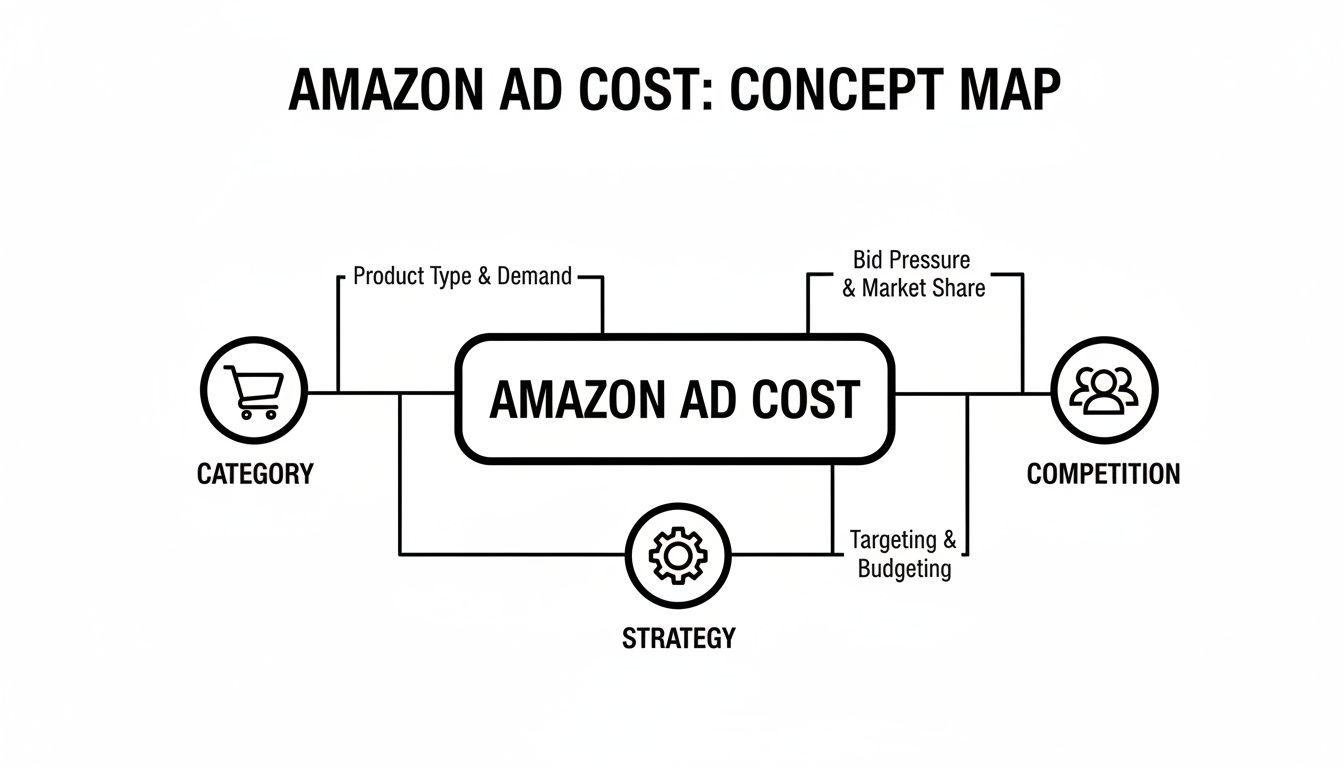
As you can see, your product category, the competition for your keywords, and your overall campaign strategy are the three pillars that hold up your ad spend.
Now, this is where it gets really interesting. Your bid is just one piece of the puzzle. Amazon combines it with a kind of "quality score" to figure out your Ad Rank.
Ad Rank = Your Bid x Ad Quality Score
The ad with the highest Ad Rank gets the best placement. This quality score is just Amazon’s way of guessing how likely a shopper is to click your ad and actually buy your product. While they keep the exact formula under wraps, we know it’s heavily influenced by a few key things:
This is exactly why a seller with a super relevant, high-converting product can beat out a competitor with a much bigger bid. Let's say your product has a fantastic sales history for the search term "organic dog treats." You might win the top ad spot with a $1.25 bid over a less relevant competitor bidding $2.00.
Your superior Ad Rank lets you get premium visibility for less money, giving you a massive competitive edge that isn't just about outspending everyone. Getting a grip on these factors is the real key to winning auctions efficiently and driving down your ad costs.

Understanding the ad auction is half the battle; knowing which ad to run is the other half. The price you pay for Amazon advertising is directly tied to the specific ad format you choose, and each one is built to do a different job. Think of them as tools in your marketing toolbox—each with its own purpose, cost structure, and sweet spot.
You wouldn’t use a hammer to saw a board, and you definitely wouldn't use a big brand-building ad to drive an immediate, bottom-of-the-funnel sale. The first step to a cost-effective strategy is simply matching your ad type to your goal. Let's break down the main players.
Sponsored Products are the ads you see everywhere. They pop up right in the search results and on competitor product pages. For most sellers, this is the bread and butter of their Amazon advertising strategy, designed to do one thing really well: drive sales for individual products.
These ads run on a cost-per-click (CPC) model. That means you only pay when a shopper actually clicks on your ad, making it a pure direct-response tool built for conversions. Because you’re targeting shoppers who are actively searching for products just like yours, they have incredibly high purchase intent. This makes them absolutely essential for any brand focused on driving revenue.
But be warned: the competition is fierce. The average CPC for these ads has been climbing as more sellers jump into the ring. A recent analysis found the average CPC on Amazon hit $1.12, a 15.5% jump from the previous year. And that's just the average. Costs can swing wildly, peaking around $1.19 during busy summer months and spiking another 20-30% higher in Q4.
Costs also vary hugely by niche. A click in health and personal care might average around $0.85, but in a cutthroat category like electronics, you could be looking at nearly $1.50 per click. You can find more Amazon advertising statistics and trends on SequenceCommerce.com.
If Sponsored Products are for selling one item, Sponsored Brands are for selling your entire brand story. These are the banner ads you see perched right at the top of the search results, showcasing your logo, a custom headline, and a handful of your products.
Like their counterparts, Sponsored Brands mostly use a CPC model. But their goal is much broader—they're all about boosting brand awareness and getting shoppers to consider you over the competition. When someone clicks a Sponsored Brand ad, you can send them to a custom landing page or your Amazon Storefront, giving you the chance to create a much more curated shopping experience.
Thanks to that premium, top-of-page real estate, Sponsored Brands often have a slightly higher average CPC. They're a fantastic tool for brands looking to:
Sponsored Display ads let you take your marketing beyond the search results page. These are visual ads that can show up both on and off Amazon—think competitor product pages, the Amazon homepage, and even third-party websites and apps.
This ad type gives you more flexible pricing, with options for either CPC or vCPM (cost-per-thousand-viewable-impressions). You can pay when someone clicks, or you can pay for every 1,000 times your ad is seen. Their real superpower, though, is retargeting. You can serve these ads to shoppers who checked out your product but didn't buy, giving them a gentle nudge to come back and finish the job.
Sponsored Display is your go-to tool for re-engaging shoppers who got distracted. It's like having a friendly salesperson follow up with a customer who left an item in their physical shopping cart.
Finally, there's Amazon DSP (Demand-Side Platform), which plays in a completely different league. This platform is built for advertisers with bigger budgets who want to programmatically buy display, video, and audio ads to reach massive audiences—both on Amazon-owned sites and across the web.
Amazon DSP operates exclusively on a CPM (cost-per-mille) model, where you pay for every 1,000 impressions. You’re not targeting keywords here; you’re targeting audiences based on their shopping behaviors, demographics, and lifestyle interests. You can learn more about its powerful features in our complete guide to Amazon DSP advertising strategies. This is the tool for large-scale, brand-building campaigns designed to reach new customers long before they even think about searching on Amazon.

Running ads on Amazon is easy. Running them profitably is a completely different ballgame. Clicks, impressions, and ad spend are just noise if they don't translate into actual profit. To figure out what's working versus what's just draining your budget, you need to get comfortable with a few key performance metrics.
These aren't just numbers on a dashboard; they're the vital signs of your advertising health. Understanding them is the difference between blindly throwing money at the wall and making calculated investments that actually scale your brand. Let's break down the essential formulas that will define your success.
The most common metric you'll see everywhere is ACoS (Advertising Cost of Sale). It measures how much you spend on ads to generate one dollar of sales from those ads. Think of it like the fuel efficiency of a single delivery truck on one specific route.
The formula is dead simple:
ACoS = (Total Ad Spend / Total Ad Sales) x 100
So, if you spend $30 on ads and get $100 in sales directly from those ads, your ACoS is 30%. A lower ACoS means your campaigns are more efficient at turning ad spend into revenue. While there's no magic "good" ACoS, a common target for established products is often below 25-30%. But honestly, this can swing wildly depending on your profit margins and what you're trying to achieve with a campaign. You can dive deeper into this metric in our guide explaining what ACoS stands for on Amazon.
While ACoS looks at cost, ROAS (Return on Ad Spend) flips the script to measure your return. It tells you how many dollars in revenue you earn for every single dollar you spend on advertising. It’s the inverse of ACoS and is often the go-to metric for advertisers who think in terms of investment returns.
The formula is just as straightforward:
ROAS = Total Ad Sales / Total Ad Spend
Using the same numbers, if you generate $100 in ad sales from $30 in ad spend, your ROAS is $3.33. This means for every $1 you put into ads, you get $3.33 back in revenue. It's just another way of looking at the same data, but it frames the conversation around returns, not just costs.
Key Takeaway: ACoS and ROAS measure the exact same thing from different angles. A 25% ACoS is the same as a 4x ROAS. Pick the one that makes the most sense for your financial reporting and stick with it.
Okay, here's where things get really interesting. ACoS only tells part of the story. It completely ignores the powerful "halo effect" of advertising. A great ad campaign doesn't just drive paid sales; it boosts your organic ranking, which drives more organic (free) sales.
This is where TACoS (Total Advertising Cost of Sale) comes into play. It measures your ad spend against your total revenue—both paid and organic.
TACoS = (Total Ad Spend / Total Sales) x 100
Let’s go back to our delivery truck analogy. If ACoS is the fuel efficiency of one truck on one route, TACoS measures the efficiency of your entire fleet and how it impacts your overall business. It shows whether your advertising investment is genuinely growing your total sales or just stealing organic sales you would have gotten anyway.
A healthy sign is a stable or decreasing TACoS over time, even if your ACoS holds steady. This tells you that your ad spend is successfully lifting your brand's overall sales velocity, creating that flywheel effect that’s absolutely critical for long-term, sustainable growth on Amazon.
Once you have a firm grip on your ACoS and TACoS, it's time to shift from just monitoring your ad spend to aggressively optimizing it. The real art of managing your Amazon advertising cost isn't just watching metrics go up and down; it's about actively plugging the leaks that drain your budget and kill your profitability.
Think of your ad account like a high-performance engine. It needs constant, precise tuning to run at peak power without wasting fuel. This means going beyond the basics and getting surgical with your tactics to cut out every last dollar of wasted spend.
One of the fastest ways to burn through your budget is by paying for clicks that have zero chance of converting. This is where a rock-solid negative keyword strategy becomes your first line of defense. It’s all about proactively telling Amazon which search terms have nothing to do with your product.
For example, if you sell premium leather dog collars, you absolutely don't want to show up for searches like "cheap nylon dog collars" or "chain dog collars." Every single click from those shoppers is just money down the drain. Start by digging into your search term reports and adding any irrelevant or non-converting terms as negative exact or negative phrase matches.
A strong negative keyword list isn't a "set it and forget it" task—it's a continuous process of refinement. Carve out time every week to review your search term reports. This discipline alone can slash your advertising costs by making sure your budget only goes toward the most qualified shoppers.
A classic—and costly—mistake is bidding too much on your own branded keywords. While you definitely want a defensive strategy in place, aggressively bidding on your brand name often means you’re just paying for clicks you would have won organically anyway, for free. This is what we call branded keyword cannibalization.
To fight this, take a hard look at your organic ranking for your brand terms. If you consistently own the #1 organic spot, you can probably afford to lower your bids on those keywords quite a bit. The goal is to find that sweet spot where you protect your brand from competitors and maintain top placement without overpaying.
Do your products fly off the shelves on weekday evenings or is it weekend mornings when things really heat up? Dayparting, which is just a fancy term for ad scheduling, lets you adjust your bids based on when your customers are most likely to buy. By analyzing your hourly and daily sales data, you can start to see clear patterns in shopper behavior.
Use that intel to pump up your bids during your most profitable hours and pull back when conversion rates typically drop. This ensures your budget is concentrated on the periods with the highest purchase intent, which is a surefire way to maximize your ROAS. For brands wanting a complete blueprint for growth, frameworks like the COSMO Framework can provide a structured way to scale without wasting money.
You don't have to shut off your ads completely during slow periods. A simple 15-25% bid reduction during those lulls can make a huge difference. Many experienced sellers find this level of control is a non-negotiable part of advanced Amazon advertising optimization and performance tuning.
Don't get stuck in a Sponsored Products rut. Amazon is always rolling out different ad formats that can offer a much more cost-effective way to reach shoppers. For instance, Sponsored Brands Video ads have shown incredibly high engagement rates and often come with a lower cost-per-click than standard image ads.
These video ads pop up right in the search results and start playing automatically, grabbing a shopper's attention in a way a static image just can't. They're perfect for telling your product's story, showing it in action, and creating a real connection. By testing these different formats, you can diversify your strategy and discover new, more efficient paths to conversion.
Diving into Amazon advertising always brings up a ton of practical, “what should I actually do?” questions. You can have the best high-level strategy in the world, but it’s the day-to-day decisions that really make or break your success.
This section is your quick-reference guide for the most common questions we see sellers asking. Think of it as a playbook for making smarter, more confident choices with your ad budget, whether you're just launching or you're already scaling.
There's no magic number, but a solid rule of thumb for a new product launch is to set aside 5% to 10% of your total projected revenue for ads. So, if you're aiming to hit $10,000 a month in sales, you should plan for an ad budget between $500 and $1,000.
Don't think of this initial spend in terms of immediate profit. You're buying data—crucial data. This money helps you discover which keywords actually convert, how real customers search for products like yours, and what your true cost-per-acquisition looks like. Your first month's budget is really an investment in your education that will pay off massively down the road.
When you’re launching something new, your ACoS target needs to be way higher than it would be for an established product. It's not unusual—or unhealthy—to see an ACoS between 40% and 80% in those early days.
Why so high? Because your goal isn't profit right out of the gate. It's about generating momentum and visibility.
Once you start getting some organic traction, you can begin to slowly dial back and optimize your campaigns to get that ACoS down to a more sustainable level, usually somewhere below 30%.
For a new product, a high ACoS is the cost of entry. You are investing in future organic sales by paying for initial momentum. Focusing too heavily on a low ACoS from day one can starve a new product of the visibility it needs to succeed.
Almost always. Bidding on your own brand keywords is a smart, defensive move that every brand should be making. Even if you hold the #1 organic spot, competitors can (and absolutely will) run Sponsored Product ads on your brand name, sticking their product right above your hard-earned listing.
This is your chance to completely own the top of the search results page. Bidding on your brand is typically very cheap since the clicks are hyper-relevant. Think of it as a low-cost insurance policy to make sure you capture every single high-intent search for your brand and protect your loyal customers from being poached by savvy competitors.
You don't need to live in your ad console, but you can't just set it and forget it, either. A balanced approach works best. For new or highly active campaigns, it’s a good idea to check in and make small bid adjustments once or twice a week.
For more mature, stable campaigns, checking in every 7 to 10 days is usually enough. The most important thing is to avoid knee-jerk reactions based on a single bad day. Always look for trends over at least a week before you make any big changes to your bids or daily budgets.
At Million Dollar Sellers, we know mastering these details is what separates good sellers from the truly elite. Our private community is built for top-tier entrepreneurs to share advanced strategies on everything from ad optimization to supply chain logistics, helping you scale faster and more profitably. Learn more about how MDS can help you stay ahead.
Join the Ecom Entrepreneur Community for Vetted 7-9 Figure Ecommerce Founders
Learn MoreYou may also like:
Learn more about our special events!
Check Events