Chilat Doina
January 3, 2026
Running an e-commerce business can feel like you're just trying to keep your head above water. You're constantly putting out fires—a customer complaint here, a shipping delay there. Strategic planning is what pulls you out of that reactive cycle and puts you firmly in control of your company's destiny.
It’s the simple act of defining where you want to go and then, critically, mapping out exactly how you're going to get there. This isn't about creating some dusty binder that sits on a shelf; it's about building a practical, living roadmap for growth.

Let's be real for a moment. As an Amazon seller or DTC founder, you're wearing a dozen different hats. You’re the marketer, the product developer, the fulfillment chief, and the customer service rep, all rolled into one. It's incredibly easy to get so bogged down in the day-to-day grind that you lose sight of the big picture.
Pure hustle will only get you so far before you hit a wall—or worse, burn out completely. This is where a solid strategic plan changes the game. It forces you to lift your head up and ensure every bit of effort, every dollar spent, and every decision made is pushing you toward your ultimate goal.
The numbers don't lie. Businesses with a formal, written plan actually grow 30% faster than those flying by the seat of their pants. Think about the fastest-growing e-commerce brands you know; an incredible 71% of them use a strategic plan to steer their growth.
This is huge, especially when you consider that most leaders spend less than a single day per month on actual strategy. It’s no wonder nearly half of them miss their performance targets. For those wanting a deeper dive, developing a comprehensive strategic plan provides some great additional context on the fundamentals.
This guide will walk you through a simple, no-fluff framework to turn your vision into an actionable plan. We're going to build it together, step-by-step.
A strategic plan is the ultimate filter for opportunity. It gives you the clarity to say "no" to distracting shiny objects and "yes" to the initiatives that truly move the needle toward your long-term vision.
So, what does this actually look like in practice? It’s the difference between randomly boosting an Instagram post and executing a targeted ad campaign designed to increase customer lifetime value. It’s choosing to order inventory based on solid sales forecasts, not just a gut feeling, so you can optimize cash flow and avoid costly stockouts.
The difference a solid plan makes is night and day. Below is a quick breakdown of what you can expect.
Area of BusinessWith a Strategic PlanWithout a Strategic PlanDecision-MakingFocused, confident choices aligned with long-term goals.Reactive, often based on gut feelings or the "fire of the day."Resource AllocationMoney, time, and team effort are invested in high-impact activities.Resources are spread thin across too many "good ideas."Team AlignmentEveryone knows the mission and how their work contributes.Teams work in silos, sometimes pulling in opposite directions.Market ChangesProactively anticipates shifts and pivots with agility.Constantly caught off-guard and forced into crisis mode.
Ultimately, a plan gives you clarity and control. You'll find yourself making better decisions, your team will be more aligned, and your business will be far more resilient in the face of inevitable market shifts.

Before you can even think about building a roadmap, you have to know where you're going. Every single part of your strategic planning for a small business is built on a rock-solid understanding of who you are and why your company even exists. This is your brand's North Star—that constant, unwavering point on the horizon that guides every single decision.
Too many founders treat their mission and vision statements as fluff to fill the "About Us" page. That’s a huge mistake. Your North Star is a practical, everyday tool. It's the filter you run every decision through, from which products to launch next to which marketing channels deserve your budget, and even who you bring onto your team.
Your vision statement has nothing to do with what you do today. It's all about the future you're trying to create. It needs to be big, aspirational, and compelling enough to make your team genuinely excited to show up in the morning. A great vision statement answers one simple question: "What world are we trying to build for our customers?"
Take an e-commerce brand selling sustainable home goods. Their vision could be: "To make every home a zero-waste sanctuary." See how much more powerful that is than something generic like, "To sell eco-friendly products"? The first one paints a vivid picture of a better future, giving the whole team a purpose that goes way beyond just hitting sales numbers.
If the vision is your destination, the mission is the vehicle you'll use to get there. It spells out your core purpose, who you're helping, and the unique value you bring to the table. A truly useful mission statement is specific enough to guide your day-to-day work.
A strong mission statement usually covers three things:
For that same sustainable brand, a solid mission could be: "To provide families with beautifully designed, plastic-free home essentials that make sustainable living simple and accessible." Right away, this mission dictates everything—product sourcing must be plastic-free, design has to be beautiful, and marketing copy should focus on simplicity and accessibility.
Your brand’s core identity is more than just words on a page. It's the operational DNA that dictates your actions when faced with tough choices. When your values are clear, difficult decisions become surprisingly easy.
Finally, you have your core values. These are the non-negotiable beliefs that define your company culture and how you act, even when no one is watching. Don't just pick trendy words like "innovation" or "integrity." You have to define them with specific, observable actions.
For example, if one of your core values is "Radical Transparency," what does that actually look like? It might mean you share your entire supply chain with customers, you're brutally honest about shipping delays, or you hold open-book financial meetings with your team.
These values become the bedrock of your brand strategy, guiding everything from who you partner with to how you handle a customer complaint. You can learn more about how to develop a brand strategy that truly aligns with these core principles.
Getting your North Star right is the single most important first step in strategic planning. Once your vision, mission, and values are locked in, every other piece of this guide—from market analysis to financial forecasting—will be clearer, more focused, and a whole lot more effective.

Okay, you've defined your brand's North Star. Now, it's time to look outward. Winning in e-commerce means knowing your battlefield better than anyone else, and a core part of strategic planning for a small business is a brutally honest look at your market and the competitors fighting for the same customer dollars.
So many founders get this wrong. They only look at the obvious, direct competitors—the brands selling practically the same thing. But real market intelligence goes so much deeper. Your true competitors are any solution your customer might choose instead of yours.
Think bigger than just product-for-product matches. Let's say you sell a high-end, organic baby formula. Your competitors aren't just other formula brands. They're also companies selling breast pumps, lactation consulting services, and even premium baby food purees. You're all competing for the "premium infant nutrition" budget.
To get a clear picture, I like to sort competitors into three buckets:
Once you’ve mapped this out, you can start looking for the gaps. The goal isn't just to see what everyone else is doing; it's to find the holes in their strategy that you can drive a truck through.
Before jumping into a SWOT analysis, you need a realistic sense of your market's potential. Investors call this the Total Addressable Market (TAM), but for our purposes, it's about gauging the real-world ceiling for your growth. Don't get bogged down in complex formulas; a practical approach is all you need.
Start with industry reports and keyword search volume tools. These can help you estimate how many people are actually looking for what you sell. If you sell specialized camera bags for hikers, you could combine data on the size of the outdoor photography market with search volumes for terms like "waterproof camera backpack."
This gives you a data-backed gut check on demand. It stops you from building a brilliant plan for a market that's just too small to hit your financial goals.
Market analysis isn't an academic exercise. It's an intelligence-gathering mission to find your competitor's blind spots and your customer's unmet needs. The best opportunities are often hidden in plain sight—in customer reviews, forum complaints, and social media comments.
The SWOT analysis (Strengths, Weaknesses, Opportunities, Threats) is a classic for a reason. It organizes all your intel into a simple, actionable framework. For e-commerce brands, the key is to ground every point in the reality of selling online.
Strengths (Internal, Positive)
What's your secret sauce? This could be a patented product, a super-efficient supply chain that gives you better margins, a fanatically loyal customer base, or a brand story that just connects with people.
Weaknesses (Internal, Negative)
Time for some tough love. Are you way too dependent on Facebook Ads? Do cash flow problems keep you from ordering enough inventory? Are your shipping times getting crushed by Amazon Prime?
Opportunities (External, Positive)
Where are the gaps? Maybe you notice competitors’ reviews are full of complaints about terrible customer service. Perhaps a new social platform is blowing up with your target audience, but your rivals haven't noticed. It could also be a rising consumer trend that aligns perfectly with your product.
Threats (External, Negative)
What could knock you off course? Think rising ad costs, new regulations from Amazon, a major competitor starting a price war, or an economic downturn that makes customers think twice about buying in your category.
If you want to go even deeper on this, exploring a detailed competitive analysis framework for e-commerce can give you more structure for this crucial process.
By mapping out these four areas, you turn raw data into strategic insights. This analysis will directly feed the goals you set and the roadmap you build next, ensuring your plan is firmly planted in reality, not just wishful thinking.
You’ve got a killer vision and you know the market inside and out. That's the exciting part. But let's be honest, this is where most strategic plans gather dust. A great strategy is useless if it doesn't change what your team does on a Tuesday morning. The real trick is building a clear, direct line from your big-picture ambitions to the day-to-day work.
For any e-commerce brand, this means getting brutally specific. Forget vague targets like "grow the business." We need to set goals that are so clear everyone on the team—from the person packing boxes to the one running ads—knows exactly how their work moves the needle.
There are a million ways to set goals, but for e-commerce, two frameworks stand out: SMART goals and OKRs. People often mix them up, but they're best used together to cover different needs.
I've always found it helpful to think of it this way: Use OKRs to define the outcomes you’re chasing each quarter. Then, use SMART goals to map out the specific projects that will help you achieve those outcomes. They're two sides of the same coin.
Okay, let's make this real. Imagine your SWOT analysis screamed "huge opportunity in customer loyalty!" You noticed your competitors are terrible at getting people to buy a second time. So, your big strategic focus is to get customers to come back again and again.
Here’s how you could frame that as an OKR for the next 90 days:
Objective: Turn one-time buyers into raving fans who can't stop coming back.
Key Results:
See how that works? The objective is aspirational and gets the team fired up. The key results are pure, undeniable metrics. There’s no ambiguity. Your marketing team knows what to aim for, your customer service reps know what matters, and you have a clear yardstick for success this quarter.
With your goals set, you need a dashboard—the vital signs you check constantly to see if you're on track. These are your Key Performance Indicators (KPIs). You can't measure everything, or you'll drown in data. The key is to focus on the handful of metrics that have an outsized impact on your business.
For most e-commerce brands, they fall into a couple of key buckets.
When you link these day-to-day KPIs back to your quarterly OKRs, something magical happens. Your strategy stops being a document and becomes a living, breathing part of your operations. If your "repeat purchase rate" Key Result is stalling, you can immediately dive into KPIs like shipping time or order accuracy to figure out why. It’s this constant feedback loop that lets you make smarter decisions, faster.
Let's be honest—a brilliant strategy is just a dream until you figure out how to pay for it. This is where the rubber meets the road. Getting your financial and resource plan right is what separates the brands that scale from those that flame out.
This isn't about creating some stuffy budget document that gathers dust. It's about building a living, breathing financial model that guides your decisions. Think of it as your financial co-pilot, helping you project sales, manage cash flow, and see your Profit & Loss (P&L) with clarity.
Everything starts with a sales forecast that's grounded in reality. Pull up your past performance, look at the market analysis you just did, and connect it all back to the goals you've set. If you're aiming to boost repeat purchases, what does that actually look like in dollars and cents over the next 12 months?
Once you have a revenue projection, it's time to map out what it will cost to get there. And for an e-commerce business, the devil is in the details. Go beyond the obvious like rent and salaries.
Your expense list needs to include:
Getting deep into these numbers isn't just an accounting exercise; it's where you find opportunities. A solid grasp of your numbers is the key to unlocking better profitability. For a complete guide on this, check out our article on what is unit economics—it's required reading for any e-commerce owner.
This is the step where so many plans fall apart. It's shocking, but studies show that a staggering 60% of organizations never actually connect their budget to their strategic goals. That's a recipe for failure.
Think about it this way: top-tier e-commerce brands often use six or more different tech tools for analytics and operations, while struggling ones might use just one or two. If your strategy relies on better data, that software investment has to be in the budget.
This kind of financial discipline has never been more important. After the pandemic, over 90% of businesses hit financial roadblocks, but the ones with a clear financial strategy were the ones that bounced back. You can discover more insights about small business growth on ChalifourConsulting.com.
Your budget isn't a leash; it's a playbook. It tells you and your team exactly where to focus your resources—time, money, and energy—to turn your strategy into reality.
The market couldn’t care less about your perfect plan. Things change. That’s why a smart financial model includes a bit of "what-if" planning. This isn't about being negative; it's about being prepared.
Start asking yourself the tough questions and modeling the financial fallout:
By building out best-case, worst-case, and most-likely scenarios, you’re never truly caught by surprise. You’ve already thought through your next move, whether that's shifting ad dollars to another platform or tapping into your line of credit. This is the kind of foresight that lets you navigate storms and confidently jump on opportunities when they appear.
A brilliant strategic plan is worthless if it just sits in a folder. The final, and arguably most important, part of strategic planning for a small business is turning all that thinking into real, everyday action. This is where the rubber meets the road—where execution becomes everything.
Your annual plan can look like a mountain. The trick is to break it down. Think in quarters. For each 90-day stretch, what are the one or two big-ticket items that will move the needle most toward your vision? Focus on those.
With your quarterly priorities defined, it’s time to get specific. Every single initiative needs a clear owner. Who is responsible for getting this done? What are the exact steps, and when are they due? This isn't about bureaucracy; it's about building a culture of accountability where everyone knows their part.
Let's say a key priority is to "Improve customer retention by 15%." Your roadmap might break down like this:
To really bring your strategy to life, especially in e-commerce, you'll need to dig into digital marketing tactics. For example, if a major goal is boosting organic traffic, exploring effective SEO strategies provides a concrete way to start executing immediately.
A plan left unchecked is a plan that's already failing. You need a consistent rhythm for reviewing progress, tackling problems as they pop up, and adjusting to reality. This isn't micromanagement; it's about keeping the momentum going.
Here's a simple, effective model for structuring your review meetings to keep your strategic plan front and center.
Meeting TypeFrequencyKey FocusAttendeesWeekly Check-inWeeklyProgress on tasks, identifying roadblocksCore teamMonthly Performance ReviewMonthlyDeep dive on KPIs, performance against targetsLeadership, department headsQuarterly Strategy SessionQuarterlyReview previous quarter's OKRs, set next 90-day prioritiesLeadership team
This kind of structured cadence ensures that your strategy doesn't just get discussed once a year—it gets lived out every single week.
The diagram below shows the financial heartbeat of your plan.
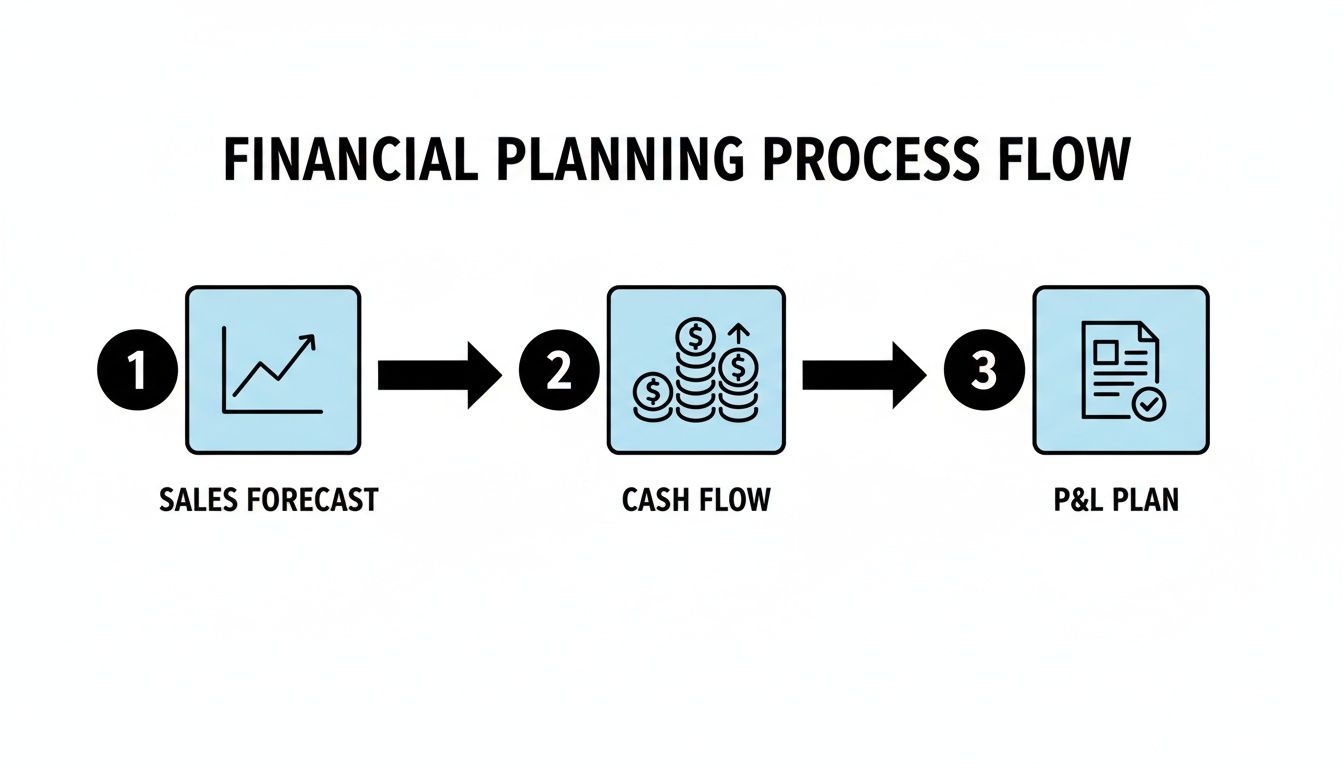
Keeping a close eye on this flow—from sales forecasts to cash management and your P&L—is what fuels your entire strategy.
Think of your strategic plan not as a set of rules carved in stone, but as a hypothesis about the future. Your review meetings are the experiments where you test that hypothesis against what’s actually happening and make smart adjustments.
This disciplined cycle of execution and review is what makes a strategy real. It bridges the gap between where you are and where you want to be, making sure every day is a deliberate step toward your North Star.
As you start mapping out your business's future, a few common questions always seem to surface. Let's dig into some of the ones I hear most often from ecommerce founders.
This is a great question. Your core vision should be your North Star—fairly constant. But the plan to get there? That needs to be a living, breathing document.
I recommend a deep-dive strategic review quarterly. This is your time to really look at what's working and what's not, measure progress against your OKRs, and adjust for any new market changes or opportunities that have popped up.
Beyond that, you should be doing a lighter check-in on your main KPIs at least monthly. This cadence is perfect for catching small problems before they become big ones. It keeps you nimble enough to make smart adjustments without losing sight of your bigger goals.
The worst thing you can do is spend weeks crafting a brilliant plan only to let it sit in a folder collecting digital dust. A strategy is only useful if it's influencing your daily decisions, how you spend your money, and what your team is focused on. It has to be part of your operations, not just a document.
Strategic planning isn't a luxury reserved for massive corporations. Honestly, it’s even more crucial when your team is small and lean. A crystal-clear plan ensures that every bit of your limited time, money, and energy is aimed at the same target. Nothing gets wasted.
The trick for smaller teams is to keep it simple. Don't get bogged down in a 50-page document. A one-page strategic plan that clearly lays out your vision, your goals for the next 90 days, and the key actions you'll take to get there can be unbelievably effective.
Absolutely not. The quality of your strategic thinking matters a whole lot more than the tool you use to document it. You can build and run a killer strategic plan using simple software you probably already have.
Start with these. Once you get the process down and your business grows, you can always look into more specialized strategy software if you feel the need.
At Million Dollar Sellers, we know that a rock-solid strategy is what separates good brands from the 8- and 9-figure powerhouses. Our private community is where the top minds in e-commerce share the high-level plans that are actually working today, so you can scale smarter. Learn more about Million Dollar Sellers.
Join the Ecom Entrepreneur Community for Vetted 7-9 Figure Ecommerce Founders
Learn MoreYou may also like:
Learn more about our special events!
Check Events