Chilat Doina
November 26, 2026
You agree on a growth plan in Monday's meeting. The brand will improve margin, fix inventory availability, and make DTC less dependent on paid acquisition. Everyone leaves with the same presentation.
By Friday, the media buyer wants more budget, the operations lead has flagged a stockout, and the creative agency is waiting for approval. You spend the next quarter reacting to ad costs and replenishment problems. The strategy hasn't changed, but nobody can explain which decisions it should change.
That's the gap between a deck and an operating plan. In AchieveIt's survey of more than 250 leaders, 91% identified a lack of strategic vision as a key reason organizational plans fail. For an ecommerce founder, a useful vision must reach further than a revenue target. It must clarify what teams prioritize, who resolves conflicts, and which key performance dashboard metrics prove progress.
A useful strategy implementation example connects a decision to daily work. The frameworks below serve different purposes, from aligning a team to testing an unfamiliar channel. Each includes an illustrative Amazon or DTC scenario, the friction to watch for during weeks three through six, and a tactic you can copy. Public business outcomes are identified separately, not presented as results those hypothetical brands achieved.
A brand can increase revenue while making its business harder to operate. Discounts lift conversion, advertising consumes margin, and customers wait longer for orders. The Balanced Scorecard helps you evaluate those consequences together, using financial, customer, internal-process, and learning-and-growth measures.
Illustrative scenario: An Amazon-led skincare brand wants profitable DTC growth. On Monday, the founder asks finance, marketing, operations, and customer support to agree on metric definitions before approving more acquisition spend.

The team selects ecommerce KPIs that describe the whole purchase experience:
During weeks three through six, expect disagreements about attribution. Marketing may celebrate stronger conversion while finance questions whether discounting produced profitable orders. Give each measure an owner, and document which costs and customer groups it includes.
A connected approach has a useful public parallel. In Infoglobal's retail transformation case study, conversion rate increased from 0.9% to 2.6%, while advertising return on ad spend improved from 1.8x to 5.6x. That case combined platform development, marketing, and conversion optimization. It doesn't establish an expected lift for your brand.
Expected outcome: A clearer explanation of whether growth improves business health, rather than an automatic performance increase.
Replicable tactic: Write a cause-and-effect hypothesis beside each initiative. For example, clearer product descriptions should reduce purchase uncertainty, improve conversion, and support contribution margin. Review whether that chain holds in practice.
“Launch retention campaigns” describes work. “Make replenishment easier for existing customers” describes a direction. OKRs connect that direction to measurable customer or business outcomes, rather than treating completed tasks as proof of success.
For an illustrative DTC consumables brand, the objective is to make repeat purchasing more dependable. The founder starts by checking whether customer identities, purchase dates, refunds, and subscription orders are recorded consistently.
The team then defines outcomes around repeat purchase behavior, contribution from returning customers, and replenishment-related support contacts. It sets targets from its own baseline and buying cycle, not another brand's benchmark. These ecommerce OKR examples can help distinguish an outcome from the tasks intended to produce it.

During weeks three through six, the email team may report successful flow launches while repeat purchasing remains unchanged. That doesn't necessarily mean the work failed. Customers may not yet need another order, or the offer may have reached people who would have purchased anyway.
Review customer cohorts against their normal replenishment window. Keep campaign activity visible, but don't substitute email sends or creative approvals for customer outcomes.
Practical rule: A completed task earns a progress update. A changed customer behavior earns an outcome claim.
The trade-off is patience. Outcome-based management can feel slower than counting deliverables, particularly when the buying cycle extends beyond the review period.
Expected outcome: Better prioritization and fewer campaigns launched only because somebody requested them.
Replicable tactic: Add a confidence statement to each weekly review. The owner should explain whether the result remains achievable, what evidence changed, and which decision they need from leadership.
A supplier lead-time initiative can fail before anyone places a purchase order. Finance wants less cash in inventory, marketing wants uninterrupted availability, and procurement wants larger orders to secure better terms. Hoshin Kanri makes those competing requirements explicit before teams commit.
The method connects long-term direction with operating priorities and accountable owners. Its useful feature is catchball, a back-and-forth discussion in which the people doing the work challenge assumptions and propose feasible commitments.
Illustrative scenario: An Amazon brand wants more dependable availability without indiscriminately increasing stock. The founder proposes the direction, then asks procurement, forecasting, and marketing to test the assumptions together.
During weeks three through six, expect frontline constraints to challenge the original target. A supplier may accept smaller orders but require longer production notice. Don't label that resistance. Use it to revise the plan.
Toyota offers a documented example of staged operating change, although it isn't proof of this hypothetical brand's outcome. According to MIT Sloan Management Review, Toyota introduced the supermarket method in 1954 and adopted kanban management company-wide by 1963. The transferable lesson is to develop the mechanism, test it, and expand it deliberately.
Use the video as a discussion aid before mapping responsibilities.
Expected outcome: A replenishment plan that reflects actual supplier and cash constraints.
Replicable tactic: Pilot the revised ordering process with a manageable product family. Expand only after the team can explain exceptions and repeat the process without founder intervention.
If everyone agrees with the strategy but execution still stalls, inspect the organization supporting it. The McKinsey 7S Framework considers strategy, structure, systems, shared values, skills, style, and staff as interdependent elements.
An illustrative Amazon brand entering DTC makes the problem concrete. Leadership approves the channel, hires an agency, and launches Shopify. Yet the team still evaluates every decision using marketplace habits.
The founder's first action should be an alignment review, not another campaign brief. Ask who owns the DTC profit-and-loss statement, who can approve site changes, and whether anyone can reconcile Shopify orders with advertising and fulfillment costs.
During weeks three through six, the agency may request landing-page changes that nobody internally can approve. The ecommerce manager owns revenue but not development capacity. Finance receives reports that don't match its cost definitions.
In AchieveIt's strategy execution findings, 68% of surveyed leaders said their teams were not fully aligned with the organization's strategic direction. For your review, translate alignment into observable permissions and capabilities:
The trade-off is uncomfortable visibility. A capability gap may require training, narrower scope, or a different role assignment. A framework won't remove that decision.
Expected outcome: A defensible explanation of why execution is blocked, with responsibility assigned to fix it.
Replicable tactic: Trace a real change request from proposal to release. Record every approval, missing skill, and reporting dependency. Repair that path before redesigning the entire organization.
A new fulfillment process can be technically sound and still be ignored. Warehouse staff keep the familiar spreadsheet, customer support promises the old delivery window, and managers make exceptions for urgent orders.
Kotter's model addresses adoption, moving from urgency and a guiding coalition through vision, communication, removing barriers, visible wins, sustained improvement, and embedding the change.
Illustrative scenario: A DTC brand replaces informal dispatch rules with a shared order-priority process. The operations lead begins with a review of late-order causes and asks warehouse, support, and finance representatives to agree on the customer problem.
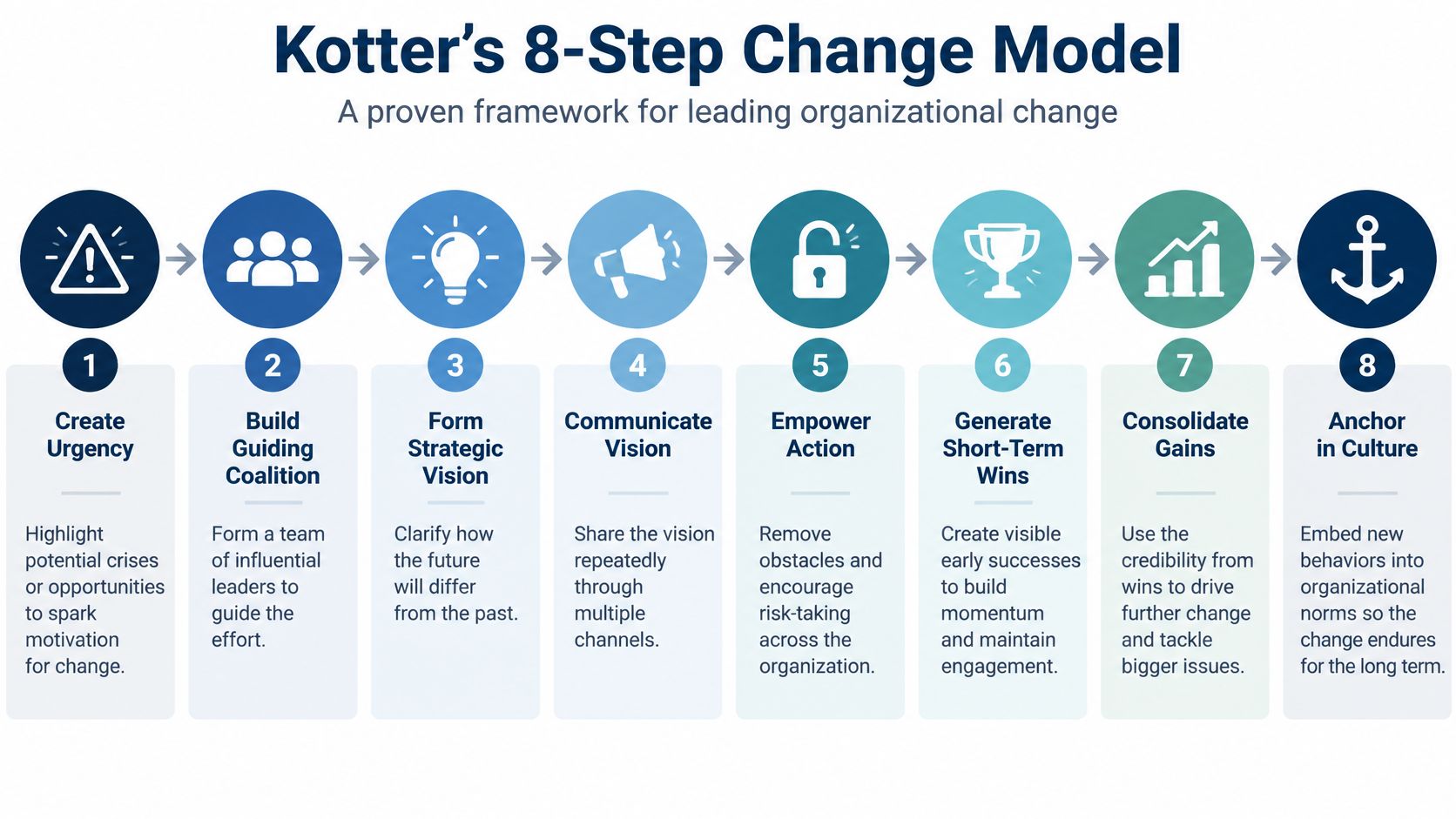
During weeks three through six, watch for parallel processes. Employees may update the new system for management while continuing to make decisions in the old spreadsheet. Ask what the new process makes harder before assuming people lack commitment.
Choose an early win customers and staff can recognize, such as fewer orders requiring manual status investigations. Document the process behind it, including exception handling.
Don't celebrate adoption because people attended training. Check which system they use when an order goes wrong.
Controlled rollout has a relevant public example. A Mercatus grocery ecommerce case study reported a 10-month rollout and a 10.3% increase in overall weekly shopping revenue for stores moving from no ecommerce capability to a fully integrated experience. That's a rollout example, not evidence that the retailer used Kotter's model.
Expected outcome: More consistent use of the new process, with fewer unofficial workarounds.
Replicable tactic: Have the pilot team write the exception-handling SOP. Expand after another team can follow it without the original project leader translating each step.
Daily trading problems don't pause while your team pursues a strategic target. 4DX creates a protected execution rhythm through a focused goal, controllable lead measures, a visible scoreboard, and regular accountability.
Illustrative scenario: An Amazon brand wants to improve the profitability of an established product family. The team starts by separating weak product-page performance from pricing, inventory, and traffic-quality problems.
The founder selects a focused outcome and asks each owner to propose actions they can directly influence. Before applying a strategy-to-execution framework, confirm that the chosen goal is narrow enough to guide trade-offs.

The scoreboard should distinguish effort from evidence:
During weeks three through six, urgent requests will compete with planned interventions. The common mistake is to keep every commitment active while adding more work. Ask which commitment must stop when a new priority enters.
A second risk is counting tests instead of learning from them. Launching more experiments isn't useful if traffic is insufficient, changes overlap, or nobody records the decision afterward.
Expected outcome: A steadier cadence of completed, interpretable improvements. The framework doesn't guarantee that every intervention works.
Replicable tactic: End each weekly review with a named commitment, its completion evidence, and the obstacle leadership must remove. At the next review, discuss the prior commitment before introducing new ideas.
Before approving a new product, write the customer announcement you'd want to publish after launch. If the benefit sounds interchangeable with competitors' listings, more development work won't solve the positioning problem.
Working Backwards uses a proposed press release and FAQ to test customer value before committing resources. The press release explains the benefit. The FAQ confronts the commercial and operational questions behind it.
Illustrative scenario: A homeware brand considers a refillable cleaning product. The founder asks product, operations, marketing, and support to review the same document before requesting a full production commitment.
The FAQ should answer specific objections:
During weeks three through six, attractive wording may run into manufacturing constraints. A convenient refill format could require packaging that changes freight costs or creates leakage risk. Revise the customer promise or stop the proposal before sunk costs dominate the decision.
Long-horizon implementation also requires capability milestones. Retail Brew's account of Walmart's ecommerce development describes its marketplace opening in 2009 and its acquisition of Jet.com in 2016. Walmart's history isn't a PR/FAQ case study, but it illustrates why channel strategy needs successive capabilities, not merely a launch announcement.
Expected outcome: A clearer launch decision, including explicit reasons not to proceed.
Replicable tactic: Give the document to a skeptical reviewer who doesn't own the proposal. Ask them to identify the customer promise most likely to fail and the evidence needed to support it.
An unfamiliar channel is an assumption to test, not a commitment to defend. The Build-Measure-Learn loop helps a brand run a limited experiment, observe customer behavior, and decide whether to continue, change direction, or stop.
For an illustrative DTC accessories brand, the question is whether customers want a travel-oriented version of an existing product. The team writes a hypothesis, defines acceptable economics, and chooses a limited test before ordering a broad assortment.

A landing page can test whether the proposition earns attention. A limited, fulfillable batch can test whether buyers pay, use the product, and keep it. Don't confuse those signals, especially when you're landing your first paying customers.
During weeks three through six, encouraging clicks can tempt the team to scale before it understands fulfillment costs or returns. The opposite mistake is abandoning a promising concept because the first creative treatment performed poorly.
Decision discipline: Specify what the experiment can prove, what it cannot prove, and which evidence would justify the next investment.
Use honest availability messaging. If you accept preorders, confirm that the channel permits them and that your delivery promise is supportable. A small test still creates real customer obligations.
Expected outcome: Less uncertainty about a particular assumption, not a guaranteed successful product. Some tests should end with a decision not to expand.
Replicable tactic: Write the decision rule before launching. Record the intended audience, offer, measurement window, economic constraints, and next action for each possible result. Don't rewrite the rule after seeing disappointing results.
| Item | Core Mechanism | Typical Review Cadence | Biggest Execution Risk | Best Fit for Ecommerce Teams |
|---|---|---|---|---|
| Balanced Scorecard | Links financial, customer, process, and learning measures to strategy | Monthly | Too many metrics or untested cause-and-effect assumptions | Teams aligning operational KPIs with long-term growth |
| Objectives and Key Results (OKRs) | Sets ambitious objectives with measurable, time-bound key results | Quarterly goals, weekly or biweekly check-ins | Activity-based or easy-to-game key results | Teams needing focus, alignment, and regular course correction |
| Hoshin Kanri (Policy Deployment) | Cascades breakthrough objectives into actions through X-matrix planning and PDCA | At least monthly | Bureaucratic implementation without sustained discipline | Teams improving fulfillment, listings, or supplier lead times |
| McKinsey 7S Framework | Diagnoses alignment across strategy, structure, systems, shared values, skills, style, and staff | After major changes or when results falter | Abstract analysis without measurable actions | Teams handling restructuring, channel expansion, or capability gaps |
| Kotter's 8-Step Change Model | Guides change from creating urgency to embedding new behaviors in culture | Throughout the change program, with early-win reviews | Rigid sequencing that slows fast-moving teams | Teams implementing major transformations or new operating models |
| 4 Disciplines of Execution (4DX) | Focuses on a few priority goals, lead measures, a scoreboard, and accountability | Weekly accountability meetings | Losing consistency in the weekly execution cadence | Teams pursuing a focused revenue, margin, or conversion goal |
| Working Backwards (PR/FAQ Method) | Tests customer value and feasibility through a launch-style press release and FAQ | Before decisions and again after launch | Time-intensive writing without validating financial viability | Teams evaluating new products, features, or private-label launches |
| Lean Startup Build-Measure-Learn Loop | Builds an MVP, measures customer response, and pivots or perseveres | Rapid cycles tied to experiments and decision dates | Drawing misleading conclusions from small or weak tests | Teams testing new products, SKUs, categories, or channels |
Use the table as a selection tool, not a ranking. Each framework controls a different part of execution. Some force attention. Some test cause and effect. Some expose organizational mismatch. Others manage uncertainty through fast experiments.
For an Amazon or DTC brand, the practical question is simple: what is breaking this month? If the team is busy but the main number is flat, OKRs or 4DX usually fit. If local metrics look healthy while cash, margin, or customer experience deteriorates, Balanced Scorecard surfaces the trade-off. If fulfillment, listings, or supplier commitments keep slipping across functions, Hoshin Kanri gives the work a tighter operating rhythm.
Use McKinsey 7S when strategy changed but roles, decision rights, skills, or incentives did not. Its value is diagnosis, not weekly control. Use Kotter's 8-Step Change Model when the change requires new behavior across a team, such as a new operating model. The risk is treating the steps as a fixed script while market conditions keep moving.
Working Backwards and the Lean Startup loop fit uncertain bets. Working Backwards is stronger before committing to a product promise, because the press release and FAQ force clear customer language. Lean Startup is stronger when the team can run a small test and make a decision from the response. An illustrative scenario: a DTC brand tests a new SKU with a small batch and a clear decision date. The first action is defining the customer, offer, audience, and threshold. In weeks three to six, the usual problem is weak signal quality from poor targeting or thin volume. The expected outcome is a better decision about expansion, not certainty. The replicable tactic is to write the decision rule before launch and keep it fixed.
The framework should match the execution constraint. That gives the team one system to run, one review rhythm, and one definition of progress.
Choose the framework that matches the constraint you can name today. Use OKRs or 4DX when a clear growth priority keeps losing attention. Use 7S when capable people can't coordinate decisions, and the Lean Startup loop when demand or channel economics remain uncertain.
A scorecard fits a different problem: teams optimizing local metrics while the overall business suffers. Hoshin Kanri helps negotiate cross-functional operating commitments. Kotter supports adoption, while Working Backwards pressure-tests a customer promise before you fund it.
Define one measurable goal, document its baseline, and name an accountable owner. Pick two lead measures the team can influence, then identify guardrails that prevent a misleading win. These are planning choices, not universal performance benchmarks.
Write the handoffs as carefully as the goal. A marketing strategy implementation study identifies interpretation gaps, missed requirements, and inaction as risks when work passes between functions and external partners. Give each handoff an acceptance condition, such as approved claims, confirmed inventory, working tracking, or a tested support response.
Run a weekly review around evidence, blockers, and decisions. Don't turn it into a presentation contest. When a commitment slips, distinguish insufficient capacity from an incorrect assumption or an unresolved dependency.
Keep technical initiatives tied to the business problem. If slow product pages obstruct the purchase journey, assign someone to improve Core Web Vitals by template, then verify both the technical change and its relevance to customer behavior. Faster pages alone aren't proof of profitable growth.
Schedule a day-90 retrospective against the original hypothesis. Compare the outcome, costs, customer effects, and operating effort with what you expected. Separate a failed idea from a poorly executed test.
Then make an explicit decision:
Founders can sharpen these decisions by pressure-testing them with peers who run real businesses. That's the premise behind Million Dollar Sellers' founder-led community: discuss the inventory constraints, channel conflicts, and execution trade-offs behind a plan, not just its headline result.
Million Dollar Sellers offers ecommerce founders a peer network, recorded weekly tactics calls, and member SOPs and templates to help turn strategic priorities into operating decisions. Visit Million Dollar Sellers to explore the community and bring your next execution challenge to founders who understand Amazon, DTC, and omnichannel businesses.
Join the Ecommerce Community for Founders Scaling from 7 to 9 Figures
Learn MoreYou may also like:
Learn more about our events!
Check Events