
Chilat Doina
August 17, 2026
Most ecommerce sustainability advice starts with the least important question: Which package looks greener? A cardboard mailer, recycled sticker, or eco badge may improve the unboxing story, but none of those changes can compensate for poor supplier data, inefficient freight, excess inventory, avoidable returns, or a product that can't support reuse or recovery.
Sustainable business practices create value when they change how the business buys, makes, moves, sells, and measures products. Packaging still matters, but it's only one visible part of a much larger operating system. The harder work sits upstream, where founders have less control and where Scope 3 emissions often represent the majority of an SME's footprint. Recent research on Scope 3 measurement and SME supply chains makes the practical problem clear: indirect emissions are both highly significant and difficult to manage because they depend on suppliers, manufacturers, carriers, and other partners.
The common failure pattern is predictable. A founder changes the shipping mailer, adds sustainability language to the product page, and treats the project as complete. The brand may look more responsible, but the business hasn't necessarily reduced its largest impacts, improved its unit economics, or created evidence that can survive customer, retailer, investor, or regulatory scrutiny.
A packaging swap can be worthwhile when it reduces material use, lowers dimensional weight, protects the product, and comes with credible end-of-life information. It fails when the new material costs more, causes damage, requires extra void fill, or creates a recycling claim customers can't verify. The same logic applies to energy purchases, carbon claims, and supplier badges. A visible initiative isn't automatically a material initiative.
Founders often separate sustainability from operations. Operations owns cost, procurement owns suppliers, marketing owns claims, and sustainability becomes a presentation layered over all three. That structure produces activity without accountability. Nobody owns the relationship between packaging specifications, freight charges, damage rates, supplier emissions, and customer trust.
A better model treats sustainability as an operating-model redesign. Start with the decisions that shape both impact and margin:
Practical rule: If a sustainability initiative has no owner, baseline, operating target, and review date, it's probably a campaign rather than a business practice.
The evidence from corporate sustainability infrastructure supports this broader view. CDP receives environmental disclosures from more than 22,000 companies annually, while S&P Global's Corporate Sustainability Assessment uses up to 1,000 ESG datapoints across more than 35 sustainability criteria and themes. A company-level ESG lookup covers about 13,000 companies, and one sustainability reporting summary states that almost 50,000 companies became subject to mandatory sustainability reporting in 2024. These figures are compiled in this ESG firm-level data overview. The direction is unmistakable: sustainability is moving from reputation management toward structured business data.
Sustainability can support revenue, but founders should be skeptical of broad claims about customers paying more. The purchase decision happens under friction. Shoppers compare price, delivery speed, product quality, reviews, convenience, and return risk. A general statement that a brand cares about the planet rarely wins against a better offer.
Independent research summarized by Sustainable Atlas describes this intention-action gap: roughly 80% of global consumers say they're willing to pay more for sustainable goods, yet verified environmental claims capture only about 35% of spending in the categories where they compete. The practical implication isn't that sustainability doesn't sell. It's that vague values messaging often fails at checkout.
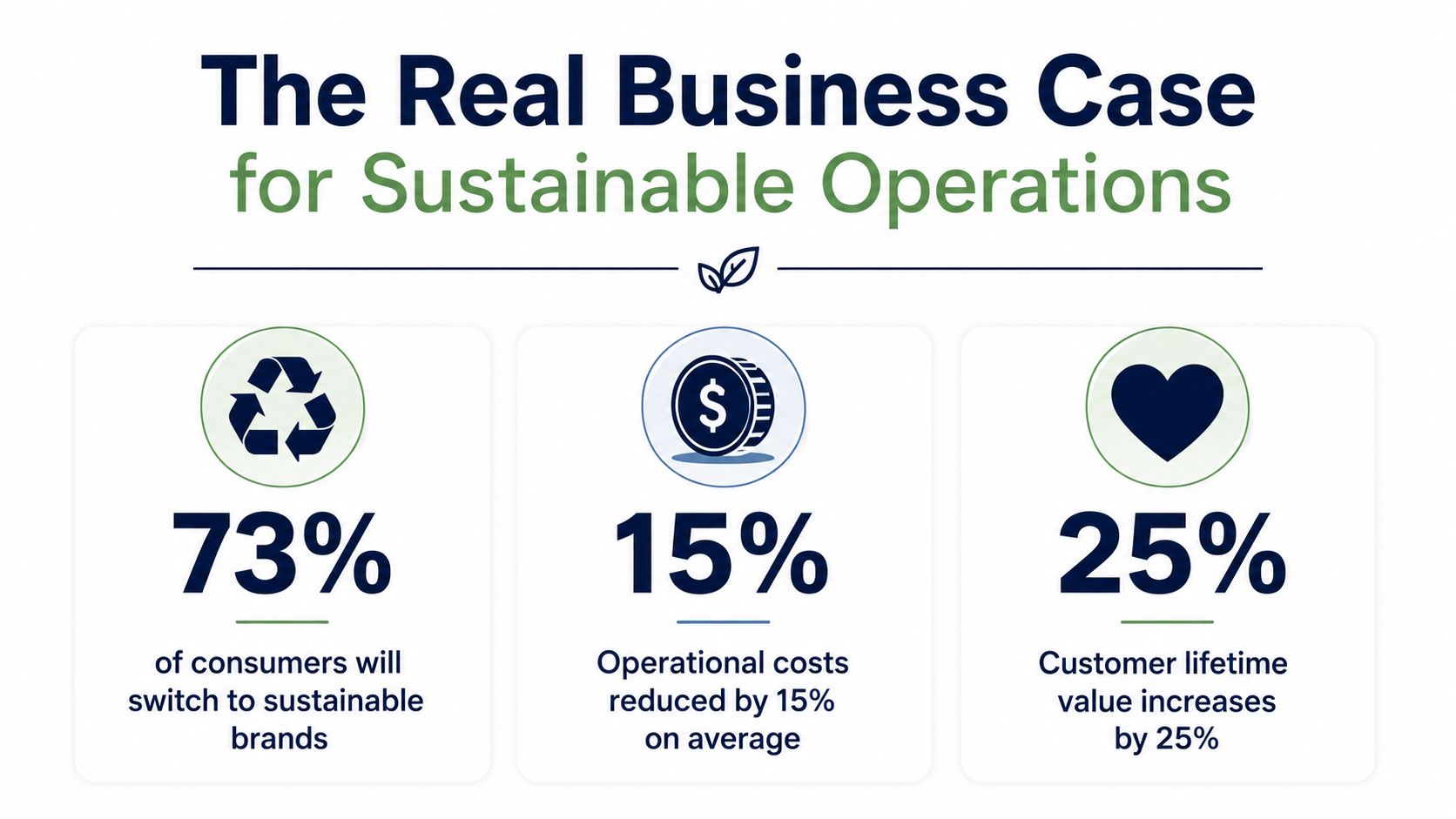
The strongest business case usually comes from operational improvements customers may never see:
Canadian survey data shows how widely these practices have already entered normal business operations. In Q3 2023, 68.4% of Canadian businesses or organizations had at least one environmental or green practice in place. The most common action was reducing waste, reported by 48.8%, followed by encouraging employees to adopt environmentally friendly practices at 37.5%, reducing energy or water consumption at 34.9%, using recycled or waste materials as inputs at 21.4%, implementing green processes at 15.0%, and choosing suppliers based on environmental practices or products at 12.4%. The Canadian sustainability practice reference shows sustainability operating across waste, workplace behavior, resources, inputs, processes, and procurement.
The reporting environment adds urgency. Private ecommerce brands may not face every disclosure requirement directly, but large customers, investors, marketplaces, and supply-chain partners can still request data. Build the measurement habit before someone else sets the deadline.
For practical ideas on presenting responsible products without turning every message into a corporate report, founders can also browse the artisan marketplace resource hub. Use inspiration selectively. Your own product specifications and operational evidence should carry the claim.
Don't start by buying a carbon platform. Start with the records your team already has: purchase orders, packaging invoices, freight bills, warehouse utility statements, product bills of materials, return reasons, disposal invoices, and supplier questionnaires. A useful baseline is more valuable than a detailed dashboard filled with assumptions.
Separate the audit into direct operations, fulfillment, and the upstream value chain. Direct operations include warehouses, offices, owned equipment, and energy use. Fulfillment covers packaging materials, storage, pick-and-pack activity, shipping modes, delivery routes, damage, and returns. The upstream layer includes raw materials, manufacturing, supplier energy, inbound freight, and outsourced services.
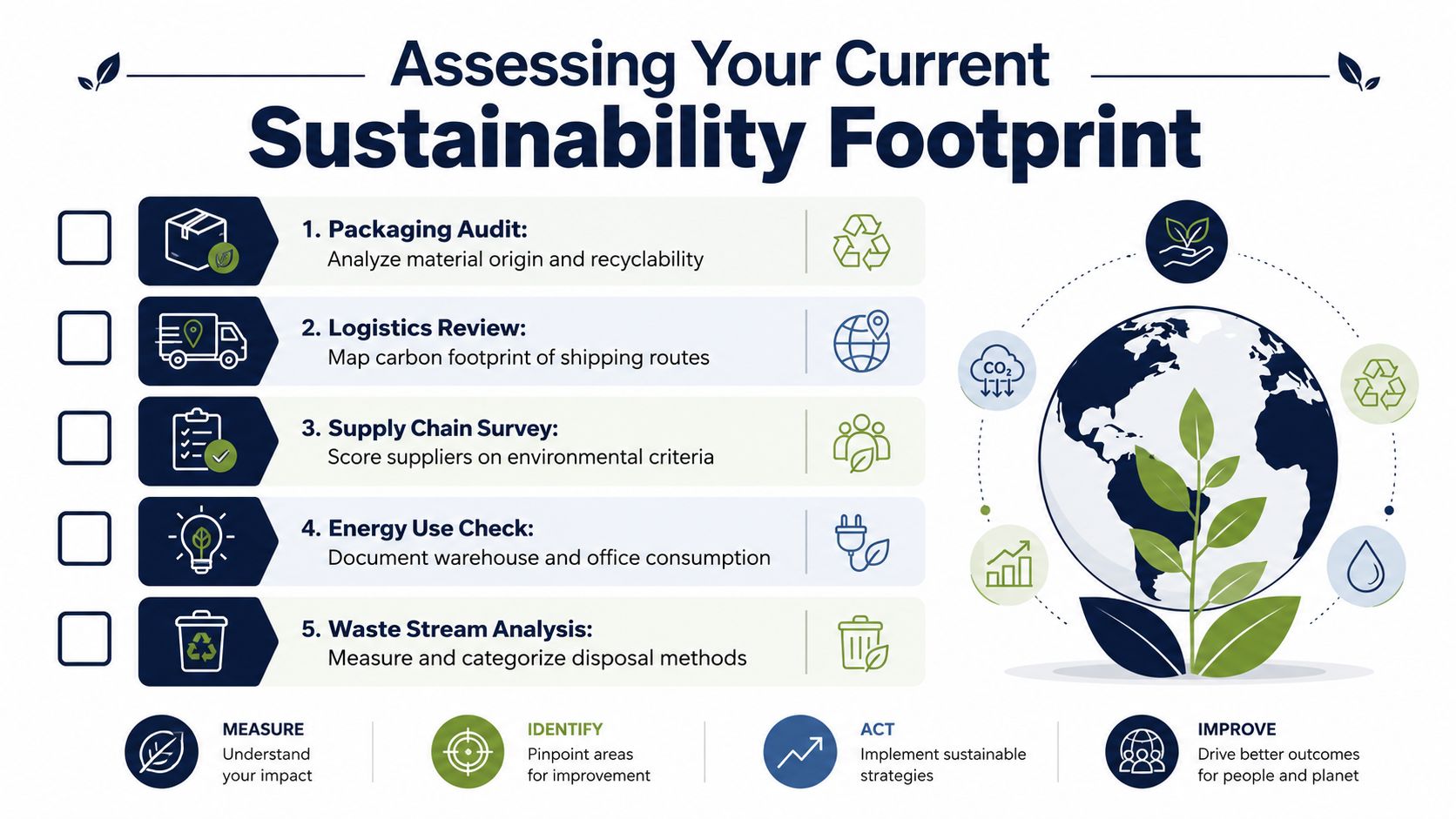
For each major SKU and supplier, collect the following:
Don't demand perfect supplier data on day one. Mark every figure as measured, supplier-provided, estimated, or missing. That status is as important as the value because it tells you where future work will improve confidence.
Rank each impact by business relevance, not emotional visibility. A small packaging improvement may be easy to implement but irrelevant beside a high-volume supplier using opaque material inputs. A difficult supplier conversation may generate more value than a new box design, especially when that supplier controls product composition, production yield, and inbound freight.
Use this supplier vetting checklist to strengthen procurement questions, then add sustainability fields to the same workflow rather than creating a separate process nobody maintains. The first audit should end with a short list of high-confidence actions, unresolved data gaps, and an owner for each next step.
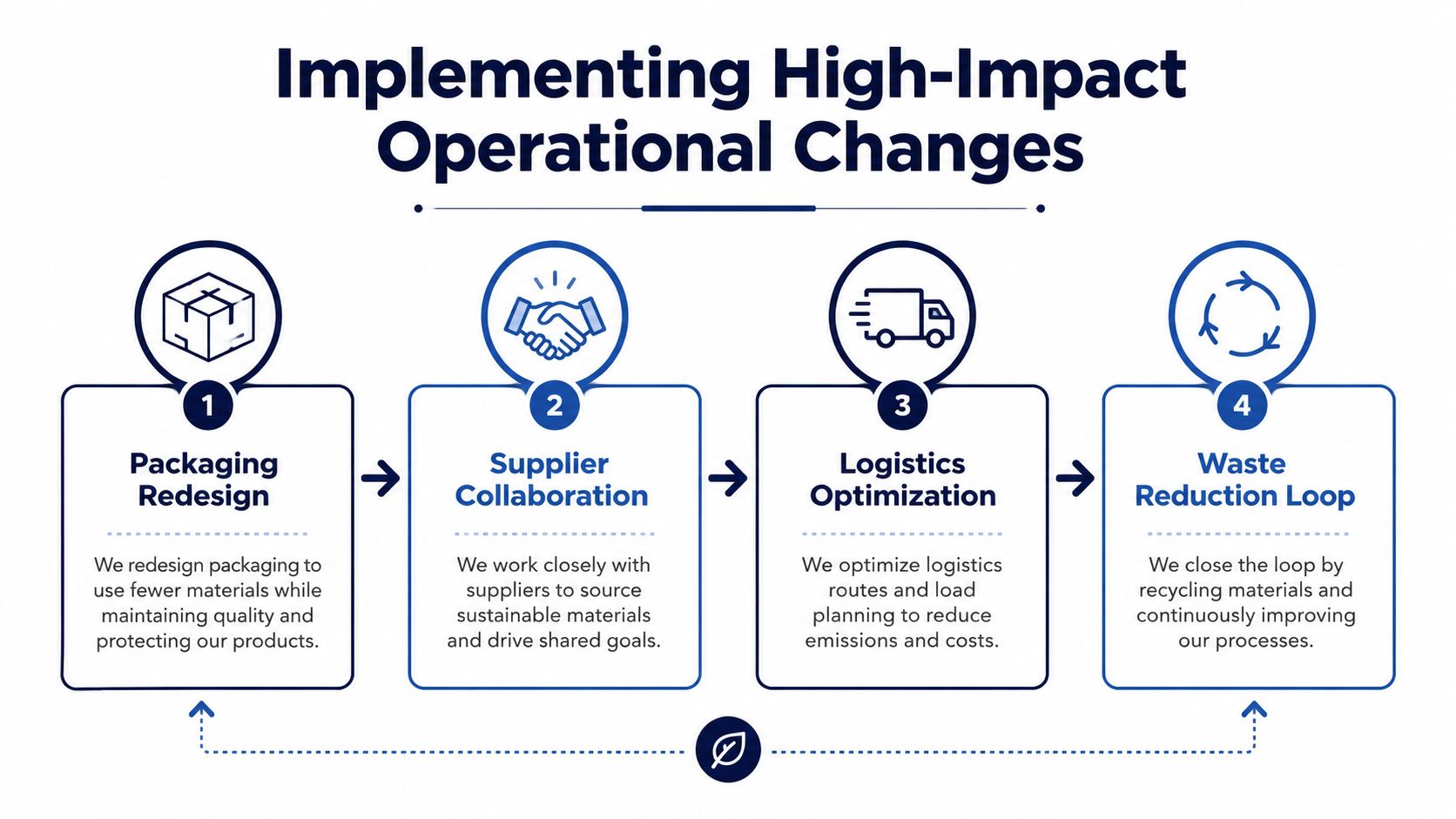
Implementation works best when the team sequences changes by control, impact, and reversibility. Test changes where you can observe product quality and customer response, then scale only after finance and operations agree on the result.
For Amazon FBA, packaging must protect the product, meet fulfillment requirements, survive handling, and avoid creating unnecessary dimensional volume. For DTC, you have more control over the unboxing experience, but carrier pricing, warehouse throughput, and damage exposure still determine whether a packaging change makes sense.
Test the top-volume SKUs first. Measure material weight, pack time, cube, freight cost, damage, customer complaints, and disposal instructions. A recycled material that increases breakage is not a sustainable improvement once replacement shipments and discarded products enter the calculation.
Packaging changes can be low complexity when they involve standard mailers, tape, labels, or carton sizes. Custom inserts, product redesign, and reusable systems require deeper testing and supplier coordination. Don't approve a new specification from a sample alone. Run it through actual fulfillment conditions.
Supplier collaboration is where many ecommerce programs become serious or stall. Ask suppliers to provide product composition, production-site information, energy and waste practices, packaging specifications, and evidence supporting environmental claims. Put the requirements into purchase orders and supplier scorecards, then make missing data visible during sourcing decisions.
The goal isn't to punish every supplier that lacks mature reporting. Give strategic suppliers a clear path to improve, while using documented gaps in allocation, renewal, and negotiation decisions. Consolidated purchasing, longer planning windows, and predictable orders can sometimes make better materials or process changes commercially feasible without accepting a higher unit cost.
Founders who want a broader operational view can review this guide on improving supply chain efficiency. For packaging and material sourcing questions, Monopack ltd sustainable sourcing advice offers another useful reference point.
Shipping decisions affect both cost and Scope 3 exposure. Consolidate compatible orders, reduce split shipments, improve carton utilization, and reserve expedited freight for genuine service requirements. Review inbound routing as well as outbound delivery. A supplier's low unit price can disappear when lead times force air freight or when inconsistent cartons consume warehouse space.
Close the loop through returns, refurbishment, resale, donation where appropriate, and material recovery. A circular process only works when somebody owns disposition, records the outcome, and feeds the failure reason back into product, packaging, or forecasting decisions.
Sustainability reporting becomes useful when it helps a manager make a decision. Track the metrics that affect purchasing, fulfillment, product quality, cash flow, and compliance. A marketing dashboard full of recycled badges won't tell you whether a supplier change increased damage or whether a logistics change reduced cost.
Operating metrics should answer practical questions. How much packaging does each order use? Which suppliers provide verified data? How often does a product require replacement? How much waste leaves each facility, and through which disposal route? Which shipment lanes create the most cost and emissions exposure?
Keep the initial system simple. A controlled spreadsheet can work for a smaller brand if each metric has a definition, source, owner, unit, period, and confidence status. Larger teams can connect procurement, warehouse, freight, and finance data in a business intelligence tool, but automation won't repair inconsistent product codes or missing supplier records.
The ADIM pilot described in this industrial circular-economy study used assessment, design, implementation, and monitoring with surveys, expert interviews, case studies, and a pilot test. It met 92% of predefined KPIs, including a 38% waste reduction and €18,750 in monthly savings. Those results illustrate the value of connecting initiatives to defined operating targets and continuous monitoring, rather than treating sustainability as a communications exercise.
| Business Stage | Core KPIs | Advanced KPIs | Reporting Frequency |
|---|---|---|---|
| Early validation | Packaging weight per order, packaging cost, damage reasons, supplier data status | Product material inventory, shipment-mode mix, disposal pathways | Monthly |
| Growing multichannel brand | Packaging material mix, freight cost by lane, return and replacement causes, warehouse energy use | Supplier scorecards, estimated Scope 3 categories, waste intensity, inventory write-offs | Monthly, with quarterly review |
| Acquisition or investment preparation | Documented baselines, target progress, data ownership, claim evidence | Assurance-ready records, value-chain emissions methodology, scenario analysis, audit trail | Monthly dashboard, quarterly leadership review |
Don't set targets that your team can't influence. Scope 3 data may initially rely on estimates, but document the method, improve supplier-specific information over time, and avoid presenting estimates as measured facts. The WBCSD circular business model survey highlights the execution gap: 54% of respondents said they were active and successful in process innovation, while only 18% said they were successfully engaged in business-model innovation. Efficiency matters, but product design, take-back, reuse, and monetization need to work together if the business wants to capture circular value.
Customers don't need more sweeping promises. They need claims they can understand, verify, and connect to the product in front of them. “Eco-friendly” says almost nothing without a defined attribute, scope, and proof.
Lead with the product benefit when sustainability is secondary. A durable bottle, concentrated formula, refill system, repairable item, or lower-material packout can earn attention because it solves a customer problem first. Sustainability then reinforces the choice. Lead with the environmental attribute when it directly changes the purchase decision, but explain what changed and what didn't.
A strong claim identifies the object, comparison, boundary, and evidence. “The mailer contains recycled content” is more useful than “green packaging.” “The carton uses recycled fiber” still needs documentation and shouldn't imply that every part of the shipment has the same property.
For Amazon listings, place concise proof near the relevant product attribute and avoid unsupported badges. For DTC sites, add a materials panel, sourcing notes, care guidance, and end-of-life instructions near the product information. Keep the claim consistent across the listing, package, email, and customer service scripts.
The climate pledge friendly products guide can help sellers think about marketplace-facing product criteria, but qualification should never replace your own documentation. Marketplace eligibility, environmental performance, and marketing language are related but distinct questions.
For communications teams, this practical guide to avoid greenwashing in PR is a useful reminder to match every public statement with evidence and a clearly defined scope. Trust grows when the brand explains trade-offs instead of hiding them. A heavier protective package may prevent product waste, and a recycled input may have supply limitations. Say so.
A workable sustainability program starts small enough to survive peak season and becomes rigorous enough to guide procurement. The sequence below assumes a founder has limited internal bandwidth and needs early operational wins without pretending that supplier transformation happens instantly.
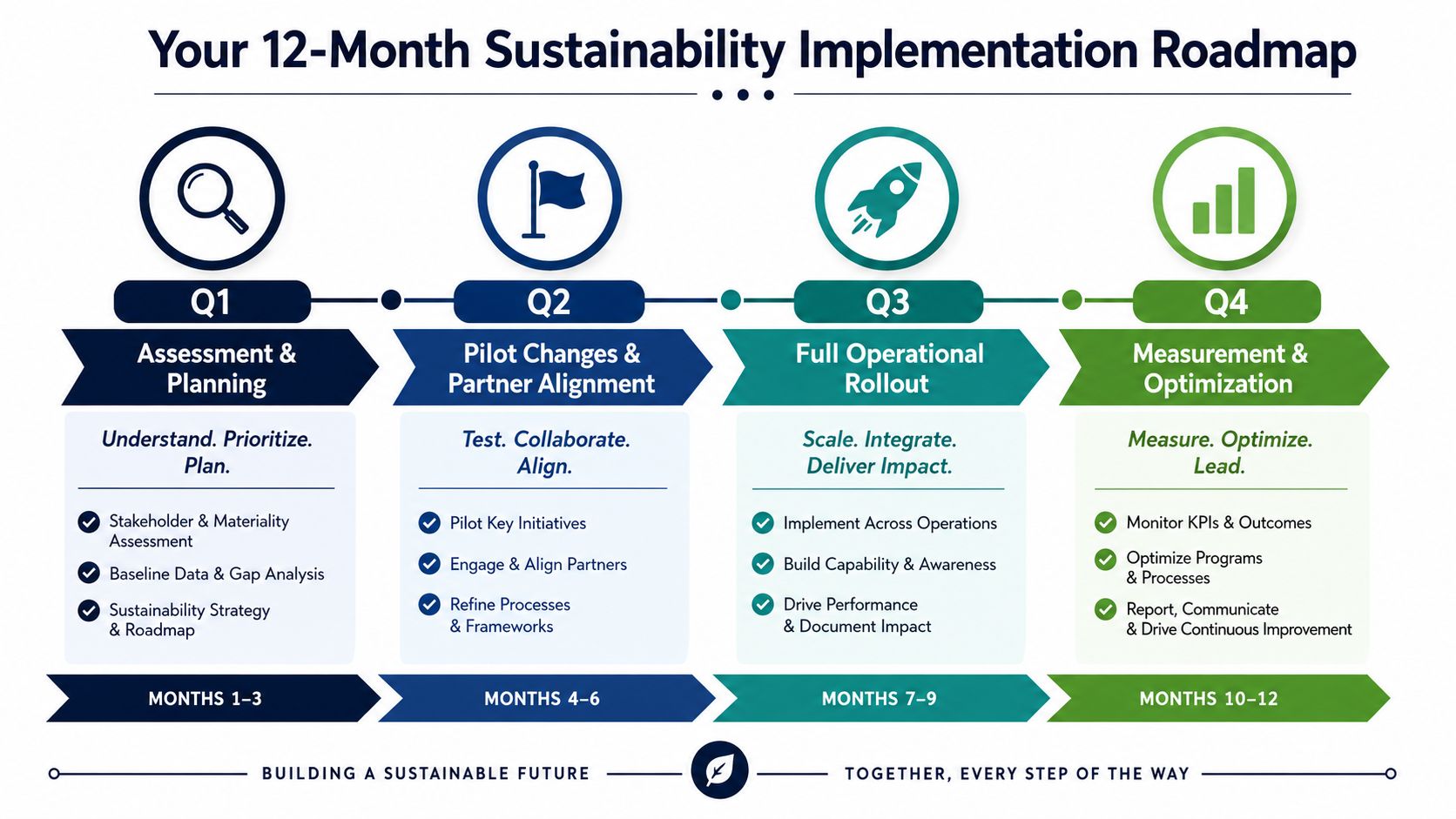
Choose a program owner, define the boundary of the audit, and gather existing data. Rank products, suppliers, packaging formats, and shipping lanes by spend, volume, failure rate, and data quality. Finish the quarter with a baseline, a short priority list, and claims your team can already substantiate.
If data is missing, don't delay the whole program. Mark the gap, assign a supplier request, and use a conservative estimate for internal prioritization. Don't publish that estimate as a verified environmental result.
Run controlled tests on selected packaging formats, suppliers, or freight lanes. Finance should review total landed cost, operations should review throughput and damage, and customer experience should review complaints and returns. Suppliers need written specifications, response deadlines, and a clear explanation of how performance affects future purchasing.
Resistance usually appears here. A supplier may reject a material change, a warehouse may resist a new packout, or a buyer may prioritize unit price over lifecycle cost. Keep the pilot narrow, document the trade-off, and escalate only decisions that affect strategic volume.
Scale the tests that improved the combined score of cost, quality, service, and environmental performance. Add approved specifications to purchasing workflows, train fulfillment teams, and update product and packaging instructions. Build exception reporting so a rushed shipment, substitute material, or packaging shortage doesn't undermine the program.
Compare the latest data with the baseline, investigate underperformance, and decide which targets need revision. Prepare a concise evidence file with supplier records, calculations, approvals, test results, and claim language. That file supports internal decisions today and creates a stronger foundation for future partner or regulatory requests.
The broader lesson is simple. Process improvements can reduce waste, but business-model integration determines whether sustainability creates durable value. Review product lifecycle, returns, refurbishment, refill, resale, and take-back options before declaring the program complete.
Million Dollar Sellers offers ecommerce founders a private peer network, strategy sharing, and practical insight from operators scaling Amazon, DTC, and omnichannel brands. Visit Million Dollar Sellers to connect with experienced sellers who can help you turn sustainability goals into disciplined supply-chain, margin, and growth decisions.
Join the Ecom Entrepreneur Community for Vetted 7-9 Figure Ecommerce Founders
Learn MoreYou may also like:
Learn more about our special events!
Check Events