
Chilat Doina
March 22, 2026
It's one thing to have a fantastic product. It's another to have a business that’s truly ready for the demands of big-box retail. Before you even think about pitching Target, you need to prove you have market demand, solid financials, and a brand story that clicks with their "Expect More. Pay Less." promise.
Landing your product on Target's shelves is a dream for most founders, but it's a marathon, not a sprint. The excitement of seeing your brand under that iconic red bullseye can easily blind you to the massive operational pressures that come with it.
So, before you draft that first email to a buyer, it’s time for a frank, honest self-assessment of your business.
A buyer's biggest concern is risk. They need to back brands that are not just cool and innovative, but also stable and reliable. A product that flops after launch is a headache for them and reflects poorly on their judgment. That’s why they will scrutinize your brand’s readiness from every possible angle.
Target has carefully built a brand identity around discovery, quality, and value. Your brand story and your product have to fit seamlessly into that world. It isn't just about having a great product; you need to show how you help Target deliver on its "Expect More. Pay Less." motto.
Think about how your brand speaks to the core Target shopper. Does your packaging look like it belongs on their shelves? Is your price point an attainable luxury or a smart value? Buyers are searching for brands that already feel like they're part of the Target family.
An idea is just an idea until you have the sales to back it up. Target buyers are flooded with pitches every single day. The ones that get a second look are those with undeniable proof of market traction.
This means you need strong, consistent sales data from your direct-to-consumer (DTC) site, other marketplaces like Amazon, or even smaller independent retailers. You have to show a clear history of winning customers and building velocity. For instance, can you show that your sales have grown 20% month-over-month for the last year? That kind of data proves people want what you're selling and takes a huge amount of risk off the buyer's plate.
This chart breaks down the three core pillars you need to have in place: a compelling brand story, real market demand, and solid financials.
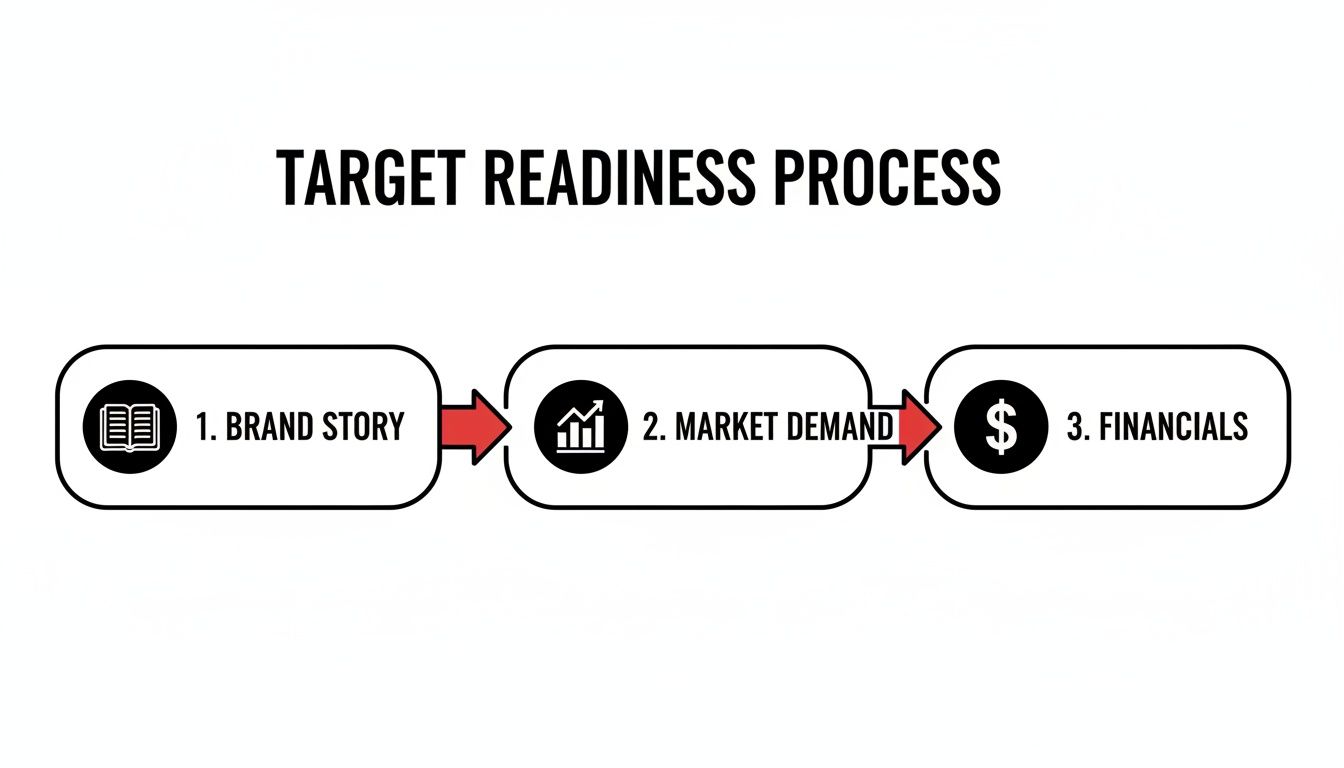
Think of it this way: your brand story is what gets a buyer's attention, but the demand and financial data are what will convince them to take a chance on you.
To help you get a clear picture of where you stand, use this quick checklist. Be honest with your answers—it will save you a ton of time and effort down the road.
| Requirement Area | What Target Looks For | Your Status (Ready/Needs Work) |
|---|---|---|
| Brand Identity | A clear brand story that aligns with Target's "Expect More. Pay Less." promise. | |
| Market Traction | Consistent sales growth (1-2 years of data) from DTC, Amazon, or other retailers. | |
| Financial Health | Healthy gross margins (enough to support wholesale), positive cash flow, and a clean balance sheet. | |
| Operational Capacity | Ability to handle large purchase orders, EDI compliance, and retailer logistics. | |
| Product & Packaging | Retail-ready packaging with UPCs and a price point that fits Target's model. |
This checklist isn't about passing a test; it's about making sure your business is prepared for the incredible opportunity—and the intense pressure—of a Target partnership.
This might be the most critical piece of the puzzle. Target simply cannot afford to partner with a brand that might run out of cash. The scale of these B2B relationships is enormous—the global B2B e-commerce market is expected to hit an astounding $32.11 trillion by 2026.
A buyer's worst nightmare is onboarding a brand that runs out of cash three months after launch, creating empty shelves and disappointed customers. You must prove you have the financial runway to handle the scale of a Target partnership.
This means you need a rock-solid grasp on your numbers.
A huge part of this is showing you've thought it all through. Having a deep understanding of your market potential, detailed in your essential marketing plan elements, signals to a buyer that you’ve done the homework. Proving you’re ready for the financial reality is every bit as important as having a product they love.

Alright, your business is primed and ready. Now for the hard part: getting a Target buyer to actually notice you. Let’s be clear—this isn’t about finding a secret back channel or some hidden email address. It’s about strategically using the official pathways and creating a pitch that’s simply too good to ignore.
Your brand has two primary doorways into the Target ecosystem: becoming a direct supplier for their thousands of brick-and-mortar stores, or joining the curated Target+ marketplace as an e-commerce seller. The approach is slightly different for each, but the core of a killer pitch stays the same.
A buyer’s inbox is a battlefield. You need more than just a great product to cut through the noise. You need a story, and you need the data to back it up.
Your number one job is to make the buyer's job easier. They don't have time for a 20-slide presentation detailing your life story. What they need is a single, visually sharp one-page PDF that gets straight to the point. This forces you to be ruthless with your messaging and focus only on what truly moves the needle.
Think of this one-pager as a data-rich snapshot of your brand's potential. It needs to answer a buyer’s biggest questions before they even have to ask.
Here’s what your one-page pitch must nail:
This document is your entire first impression. It has to be so clear and persuasive that a buyer grasps your value in under 60 seconds. A strong pitch here is a foundational step if you want to sell to Target.
Once that one-pager is polished, it’s time to send it. Your email is just the delivery truck for your pitch deck—its only goal is to get the buyer to open that attachment. Keep it incredibly short, professional, and data-forward.
Subject Line: This is your first and most important test. Generic subjects like "Potential Partnership" are a one-way ticket to the trash folder. You need a data-driven hook that sparks curiosity.
The email body should be three or four sentences, max. Introduce yourself, drop your one-sentence hook, hit them with one powerful data point, and attach your one-pager. That's it. You're showing respect for their time while proving you know how to communicate value.
A common mistake founders make is sending a novel-length email detailing their entire life story. Buyers don't have time for that. A short, sharp, data-backed email with a one-page attachment proves you understand how to communicate effectively.
Don't forget how much your overall brand presentation matters here. Your pitch, your email, and your one-pager are all extensions of your brand. Our guide on how to build a powerful brand identity can help you ensure every touchpoint feels polished and professional.
If you have any international success, make sure it’s front and center in your pitch. It’s a huge differentiator. With 52% of online shoppers now buying from international sites, proving your product has cross-border appeal is a massive de-risking factor for a buyer.
This isn't a small trend; it's fueling a $6.86 trillion global sales market. If you can show you already have traction in major markets like the UK or Germany, you’re not just pitching a product—you're offering a proven, scalable asset. You can dig into more of these powerful global e-commerce trends on sellerscommerce.com.
While a well-crafted cold email can definitely work, you should also be knocking on Target's official front doors. These are fantastic opportunities to get seen by the right people.
Using these formal channels shows you’ve done your homework and are serious about building a real partnership. It’s a key part of any smart strategy to successfully sell to Target.
Getting that "yes" from a Target buyer feels like you've crossed the finish line, but really, you're just at the starting line of a whole new race. Now comes the hard part: actually making money from the deal. This is where so many promising brands stumble, dazzled by the prestige of seeing their product on Target shelves without a clue about the real-world financials.
Let’s be blunt: the numbers game with a retail giant like Target is unforgiving. Your direct-to-consumer (DTC) pricing model won't cut it here. You have to build a wholesale pricing structure from the ground up, one that can withstand the intense, margin-crushing pressures of big-box retail. It means accounting for every single penny from the very beginning.
Before you can even think about your wholesale price, you need to nail down your landed cost. This isn't just your cost of goods; it's the total, all-in expense to get a single unit of your product sitting in a Target distribution center.
Getting this number right is non-negotiable. Your landed cost must include:
Miscalculate this, and you could be losing money on every sale without even knowing it. This calculation is the absolute foundation of a profitable partnership.
Once you have a rock-solid landed cost, you can build out your pricing structure. It typically looks something like this:
Your challenge is to set a wholesale price that gives Target its required margin while still leaving enough profit on the table for you to run your business and grow. It’s a delicate balancing act.
To get a true grip on your profitability, you need a dedicated Profit & Loss (P&L) statement just for your Target business. Don't make the mistake of lumping these numbers in with your DTC sales. Retail is a completely different beast with its own set of costs.
This Target-specific P&L is what will save you from the "hidden" expenses that can silently eat away at your margins until there's nothing left.
Your standard P&L won’t cut it. A channel-specific P&L for Target will expose the hidden costs—chargebacks, marketing fees, and markdowns—that can turn a seemingly great deal into a financial drain. It’s your single source of truth for channel profitability.
Be sure to track these key line items in your Target P&L:
This detailed view gives you a real-time picture of whether you're actually making money. If your net margin for the Target channel is razor-thin, you've got a fire to put out immediately. For more context on setting healthy targets, our guide on what makes a good profit margin can help you establish some solid benchmarks.
Once you've got your numbers in order, the real negotiation begins. Target's buyers are masters of their craft, and it's shockingly easy to get caught up in the excitement and agree to terms that will hamstring your business down the road.
Be ready for them to ask for things like category exclusivity, which would lock you out of selling to their direct competitors. They might also push for a large upfront marketing contribution or demand lower pricing that squeezes your margins to an unsustainable level.
This is why you must define your "walk-away" points before you even step into the room. Know the absolute lowest wholesale price you can accept. Decide on the maximum amount you're willing to commit to marketing. Get crystal clear on which terms, like exclusivity, are complete non-starters for you.
Having these red lines drawn in the sand beforehand gives you the confidence to say "no" to a bad deal, no matter how tempting that Target logo looks. Selling to a retail giant is a marathon, and the only way to finish is to start on a profitable footing.

Think you've cleared the biggest hurdle once your pricing is approved? Think again. Welcome to the world of big-box retail logistics, where operational excellence isn't just a nice-to-have—it's a requirement enforced by hefty fines.
This is the operational core of your business. Any slip-ups can lead to profit-eating chargebacks and, worse, a strained relationship with Target. To succeed, you have to speak their language and move products through their system with near-perfect precision. For many brands, this is where the real, and often expensive, education begins.
At the center of Target's operations is Electronic Data Interchange (EDI). It’s basically a standardized digital language that lets your systems talk directly to Target's without a human touching anything. This is how they’ll send you purchase orders (an 850 document) and how you’ll send back critical info like advance ship notices (ASNs) and invoices.
Target relies on EDI for one reason: scale. With millions of orders and shipments to track, manual data entry is out of the question.
Don't worry, you don't need to build this from scratch. You'll partner with an EDI provider who acts as a translator between you and Target. Choosing the right one is a big deal; some are full-service, while others are more DIY. Skimping here is a classic rookie mistake—a good EDI partner is your first line of defense against costly errors.
To truly get a handle on your supply chain and meet Target's strict requirements, understanding tools like EDI is non-negotiable. You can get a deeper look into supply chain visibility by Mastering EDI Express Tracking for Modern Logistics.
Target has incredibly specific rules for how your products must be packaged and labeled. These aren't suggestions. They're rigid standards, and getting them wrong leads to automatic financial penalties known as chargebacks.
Every single item needs a GS1-compliant UPC barcode, which serves as its unique fingerprint in the retail world. But it doesn't stop there. Your master shipping cartons need their own specific labels—usually an SSCC-18 barcode—that tells their scanners exactly what's inside.
Chargebacks are the silent profit killer in retail. A simple mistake, like a misplaced label or a carton that’s slightly crushed, can cost you hundreds of dollars per shipment. A former Target buyer once told me they see brands lose up to 5% of their total revenue to preventable chargebacks in their first year.
These rules exist so your shipment can fly through a massive distribution center, getting scanned, sorted, and routed by machines without a hitch. One mislabeled box can gum up their entire automated system, and you'll be the one footing the bill.
As a new supplier, you'll almost certainly be shipping your products to one of Target's massive Distribution Centers (DCs). Target then takes over, breaking down your pallets and sending the right amount of inventory to individual stores. This is the standard, most efficient path.
Occasionally, you might be asked to ship Direct to Store (DTS), maybe for a special promotion or a regional launch. This is a whole different ballgame—it involves smaller, more frequent shipments to hundreds of separate locations. It’s far more complex and is usually best managed by working with a third-party logistics (3PL) provider. You can check out our deep dive into what 3PL fulfillment is and see how they can support this kind of retail growth.
With either method, the most important deadline is the Must Arrive By Date (MABD). This is the exact date your shipment must land at the DC. Not a day early, and definitely not a day late. Missing your MABD window is one of the most common—and expensive—chargebacks. Always plan your production and freight schedules with plenty of buffer time. Building this discipline from day one is the only way to protect your profits and build a lasting partnership with Target.
You finally got the purchase order. Your products are loaded on the truck. Time to celebrate, right? Not so fast. Getting your product on the shelf is just the beginning—now you have to prove you deserve to stay there.
The next 90 days will make or break your brand’s entire future with Target. This is the moment where so many promising brands stumble. They nail the pitch, celebrate the launch, and then step back, expecting Target to do the heavy lifting. That’s a fatal mistake. The brands that win treat launch day as the starting line for an all-out sprint to prove their value.
Your one and only job during this initial window is to drive sell-through. Believe me, Target is watching your weekly sales data like a hawk. Slow sales right out of the gate are a massive red flag for a buyer, making them second-guess the bet they placed on you.
You absolutely need a game plan to generate velocity from day one. This isn't about one tactic; it's a coordinated push across both the physical and digital aisles. Don't wait for Target to feature you in a circular—you have to create your own buzz.
Your launch plan should be laser-focused on a few core activities:
Driving Store Traffic: Get tactical with your marketing. Run geo-targeted social media ads aimed at shoppers near the specific Target locations that stock your product. Your content should be crystal clear: "Find us in the personal care aisle at your local Target!"
Supporting the Digital Shelf: Even if you’re only in brick-and-mortar stores, you'll have a product page on Target.com. Drive traffic to that page and pull out all the stops to get those first critical ratings and reviews. Social proof is everything.
Coordinating In-Store Marketing: Talk to your buyer or broker about any promotional opportunities on the horizon. Can you score an endcap display? Can you be included in a Target Circle offer? These placements are gold and can make a huge difference in your initial sales.
Once you've made it through the launch and are seeing a steady sales rhythm, your focus needs to shift. Now, it’s all about inventory management and forecasting. The goal is to keep your product on the shelf without interruption.
This is a different beast altogether. Launching is a sprint; replenishment is a marathon.
Here’s a quick breakdown of how your mindset and activities should change:
| Activity | Launch Phase Focus | Replenishment Phase Focus |
|---|---|---|
| Primary Goal | Generate initial sales velocity and prove the concept. | Maintain consistent sales and prevent stockouts. |
| Key Metric | Weekly sell-through rate per store. | Forecast accuracy and inventory turn. |
| Marketing | Aggressive, short-term campaigns to drive trial. | Sustained brand building and loyalty programs. |
| Communication | Frequent updates to the buyer on launch performance. | Proactive forecasting discussions and inventory updates. |
Your job is to get so good at reading your data that you can anticipate Target’s needs, transitioning from a new "test" brand to a reliable, long-term partner.
Every single week, you’ll get a sell-through report showing how many units sold in each store. This data is your new best friend. It tells you what’s working, what isn’t, and where to point your efforts. A healthy sell-through rate is your best ammunition for securing reorders.
When you dive into the data, look for the story it’s telling you:
Slow initial sales are the number one reason brands get discontinued after one season. A buyer once told me, "If a brand isn't showing a pulse in the first 60 days, I'm already looking for its replacement."
Don't let the data intimidate you—use it. If sales are lagging, get on the phone with your buyer. Show them the marketing you’re running to drive traffic and ask for their insights. This kind of proactive communication shows you’re a true partner, not just another supplier waiting for an order. It’s how you truly succeed when you sell to Target.
Even with the best game plan for getting into Target, a few big questions always pop up. It's totally normal. Landing a major retail account is a huge undertaking, and a lot of founders have the same nagging worries.
Let's cut through the noise and tackle those common anxieties with some straight-up, real-world answers.
The single biggest misstep I see is underestimating the true financial hit. Brands get so star-struck by the idea of being on Target shelves that they completely fail to model out the real costs.
We're not just talking about inventory. You've got to fund a massive initial PO, absorb marketing fees, and brace for potential chargebacks—all of which can vaporize your profits before you even get started.
Another classic mistake is having a fuzzy value proposition. Your product might be fantastic, but if it doesn't solve a clear problem for the Target guest or fill a glaring hole in their current lineup, the buyer has no real reason to care. You have to spell out exactly why your brand on their shelf is a guaranteed win.
And finally, so many founders just don't grasp the logistical nightmare. They aren't ready for the rigid demands of EDI, GS1 compliance, and those unforgiving MABD (Must Arrive By Date) shipping windows. I know one founder who hemorrhaged nearly $15,000 in his first quarter from chargebacks alone. Why? His warehouse simply wasn't equipped to handle Target's strict labeling rules.
There’s no magic number here, but let’s be clear: you need a serious budget for both upfront and ongoing costs that go way beyond just your product. Getting this number right is make-or-break for any brand trying to sell to Target.
Here are the big-ticket items you absolutely have to plan for:
Thinking your DTC budget will work for a Target launch is a recipe for disaster. You should plan for at least $50,000 to $150,000 in non-inventory costs just to get through the first six months. That covers everything from compliance tech to bigger insurance policies and marketing allowances.
A "no" from Target feels like a gut punch, but it’s part of the game. What you do next is what really counts. First rule: stay professional. Never, ever burn that bridge.
Thank the buyer for their time. Give it a week or two, then send a polite follow-up. Ask if they’d be open to sharing any specific feedback on why it wasn't a fit right now. Some won't reply, but many will drop a golden nugget of advice—maybe your price was off, or they already had something similar in the works.
Take that feedback and run with it. Treat the rejection as a data point, not a failure. It’s a free roadmap telling you what to fix, whether it's your sales velocity, your packaging, or your entire pricing model. Re-engage in six to twelve months, but only when you have a killer new story to tell, backed by real progress on the exact things they pointed out.
The smartest founders know that the ultimate cheat code is learning from people who have already cleared these hurdles. At Million Dollar Sellers, you get a direct line to a private community of elite e-commerce entrepreneurs who've scaled their brands into major retail and beyond. If you're serious about taking your business to the next level, see if you qualify for our community at Million Dollar Sellers.
Join the Ecom Entrepreneur Community for Vetted 7-9 Figure Ecommerce Founders
Learn MoreYou may also like:
Learn more about our special events!
Check Events