Chilat Doina
May 20, 2026
Most advice on top selling items on walmart is backwards.
It tells you to scrape the public best-seller pages, copy whatever looks hot, and rush inventory into the obvious winners. That works if your goal is to join a price war late, inherit weak margins, and compete against listings that already own trust, reviews, and basket placement.
The better read is simpler. Walmart doesn't behave like a trend marketplace first. It behaves like a replenishment marketplace. Its public best-seller pages lean heavily toward convenience and repeat-purchase products, with everyday items like Angel Soft toilet paper and Lasko box fans showing up prominently on Walmart's own pages, while many third-party roundups keep pushing seasonal decor, LEGO, and air fryers as the headline opportunity (Walmart best-seller pages).
That gap is where disciplined sellers win.
If you already sell on Amazon or run a serious DTC brand, the Walmart opportunity usually isn't the flashy SKU everyone in your Slack groups is talking about. It's the dull product with stable demand, low story requirement, practical value, and room for a sharper offer. Think value packs, adjacent variations, better unit economics, and products that fit the way Walmart customers shop.
The strongest Walmart listings often aren't exciting. They're easy to understand, easy to reorder, and easy to justify in the cart.
A lot of sellers treat the best-seller badge like a treasure map. It isn't. It's a snapshot.
The badge tells you a product is moving now. It doesn't tell you whether you can enter profitably, whether Walmart itself owns the key placements, whether review velocity is already too entrenched, or whether the demand is durable enough to survive after a promo window closes. Serious operators don't confuse visibility with opportunity.
The most common mistake is assuming all Walmart demand pools behave the same way. They don't.
A seasonal decor winner, a LEGO set, an air fryer, a pack of toilet paper, and a box fan can all appear in "top selling" conversations. But they run on different economics. Some are driven by gifting and spikes. Others are driven by basket-building, convenience, weather, or repeat use. If you lump them together, you'll overpay for inventory in the wrong categories and underinvest in the products that can compound.
The listings that look glamorous in roundup articles usually attract the most copycats. The products that steadily keep moving often sit in categories where shoppers already know what they need. That changes everything about how you launch, how you price, and how much brand storytelling matters.
Walmart customers reward practicality. They buy what solves the immediate need, fits the budget, and arrives without friction.
That means you should care more about these questions than about a badge:
Operator lens: Don't ask, "Is this a top seller?" Ask, "Why is this item top selling on Walmart, and can I participate without becoming the cheapest loser in the category?"
The better target is the boring gap.
That could be a value-pack format in a household category. It could be a cleaner variant in personal care. It could be a private-label item adjacent to an incumbent baby-care product. It could be a bundle that rides existing search demand while giving you a reason to exist beyond matching the market leader one-for-one.
Walmart rewards sellers who understand repeat behavior better than trend spotting. That's the game worth playing.
Top sellers don't run product research as a one-time brainstorm. They run it as a loop.
The loop matters because each launch gives you new information about pricing tolerance, conversion friction, content gaps, shipping constraints, and post-purchase behavior. You feed that back into the next candidate and get sharper each cycle.
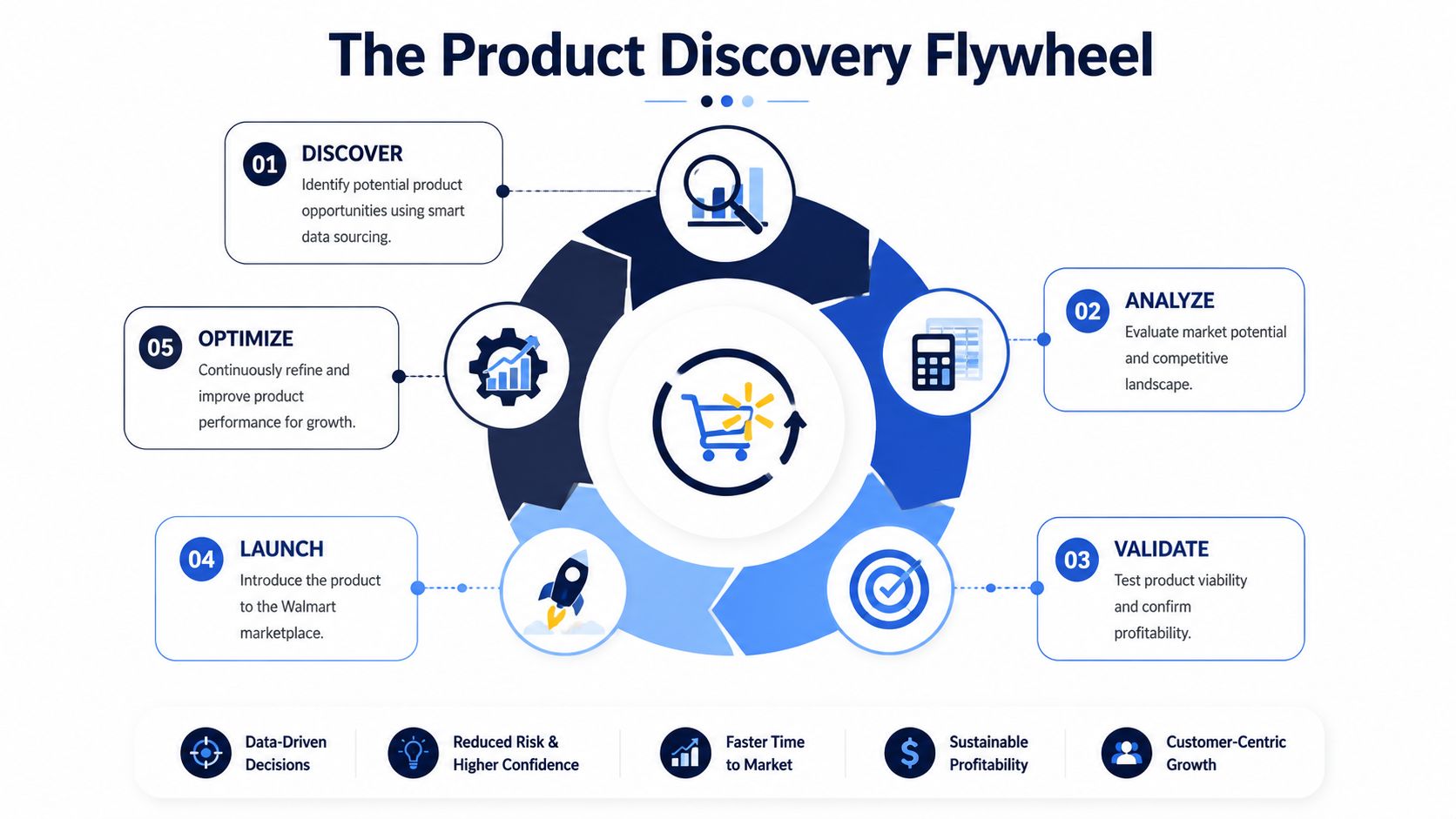
Start wide, but not blindly.
A practical workflow is to combine Walmart's Best Sellers list, Google Trends, and Walmart-specific keyword tools, then narrow candidates by reviewing what shoppers are already buying and searching for. After that, validate on Walmart itself by checking competition, Buy Box winners, ratings, and pricing. The core warning is equally important. A product can show demand and still be a bad business if the margin structure is weak once you model COGS, shipping and fulfillment, returns and damages, and ad spend (Walmart product research workflow).
If you need a broader cross-marketplace framing before narrowing to Walmart-specific signals, this guide on how to find winning products is a solid complement.
At this stage, most sellers either become operators or stay tourists.
Analysis means separating raw demand from accessible demand. A category can be huge and still be wrong for you if incumbents own price, reviews, and fulfillment speed. On Walmart, you need to look at assortment shape, not just product popularity. Is the shelf dominated by one brand? Are there gaps in pack count, scent, color, size, or bundle logic? Does the search page show repetitive listings that all make the same offer?
A candidate gets more interesting when the market is active but the offers are lazy.
Validation is the kill step. Use it aggressively.
You don't need perfect certainty. You need enough evidence to reject bad ideas before they absorb capital. That means checking whether the current price architecture leaves room after all costs, whether shoppers tolerate the pack format you're considering, and whether your listing can plausibly win clicks and conversions without pretending to be the category king on day one.
A lot of products die here. That's healthy.
If your spreadsheet only works when ad costs stay low, return rates stay minimal, and no one reprices, you don't have a product. You have a fantasy.
A Walmart launch should be scoped, not theatrical.
You don't need a massive catalog rollout to prove a thesis. You need a clear offer, strong PDP fundamentals, a price the customer accepts, and enough operational control to avoid stockouts or fulfillment slippage while the listing is still earning trust. The launch phase is where simple offers usually beat clever ones. Walmart shoppers often respond faster to value clarity than to heavy brand narrative.
Optimization is where compounding happens.
Watch what the market tells you. Look at traffic quality, conversion behavior, review themes, pricing pressure, and the effect of small assortment changes. Then feed those learnings back into discovery. Maybe the original SKU doesn't deserve expansion, but the pack variation does. Maybe the category is too crowded, but the adjacent accessory has cleaner economics. Maybe the listing converts only when fulfillment speed improves.
That is why this is a flywheel, not a checklist.
The first job isn't to "find winners." It's to read demand correctly.
Most sellers overweight public lists and underweight signal stacking. They see one ranking page, one tool output, or one viral mention and treat it as confirmation. Walmart requires a tighter approach because the most profitable openings often sit one layer away from the obvious best seller.

Walmart gives you more clues than most sellers use.
Look at category best-seller pages, search autocomplete, sponsored density, item-page review themes, and whether the assortment looks built around repeat utility or around temporary spikes. Then compare what appears across adjacent categories. If the same demand logic keeps surfacing in household, baby, personal care, and convenience-led products, that's not noise. That's a buying pattern.
I care less about the single top-ranked SKU and more about what the page structure says about customer behavior. Are shoppers choosing between sizes? Between count formats? Between national brands and value offers? Between standard and premium versions of the same function? Those are actionable clues.
Third-party tools help most when they validate something Walmart is already signaling.
Publicly available research points to a consistent pattern. Top Walmart products cluster around household essentials and baby care. SellerApp's 2026 analysis flagged Pampers Swaddlers Diapers Size 4 with estimated daily orders of 400 to 600 units and Clorox Disinfecting Wipes 5-Pack at 250 to 400 daily orders, which is useful because it shows the scale that replenishable goods can reach on the platform (SellerApp Walmart category analysis).
That doesn't mean you should launch diapers or disinfecting wipes tomorrow. It means you should pay attention to the structure behind those products. They are practical, frequently repurchased, easy to understand, and tied to ongoing household need.
For teams building stronger research systems, AI and advanced analytics for scaling sales insights is useful because the true edge is in combining multiple weak signals into one strong decision.
A candidate product gets more credible when it clears three tests:
| Signal type | What to check | Why it matters |
|---|---|---|
| Walmart-native signal | Best-seller placement, search suggestions, review activity, assortment gaps | Shows platform-specific demand and competition structure |
| External intent signal | Google Trends, off-platform search behavior, category chatter | Helps distinguish enduring interest from short-lived spikes |
| Commercial viability signal | Price architecture, fulfillment practicality, competitive offer quality | Prevents you from chasing demand that won't pay you |
Most product research fails because sellers stop after the first signal. Demand exists. They feel validated. Then they discover the listing economics are awful or the page is packed with stronger incumbents.
A short training video can help your team think more systematically about this workflow before committing deeper research time:
Use this sequence:
The market usually tells you what shoppers want. Your job is to notice where current listings fail to package that demand efficiently.
The sellers who win on top selling items on walmart aren't better at trend hunting. They're better at reading basket logic and seeing the next-best offer before everyone else notices it.
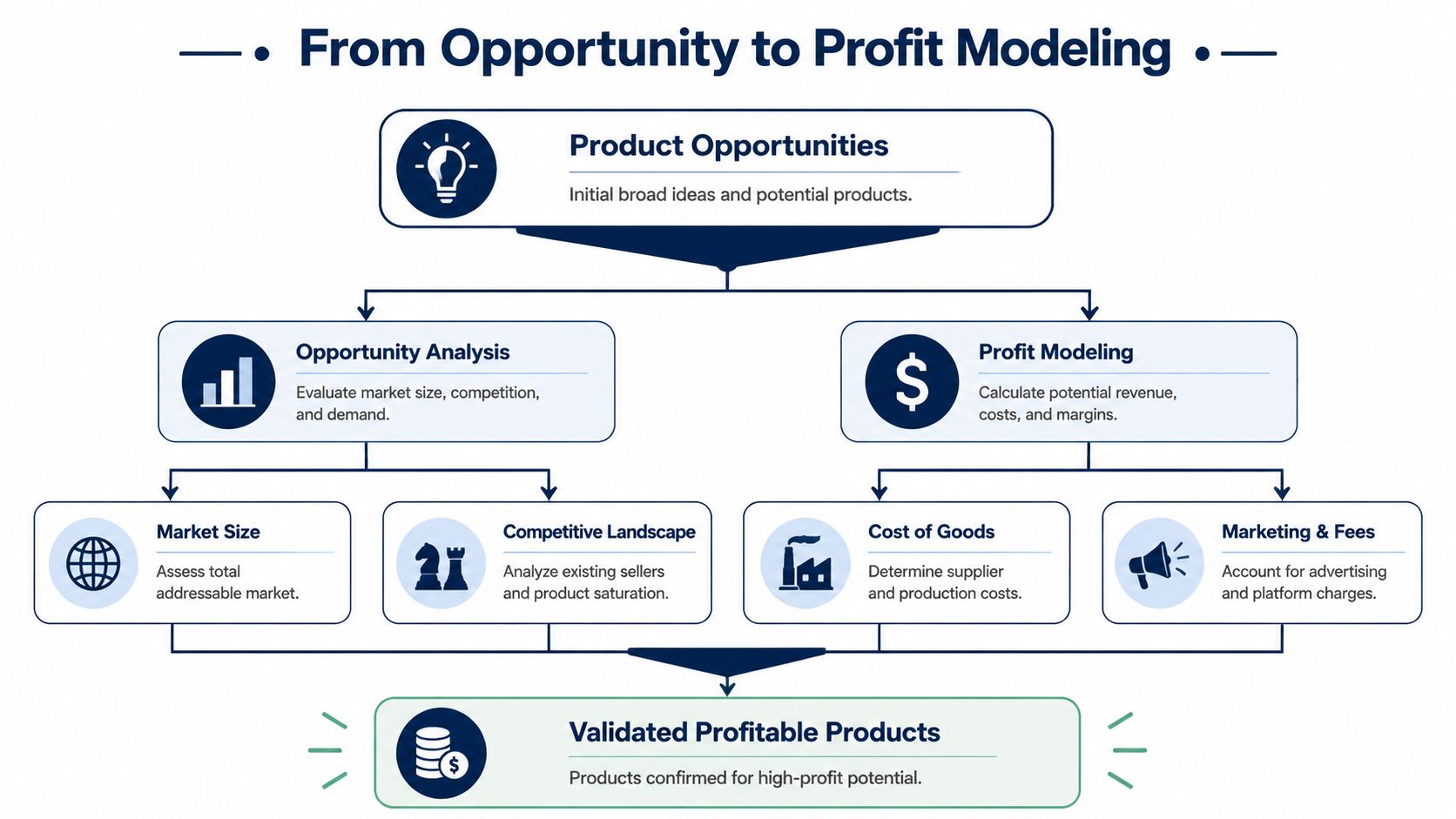
Demand without margin is a hobby.
A lot of sellers coming from Amazon make the same mistake on Walmart. They find a product with strong visible movement, assume they can buy traffic into it, and only later realize the economics were fragile from day one. Walmart punishes that mistake because shoppers are price aware and many categories already contain trusted incumbents.
Start with the category's operating reality.
Walmart's U.S. business is heavily shaped by grocery. According to Statista's Walmart merchandise unit breakdown, grocery accounted for 59.8% of Walmart U.S. net sales in fiscal 2024, and the same source projected 59.1% in fiscal 2026, while general merchandise was projected at 23.8% in fiscal 2026. That matters because the biggest demand pools often sit in replenishable, high-frequency buying behavior, not in discretionary products. Walmart has also highlighted bananas as one of its top-selling items and often recognized as the single best-selling grocery product in its stores, which reinforces how much volume flows through staple purchasing behavior.
That doesn't mean every seller should chase consumables. It means your analysis should respect the platform's center of gravity. A practical household or personal-care SKU often fits Walmart better than a novelty item with a higher theoretical margin.
Before building a full P&L, answer these:
Who owns the page today
Is the category led by Walmart, a major brand, marketplace specialists, or a messy long tail of weak offers?
What kind of demand is this
Is it replenishment, replacement, convenience, weather-driven, seasonal, or promo-led?
How standardized is the product
The more standardized it is, the harder it becomes to defend price.
Where can you differentiate
Look for count, bundle structure, formulation, compatibility, sizing, or merchandising clarity.
How ugly will repricing get
If every seller can source the same thing, assume the race goes downward.
Founders usually know this in theory and skip it in practice. Don't.
Your model should include every cost that can erode contribution margin:
| Cost bucket | What to include |
|---|---|
| Product cost | Unit cost, packaging, prep, compliance-related costs |
| Landed cost | Freight, duties if relevant, inbound handling |
| Fulfillment cost | WFS or 3PL pick, pack, storage, shipping impact |
| Marketplace cost | Referral fees and platform-specific selling costs |
| Advertising cost | Launch spend, ongoing sponsored product spend, testing budget |
| Post-purchase drag | Returns, damages, replacements, customer service burden |
Then pressure-test the model. What happens if price softens? What happens if ad efficiency is weaker than expected? What happens if the item returns more often because shoppers misunderstand count or size? What happens if freight shifts against you?
Non-negotiable filter: If the SKU only works under ideal assumptions, kill it before it kills your cash flow.
The same product can be a bad business in one format and a good business in another.
A single unit might be too cheap to absorb fulfillment and ad costs. A value pack might improve economics and increase perceived savings. A bundle may remove direct apples-to-apples comparison. A differentiated variant may convert better because it gives the shopper a simpler reason to choose.
That is why founders should model offer architecture, not just product identity.
Use a simple three-bucket decision screen:
Green light
Clear demand, obvious gap, resilient margin structure, workable launch path.
Yellow light
Demand exists, but the edge depends on one or two assumptions you haven't proved yet.
Red light
Strong sales signs, weak economics, entrenched competition, no real differentiation.
The yellow bucket is where teams often waste time. If the uncertainty is fixable through supplier changes, pack redesign, or listing improvements, keep going. If the uncertainty depends on the market acting nicer than it usually does, move on.
A disciplined founder would rather reject ten exciting products than fund one impressive-looking loser.
Once you've found a viable category, the next mistake is trying to beat the incumbent at being the incumbent.
That approach burns capital fast. The existing winner usually has stronger review density, stronger trust, and a cleaner path to conversion. If you launch a near-identical listing and hope ads solve the problem, you'll spend your way into someone else's moat.
A sharper move is to target adjacent demand.
Walmart's own best-seller ecosystem points to a useful strategy. Instead of going head-to-head with the current category leader, focus on private-label or differentiated variants that ride the same traffic while avoiding a direct clone war. The opportunity is often in assortment gaps, bundles, or value-pack formats because Walmart shoppers are concentrated in practical baskets and often buy for utility first (Walmart best-sellers strategy angle).
That changes product strategy from "Can I outrank this winner?" to "Can I offer a better-fit option for the same shopper intent?"
Examples of adjacent demand thinking:

On Walmart, your moat usually comes from one of four places:
When the category is crowded, margin often improves through packaging logic. Multipacks, bundles, and value formats can create a cleaner contribution profile while also giving the shopper an easy value story.
Walmart shoppers often respond to clarity faster than to aspiration. If your title, hero image, count callout, and benefit hierarchy reduce confusion, conversion can improve even in a mature category.
One SKU rarely wins the market. A tight cluster of related offers can. Launch the hero item, then add the obvious adjacent variants that cover practical buyer needs without exploding complexity.
A mediocre product with clean in-stock performance, solid fulfillment, and a well-maintained listing can beat a stronger concept that constantly slips operationally.
Crowded categories don't eliminate opportunity. They force you to earn it through sharper positioning and cleaner execution.
The launch phase should look deliberate, not loud.
Use listings that state the offer clearly. Make the pack size, use case, or differentiator impossible to miss. Price to earn trial, but don't train the market that your only value is being cheaper. Use early ad spend to learn search behavior and conversion friction, not to force volume at any cost.
A practical launch checklist:
Optimization then becomes less about chasing rank and more about tightening fit between product, shopper intent, and margin.
The sellers who build real businesses on Walmart stop acting like prospectors.
They stop looking for the one magical product that changes everything. They build a repeatable system for finding practical demand, filtering it through hard economics, and launching offers that make sense for Walmart's customer. That's what scales. Not luck. Not screenshots of a badge. Not copying whatever went viral last week.
The most useful shift is mental. Stop treating top selling items on walmart as a list to imitate. Treat them as evidence of how the platform works. The signal isn't only which products sell. It's why they sell, how often shoppers come back, what kind of basket they're part of, and where the current offers leave money on the table.
Use this operating sequence:

If you want another tactical resource that complements this approach, Headline Marketing Agency put together a useful performance playbook for brands. For an additional operator-focused view on marketplace mechanics, this guide on how to sell on Walmart Marketplace is worth bookmarking.
Walmart rewards founders who respect unit economics, understand practical demand, and keep improving the offer after launch.
That is the play.
If you're building at a serious level and want to pressure-test strategies like this with proven operators, Million Dollar Sellers is where top e-commerce founders share what's working across Amazon, Walmart, and DTC.
Join the Ecom Entrepreneur Community for Vetted 7-9 Figure Ecommerce Founders
Learn MoreYou may also like:
Learn more about our special events!
Check Events