
Chilat Doina
July 3, 2026
Most advice about acquisition strategy is too small.
Founders hear “acquisition” and think one of two things. They either think paid ads and CAC, or they think private equity rollups and giant M&A deals. Both views miss the point. In ecommerce, acquisition strategy is the operating plan for how you gain access to growth. Sometimes that means acquiring customers one by one. Sometimes it means acquiring distribution, audiences, suppliers, partnerships, or even whole brands.
That distinction matters because a lot of brands are still trying to brute-force growth through media buying alone. Yet strategic acquisitions drive 30-40% faster market entry with 25% lower customer acquisition costs compared to organic growth, while 78% of ecommerce founders still lack a structured acquisition strategy because they rely solely on paid ads. If your entire growth plan lives inside Meta Ads Manager, you don't have an acquisition strategy. You have a traffic dependency.
Good founders already know this intuitively. When margins tighten, they start asking better questions. Should we buy attention, or borrow it through creators? Should we build wholesale from scratch, or buy a smaller brand that already has retail doors? Should we fight for cheaper clicks, or secure a better supplier so we can win on price and availability?
That's what this topic is really about. Not procurement jargon. Not theory. What is acquisition strategy? It's the deliberate plan for how your business acquires growth assets with the least friction and the best odds of compounding.
Founders usually hear "acquisition strategy" and picture one of two things: buying traffic or buying a company. That framing is too small for ecommerce.
For a brand operator, acquisition strategy is the plan for getting control over growth inputs before competitors do. Sometimes that input is customers. Sometimes it is distribution, supplier access, retail relationships, creator attention, proprietary audiences, or a business you can fold into your own. The point is not the label. The point is control.
The useful part of the formal definition is the discipline behind it. A real acquisition strategy forces clear decisions under constraint. It answers a few hard questions before money gets spent and complexity gets added:
That standard applies whether you are launching a new product line, entering wholesale, acquiring a niche content asset, or evaluating a smaller brand with overlap in customers or channels. If the move is material, it deserves structure. If you are considering the second path, this due diligence checklist for acquisitions is the kind of prep work that keeps a "strategic" deal from turning into an expensive distraction.
In practice, ecommerce acquisition strategy runs on two tracks.
One track is transactional. It covers the systems that bring in buyers and turn first orders into repeat revenue.
The other track is positional. It covers the assets that make future growth cheaper, faster, or harder for competitors to copy.
That distinction matters because a lot of brands still mistake channel activity for strategy. Running Meta, Google, and Amazon ads is execution. Useful execution, often profitable execution, but still execution. Strategy sits one level above that. It decides whether you should keep renting demand or start owning more of the conditions that create it.
Here is the test I use. If higher CPMs or a ranking drop can stall the business in a month, the company has a channel plan, not a serious acquisition strategy.
Good sellers learn this the same way they learn sourcing. Buying one PO at a time from the same factory keeps inventory moving, but it does not change your bargaining power. Securing better terms, exclusivity, backup capacity, or a supplier with a complementary line changes the economics.
Growth works the same way.
A founder stuck in operator mode asks how to get cheaper clicks. A founder thinking strategically asks which asset would make every click convert better, every reorder arrive faster, or every new channel easier to open. Sometimes the answer is creative and conversion work. Sometimes it is a distribution partner, a retail foothold, an owned audience, or a tuck-in acquisition.
That broader view is where real scale starts.
Customer acquisition is like fishing with a net. Corporate or market acquisition is like buying the lake.
Most founders spend nearly all their time on the net. They improve hooks, test bait, and move to a new part of the water when results soften. That work matters. But if another operator owns the lake, controls access, or stocked it better than you did, your optimization only goes so far.
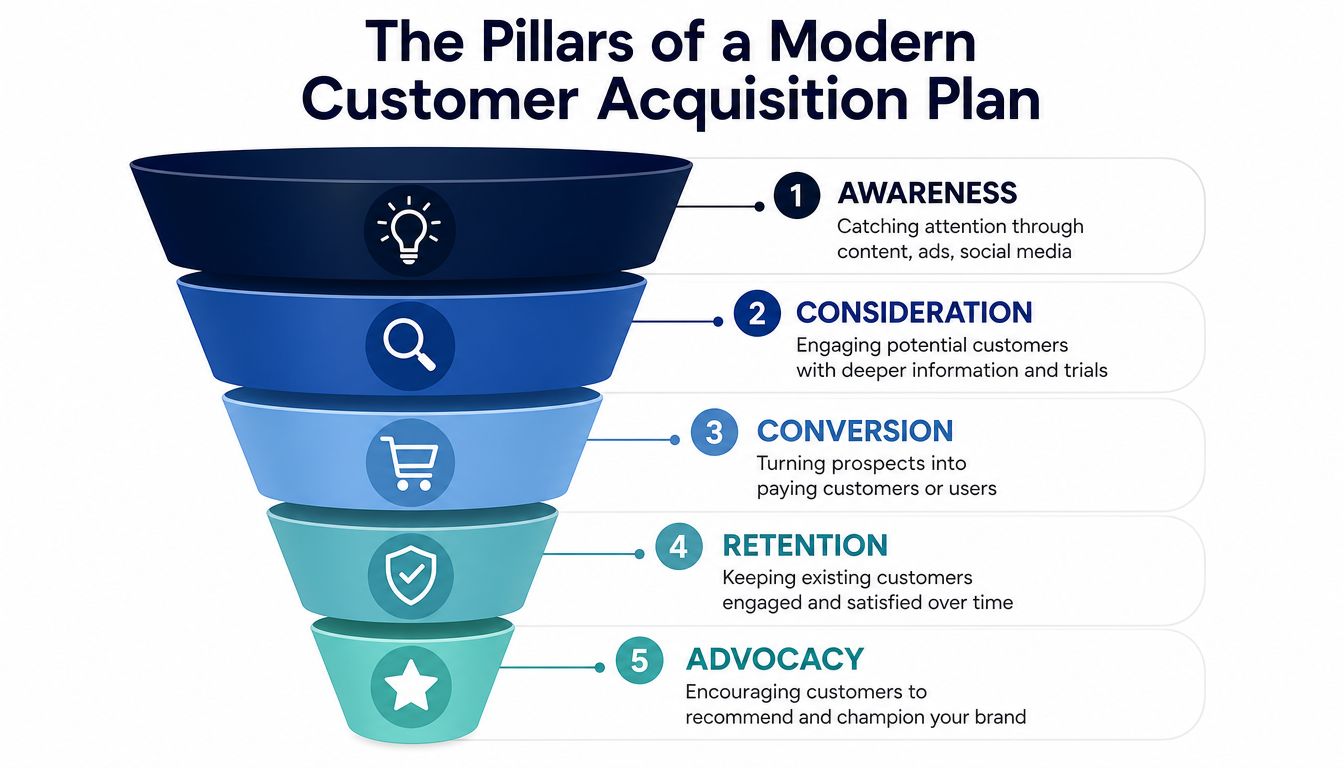
Customer acquisition is the familiar side of growth. It includes the systems you use to attract, convert, and retain buyers.
That usually means:
This side of acquisition is continuous. You're always feeding it, tuning it, and defending efficiency.
A lot of founders stop there because it feels measurable and controllable. You launch creatives, review attribution, cut losers, scale winners. That's useful. It's also incomplete.
A quick visual helps frame the customer path:
This is the part founders often ignore because the word “acquisition” sounds too corporate.
It shouldn't. In ecommerce, corporate acquisition can be as practical as:
This is still strategy, not just dealmaking. The point isn't to buy things. The point is to acquire a capability you'd struggle to build fast enough internally.
A sloppy deal creates more problems than a well-run ad account ever will. But the right deal can remove years of slow execution.
The overlap with formal acquisition planning is useful here. A real strategy has to show realism, stability, and resource alignment, not just ambition, as outlined in the formal acquisition strategy guidance. That same discipline should guide founder-led deals. If you're exploring targets, a practical due diligence checklist for acquisition helps keep excitement from outrunning facts.
A modern customer acquisition plan shouldn't start with channels. It should start with need.
Under FAR Part 7, a traditional acquisition strategy begins with a concise statement of need and a rigorous analysis of alternatives. That's a useful rule for ecommerce because most weak acquisition plans fail before channel selection. They're trying to scale a blurry promise to a blurry customer.
If your statement of need is vague, your acquisition gets expensive fast. “We sell premium wellness products for everyone” is not a need statement. “We help busy parents solve a repeat purchase problem without adding friction to the morning routine” is far more usable.
Write this in one paragraph. If you need a page, you don't understand the problem yet.
Your version should answer:
That buying context matters more than founders think. The same product can need different acquisition systems on Amazon, Shopify, TikTok Shop, or retail shelves.
A lot of teams copy a competitor's channel mix and wonder why it doesn't work. The better move is to map channels to buyer intent.
| Channel | Primary Strength | Best For |
|---|---|---|
| Paid social | Fast testing of angles and offers | New product discovery and creative iteration |
| Search | Capturing existing intent | Problem-aware shoppers and branded demand |
| Influencer partnerships | Borrowed trust | Demonstration-heavy products and social proof |
| Email and SMS | Monetizing owned attention | Repeat purchase, launch sequencing, retention |
| Amazon marketplace | High-intent conversion | Functional products and demand capture |
| Community and creator-led growth | Durable trust and feedback loops | Niche categories and premium positioning |
If your segmentation is weak, every channel underperforms. A sharper customer segmentation strategy usually improves messaging faster than adding another platform.
Use a simple funnel, but make it operational.
If one stage is weak, spending more on the stage above it only magnifies waste.
Rigid annual plans rarely survive contact with the market. The old model was to set budget, lock channels, and defend the plan. The better model is to lock the objective and keep the route flexible.
That means keeping a test pipeline, rotating creative aggressively, and evaluating alternatives before scaling one path too hard. In seller terms, it's the same discipline you use in logistics. You don't rely on one freight lane if a port disruption can shut down inventory flow.
Customer acquisition adds buyers. Market acquisition changes your position.
That difference matters when you're stuck in a category where everyone has roughly the same media access, the same suppliers, and the same offers. At that point, optimization gets incremental. You need a move that changes the board.
A useful model comes from acquisition reform outside ecommerce. In 2025, the U.S. Department of War's acquisition strategy shifted to prioritize speed to capability, treating commercial products as the default and using flexible contracts to bypass slower processes, according to this analysis of the policy shift. Founders should pay attention to the principle, not the bureaucracy.
The principle is simple. Don't ask, “What can we build eventually?” Ask, “What capability do we need now, and what's the fastest credible route to own it?”
For ecommerce, that can mean:
Say you run a strong Amazon brand in home organization. You convert well on marketplace demand, but your off-Amazon presence is weak. Your email list is small, subscription revenue is thin, and creator relationships are inconsistent.
You could spend the next year building DTC capabilities from scratch.
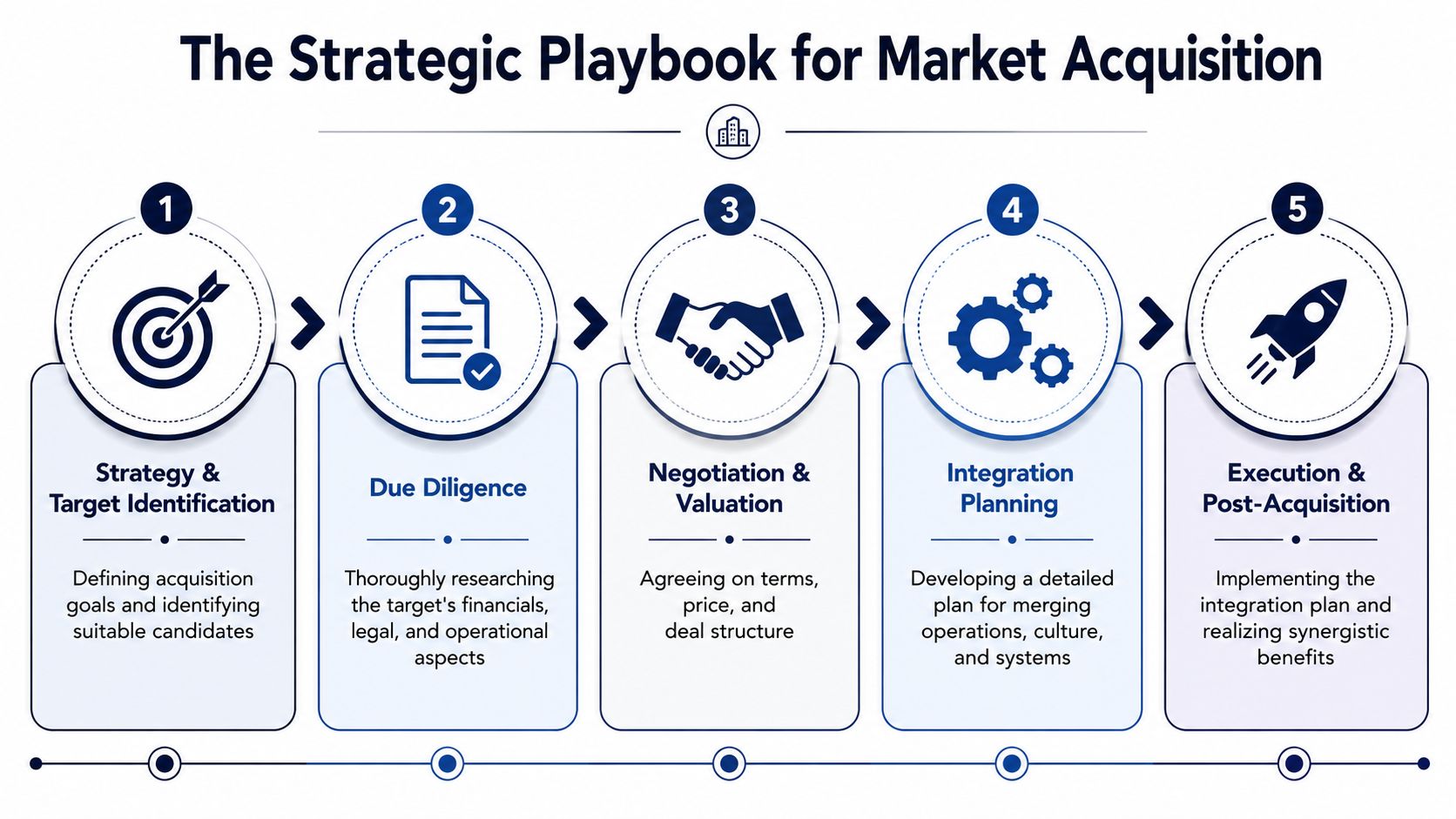
Or you could acquire a smaller DTC brand in the same category that already has:
That's market acquisition. You didn't just buy revenue. You bought capability, speed, and channel diversification.
Founders get in trouble when they chase surface-level fit. The target looks attractive because the niche is adjacent, the branding is clean, or the customer overlap sounds obvious. None of that is enough.
Check these instead:
Good acquisitions solve a bottleneck. Bad ones add one.
If you're trying to validate demand before making larger strategic moves, communities can help expose language, objections, and category fit. A smart resource for that is this Reddit marketing playbook for 2026, especially if you want founder-level insight into where niche audiences talk before you buy access to them.
What works is acquiring something your current machine can improve. Better operations, stronger conversion, more disciplined inventory planning, tighter creative systems. That creates immediate advantage.
What fails is buying a messy asset and assuming ownership alone fixes it. It doesn't. If the economics are weak, the brand is overdependent on one person, or the supply chain is unstable, you didn't buy growth. You bought cleanup.
A lot of ecommerce founders are disciplined about CAC and careless about acquisition decisions.
That gap gets expensive fast. A paid channel can miss target for a week and you can correct it. A bad market acquisition, a bad distribution move, or a bad capability bet can tie up cash, management time, and inventory planning for a year.
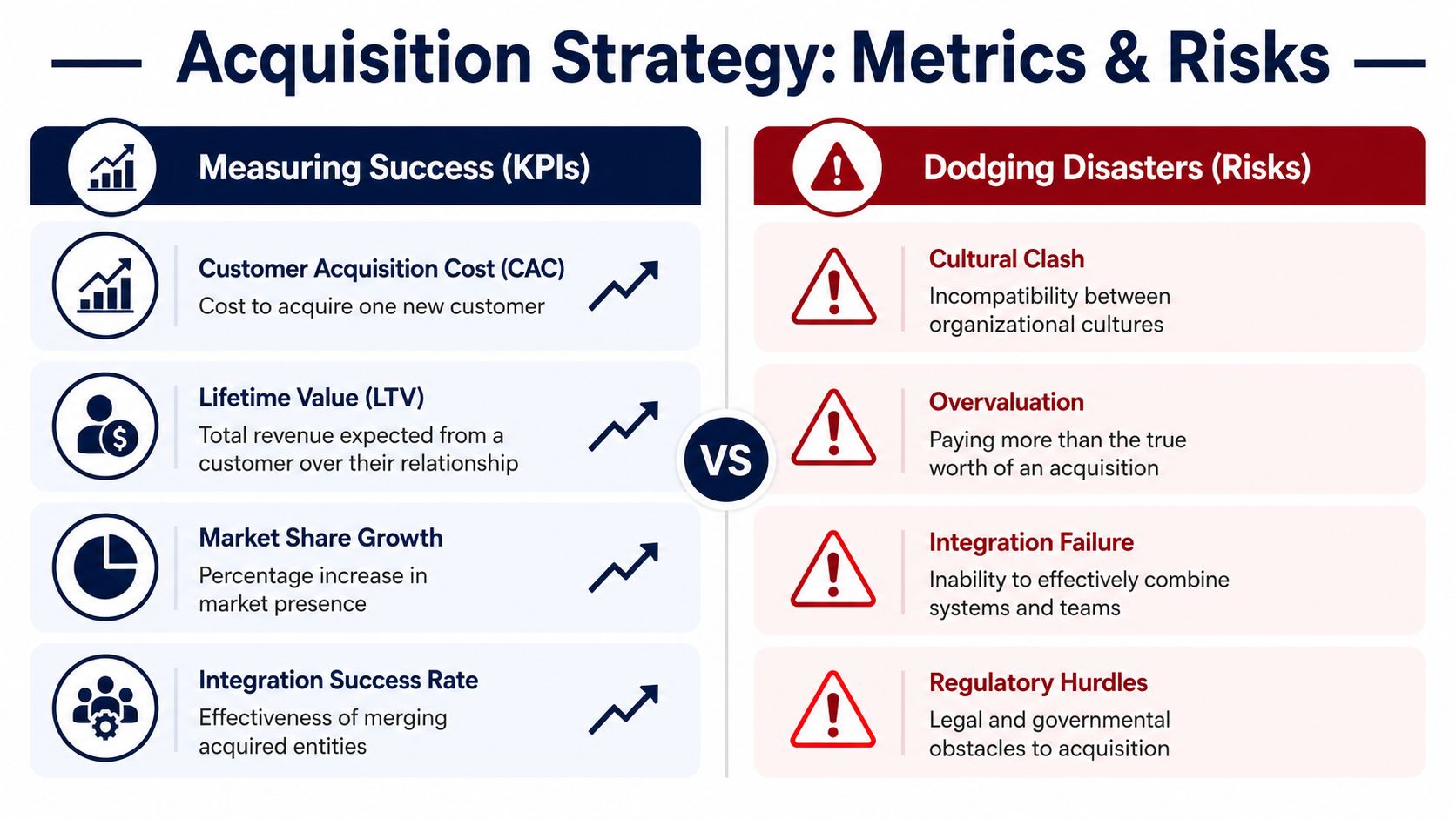
The fix is simple. Measure customer acquisition and market acquisition on separate scorecards. They solve different problems, so they need different tests.
Customer acquisition should be measured like a buying system you expect to scale. If unit economics break at higher spend, you do not have a strategy. You have a temporary result.
Track a tight set of numbers your team can use:
A clean ecommerce KPI framework keeps teams from chasing vanity metrics and missing the numbers that impact budget decisions.
Market acquisition is a different discipline. The question is not whether you bought revenue. The question is whether you bought position.
That means tracking whether the move improved the business in ways that would have been slower, riskier, or more expensive to build internally.
Use metrics like these:
This is the part founders often miss. A brand can look healthy on a trailing twelve-month basis and still be fragile if one channel, one operator, or one promo mechanic is carrying the whole thing.
AI can help sort options, flag outliers, summarize vendor data, and speed up due diligence. That matters when you're comparing channels, suppliers, creators, or targets across too many inputs for a human team to process cleanly every week.
It does not replace operator judgment.
In practice, the win is faster decision support. Teams that structure their inputs well can review more opportunities, pressure-test assumptions earlier, and catch weak fits before they become expensive commitments.
The edge is not using AI. The edge is reducing the number of bad bets you approve.
The failures are usually predictable. They look different on the surface, but the pattern is the same. Someone bought growth without checking whether the business could carry the load.
Overpaying for a hot channel: Revenue looks strong until CPMs rise, attribution gets noisy, or creative fatigue hits.
Do instead: Run constrained tests and look at payback, incrementality, and post-promo behavior before you scale spend.
Confusing adjacency with fit: A target brand sells to a similar demographic, but the buying triggers, AOV, or replenishment pattern are different.
Do instead: Check merchandising logic, repeat behavior, refund rate, and customer overlap before calling it synergy.
Ignoring channel concentration: One marketplace, one retailer, or one ad account drives the whole asset.
Do instead: Discount the valuation for concentration risk and map a diversification plan before closing.
Underestimating operational drag: Inventory complexity, returns, compliance, and team dependencies can erase the upside.
Do instead: Review the ugly parts first. SKU rationalization, supplier stability, return reasons, and reporting hygiene tell you more than a revenue screenshot.
Buying something your team cannot absorb: The thesis may be right, but the timing is wrong if your operators are already stretched.
Do instead: Build the first 100-day integration plan before signing and assign real owners to systems, supply chain, finance, and marketing.
Buying revenue with no strategic reason: Sales come in, but nothing improves in margin, demand ownership, channel access, or bottleneck removal.
Do instead: Define the exact asset you are acquiring. Margin, audience, supply security, distribution, content capability, or speed to market.
Good acquisitions remove friction from the machine. Bad ones add another warehouse aisle to trip over.
Founders overcomplicate acquisition strategy because strategy feels expensive and execution feels urgent. In ecommerce, the opposite is usually true. Ten clean decisions on one page will protect more cash than a polished deck ever will.
The page matters because acquisition has two lanes. One lane buys attention and customers. The other buys position: a new category, a better supply edge, a retailer relationship, a creator network, or another brand. If those two lanes get mixed together, teams start chasing growth that looks good in a recap and creates no real advantage.
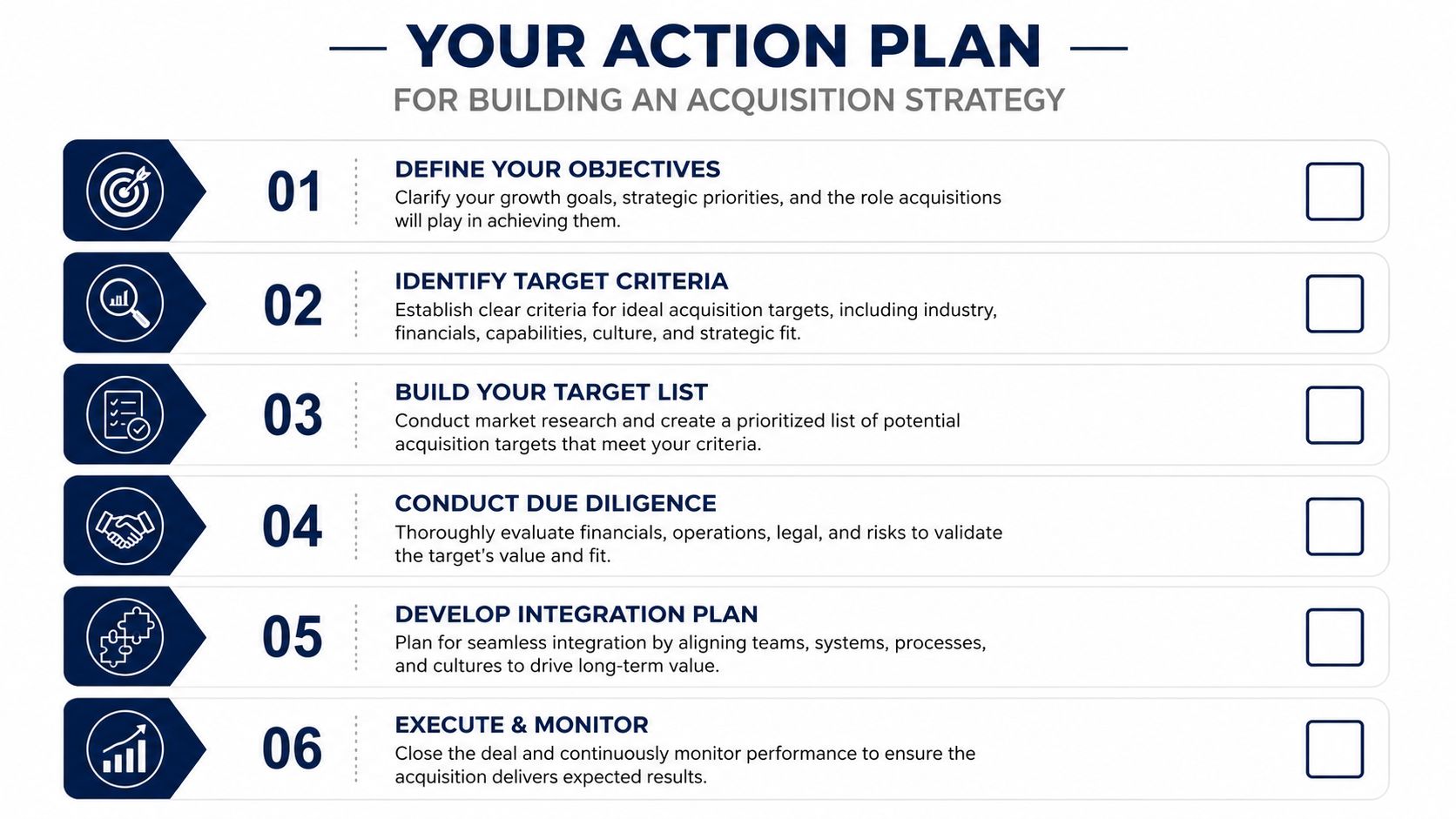
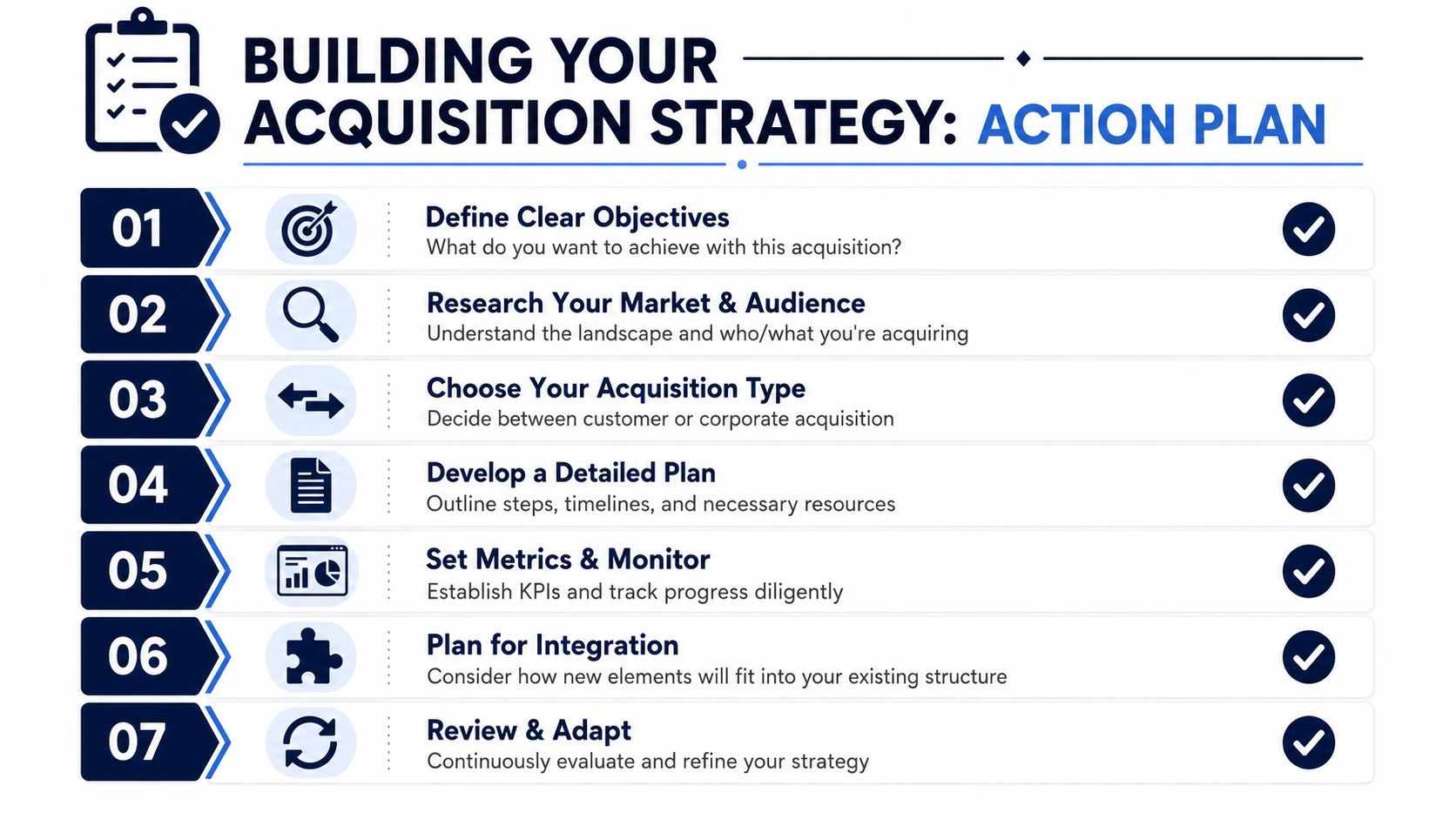
A practical way to build the plan is to make the decisions in order, the same way you would source a new product line.
Start with the business problem, not the tactic. A founder might say, “We need to grow.” That is too loose to be useful. A usable version sounds more like this: CAC is rising on Meta, Amazon is too large a share of revenue, and the brand has no edge in retention. Now the strategy has a job. It needs to get cheaper customer acquisition, better channel mix, or a stronger repeat engine.
Then choose what you are trying to acquire. Sometimes it is new customers with a specific profile. Sometimes it is access, such as retail distribution or a creator pipeline. Sometimes it is a hard asset, like a smaller brand with ranking, reviews, and supplier terms you do not have. Precision matters here. The target should read like a sourcing spec, because vague targets create expensive tests.
The next decision is route selection. Here, disciplined operators separate from founder optimism. You can build the capability, partner for it, license it, test it through a lighter channel, or buy it outright. Each route has a cost beyond the invoice. Building costs time and management focus. Partnerships reduce control. Acquisitions buy speed but create integration load. The right call is the one that gets the asset at the best total cost, including distraction.
Here is what that looks like in practice. A skincare founder wants entry into retail. The wrong version of the plan says, “Expand omnichannel.” The useful version says, “Get into specialty retail within 12 months without breaking contribution margin on the DTC business.” That framing changes the options. Instead of hiring a large wholesale team immediately, the founder might test with a broker, tighten packaging and case-pack requirements, and use a limited retailer pilot to see whether velocity is real before committing more inventory and headcount.
After that, set the boundaries. Good plans protect the core business while they pursue the next one. If the move ties up too much cash, forces the team to neglect replenishment, or adds SKU complexity your ops team cannot absorb, the strategy is wrong for this season even if the idea is sound. Timing is part of strategy.
Then write the scorecard in plain English. If the goal is customer acquisition, the scorecard should show whether you are getting profitable first orders and quality repeat behavior. If the goal is market acquisition, the scorecard should show whether you gained something structural, such as distribution, margin, supply stability, or audience ownership. Keep it tight enough that a weekly review leads to a decision, not a debate.
Close with one committed move. Real strategy ends with ownership and a clock. Launch the test funnel. Send the LOI. Audit the supplier. Put three potential partners into diligence. Give one operator the responsibility and a date.
That is the whole point. Acquisition strategy for an ecommerce founder is not a corporate buzzword borrowed from government procurement or M&A bankers. It is a decision system for getting the next asset your business needs, whether that asset is customers or market position.
If you're building at a level where these decisions affect real enterprise value, Million Dollar Sellers is the kind of room worth being in. It brings together serious Amazon, DTC, and omnichannel founders who share what's working behind the scenes, from customer acquisition systems to strategic growth moves that don't show up in public playbooks.
Join the Ecom Entrepreneur Community for Vetted 7-9 Figure Ecommerce Founders
Learn MoreYou may also like:
Learn more about our special events!
Check Events