Chilat Doina
March 10, 2026
Customer segmentation is all about slicing your customer base into smaller, more focused groups who share common traits. It’s how smart e-commerce brands stop shouting into the void with generic marketing and start having meaningful conversations that actually drive loyalty and—more importantly—revenue.
The core idea is a simple one. Not all customers are created equal, so why would you treat them that way?

For any high-growth e-commerce brand, the days of just leaning on a single metric like Average Order Value (AOV) are long gone. To build real, sustainable growth and carve out a competitive advantage, top operators are treating segmentation not just as a marketing task, but as a central business strategy. It’s a shift that touches everything from product development and inventory planning all the way to your customer service scripts.
The most successful 7- and 8-figure founders I’ve worked with get it: deep segmentation is the engine that powers Customer Lifetime Value (LTV). It’s about digging for the patterns that your surface-level analytics just can't see.
Think about it. Instead of a vague bucket of "repeat buyers," you start to identify specific, high-value personas. You can suddenly see the "high-AOV seasonal gift-givers" who only show up twice a year and contrast them with your "low-AOV weekly replenishers." Each of these groups needs a completely different conversation.
The real magic happens when you start layering different data types to build a multi-dimensional customer profile. This is where you combine a bunch of different data points to paint a much richer, more actionable picture of who your customers are and what truly makes them tick.
Here’s a breakdown of how the sharpest e-commerce operators think about their data:
When you fuse these together, you go from a flat, one-dimensional snapshot to a dynamic, 360-degree understanding of your customer.
A brand might discover its most profitable segment isn't just "women aged 25-34," but "women aged 25-34 in urban areas who purchase organic products after 9 PM on their mobile devices." This level of detail transforms marketing from guesswork into precision execution.
This playbook is built for action. We're going to walk through the tangible steps to build, activate, and measure segments that create a real competitive edge and build the kind of brand loyalty that lasts.
Look, a lot of brands dive headfirst into data, thinking that’s the starting point for customer segmentation. It’s not. Any effective strategy starts with a destination in mind. Before you get lost in spreadsheets, you need to know exactly what you’re trying to accomplish.
Without a clear goal, you’re just sorting customers for the sake of sorting. That's a surefire way to waste a ton of time and resources.
Your goal needs to be specific and tied to a real business outcome. Are you trying to get more first-time buyers to come back for a second purchase? Or maybe you’re focused on winning back customers who’ve gone quiet for the last six months.
Pro Tip: Don't try to boil the ocean. Seriously. Pick one or two high-impact goals to start. For a 7-figure brand, a solid goal is to increase the 90-day repeat purchase rate by 15%. If you're a more established 8-figure brand, you might aim to identify your VIPs and bump their Customer Lifetime Value (LTV) by 25% over the next year.
These goals become your North Star, guiding every single decision you make from here on out.
With your goals locked in, it’s time to pick the data points—the variables—that will actually help you group your customers in a meaningful way. Think of these like ingredients in a recipe. The right mix gets you a fantastic result; the wrong one just falls flat.
We can break these down into four main types:
The most powerful customer segmentation strategies always layer these variables to build a complete customer profile. To create segments that actually work, you first have to define who your ideal customers even are. A great way to nail this is by building out detailed profiles, and you can learn more in this guide on How to Create Buyer Personas That Drive Real Growth.
Let’s make this real. Imagine your goal is to win back customers who have gone cold. You can't just email everyone who hasn't bought in a while—that's just noise.
Instead, you layer your variables to find the right people:
Just like that, you’ve created a super-specific, actionable segment: "Former High-Value Customers at Risk." Now you have a group that’s truly worth the effort, and you can build a targeted campaign just for them.
Not all data is created equal. For most 7 to 9-figure brands, some variables have way more predictive power than others. Here are the ones that matter most.
Focusing on these core metrics gives you that 360-degree view without drowning your team in data. Getting the hang of metrics like LTV is especially critical; if you need a refresher, check out our guide on customer lifetime value calculation for a deep dive.
When you strategically choose your goals and variables first, you’re building the foundation for a segmentation strategy that drives real, measurable growth.
Effective segmentation hinges on clean, accessible data. But let's be honest—for most brands, customer information is all over the place. It’s in your Shopify store, your Klaviyo account, Google Analytics, your helpdesk, maybe even Amazon Seller Central. Trying to build meaningful segments from these disconnected data silos is like trying to solve a puzzle with half the pieces missing.
The real goal here is to create a single source of truth. This is a unified view where every customer interaction and data point lives together, finally giving you a complete picture. This centralized hub becomes the bedrock for every segment you build and every marketing dollar you spend.
This isn't just a technical exercise; it's how you turn scattered information into a real, actionable asset. It’s what moves your strategy from a spreadsheet into the real world. This flow shows how your goals and data points come together to create that unified customer view.
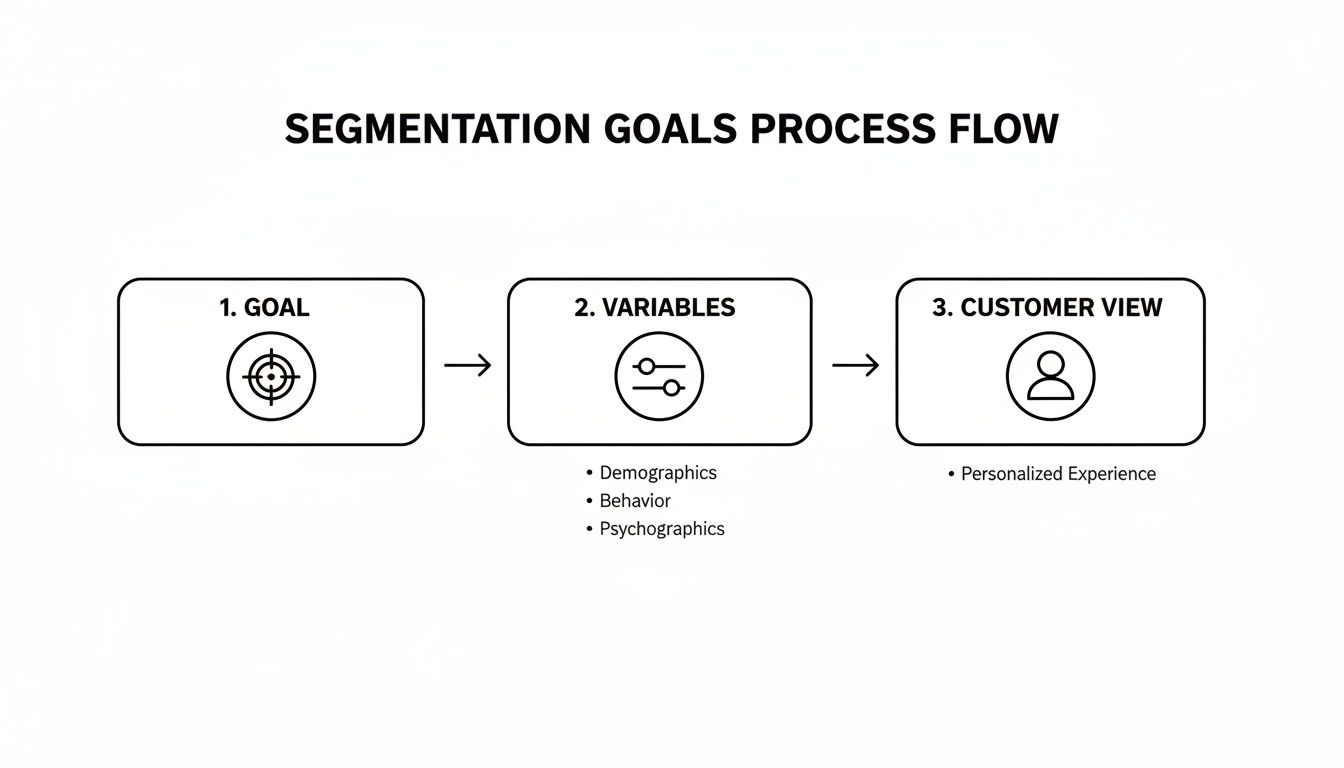
As you can see, that complete customer view isn't magic—it’s the direct result of pairing your strategic goals with the right data.
For growing e-commerce brands, pulling all this data together by hand is a complete non-starter. The solution is using technology designed to pull in and standardize information from all your different platforms.
For 7- and 8-figure brands, a couple of approaches tend to dominate the space:
Customer Data Platforms (CDPs): Tools like Segment, Bloomreach, or Simon Data are built for exactly this job. They connect to all your data sources, clean and merge the information into unified customer profiles, and then push those profiles back out to your marketing tools. Think of it as the marketing-friendly command center for all your customer data.
Modern Data Warehousing: This is a more technical but incredibly powerful approach. You use a cloud data warehouse (like Snowflake or BigQuery) to store the raw data from every system. It gives your data team total flexibility to model and analyze information, but it does require specialized expertise to manage.
For most e-commerce brands, a CDP offers the quickest path to actually getting value from your data. It handles the heavy technical lifting and puts powerful segmentation tools right in your marketing team's hands. Finding the right platform is key to managing these customer relationships, and you can see some great options in our guide to the best CRM for ecommerce.
Once your data is finally in one place, the real work begins. This is where you translate your strategic goals into defined customer groups. You can tackle this in two main ways: with rules you define yourself or with predictive models.
Rule-Based Segmentation
This is the most common and direct method. You create segments by setting specific, logical rules based on the data you’ve collected. It’s straightforward and incredibly effective.
A perfect place to start is by identifying your VIPs. You could define this segment as: "Customers who have made 3 or more purchases AND have a total lifetime spend of over $500."
This approach is powerful because it's easy to understand, build, and explain to your team. You can quickly spin up foundational segments that are immediately ready for a campaign.
The table below breaks down a few high-value, rule-based segments that top brands rely on, including the criteria and what to do with them.
High-Value E-commerce Customer Segments
These rule-based segments are your bread and butter, giving you immediate ways to personalize your marketing and drive revenue.
While rule-based segments are essential, the next level of growth comes from predictive modeling. This is where you shift from reacting to what a customer has done to anticipating what they are likely to do next.
AI-powered tools dig through your unified data to find hidden patterns and predict future behavior. Using technologies like AI customer profiling and personalization can dramatically sharpen your segmentation accuracy. These models don't just group customers; they score them based on probability.
This lets you create incredibly valuable segments that are impossible to build with simple rules alone:
Predicted High LTV Customers: This model spots new customers who share the subtle behavioral DNA of your existing VIPs. You can roll out the red carpet for them from day one, long before they've spent enough to prove their value manually.
Likely to Churn Segment: An AI model can flag customers who are showing signs they’re about to leave—even if they’re still making the odd purchase. This allows you to jump in proactively with a retention offer or a check-in from your support team.
The smartest strategy combines both. Use simple, rule-based segments for your daily marketing flows and deploy advanced, AI-powered segments for your most important campaigns. This dual approach ensures you're capturing immediate wins while also future-proofing your brand's growth.

Here's the truth: a perfectly defined segment is just an idea on a spreadsheet until you actually use it. The real money in customer segmentation strategies gets made when you activate these groups across your marketing channels, turning all that data into actual revenue.
This is where the rubber meets the road. You’re moving from analysis to action.
Activation isn't just about sending a different email to your VIPs. It's about creating a consistent, segment-aware experience everywhere a customer might interact with your brand. From the first ad they click to the product recommendations on your site, every touchpoint should show you know who they are.
The whole point is to make each person feel seen. That’s the quickest way to build real loyalty and crank up lifetime value. Let’s get into the tactical playbook for putting your segments to work where it counts.
Email and SMS are your direct lines to the customer, making them the low-hanging fruit for activation. Forget blasting your entire list with the same generic sale. It’s time to send messages that actually resonate with specific groups, and this is where you’ll see the first big returns from your segmentation work.
Take your "At-Risk Loyal Customers," for example—the ones who used to buy often but have gone quiet for 120+ days. A generic "20% off" email is probably just going to be ignored.
Here’s a much smarter play—a targeted win-back campaign:
This simple, personal touch shows you remember them, which makes them far more likely to click. Personalized campaigns like this can lift revenue by 5% to 8%, and in our experience, the results are often even better.
Your "High AOV, One-Time Buyers" need a completely different approach. These folks have proven they'll spend money, but they haven't formed a habit yet. The goal here is to drive that critical second purchase. Send them a follow-up highlighting products that complement their first purchase or new arrivals in that same category.
It’s not just a sales push; you’re showing them you get their style and are offering something genuinely useful.
Good segmentation turns your paid ad budget from a wild guess into a laser-guided missile. By syncing your customer segments with ad platforms like Meta and Google, you can boost ad relevance and slash your customer acquisition costs (CAC).
One of the most effective tactics we use is building lookalike audiences from our best segments.
Example Scenario: Building a VIP Lookalike Audience
Let's say you've identified a "VIP High LTV" segment. These are the top 5% of your customers—the ones who buy often and spend big. You can upload this list to Meta and create a lookalike audience, which is a group of new users who share the same traits as your absolute best customers.
This is huge. It lets you:
You can also use segments for exclusion, which is just as important. By excluding your "Existing Customers" segment from top-of-funnel acquisition campaigns, you stop wasting money showing "first-time buyer" offers to people who have already bought from you. It’s a simple fix that makes your ad spend instantly more efficient.
The customer journey doesn't stop after the click. Activating segments on your own website is where you create that seamless experience that drives conversions through the roof. When someone lands on your site, you should know which segment they belong to and tailor the experience in real-time.
This is where a solid Customer Data Platform (CDP) or advanced e-commerce tools prove their worth.
Here are a few high-impact ways to use segments on-site:
These on-site activations make the path to purchase feel effortless. When you consistently show customers you understand their journey, you build the kind of trust that turns one-time shoppers into lifelong fans. This is exactly how the leading 8- and 9-figure brands create a competitive advantage that’s incredibly hard to replicate.
So you’ve defined your goals, built your segments, and flipped the switch on your first targeted campaigns. Job done, right?
Not even close.
Customer segmentation isn’t a one-and-done project. It’s a dynamic process. The moment you activate your segments is the moment the real work begins: measuring what’s working, figuring out what isn't, and using that data to sharpen your approach.
Without this feedback loop, even the most brilliant segmentation model will go stale. This is how you prove your efforts are actually driving revenue and loyalty, not just creating busy work for your team. It’s time to move past vanity metrics and dig into the key performance indicators (KPIs) that really show the health of your customer base and the impact of your customer segmentation strategies.
To really see if your strategy is paying off, you need to track how your core business metrics change within each segment after launching a targeted campaign. The magic happens when you compare a targeted segment’s performance to your site-wide average. That’s how you prove ROI.
Below is a guide to the most important metrics for evaluating the success of your customer segmentation strategies. These are the numbers that 7- and 8-figure brands obsess over.
Tracking these gives you a clear, data-backed picture of what's working. You can see, without a doubt, if your win-back campaign is actually shrinking your "At-Risk" segment or if your VIP perks are truly bumping up their LTV.
Measurement tells you what happened. Testing tells you what to do next. The best operators are constantly running A/B tests on their segments to find a new edge. This isn't about throwing spaghetti at the wall; it’s a methodical process for discovering what your customers truly want.
You can A/B test pretty much anything:
The whole point is to build a data-driven feedback loop. The results from your KPIs and A/B tests should feed directly back into your segmentation model. This creates a powerful cycle of continuous improvement, making your strategy smarter and more profitable over time.
For example, you might discover that a free shipping offer drives a 30% higher conversion rate for your "Cart Abandoners" than a percentage-off discount. Boom. That’s your new go-to tactic. You've just permanently upgraded your strategy with hard evidence.
This constant refinement is what separates the brands that just do segmentation from those that truly master it. It's an ongoing commitment to understanding your customers on a deeper level. For any brand serious about making this a core strength, fully grasping the principles of data-driven decision-making is non-negotiable.
Even the sharpest operators have questions when it comes to refining a customer segmentation strategy. It’s a complex discipline where the small details can make or break your results. We've tackled some of the most common questions we hear from brand owners and marketing managers just like you.
So, what’s the real difference? Think of it this way: Demographic segmentation is about who your customers are—their age, gender, location, and other static facts. It’s a decent starting point, but it's table stakes. It rarely tells you what they're going to do next.
Behavioral segmentation, on the other hand, is about what they do. It’s dynamic. This covers their purchase history, the products they look at, how they engage with your emails, and their on-site activity. For any e-commerce brand, this action-based data is almost always the single best predictor of what someone will buy in the future.
There’s no magic number here, and piling on more segments is a classic mistake. We see it all the time: brands create dozens of hyper-specific groups that become impossible to manage or act on. This just leads to analysis paralysis, not profit.
Start with 3-5 core segments that show clear differences in value or behavior. Focus on foundational groups like your VIPs, New Customers, At-Risk Customers, and maybe High AOV One-Time Buyers. It’s far more powerful to have a handful of well-defined segments you use consistently across all your channels.
You can always get more granular down the road. Nail the basics first, then expand as your team gets comfortable with the workflow.
You don't need a massive, expensive tech stack to get this right. The smartest move is to start with the tools you already have and know inside and out. Your ESP and e-commerce platform are more powerful than you think.
Once you’re scaling past 8-figures, your data can get messy and spread out. That’s when you might look into a Customer Data Platform (CDP). A CDP acts as a central hub, unifying data from all your sources to give you the clean, consolidated view needed for truly advanced segmentation.
The most successful e-commerce founders know that scaling isn't a solo sport. Million Dollar Sellers is the exclusive community where top entrepreneurs share the exact strategies they use to build 8- and 9-figure brands. Surround yourself with operators who have already solved your next challenge. Apply for your invitation to MDS.
Join the Ecom Entrepreneur Community for Vetted 7-9 Figure Ecommerce Founders
Learn MoreYou may also like:
Learn more about our special events!
Check Events