Chilat Doina
July 22, 2026
Your dashboards don't agree with each other. Shopify says one thing, Amazon Seller Central says another, Meta has its own version of the truth, and Klaviyo is telling a different story about the same customer. Meanwhile, you're trying to answer a simple founder question, what drove that sale, and which channel deserves more budget next week?
That's where data warehouse architecture comes in. It's not an IT hobby project. It's the blueprint for turning scattered e-commerce data into a system you can trust for margin, retention, inventory, and growth decisions.
Scaling brands don't usually fail because they lack data. They fail because the data lives in too many places, uses too many definitions, and arrives too late to help. The result is familiar, a team spends half a day reconciling reports instead of acting on them, and nobody wants to commit to a number because every platform has a different one.
For a founder, that friction shows up as slow decisions. You can't confidently answer questions like which channel created the customer, which campaigns deserve credit, or whether repeat buyers are becoming more valuable over time. A single report from one platform rarely gives the whole picture, which is why many operators start by understanding broader data analytics fundamentals before they try to scale reporting.
Practical rule: if your team debates the metric before it debates the action, your data system is already costing you money.
A data warehouse solves that by becoming the central place where your business data is collected, cleaned, and organized for analysis. Instead of asking every platform for its own version of truth, the warehouse becomes the controlled layer where sales, marketing, operations, and customer data can be compared in one model. That's what makes it so valuable for e-commerce, where one order can touch paid ads, email, product catalog, fulfillment, and post-purchase support.
Control, not just cleaner reporting, is the key advantage. Once your data is centralized, your team can ask better questions, build consistent dashboards, and stop rebuilding the same spreadsheet every Monday.
Think of data warehouse architecture like the blueprint for a central library. Your source systems are the rooms where the books originate, Shopify, Amazon, ad platforms, ERP, CRM, and email tools. The architecture decides how those books are cataloged, shelved, and made available so a buyer, analyst, or founder can find the right one fast.
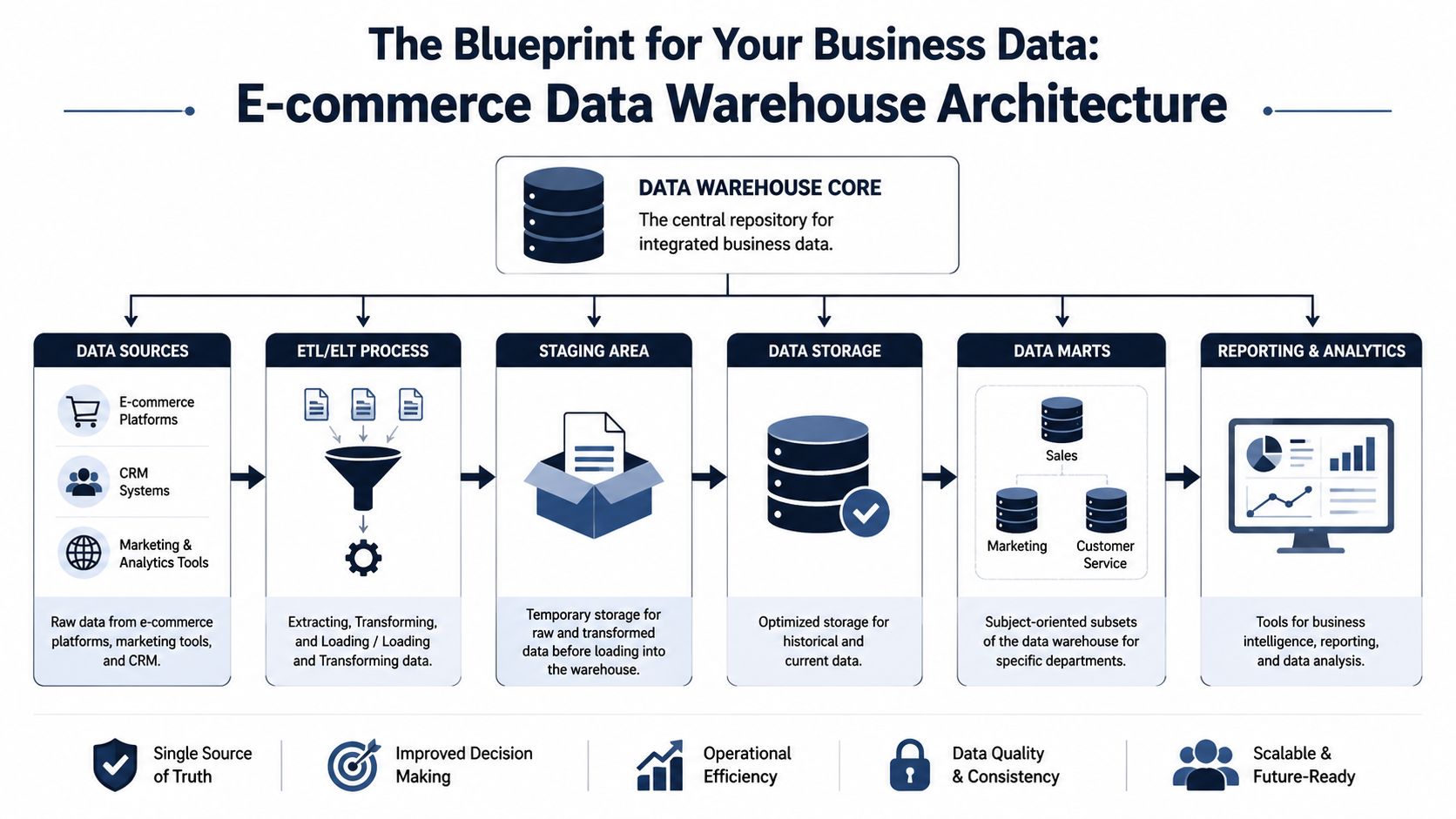
The classic model is a three-tier architecture. The bottom tier handles data ingestion and storage, the middle tier performs OLAP-based analysis, and the top tier serves reporting and user access, which is why this structure separates loading from querying efficiently as described in the three-tier model. For a founder, that separation matters because your analysts aren't trying to query live operational systems while orders are still being placed.
In e-commerce, speed and stability matter at the same time. If reporting runs directly against transactional systems, dashboards get slower right when your business gets busier. A warehouse avoids that by keeping analytical queries away from the systems that process sales, refunds, and subscriptions.
That's also why many modern references talk about layered source, staging, warehouse, and consumption zones. The naming changes, but the logic stays the same, raw data comes in first, it gets standardized, then it becomes usable for business decisions. That separation of concerns is what turns data from a mess of exports into a real operating asset.
A good way to picture it is this, the warehouse is the shelving system, not the books themselves. It doesn't create the data. It organizes it so your team can use it repeatedly without breaking the original source systems.
A warehouse that can't explain where a metric came from isn't a warehouse, it's a spreadsheet with branding.
The most useful implementations also preserve a fact-and-dimension model in storage. Fact tables hold measures, like orders or revenue, while dimension tables hold descriptive context, like product, customer, and date. That structure is what makes slicing performance by channel, cohort, or category feel natural instead of painful.
Ryware's data platform expertise is a useful reference if you want to see how these design choices are handled in practice without treating the warehouse as a generic storage bucket.
A working warehouse usually moves through four operational stages, Ingest, Transform, Model, and Serve. Microsoft's modern data warehouse playbook uses exactly that framing, and it puts the Model stage at the center because that's where data becomes a consumption-optimized structure such as a star schema for BI and reporting. That detail matters because the model stage is where messy source data becomes something your team can trust.
Ingest is the intake lane. Data arrives from storefronts, ad platforms, fulfillment tools, and customer systems, then gets persisted so it's no longer trapped inside the source app. Transform is where definitions get standardized, duplicates get handled, and business rules are applied.
Model is where the warehouse becomes useful to humans. A star schema usually places a fact table in the middle, with surrounding dimensions such as customer, product, and date. That layout reduces query complexity, which is why business users can get answers faster without writing fragile joins.
Serve is the delivery layer. Dashboards, reports, and analyst queries hit the consumption layer, not the raw ingestion layer, so the business sees consistent outputs. The same logic is also why a warehouse can support both executives who want clean KPIs and operators who want drill-down detail.
ETL and ELT sound similar, but they change where the heavy lifting happens. In ETL, data is transformed before loading. In ELT, raw data is loaded first and transformed inside the warehouse, which is often a better fit for cloud environments because compute can be handled more flexibly.
For an e-commerce team, ELT usually wins when source systems are numerous and reporting needs change fast. You keep the raw record, then shape it for specific use cases later. That's especially helpful when one team wants daily performance views while another needs customer-level history.
If you want a practical example of how data teams turn those layers into growth work, the guide to scaling insights and driving sales with AI and advanced analytics is a useful companion read.
Traditional warehouse architecture was built for a world where companies owned the hardware, sized it upfront, and paid the operational cost of keeping it alive. That model can work, but it's rigid. If demand spikes, the business has to plan for capacity instead of reacting to it.
Cloud architecture changes the trade-off. It separates compute and storage, which means you can scale analysis without redesigning the whole system as Databricks explains. That's a major shift from older systems where those pieces were tightly coupled, making scaling slower and more expensive to manage.
The business impact is simple. Cloud warehouses let a brand handle seasonal spikes, campaign surges, and reporting bursts without committing to a fixed physical footprint. That flexibility matters in e-commerce because your analytical load rarely behaves like a straight line.
A traditional on-prem setup is closer to owning the whole building. You buy the structure, maintain the structure, and absorb the pain when you outgrow it. Cloud is closer to renting a high-spec facility that can expand with demand and doesn't force your team to manage the infrastructure layer.
Here's the part many founders miss, cloud isn't just about lower overhead. It also creates room for newer workloads like streaming and AI-connected analytics, because the architecture can adapt without rewriting every downstream process. That makes it a better fit for brands that want reporting to evolve into operational intelligence.
The trade-off is governance. More flexibility can create more sprawl if ownership and definitions aren't set early. A fast-moving company still needs clear rules about what belongs in the warehouse, which teams can change models, and how metrics stay consistent.
Practical rule: choose the architecture that matches your operating rhythm, not the one that sounds most impressive in a vendor demo.
For most growing brands, cloud-native design is the default because it reduces infrastructure drag and supports change more gracefully. The important decision isn't whether cloud is modern. It's whether the team can maintain clean data habits inside that flexibility.
A warehouse earns its keep when it answers questions that spreadsheets and platform dashboards can't answer cleanly. That usually starts with attribution. When ad spend, storefront sales, and lifecycle messaging all live in separate tools, each one tells part of the story, but none of them can show the full customer journey.
A unified model lets you combine Shopify orders, marketplace sales, ad platform costs, and email behavior into one view. That makes it easier to compare campaign performance against actual revenue instead of isolated clicks or opens. It also helps a founder see whether paid traffic is profitable after returns, repeat purchases, and channel overlap.
Advanced segmentation is another high-value use case. Once fact tables and dimensions are modeled properly, your team can isolate customers by purchase frequency, product mix, channel path, and return behavior. That's the difference between broad audience guesses and real merchandising decisions.
Inventory forecasting is where the warehouse becomes operational, not just analytical. You can combine historical sales with promotion calendars, stock movement, and supply chain signals to better anticipate what should be reordered and when. The warehouse preserves history, so your forecast isn't built on whatever happened to be visible in a single tool this morning.

The business value shows up in faster action. Your team stops waiting for someone to export CSVs from three systems and stitch them together manually. Decisions like when to scale spend, which customers deserve retention offers, or which SKUs need attention become repeatable instead of reactive.
A good warehouse doesn't only make reporting prettier. It makes the business easier to run. That's why founders who are serious about sales analysis eventually need a system, not a stack of disconnected dashboards.
Use this sales data analysis guide if you want a stronger framework for turning warehouse outputs into commercial decisions.
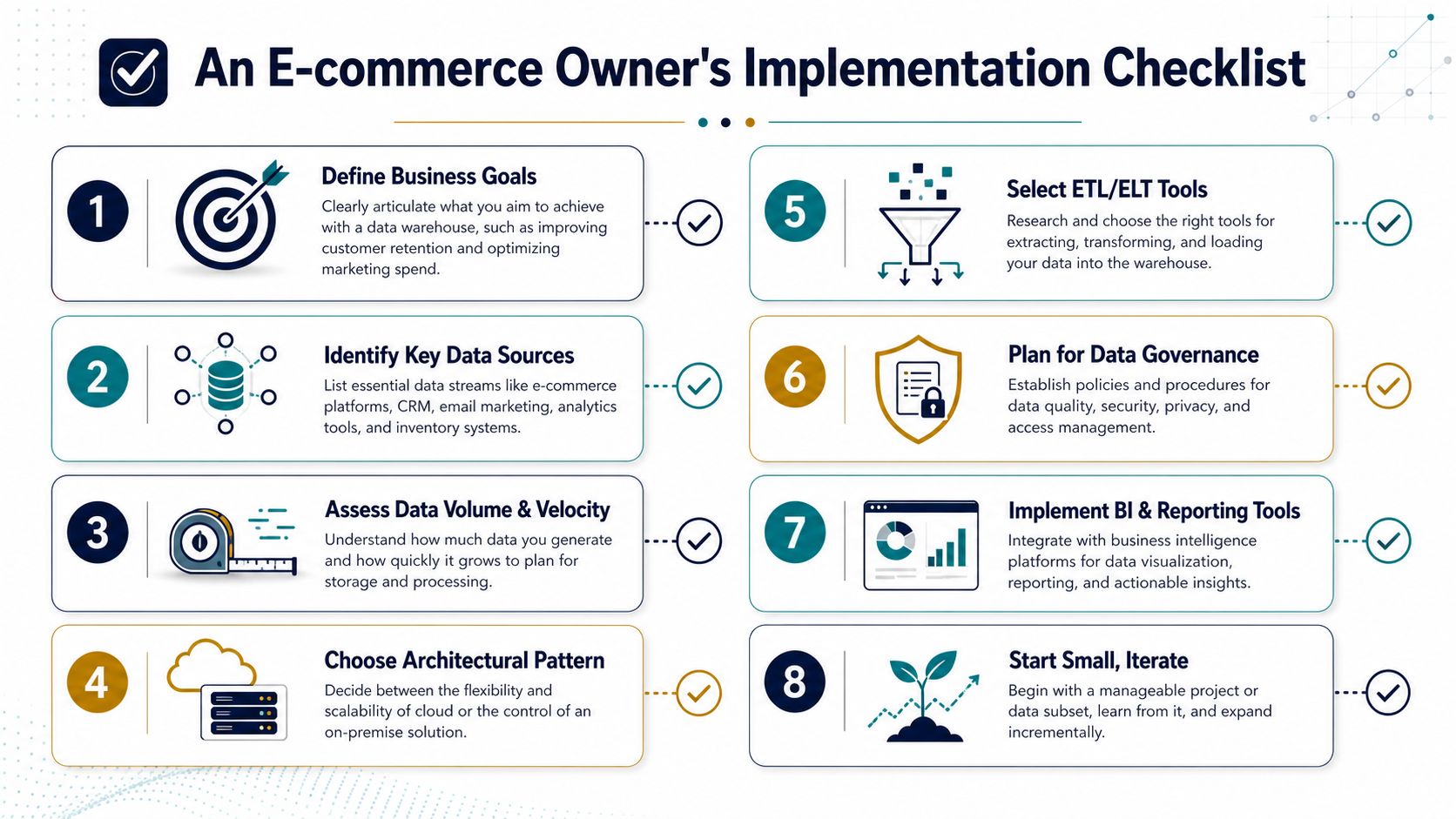
The smartest warehouse projects start with business questions, not tooling. If the team can't name the decisions the warehouse should improve, it's too early to pick a platform, a schema, or a BI layer. The architecture has to serve a real operating need, like retention, margin visibility, or channel-level profitability.
If you're running Shopify, the guide for Shopify teams on DPPs is a useful lens for thinking about structured product data and how it supports cleaner operational reporting.
Architecture is not just a technical blueprint. Enterprise guidance recognizes multiple patterns, including data marts and hybrid architectures, because different teams often need different levels of ownership and access depending on governance needs. That's why the right answer for one brand may not be the right answer for another.
A strong first project is narrow and high-value. Start with one domain, one dashboard family, or one operational pain point, then expand once the model is stable. That approach keeps the team from overbuilding before they've proven what the business needs.
If you want to build this with peers who live at the same level of complexity, join Million Dollar Sellers and use the network to pressure-test your warehouse priorities before you commit serious budget.
Join the Ecom Entrepreneur Community for Vetted 7-9 Figure Ecommerce Founders
Learn MoreYou may also like:
Learn more about our special events!
Check Events