
Chilat Doina
September 19, 2026
You usually don't start by asking, what is EDI integration. A retailer asks it for you.
The email shows up after a buyer call goes well. It might be a vendor packet from Walmart, an Amazon Vendor Central invite after years on Seller Central, or a Target onboarding thread filled with transaction codes that look like accounting shorthand from another era. Suddenly your team isn't talking about product, margin, or creative. You're talking about 850s, 856s, testing windows, and whether your ERP can even produce the right outbound documents.
That's the context for EDI. Founders don't get interested in it because the technology is exciting. They get forced into it when manual wholesale ops stop working, or when a large partner makes compliance a condition of doing business. At small volume, your team can fake it with spreadsheets, inbox rules, and a patient ops manager. Once order volume climbs and partner requirements split in different directions, that patchwork breaks.
The first stage feels manageable. A wholesale account emails a purchase order. Someone on your team keys it into Shopify, NetSuite, SAP, or Dynamics. The warehouse ships. Finance sends an invoice. It's clunky, but it works.
Then the second stage hits. Orders start landing from more than one retail channel, and each partner wants documents sent back in a specific structure. One wants a purchase order acknowledgment. Another wants an advance ship notice before the truck arrives. Another rejects invoices if a field is missing or coded differently than their guide requires.
Usually, it isn't the order itself. It's the surrounding workflow.
Practical rule: If a retailer can reject your document without a human reviewing it, you're no longer dealing with a “send a file” problem. You're dealing with an integration problem.
A lot of brands wait too long because manual work hides the system gap for a while. An ops lead can patch over errors. A customer service rep can call the buyer. A finance manager can reissue paperwork. Those fixes make the business feel functional right up until they don't.
The pain usually arrives as one of three things:
By that point, the question isn't theoretical. It's operational. You need a way for systems to exchange order, shipping, and billing data without your team re-keying everything and hoping no field gets lost.
At the simplest level, EDI integration is the setup that lets two companies exchange structured business documents directly between systems instead of by email, PDF, or manual entry.
Your ERP speaks one language. Your retailer's system speaks another. EDI is the certified translator plus the courier service plus the rules for how the package has to be labeled. If any of those parts are missing, the message may be readable to a human but unusable to the receiving system.
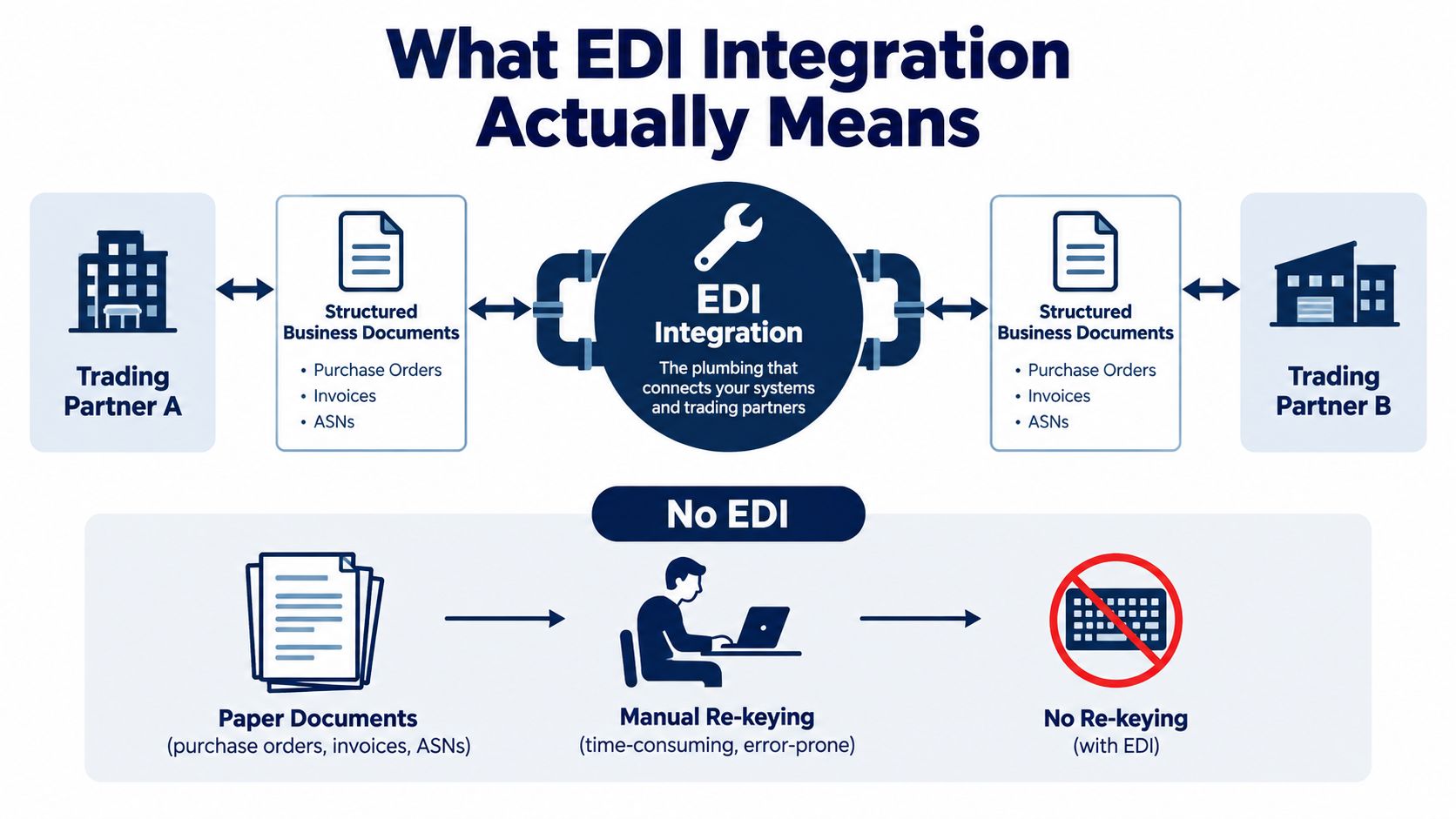
When founders ask what EDI integration is, they often get an answer that's too narrow. It's not just “electronic documents.” It's three things working together.
That last part is where work lives. “Ship date” sounds simple until one partner expects one format, another requires a different qualifier, and your ERP stores it under a different field entirely.
A normal API integration often starts with a developer reading docs and connecting endpoints. EDI usually adds partner-specific rules, certification steps, version control, and document-by-document testing. You're not just connecting software. You're joining a trading relationship with formal message requirements.
That's also why teams that already care about catalog hygiene and listing parity should think of EDI as part of the same discipline. If your product, inventory, and order records don't stay aligned across channels, your EDI layer won't save you. This is the same operational mindset behind Amazon seller data consistency, where small mismatches upstream create expensive downstream errors.
EDI works best when your internal data model is clean before the first retailer test file is ever exchanged.
EDI isn't one protocol. It's a stack.
At the standards level, the National Institute of Standards and Technology notes that ANSI ASC X12 is the dominant transaction standard in North America, while UN/EDIFACT is the dominant international standard, and the two are similarly structured but not directly compatible, so translation and mapping are usually required between formats and envelopes (NIST overview of EDI standards and envelopes).
That matters because a founder can hear “we support EDI” and assume compatibility is solved. It usually isn't. Support for one standard doesn't remove the work of partner-specific mapping.
Your partner may require X12 or EDIFACT. That requirement usually isn't negotiable. If your systems produce internal JSON, CSV, or ERP-native records, something has to translate them.
This is the business document itself. The standard gives the grammar. The transaction set gives the purpose.
| Transaction Set | Common Name | Direction | Primary Use |
|---|---|---|---|
| 850 | Purchase Order | Inbound to brand | Retailer places an order |
| 855 | PO Acknowledgment | Outbound to retailer | Brand confirms or updates the order |
| 856 | Advance Ship Notice | Outbound to retailer | Brand sends shipment details before receipt |
| 810 | Invoice | Outbound to retailer | Brand requests payment in EDI format |
| 846 | Inventory Inquiry/Advice | Either direction | Shares available inventory status |
A useful mental model is this: 850 starts the demand signal, 855 confirms it, 856 tells the partner what's physically moving, and 810 closes the billing loop.
X12 and EDIFACT don't just contain data. They also wrap messages in control segments that identify sender, receiver, grouping, and message boundaries. Those wrappers are part of the contract. If your team ignores them, testing fails before the business content even matters.
AS2 is a common direct transport for B2B EDI. A neutral technical summary describes AS2 as an HTTP/HTTPS-based method that adds S/MIME encryption, digital signatures, and MDN receipts, which is why teams also have to manage certificate exchange, acknowledgments, and partner configuration, not just file transfer (AS2 transport comparison).
Some teams use VANs instead of direct connections because they want routing, buffering, and managed partner communication. Others use SFTP for simpler flows. The right choice depends less on ideology and more on your partner requirements, internal support capacity, and how much operational overhead you want to carry.
For teams thinking beyond EDI alone, this connects to a larger architecture question around where transformations and control logic should sit in your stack. That's the same systems thinking behind data warehouse architecture, especially if you want cleaner downstream reporting across retail, DTC, and marketplace operations.
Most EDI projects don't fail because somebody misunderstood a document code. They fail because the brand treated EDI like a stand-alone tool instead of a connective layer across the business.
Your ERP sits in the middle. That might be NetSuite, SAP, Dynamics, or another system of record. Retailers send structured demand into that core. Your ERP or middleware turns that demand into fulfillable orders, then sends back the required outbound documents after warehouse and finance events happen.
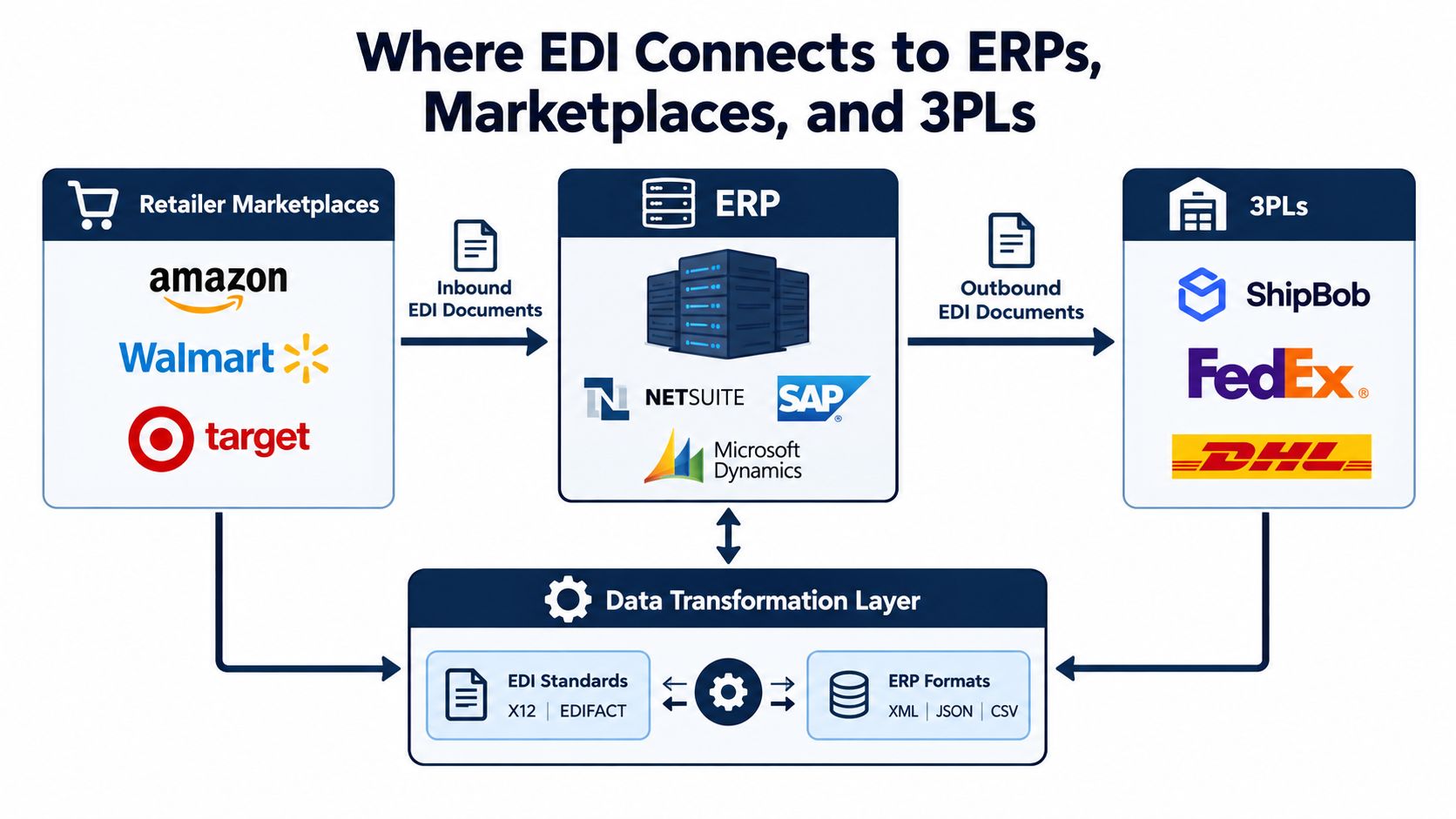
If inbound purchase orders don't map correctly into the ERP, every downstream step gets messy. Ops sees bad order records. The warehouse picks against the wrong details. Finance invoices against mismatched values. EDI often gets blamed for these failures even when the root issue is weak field mapping or inconsistent master data inside the business.
That's why teams running Microsoft environments should think carefully about ERP integration depth, not just EDI compliance. If you're evaluating how those connections behave in a UK business context, this guide on unlock UK potential with Dynamics 365 is a useful reference point.
Amazon Vendor Central behaves very differently from Seller Central. Retail EDI relationships also differ from Shopify-led DTC operations. And a 3PL may need shipping data, carton detail, or inventory feeds on a timeline that doesn't match when your ERP naturally updates.
Three friction points show up often:
For warehouse-heavy brands, EDI and fulfillment process design meet. A warehouse system doesn't have to be fancy, but it does need to support disciplined event timing and clean outbound data. That's why many teams pair EDI work with a review of their warehouse management systems.
If your ERP is the system of record and your 3PL is the system of action, EDI has to keep both telling the same story.
Most founders underestimate EDI because they picture a connector, not a rollout. In practice, going live usually looks more like onboarding a demanding enterprise customer than installing software.
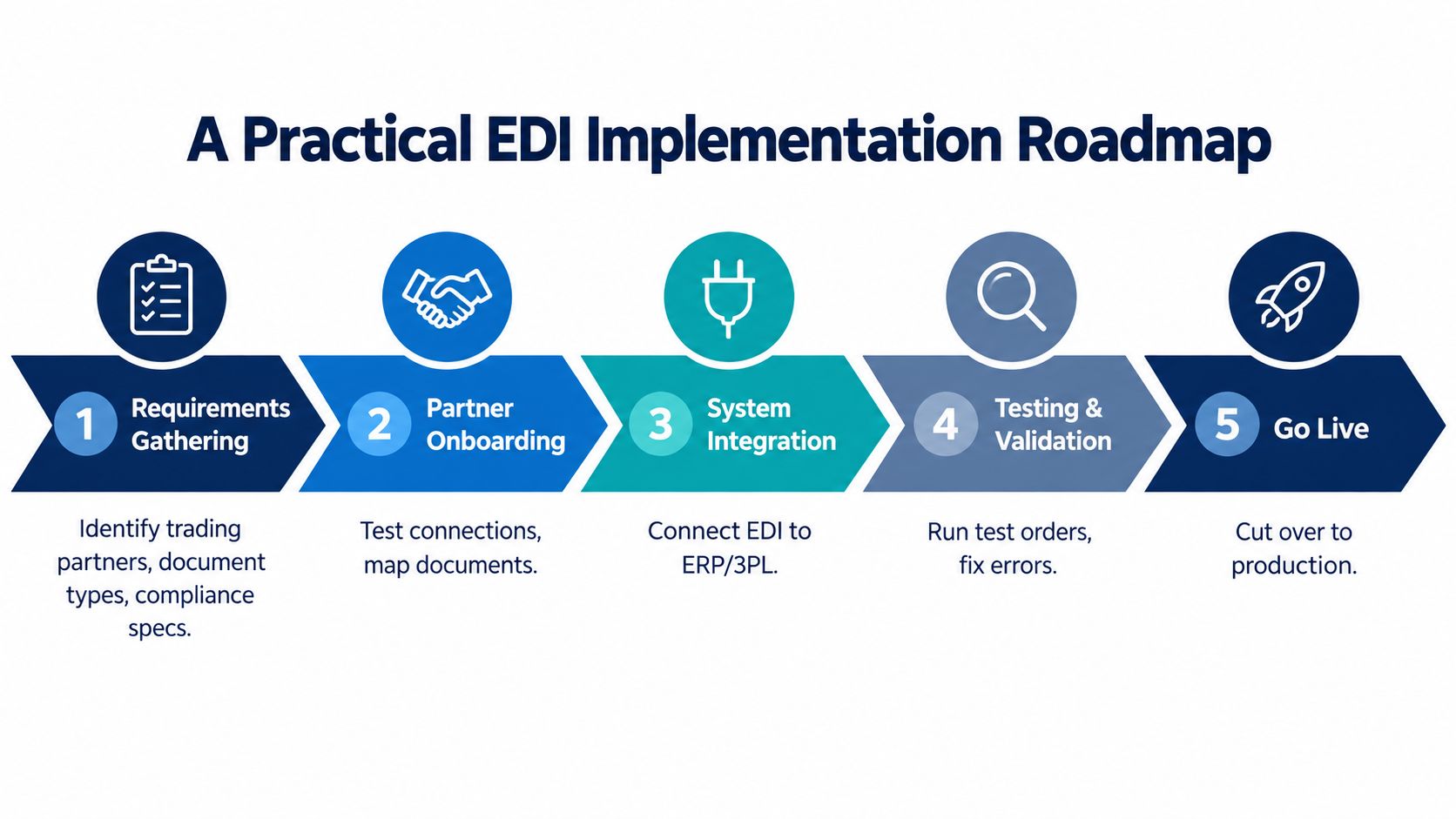
Before anyone builds anything, you need clear answers to a short list of operational questions.
This phase is usually owned by ops with help from IT and finance. The output should be concrete: implementation guides, field definitions, contact owners, and a decision on whether you're using a VAN, AS2, or a managed provider.
This is the part often waved away with “translation.” In reality, mapping forces you to decide how each partner's requirements align to your data model. If a retailer requires a qualifier your ERP doesn't store, you need a rule. If your product hierarchy doesn't line up with the partner's expected identifier, you need a decision.
A strong mapping workshop usually includes:
The fastest EDI projects aren't the ones with the best developers. They're the ones with the fewest unresolved business rules.
Testing usually includes syntax validation, envelope checks, acknowledgments, and business-level verification. A purchase order may pass a technical check and still fail because your acknowledgment logic or ship-from values don't match partner expectations.
That's why partner certification matters. The retailer or network often won't let you into production until your messages behave exactly the way their workflow expects. This can feel bureaucratic, but it protects both sides from expensive live failures.
The cleanest rollout pattern is one partner, one flow, close monitoring. Don't treat the first go live as the finish line. Treat it as the beginning of managed operations.
Brands that want smoother rollouts usually borrow process discipline from broader automation efforts. The same habits used in automating business processes help here too: clear ownership, exception paths, and documented handoffs between systems and teams.
The biggest mistake founders make with EDI costs is assuming the project fee is the whole cost. It isn't. EDI has an upfront setup layer and an ongoing operational layer, and the second one is what catches teams off guard.
There is also a difference between asking, “Can we connect to this retailer?” and asking, “Can we support this relationship for years without adding chaos?” The first question is cheaper.
Upfront costs usually include discovery, mapping, connector setup, partner onboarding, testing, and certification support. Ongoing costs usually include provider licensing, transaction or document fees, transport costs, support, and change management when partners revise requirements.
| Cost Category | Typical Range | When It Applies | ROI Counterpart |
|---|---|---|---|
| Discovery and requirements | Varies by partner count and system complexity | Before build starts | Prevents bad scope and rework |
| Mapping and translation setup | Varies by document count and partner variation | During implementation | Reduces manual order handling |
| Connectivity and provider fees | Varies by transport model and provider | Ongoing | Supports reliable document exchange |
| Certification and partner testing | Varies by retailer process | Pre go live and during changes | Lowers compliance failure risk |
| Maintenance and change management | Varies by partner churn and internal ownership | Ongoing | Avoids hidden ops labor and exceptions |
ROI usually doesn't come from one dramatic win. It comes from removing repeated manual touches across order entry, shipment communication, invoicing, and exception handling.
A few examples of where teams feel the return fastest:
You should also separate “automation” from “maintenance.” A cheap setup that leaves your team babysitting mappings and partner changes can become expensive fast. If you're evaluating vendors, ask who owns updates when a retailer changes guides, rotates certificates, or adds new required documents.
The most dangerous EDI problems aren't the ones that explode on day one. They're the ones that stay hidden until volume rises, partner rules shift, or one system starts drifting away from another.
IBM notes that as transaction volume, complex transformations, and large EDI documents increase, performance and scalability constraints can create bottlenecks, and cloud-native EDI is growing because enterprises want scalable transaction capacity with lower infrastructure ownership (IBM on EDI-ERP scalability and cloud-native demand).
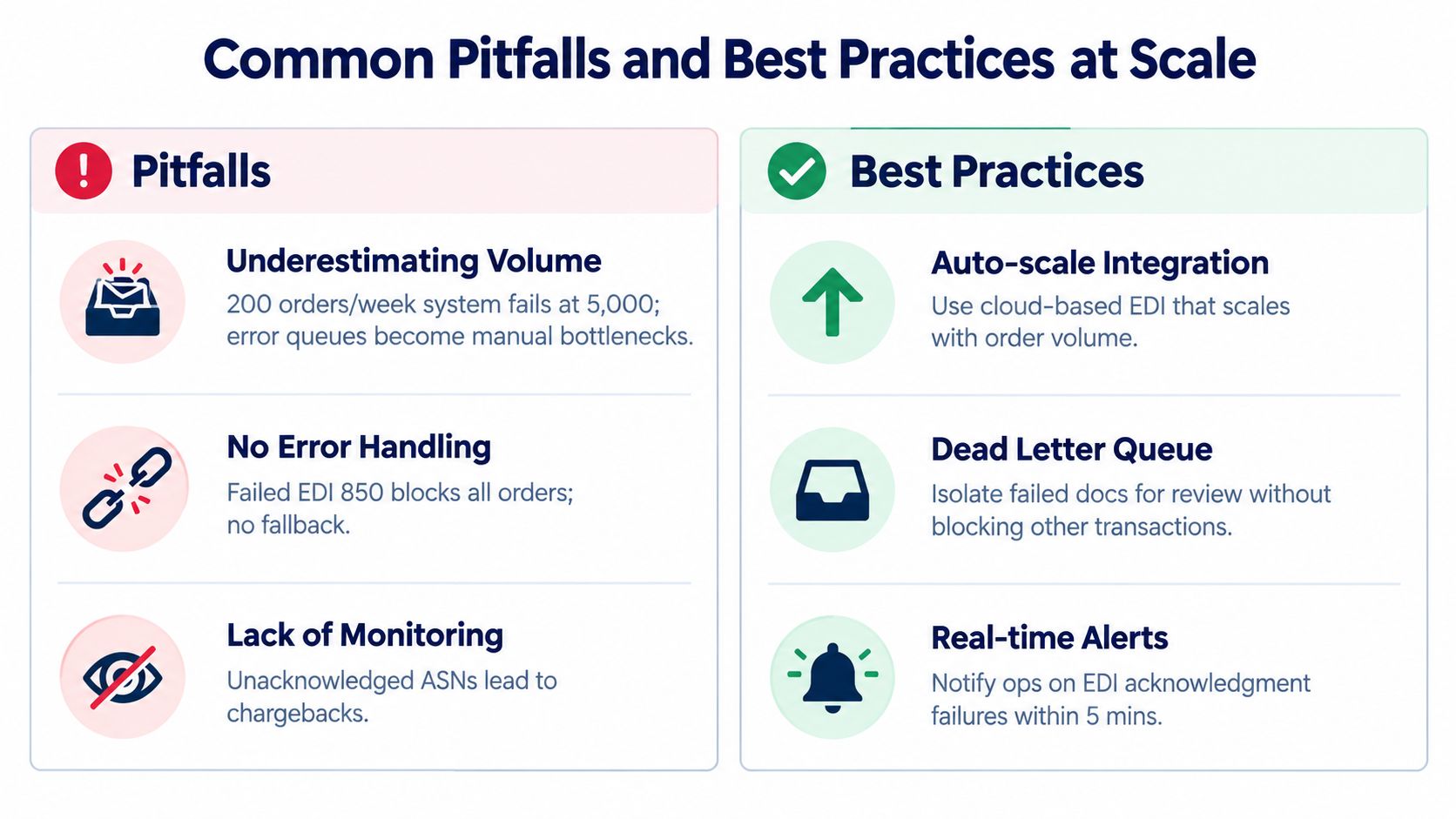
A flow that behaves fine at low volume can become a bottleneck during retail promotions, seasonal spikes, or marketplace expansion. Queues back up. Retries pile on top of retries. Ops teams end up triaging stuck messages by hand.
Best practice is boring but effective:
To see these principles through a broader integration lens, this write-up on data integration for B2B growth is a useful companion.
Here's a visual summary of the scale mindset that matters in practice.
A neutral industry whitepaper highlights recurring friction around legacy EDI systems, protocol mismatches, master data synchronization, ERP API limits, monitoring, error handling, and repeated configuration and testing after software or partner changes (EDI change-management and interoperability challenges).
That lines up with what operators see in the field. Initial go live gets all the attention. Then work begins.
Your EDI map is not a static asset. It's a maintained operating surface.
When an ASN fails or an invoice gets rejected, the issue may sit in a technical system. But the consequences land in ops, warehouse execution, finance, and partner relationships.
Best practices that hold up under pressure:
Not every brand needs a heavy EDI program right now. Some do, and pretending otherwise just delays pain.
If your business is still mostly DTC with limited wholesale complexity, a lightweight translator or managed provider with prebuilt connectors may be enough. If you're adding larger retail accounts, dealing with Vendor Central requirements, or juggling multiple partner-specific document workflows, EDI stops being optional and becomes part of core operations.
| Criterion | Build In-House | Managed EDI Provider |
|---|---|---|
| Internal engineering depth | Best when you have a strong platform team | Best when engineering time is limited |
| ERP uniqueness | Better if your workflows are highly custom | Better if your ERP is common and connectors exist |
| Partner change management | You own updates, testing, and support | Provider often handles much of the maintenance |
| Speed to onboard partners | Usually slower at first | Usually faster with existing templates |
| Operational control | Highest control | Lower direct control, higher convenience |
Ask three questions.
If the answer is yes to even two of those, you should evaluate EDI now, not after the next onboarding fire drill. Start with your last quarter's exceptions, partner requirements, and system owners. Then compare a managed option against an in-house path with brutally honest assumptions about maintenance.
What is EDI integration, in practical terms? It's the operating layer that keeps structured commerce moving between your brand and your trading partners without turning growth into back-office drag.
If this kind of systems-level scaling work is on your plate, that's exactly the kind of conversation serious operators have inside Million Dollar Sellers. MDS brings together high-level ecommerce founders who share what's working across Amazon, DTC, wholesale, operations, and infrastructure, so you can make better decisions before small process cracks turn into expensive growth bottlenecks.
Join the Ecom Entrepreneur Community for Vetted 7-9 Figure Ecommerce Founders
Learn MoreYou may also like:
Learn more about our special events!
Check Events