Chilat Doina
March 2, 2026
So, can you actually make real money dropshipping on Amazon?
Absolutely. Dropshipping on Amazon is a legitimate—and potentially very profitable—business model, but only if you play by Amazon's rules. The entire game hinges on one crucial detail: you must always be the "seller of record." This means using real wholesale suppliers and ensuring every single package and invoice features your brand, not your supplier's.
When most people hear "Amazon dropshipping," their minds jump to retail arbitrage—buying something from Walmart.com and shipping it straight to an Amazon customer. Let me be blunt: that's a one-way ticket to getting your account suspended.
True, sustainable success comes from building a real business that follows Amazon's policies to the letter. You have to be the seller of record, period. Your customer should never see a Target box or a Home Depot invoice. All packing slips, invoices, and customer communications must come from you, the seller.
This distinction is what separates a scalable, long-term asset from a risky side hustle that could vanish overnight.
This guide is for serious entrepreneurs who know that cutting corners isn't a growth strategy. We're going to break down the exact blueprint that 7- and 8-figure sellers use to build lean, powerful, and compliant dropshipping machines on Amazon.
Before you jump in, you need to understand where dropshipping fits in the broader Amazon landscape. Every model has its pros and cons, and the best fit for you depends entirely on your goals, capital, and tolerance for risk.
Let's look at the main ways to sell on Amazon.
The single biggest advantage of dropshipping is the ability to test product-market fit with almost zero inventory risk. You can list hundreds of SKUs from a new supplier to see what sticks, all without spending a dime on stock. If a product line blows up, you can then decide to either scale with dropshipping or double down with a larger FBA order.
To really see the strategic differences, it helps to put the models side-by-side. Seeing the trade-offs clearly is the first step toward building a business that can weather any storm.
.tbl-scroll{contain:inline-size;overflow-x:auto;-webkit-overflow-scrolling:touch}.tbl-scroll table{min-width:600px;width:100%;border-collapse:collapse;margin-bottom:20px}.tbl-scroll th{border:1px solid #ddd;padding:8px;text-align:left;background-color:#f2f2f2;white-space:nowrap}.tbl-scroll td{border:1px solid #ddd;padding:8px;text-align:left}ModelInventory RiskUpfront CapitalControl Over BrandingScalability PotentialDropshippingVery LowLowModerateHigh (with automation)FBA (Private Label)HighHighHighHigh (capital intensive)WholesaleMediumMedium-HighLowMedium
This table makes it clear where your resources and strengths might align. If you're short on capital but have the discipline to manage suppliers and operations effectively, dropshipping on Amazon is an incredible way to get in the game.
It's a model that thrives on data, speed, and efficiency. And the opportunity is massive. Third-party sellers, a huge portion of whom use dropshipping, now account for a staggering 58% of Amazon's total sales. In 2024 alone, independent sellers in the US averaged over $290,000 in annual sales. You can dig deeper into these dropshipping trends and statistics on Wifitalents.com.
This isn't just about flipping products. It's about building a system that taps into Amazon's massive customer base without the financial headache of holding inventory. In the next sections, we'll walk through the exact tactical steps to build this business the right way, from day one.

Let’s be honest: your Amazon dropshipping business is only as strong as your suppliers. The ability to test products with low risk is a huge plus for this model, but that advantage disappears if your supply chain is built on shaky ground.
Finding the right partners isn’t about a race to the bottom on price. It's about building a network of reliable, professional wholesalers who get the high-stakes, fast-paced world of Amazon. A great supplier isn't just a vendor; they're an extension of your business. Their performance directly hits your seller metrics, customer feedback, and ultimately, the health of your Amazon account.
First things first, you need a mental shift away from retail arbitrage. You're hunting for legitimate wholesale suppliers, distributors, or even manufacturers who are open to dropshipping. These are B2B operations, not stores selling to the public.
So, where do you find these gems? I always recommend starting with established US-based suppliers. Why? They offer much faster and more reliable shipping than most international options. Sure, an overseas supplier might have a lower unit cost, but those 15-30 day shipping times are a killer. They lead to impatient customers, canceled orders, and a nosedive in your seller metrics.
A domestic partner, on the other hand, can often get a package to the customer in just 2-5 days. That’s how you meet Amazon-level expectations.
Here are a few places I've had success finding partners:
Once you have a list of potential partners, the real work starts. Every single one has to go through a rigorous vetting process. Your goal here is to spot red flags before you trust them with your business. Do not skip this.
A supplier who agrees to dropship but sends your Amazon customer a product in a Walmart box is not a partner; they're a liability. This is a direct violation of Amazon's policy and a fast-track ticket to account suspension. Your due diligence is your only defense.
You need a consistent, thorough checklist for vetting. For a deep dive, you might want to check out our complete supplier vetting checklist, but the core questions always come down to their operational savvy and professionalism.
Your Due Diligence Checklist:
A professional supplier will have clear, immediate answers for all of this. If you get vague responses or they seem reluctant to share details, consider it a major red flag.
By focusing on building a resilient network of vetted partners, you're not just finding vendors—you're creating the very foundation for a scalable and compliant dropshipping on Amazon business.
A solid supplier network is your foundation, but a killer product listing is how you turn that foundation into actual profit. For dropshipping on Amazon, building a great listing is a delicate dance. You're balancing compelling marketing, smart SEO, and, most importantly, Amazon's strict policies. It’s not enough to just get a listing up; it needs to be found, it needs to persuade, and it absolutely must be compliant.
Your mission is to make your listing look and feel like it belongs to a high-end brand, even if you never see the inventory yourself. This is about more than just copying and pasting your supplier's generic product info. The best sellers add their own value right on the product detail page. Honestly, this is your best defense against getting dragged into a race-to-the-bottom price war.
When you're dropshipping, your approach to keyword research has to be a bit different. You're usually jumping into markets that are already established, so your goal is to zero in on very specific, long-tail search terms. Forget just targeting a broad keyword like "office chair."
Instead, you need to get into the heads of your customers. Think about how they use the product, what problems they're trying to solve, and who they are.
Sprinkling these long-tail keywords into your title, bullets, and backend search terms is how you attract shoppers who are ready to buy. They aren’t just browsing; they’re looking for a specific solution, and that almost always means higher conversion rates.
Once you've got your keywords, it's time to weave them into copy that actually sells. Your bullet points are prime real estate on an Amazon listing. A pro tip: always lead with the benefit, then explain the feature that makes it happen.
For example:
For dropshippers, getting unique, high-quality images from your supplier is non-negotiable. If they only offer you generic stock photos, you need to push for more. Many professional suppliers have a whole library of lifestyle shots or detailed close-ups they'll share if you just ask. Never, ever use watermarked images or pictures you've scraped from another website. You can dive deeper into these strategies in our guide on optimizing Amazon listings.
Remember, you are competing on more than just price. A well-crafted listing with professional imagery and benefit-driven copy instantly builds trust and allows you to command a slightly higher price point, protecting your margins.
Pricing in the dropshipping world is never a "set it and forget it" game. Your profit margins are constantly being squeezed by your supplier's costs, what your competitors are doing, and general market shifts. Trying to track this manually across hundreds of listings? It's a recipe for disaster. This is where dynamic pricing and inventory management software becomes absolutely essential.
These tools plug directly into your supplier's data feeds, letting you:
The opportunity here is massive. The global dropshipping market is on track to hit $476.1 billion this year, largely because it's so easy to get started. But as the market gets more crowded, using smart automation for pricing and inventory isn't just a nice-to-have; it's a must-have for scaling. You can see more data on dropshipping's growth at zikanalytics.com. This operational efficiency is exactly how the top sellers manage huge catalogs while keeping their accounts safe.
Operational excellence is what separates the pros from the amateurs in Amazon dropshipping. Once a customer hits that "buy" button, your entire system needs to click into place, ensuring a smooth handoff from Amazon to your supplier. A lot of sellers get this wrong—they see fulfillment as a chore, not the very heart of their customer's experience.
When you're just starting, forwarding orders to your supplier manually is doable. You take the customer's info from Seller Central, pop it into your supplier's portal, and you're done. Simple enough, but this process has a very short shelf life.
As your sales pick up, manual entry becomes a bottleneck and a huge risk. Automation is no longer a luxury; it's a necessity. The gold standard for dropshipping on Amazon is using tools that plug directly into your supplier's system via API or EDI. This kind of setup zaps order details over the second they come in, slashing fulfillment delays and getting rid of costly human errors.
Here’s the thing: even with the best suppliers, you don't personally control the logistics. This can create a communication vacuum, especially around shipping times and order status. Waiting for a customer to message you asking, "Where's my stuff?" means you've already failed.
You have to get out in front of these questions with proactive messages. A great way to do this is by setting up automated emails through Amazon's Buyer-Seller Messaging that fire off at key points.
If you want to dig deeper into building these kinds of efficient workflows, check out our guide on the essential order fulfillment process steps. Beyond just getting the package out the door, a huge part of keeping customers happy involves Mastering Last Mile Delivery, which is the final, critical leg of the journey.
Returns are a fact of life in e-commerce. For dropshippers, though, they're a massive operational headache. Amazon's policy is crystal clear: you are responsible for accepting and processing all returns. You can't just tell a customer to deal with your supplier.
Having a straightforward, compliant, and customer-friendly returns process is non-negotiable if you want to keep your account health in good standing.
Your return address must be your own or a service you control, like a prep center. Never, ever use your supplier’s address for returns. This is critical for protecting your supplier relationship and making sure you stay compliant as the seller of record.
Here’s a simple, effective way to handle returns:
This two-track system keeps your customer-facing process fast and in line with Amazon's rules, while you sort out the B2B return behind the scenes. It creates a clean separation between the customer experience and your supply chain logistics, which is exactly what you need to protect your metrics and your business.
Thinking visually about your entire operation can help you find weak spots.
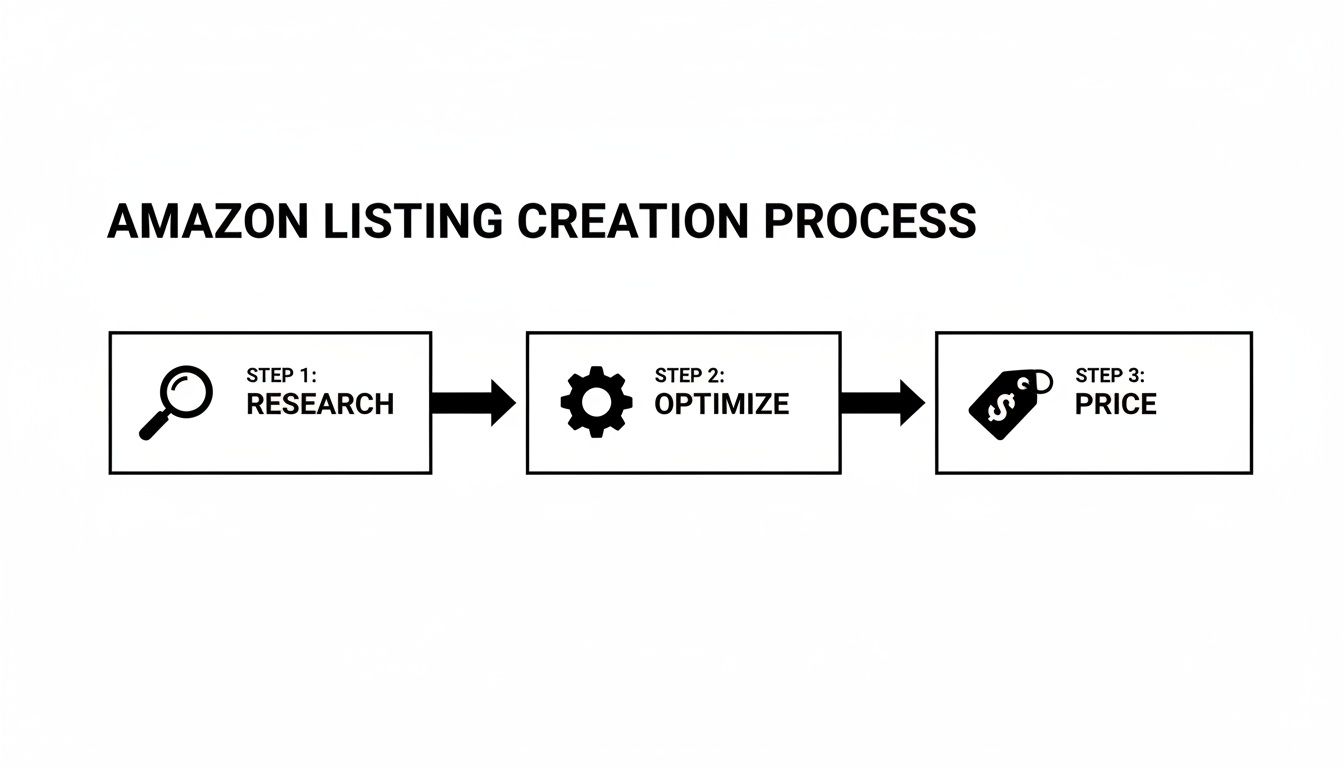
This simple flow reminds us that a successful sale doesn't start with the order. It begins much earlier, with a solid foundation in product research, listing optimization, and smart pricing. Get that right, and the fulfillment part becomes a whole lot smoother.
Once you've got the essentials dialed in—solid suppliers, optimized listings, and a smooth fulfillment process—the real fun begins. Making the jump from a six-figure side hustle to a seven or even eight-figure operation isn't about grinding harder. It’s about scaling smarter. This means evolving from doing everything yourself to building systems and managing risk like a pro.
The name of the game is handling a tidal wave of new orders without a corresponding spike in your workload. This is where automation stops being a luxury and becomes your most valuable player. By implementing software to automate order processing, inventory syncs, and customer service, you build a machine that can grow exponentially.
As your business grows, manually keying in orders isn't just slow—it's a liability. One little typo can snowball into a wrong shipment, a scathing review, and a direct hit to your seller metrics. True scale is achieved by integrating your systems directly with your suppliers.
Think about it: automated systems can push through hundreds, even thousands, of orders a day without a single manual touch. They fire off order data instantly, pull tracking information back into Amazon, and keep your inventory levels perfectly synced in real time. This isn't just about being efficient. It's about building a business that practically runs itself, freeing you up to focus on the big picture, like finding new product lines and analyzing market trends.
This level of operational excellence is what separates the top-tier sellers from everyone else. The data doesn't lie; dropshipping is a major force on Amazon. Third-party sellers fulfill 34% of sales using this model or FBA, and they account for up to 60% of total platform sales. For sellers in hyper-growth mode, execution is everything. Automation allows them to handle nearly 1,000 orders per month with 57% fewer staff while managing 3.2 times more products. You can discover more about dropshipping on Amazon to see just how powerful this model can be.
With your operational machine humming along, you can start expanding your product catalog and dipping your toes into new markets with confidence. The lean, asset-light nature of dropshipping makes it the perfect vehicle for testing new product categories or launching in international Amazon marketplaces with almost no financial risk.
The ultimate goal is to build a diversified, resilient business. Relying on a single supplier or a single hero product is a recipe for disaster. By systematically expanding, you build a robust company that can weather supplier stockouts, shifts in consumer trends, or unexpected market downturns.
As you scale, every potential risk gets amplified—from supplier failures to account health dings. Actively managing these risks is the secret to long-term survival and success. Even with a perfectly tuned dropshipping model, unexpected hiccups or rapid growth can lead to serious cash flow problems, making sharp financial planning non-negotiable.
Managing the gap between when you pay your suppliers and when Amazon's bi-weekly payouts hit your bank account is a constant balancing act. You absolutely must maintain a healthy cash reserve to cover your cost of goods and other operational expenses during this float period. As you grow, look into business credit lines to smooth out cash flow and give you the power to jump on large purchasing opportunities.
A well-defined contingency plan is another must-have. What's your play if your top supplier suddenly goes dark or can't keep up with your order volume?
To proactively manage the common pitfalls of dropshipping, it helps to have a clear checklist. This isn't just about putting out fires; it's about preventing them from starting in the first place.
.tbl-scroll{contain:inline-size;overflow-x:auto;-webkit-overflow-scrolling:touch}.tbl-scroll table{min-width:600px;width:100%;border-collapse:collapse;margin-bottom:20px}.tbl-scroll th{border:1px solid #ddd;padding:8px;text-align:left;background-color:#f2f2f2;white-space:nowrap}.tbl-scroll td{border:1px solid #ddd;padding:8px;text-align:left}Risk AreaMitigation StrategyMonitoring FrequencySupplier ReliabilityVet multiple backup suppliers for all top-selling SKUs. Maintain open communication.Quarterly ReviewInventory/StockoutsUse real-time inventory syncing software. Set low-stock alerts.Daily (Automated)Amazon PolicyStay updated on Amazon's dropshipping policy. Avoid retail arbitrage methods.Monthly ReviewAccount Health MetricsMonitor ODR, LDR, and VTR daily using seller dashboard and third-party tools.DailyCash FlowMaintain a cash reserve of 30-60 days of COGS. Secure a business line of credit.WeeklyPricing & MarginsUse repricing software with clear floor/ceiling rules. Regularly analyze profitability.Daily (Automated)Return ManagementEstablish a clear, documented returns process with your suppliers.Per Return
By consistently monitoring these areas, you build a much more resilient business that can withstand the inevitable bumps in the road.
Finally, start thinking about your business as more than just an income stream—it's a valuable, sellable asset. A well-documented, automated, and diversified dropshipping operation is incredibly attractive to potential buyers.
Clean financials, detailed Standard Operating Procedures (SOPs), and a strong, diversified supplier base are the elements that transform your business from a job into a multi-million dollar exit opportunity.
By focusing on these pillars—automation, strategic expansion, risk mitigation, and building for an exit—you lay the groundwork for scaling your Amazon dropshipping business far beyond what you could ever manage alone. This is how you build a real enterprise, not just an online store.
When you're serious about building a real dropshipping business on Amazon, a lot of questions pop up. Let's tackle some of the most common ones I hear from sellers who are ready to build a compliant, profitable, and scalable operation.
Yes, absolutely—but not in the way most people think. The days of finding a single “hot product” and getting rich are long gone. True profitability in Amazon dropshipping today comes from building a rock-solid system, not just getting lucky with one item.
Success really boils down to a few key things. It starts with finding less-crowded product niches where you aren't constantly dragged into a race to the bottom on price. From there, you need to build relationships with legitimate wholesale suppliers who can give you margins that actually work. Finally, smart automation is what lets you scale without losing your mind.
Your profit on a single sale might be lower than a private label brand, often landing around a 15-25% net margin, but the real magic is in the business model. You have zero inventory holding costs and the ability to list a massive catalog of products. That combination means your overall business profitability can be huge.
The risks are definitely real, but they're also entirely manageable if you have the right game plan. If you want to build a business that lasts, you can't just ignore them.
Here are the top three dangers and how to protect yourself:
When you’re selling products that anyone can source, differentiation is everything. You have to stand out by adding value and building trust, especially since your competitors are likely cutting corners.
In a crowded marketplace, your brand's perceived value is your most defensible asset. Since you don't control the physical product, you must control the customer's experience and perception through superior service and presentation.
First, stop trying to be a general-purpose "everything store." Build your brand around a specific, well-defined niche. This sharpens your marketing and helps you become the go-to expert in that category.
Second, your customer service has to be phenomenal. Since you don't personally ship the items, you need to over-communicate. Proactive updates on order status and quick, helpful replies to questions can turn a potential issue into a five-star review.
Third, put real effort into your listings. Your supplier should provide good photos, but you need to write unique, benefit-focused descriptions that speak directly to what your customer actually wants.
Finally, a great way to create a unique offer is by bundling complementary dropshipped products. This makes your listing one-of-a-kind, makes it harder for competitors to copy you, and helps you escape a direct price war.
At Million Dollar Sellers, we believe the fastest way to scale is by learning directly from people who have already done it. Our exclusive community connects you with 7, 8, and 9-figure e-commerce founders who have mastered complex models like Amazon dropshipping. If you're ready to stop guessing and start implementing proven strategies, find out if you qualify to join us at Million Dollar Sellers.
Join the Ecom Entrepreneur Community for Vetted 7-9 Figure Ecommerce Founders
Learn MoreYou may also like:
Learn more about our special events!
Check Events