Chilat Doina
December 30, 2025
The real difference boils down to one simple idea: Gross profit tells you how good you are at making and selling your stuff, while net profit tells you how good you are at actually running a business.
Think of it this way: Gross profit is your revenue minus only the direct costs of getting your product out the door. Net profit is what’s left in the bank after every single business expense gets paid.
For any serious ecommerce founder, getting a handle on gross profit vs. net profit isn't just a boring accounting task—it’s the secret to making smart moves that actually grow your company. These two numbers are related, but they tell completely different stories about your financial health. It’s like a fitness assessment: gross profit is your raw strength, but net profit is your long-term endurance.
Gross profit is the money you make after subtracting the costs directly tied to producing and selling your goods. This is your first, unfiltered look at how profitable each product is on its own.
Net profit, often called the "bottom line," is what’s left after all other business expenses—think marketing, software, salaries, interest, and taxes—are taken out. This number shows the real financial success of your entire operation. Nailing down both is absolutely critical if you want to scale without going broke.
This table cuts right to the chase, breaking down the core differences so you can quickly see how each metric fits into your financial picture. Getting these distinctions straight is the first step toward building a more resilient and valuable brand.
AttributeGross ProfitNet ProfitWhat It MeasuresThe profitability of your core products or services.The overall profitability of the entire business.FormulaRevenue - Cost of Goods Sold (COGS)Revenue - All Expenses (COGS, Operating Expenses, Interest, Taxes)Location on P&LAppears near the top of the income statement.Appears at the bottom of the income statement.Primary Use CaseGuides pricing, production, and supply chain decisions.Informs investment, expansion, and business valuation decisions.
Getting a clear view of these two numbers side-by-side really highlights their unique roles. One is for tactical, product-level decisions, while the other is for big-picture, strategic planning.
Key Takeaway: High gross profit with low net profit is a classic scaling trap. It means your products are selling well, but your operational spending (like marketing or software) is out of control and eating away at your bottom line. This needs your immediate attention.
To get your gross profit right, you first have to master your Cost of Goods Sold. For a deep dive, you can learn more about what is Cost of Goods Sold in our detailed guide. This is foundational stuff—get this wrong, and all your other profit calculations will be off.
Knowing the difference between net and gross profit is one thing. Actually calculating these numbers for your own brand is where the real magic happens. This is how you find the actionable insights. To get started, you’ll need to pull some specific figures from your financial statements—primarily your Profit & Loss (P&L) statement.
Let's break down the essential components you'll need before jumping into a real-world example. Each piece of this financial puzzle tells a crucial part of your business's story.
To get an accurate picture of your gross and net profit, you first have to nail down and gather the right data. These numbers are the fundamental building blocks of your P&L.
Revenue (or Total Sales): This is your top-line number. It’s all the money that comes in from sales before a single penny is taken out. Think of it as the raw measure of your sales activity.
Cost of Goods Sold (COGS): These are the direct costs tied to making and selling your products. For an e-commerce brand, this usually includes things like:
Operating Expenses (OpEx): These are the costs of keeping the lights on—everything required to run the business that isn't directly tied to a specific product you sold. It’s a huge category that covers a lot of ground.
Getting a handle on your true profitability means meticulously tracking every single expense. I've seen brands with amazing gross profit get wiped out by bloated operating expenses. It's a classic pitfall for fast-growing but inefficient businesses.
After OpEx, there are just two final categories you’ll need for your net profit calculation.
Interest: This is any interest you pay on business loans or lines of credit.
Taxes: This is the income tax your business owes the government.
Once you have a grip on these components, you can see how they fit together in a real-world scenario. You can also dig even deeper with a more detailed guide on the profit margin calculation formula to get more granular.
Let's put this all into practice with a realistic example. Imagine you run an Amazon store selling premium kitchen gadgets and you're part of the Million Dollar Sellers community, where members collectively generate over $8 billion in annual sales.
In Q1, your business brought in $1.6 million in revenue. You spent $900,000 on COGS—sourcing all those high-quality blenders and utensils. That leaves you with a gross profit of $700,000 and a solid 43.75% gross margin. Not bad at all. It shows you’re managing your direct product costs efficiently.
But the story doesn't stop there. To find your true "bottom line," you have to account for everything else it took to run the business.
Let’s stick with the same DTC brand’s Q1 figures to calculate the final net profit.
Now, let's pull it all together for the final calculation:
Net Profit = Gross Profit - Operating Expenses - Interest - Taxes
Net Profit = $700,000 - $280,000 - $25,000 - $75,000
Net Profit = $320,000
That final figure—$320,000—is what the business truly earned after every single bill was paid. This gives the brand a very healthy 20% net profit margin ($320,000 / $1,600,000). That’s a number you can take to the bank.
Knowing the formulas for gross and net profit is step one. The real magic happens when you understand what each metric is telling you about your brand’s health and, more importantly, its potential to actually scale. These aren't just numbers on a spreadsheet; they're powerful diagnostic tools that tell two completely different—but equally vital—stories about your business.
One tells you about the health of your products. The other tells you about the health of your entire operation. A smart founder needs to be fluent in both to make sound decisions. Picking one over the other is a classic mistake, and it's usually an expensive one.
Think of gross profit as a quick pulse check on your core business model. It answers one simple question: are you actually making money on the stuff you sell, before all the overhead kicks in? A strong gross profit margin means your pricing is on point, your supply chain is humming along, and your direct costs are locked down.
This is your go-to metric for making tactical, product-level decisions. For example, if the gross profit on your bestseller suddenly dips, that’s an immediate red flag to dig into rising supplier costs or shipping fees. It directly informs choices like:
A healthy gross profit is the engine of your business. It's what generates the cash to cover all your operating expenses and, hopefully, leave something left over as net profit. Without it, your business model is fundamentally broken, no matter how lean you think your operations are.
While gross profit is all about your products, net profit zooms out to give you the 30,000-foot view of your entire business. This is the bottom line—the ultimate measure of your company's long-term survival. A positive and growing net profit proves your business as a whole is sustainable.
This is the number investors, lenders, and potential buyers really care about. Why? Because it shows you can manage the entire show, not just sell a few widgets. It drives your biggest strategic decisions and guides how you scale your ecommerce business for the long haul. It helps you answer the big questions:
A high gross profit can easily mask a dangerously low net profit. I've seen brands with 70% gross margins go out of business because their operational spending was completely out of control. This signals a critical case of operational bloat that needs immediate attention before it sinks the entire company.
At the end of the day, net profit is what lets you reinvest in the brand, pay down debt, and build real, tangible value. It’s the true scorecard of your success.
Knowing your own gross and net profit margins is one thing, but those numbers don’t mean much in a vacuum. Are your margins healthy? Average? Dangerously low? The only way to really know is to benchmark your performance against industry averages. It’s a critical gut-check for any serious founder.
This comparison helps you set realistic financial goals, pinpoint operational weaknesses, and spot opportunities you might be missing. A brand in the high-margin beauty sector, for instance, will have a completely different profitability profile than a business selling low-margin consumer electronics. Without benchmarks, you're flying blind.
Comparing your numbers to industry data is a powerful reality check. Let's say your net profit margin is 5%. If the average for your niche is 12%, that’s a huge red flag. It immediately tells you that your operating expenses are probably bloated or your pricing strategy needs a complete overhaul. This is how you move from guessing to making data-driven decisions.
This diagram shows a simple, visual breakdown of how gross profit and net profit are calculated, highlighting exactly which costs hit each metric.
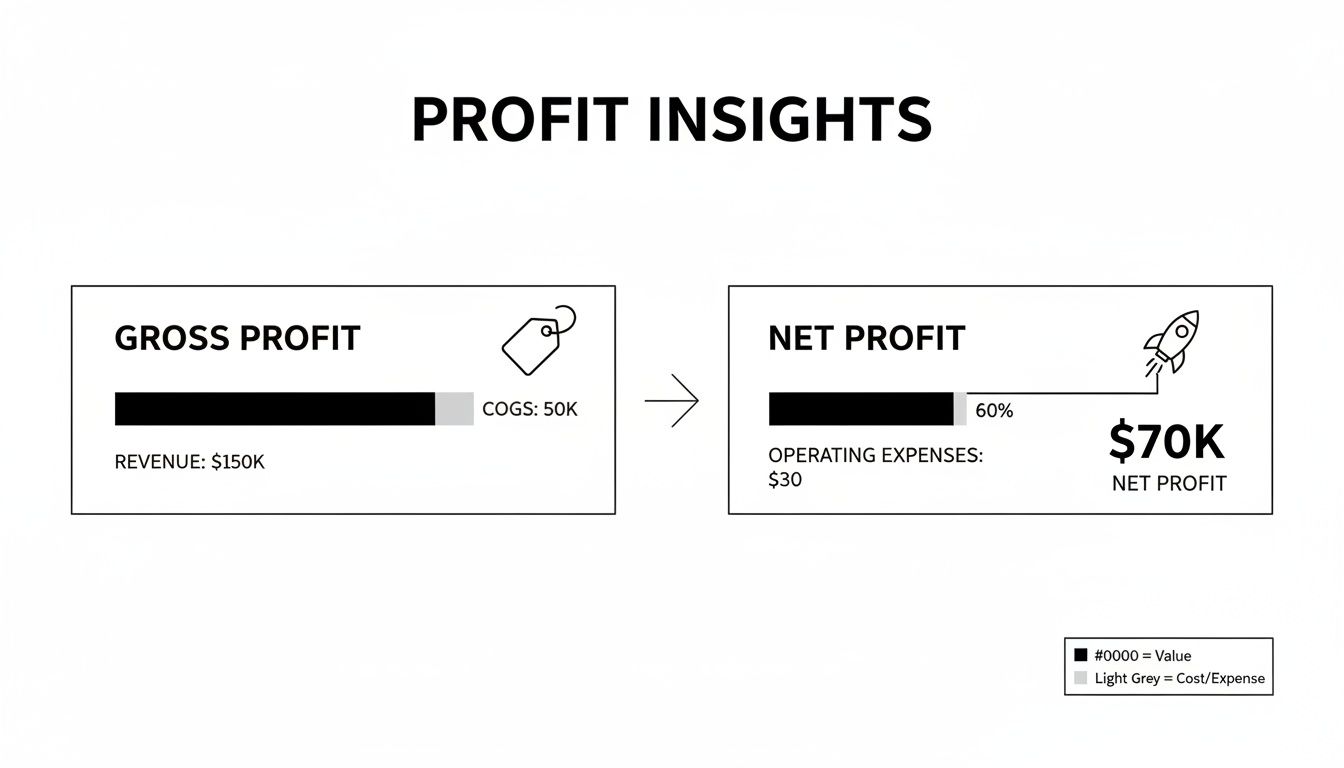
It’s a great reminder of the core difference: gross profit measures your product-level efficiency, while net profit reveals the financial health of the entire operation.
To give you a clearer picture, here’s a look at what profit margins look like across a few different industries.
IndustryAverage Gross Profit MarginAverage Net Profit MarginApparel Retail48% - 55%4% - 13%Beauty & Cosmetics50% - 60%8% - 15%Consumer Electronics15% - 25%2% - 5%Food & Beverage25% - 35%3% - 7%Furniture40% - 50%3% - 8%General Online Retail35% - 45%2% - 10%
As you can see, the gap between gross and net margins is always massive. The costs of running the business—marketing, salaries, software, rent—eat away at that initial profit.
Across all sectors, the average gross profit margin is around 36.56%. That means for every $100 in sales, businesses have about $36 left after paying for the goods themselves. But things get real when you look at the bottom line. The average net profit margin plummets to just 8.54% globally.
That stark difference is a brutal reminder of how overhead, taxes, and interest chew through your revenue. If you want to dig deeper, you can explore more detailed industry profitability data to see how other sectors perform and find the one closest to yours.
It’s also helpful to look beyond your specific e-commerce niche and understand broader economic trends. When you look at large public companies, like those in the S&P 500, you get a macro view of what a healthy, sustainable profit level looks like in a mature market. These titans of industry often operate with long-term net profit margins in the 10-12% range.
This wider perspective is crucial. It shows that even the most successful corporations on the planet work with relatively slim net margins, reinforcing the absolute necessity for disciplined financial management at every stage of your business's growth.
This isn't meant to be discouraging. It's about grounding your expectations in reality. Building a financially resilient business isn't about hitting some impossibly high profit margin overnight. It’s about making consistent, incremental improvements to both your gross and net profit, armed with a clear understanding of where you stand today.

Knowing the difference between gross and net profit is step one. But real growth happens when you turn that knowledge into action. Boosting these key metrics requires a two-front attack: you need to get smarter about the profitability of each product you sell (gross profit) and tighten up the efficiency of your entire business (net profit).
If you focus on one and neglect the other, you end up with an unbalanced business. The secret lies in making small, consistent tweaks in both areas. These changes compound over time, building a far more resilient and valuable brand. Let's dig into the specific levers you can pull to make it happen.
Improving your gross profit boils down to maximizing the cash you make from every single sale. You either have to increase revenue per order or slash the direct costs tied to that order. The goal here is simple: widen the gap between your sale price and your Cost of Goods Sold (COGS).
Here are four high-impact strategies to get you started:
Always remember, every single dollar you save on COGS drops straight to your gross profit line. This is often the lowest-hanging fruit for improving profitability because it directly impacts the math on every unit you sell.
Once you've squeezed every last drop out of your gross profit, the next fight is to protect it from being eaten up by operational overhead. Increasing net profit is a game of efficiency. It's about putting every expense that isn't directly tied to making your product under a microscope and demanding it prove its worth.
Here’s how to run a leaner, more effective operation:
Improving operational efficiency isn't a one-and-done project; it's a continuous process of refinement. For a deeper dive, check out these proven strategies to reduce operational costs. By staying on top of both your gross margins and your operating expenses, you'll build a powerful financial engine that doesn't just survive—it thrives.
When you're in the trenches of scaling an e-commerce brand, the difference between gross and net profit isn't just academic—it's everything. Once you get the basics down, a bunch of trickier questions usually pop up.
Let's dig into some of the most common ones we hear from founders.
Absolutely. In fact, this is one of the most common scenarios for a growing business, especially one that's gunning for market share. A high gross profit is a fantastic sign. It tells you your core business model is healthy—you’re pricing products correctly, and your cost of goods is under control.
The problem comes when your operating expenses swallow that entire gross profit and then some, leading to a net loss. This usually happens when a brand is deliberately pouring cash into growth levers like:
This isn't necessarily a bad thing, but it's a strategic bet. You're betting that today's spending will drive enough future revenue to not only cover all your costs but eventually spit out a healthy profit. It's a calculated risk that needs to be watched like a hawk.
They both matter, but they tell different parts of the story to a potential buyer. Gross profit is the first hurdle. An acquirer looks at it to see if the fundamental business of selling your products actually works. If your gross margins are thin, they'll see a business that's hard to scale profitably.
But when it comes time to put a number on the business, Net Profit (or more commonly, an adjusted version like EBITDA) takes center stage. This is what usually drives the final valuation multiple.
A solid net profit proves the entire machine is well-oiled and sustainable, not just the product-and-supplier part. A company with awesome gross profit but weak (or negative) net profit might get flagged for having bloated operations, which will definitely drag its valuation down.
For any e-commerce brand that’s serious about growth, you need to be looking at these numbers monthly, at a minimum. A monthly P&L review should be a non-negotiable ritual for you and your team.
This cadence is frequent enough to catch problems before they spiral. A sudden drop in gross margin could mean a supplier jacked up their prices. A dip in your net margin might tell you that new Facebook ad campaign isn't performing as well as you thought. Many seven and eight-figure sellers I know are in their financial dashboards weekly, if not daily, to keep a pulse on the business.
At Million Dollar Sellers, we know that mastering your financials is the foundation for building a brand that's not just big, but valuable. Join our exclusive community to get the strategies and peer support you need to turn numbers on a spreadsheet into real, sustainable growth. Learn more at https://milliondollarsellers.com.
Join the Ecom Entrepreneur Community for Vetted 7-9 Figure Ecommerce Founders
Learn MoreYou may also like:
Learn more about our special events!
Check Events