
Chilat Doina
August 24, 2026
A customer sees your product in a social post, opens your site on a phone, checks availability at a nearby store, and finishes the order from a laptop later that evening. Your marketing team sees several sessions, your store team sees a stock inquiry, and your support team sees a customer asking whether the item can be reserved. The shopper sees one brand, but your systems may treat the journey as unrelated events.
That disconnect explains what omnichannel strategy really means. It isn't a plan to publish on every available channel. It's an operating model that connects customer identity, inventory, messaging, orders, service, and fulfillment so the buyer can move between touchpoints without starting over. The hard work happens behind the storefront, where systems must recognize the same person and respond to each new signal.
A shopper discovers a product through social media during a commute, saves it for later, compares specifications on a phone, then checks local availability before buying. Each step creates a handoff between systems. If the website shows stock that the store cannot find, the journey stalls. If an email sends a first-purchase offer after the order is complete, the brand exposes a missing customer record.
This behavior is common across modern retail. A Harvard Business Review analysis of 46,000 retail shoppers found that 73% used multiple channels during their buying journey, compared with 7% who were online-only and 20% who were store-only. The research also found that the average journey involved roughly six touchpoints. Channel-level reporting can therefore assign value to isolated events while missing how the purchase developed.
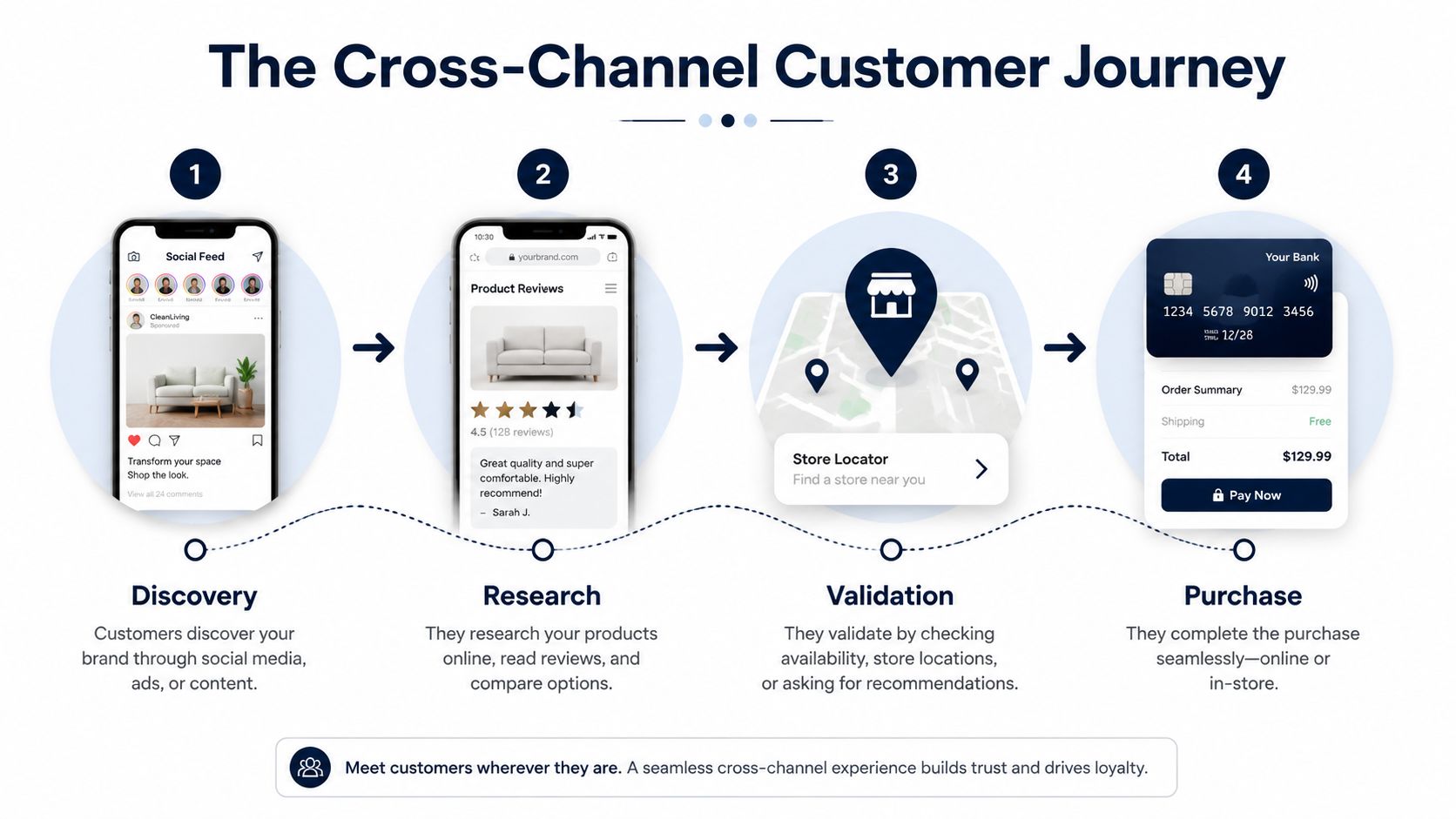
Customers rarely organize their behavior around internal channel ownership. They expect product information, availability, offers, and service history to remain consistent as they move from paid social to ecommerce, a store locator, a physical shop, or desktop checkout.
Consumer behavior analysis becomes useful when it produces specific system requirements. A journey map should identify the signals each system must exchange, including product views, cart activity, store searches, purchases, returns, and support conversations. It should also define which event takes priority when records conflict.
The isolated model fails in predictable ways:
Practical rule: Treat every channel as a customer-facing window into one commerce operation, not as a separate business.
The operational priority is connection. Customer identity, product data, inventory, orders, and service events must update the next interaction quickly enough for the journey to feel continuous. Adding another outlet before those handoffs work usually increases exceptions, reconciliation work, and customer confusion.
Omnichannel strategy is the coordinated design of every customer touchpoint and the systems behind it, so a shopper can move between channels with consistent identity, information, pricing, service, and fulfillment. The customer sees a continuous experience. Behind it, identity records, product data, inventory, orders, and communication rules must stay aligned.
Omnichannel extends multichannel retail by connecting all channels around the customer journey instead of around internal channel ownership. A website, store, marketplace, service desk, and marketing platform can keep their specific roles while sharing the records and decisions that shape the next interaction.
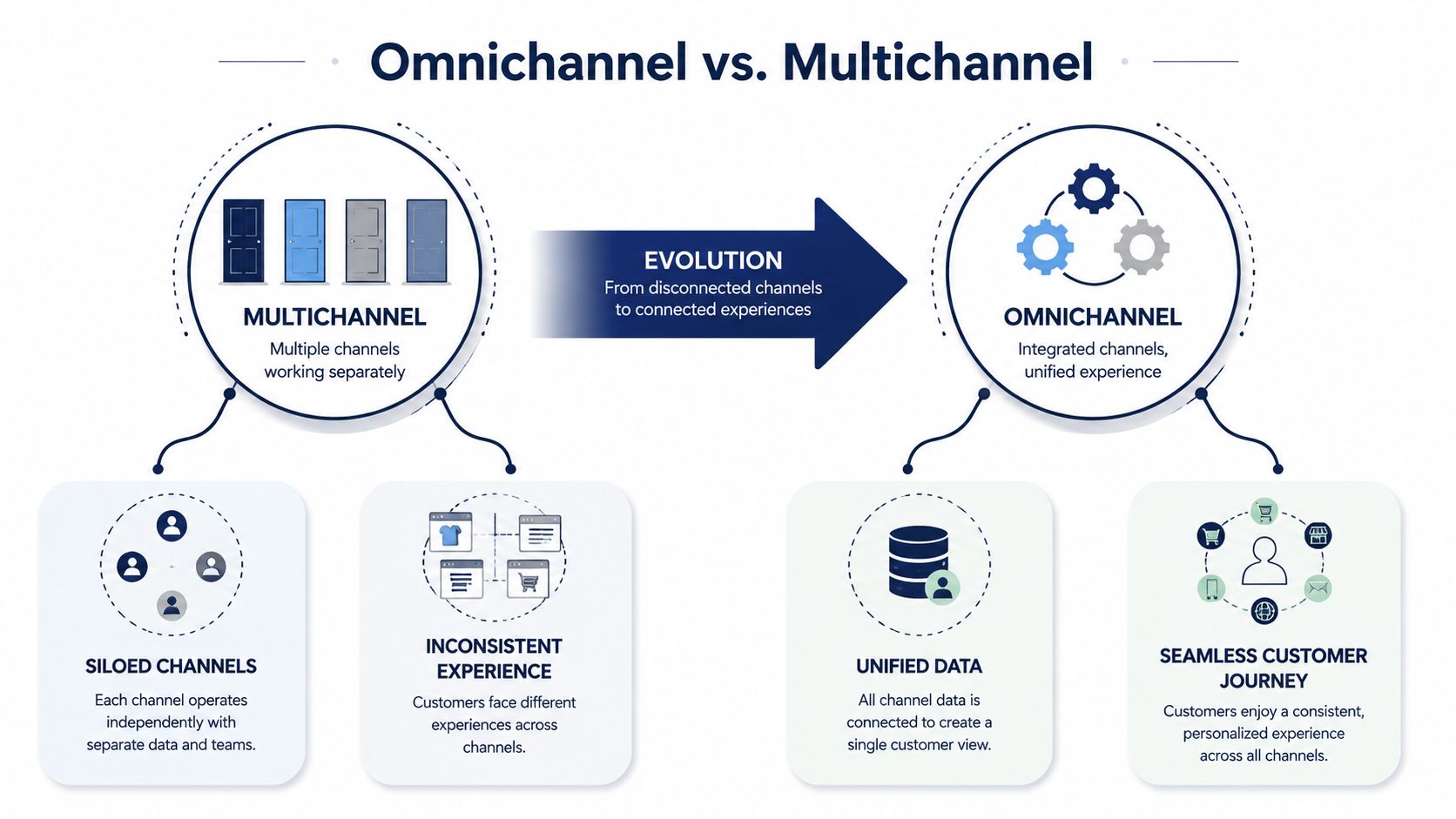
Unified customer view. The business needs a dependable record that can connect an authenticated account, email address, loyalty profile, point-of-sale purchase, support history, and relevant anonymous behavior. That record does not need every possible data point. It needs trusted identifiers and events that service, personalization, and measurement can use consistently.
Synchronized inventory. Online availability must reflect the state of each unit, not just a warehouse total. A store item may be available for walk-in purchase, reserved for pickup, held for a return exchange, or allocated to an online order. Availability promises require those states and the timing of each handoff to be visible.
Consistent messaging. A completed purchase should remove the customer from an abandoned-cart sequence. A returned item should stop triggering product reminders unless the message accounts for the return. Promotions, eligibility, exclusions, and frequency rules must remain consistent across email, SMS, paid media, onsite experiences, and store interactions.
Frictionless fulfillment. The order-routing decision should reflect the promise the brand can keep. Depending on stock and service commitments, fulfillment may come from a warehouse, store, pickup counter, or multiple locations. Channel ownership should not determine the route.
Brightpearl's survey reported that 91% of retailers and brands either already had an omnichannel strategy or planned to invest in one soon. It also associated omnichannel customers with 16% more spend per order, 30% higher lifetime value, and 89% retention versus 33% for weak single-channel engagement in the cited industry data (Brightpearl's omnichannel study). These figures do not guarantee the same outcome for every retailer. They do clarify the operational question: whether the business can make its channels behave like one connected operation.
Most implementation mistakes happen in the order of operations. Teams launch a marketplace, app, store pickup option, or new campaign before deciding how customer identity, stock, orders, and events will move through the business. The result looks broad from the outside but remains fragmented underneath.
A scalable architecture has three coupled pillars:
Start with the record that lets the business answer, “Who is this customer, and what has already happened?” A customer data platform, CRM, or warehouse-centered model can play that role, depending on the company's needs. The important requirement is not the product category. It's the identity logic, consent handling, event model, and ownership rules.
Define a canonical customer ID and the events that update it. A product view might inform merchandising, while a completed order should change marketing eligibility, service context, loyalty state, and attribution. Teams designing the data layer can use this guide to understand data warehouse architecture before choosing tools that merely duplicate records.
A store's stock can serve two purposes at once. It can support an in-store shopper and act as a fulfillment resource for an online order. That creates a demand-allocation problem, not a simple inventory-display problem.
A Naval Research Logistics study of omnichannel retail networks describes a two-stage approximation with location-specific, time-varying inventory thresholds to ration store inventory between online and in-store demand. Its numerical studies on realistic U.S.-embedded networks found that the heuristic outperformed benchmark approaches because it accounted for cross-channel demand substitution and network-wide fulfillment coupling.
The operating sequence should be explicit:
Marketing automation becomes dangerous when it knows behavior but not business state. A browse event should not trigger the same message after a purchase, cancellation, or return. A pickup-ready notification should reflect actual handoff status, not merely order creation.
Operational integration matters because distribution-network design, inventory and capacity management, and delivery planning work together. A systematic literature review of 58 papers identified those three dimensions as the core technical architecture of omnichannel e-fulfillment, while later optimization work reported average cost reductions of 11.81% on short horizons and 3.93% on longer horizons versus prior literature (systematic literature review of omnichannel e-fulfillment). The lesson is straightforward: don't optimize campaigns, inventory, and delivery as separate departments when the customer experiences one chain of events.
A brand can have a website, app, marketplace presence, stores, email program, and support desk while still failing at omnichannel execution. The missing layer is orchestration. A customer signal must trigger coordinated action across the systems that influence the next interaction.
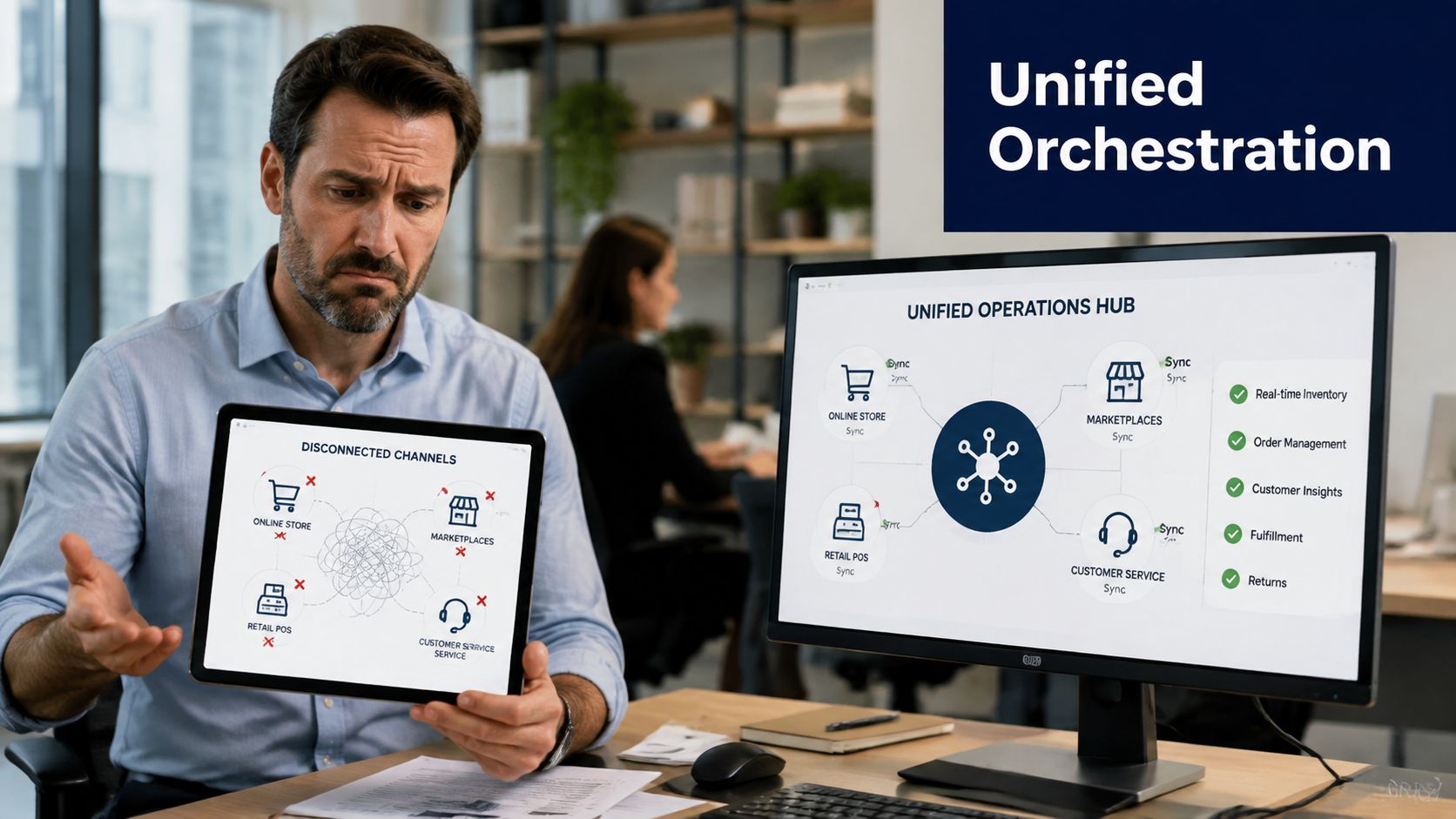
The 2026 State of Omnichannel Commerce report calls this an “Omnichannel Execution Gap” and bases its findings on 408 commerce decision-makers. The useful maturity test isn't how many channels are active. It's whether one reliable customer signal changes the experience everywhere it should.
Consider a return. The return authorization should update the order record, customer service view, inventory state, refund workflow, loyalty logic, and marketing suppression rules. If only the ecommerce platform knows about it, the customer may receive a replenishment email for an item that has just been returned, while the support agent lacks the reason and the warehouse lacks the expected intake.
Use event contracts to make each handoff explicit:
Maturity isn't channel count. It's the number of customer signals that produce the right cross-channel action without manual reconciliation.
Point-of-sale, ecommerce, support ticketing, order management, warehouse systems, and messaging platforms don't need to become one application. They do need clear ownership, reliable integration, shared identifiers, and observable failures. A CRM implementation should therefore include process design, data governance, agent workflows, and escalation paths, not just software configuration.
Watch the following overview with one question in mind: which customer events should change the experience across your business?
Start with a narrow journey that creates visible friction. Pickup is often a good candidate because it forces inventory accuracy, store readiness, customer notification, and handoff confirmation to work together. The goal isn't to automate every journey immediately. It's to prove that the organization can make one promise and keep it across systems.
Technology selection should follow operational complexity, not enthusiasm for a particular category. An all-in-one suite may reduce integration work for a simpler model, while a specialized architecture may offer better control when stores, marketplaces, warehouses, and regional rules create competing demands.
The first decision is whether your commerce platform can remain the system of record for orders and inventory without becoming a bottleneck. The second is whether customer data and marketing decisions belong there or in a separate customer data, CRM, or warehouse layer. The third is how much real-time coordination your fulfillment promises require.
| Platform Type | Best For | Key Strength | Implementation Complexity |
|---|---|---|---|
| All-in-one commerce suite | Brands with a relatively contained operating model | Faster deployment across storefront, orders, and basic customer workflows | Lower to moderate |
| Headless commerce platform | Teams needing flexible storefronts across devices and touchpoints | Separates customer experience design from commerce services | Moderate to high |
| Order management system with distributed inventory | Retailers coordinating warehouses, stores, pickup, and shipping | Centralizes order routing and fulfillment decisions | High |
| Customer data platform with marketing automation | Brands prioritizing identity, segmentation, and lifecycle journeys | Connects behavioral signals to cross-channel messaging | Moderate |
| Middleware and integration layer | Businesses with established best-of-breed systems | Translates events and synchronizes records across applications | High |
| Data warehouse with activation tools | Operators needing governed analytics and flexible modeling | Supports unified measurement and downstream activation | High |
If your main problem is inconsistent campaigns, fix identity, consent, segmentation, and suppression before buying another channel tool. If the main problem is canceled pickup orders, prioritize inventory accuracy, reservation logic, and store processes. If the main problem is split shipments and margin leakage, focus on order management and fulfillment economics.
Specialized middleware can be powerful, but it adds another layer to monitor. Headless commerce offers flexibility, but it also shifts integration and maintenance responsibility to your team. An all-in-one platform can speed up early execution, but its default workflows may become restrictive as your operating model expands.
Marketing and promotion design still matters after the architecture is sound. For practical ideas on revenue-boosting platform strategies from Quikly, evaluate each tactic against your identity, inventory, and fulfillment constraints rather than treating campaign performance as independent from operations.
A good stack makes failure visible. It should show whether an event arrived, whether a customer matched, whether inventory was reserved, whether the message was suppressed, and whether the final outcome returned to the shared record. If your team can't trace those steps, adding more software will likely increase confusion instead of creating coordination.
Channel-specific revenue can look healthy while the combined customer journey loses money. A paid social campaign may introduce demand that email converts. A store associate may complete an order that began online. A pickup option may improve conversion but add labor and shrink risk. Measuring each channel in isolation can cause teams to cut the contribution that another channel depends on.
Build the dashboard around journeys, customers, and operational promises.
Digital Commerce 360 reported curbside pickup conversion at 4.1%, BOPIS at 3.4%, and in-store stock status at 3.3% among retail chains in 2025 (Digital Commerce 360's omnichannel conversion analysis). The figures support a practical point: fulfillment features create value only when the underlying operation can keep the promise.
Fix the data foundation before expanding channel count. Establish identity, event definitions, inventory states, and attribution rules first. Then add a journey that depends on those foundations, measure its commercial and operational effect together, and expand only after the process is stable.
A retailer promising same-day store pickup must coordinate more than a checkout option. It needs a customer record that carries the order, inventory state, payment status, and collection event across systems. Without that connection, a customer can reserve an item another shopper has already bought, while store staff work from outdated instructions.
One practical implementation treats stores as fulfillment nodes without treating every unit as available for online orders. The allocation logic protects walk-in demand, confirms stock before payment, assigns a picking task staff can complete, and removes the item from every selling surface once reserved. The Naval Research Logistics research described earlier supports this operating model: store and online demand can draw from the same inventory, so allocation must account for both.
A direct-to-consumer brand faces a different integration challenge. Its customer record can connect email eligibility, onsite content, paid-media suppression, support history, and post-purchase workflows. The operational gain comes from state changes. A prospect becomes a buyer, a buyer becomes a repeat customer, or a return request changes which messages and service actions are permitted.
Digital Commerce 360 reported that curbside availability among retail chains fell from 53.9% in 2021 to 24.9% in 2025, while curbside still recorded 4.1% conversion (the reported curbside availability and conversion data). That trade-off matters operationally. Keep a fulfillment option when the customer promise is valuable and the connected inventory, store workflow, and margin can support it.
Million Dollar Sellers gives ecommerce founders access to vetted peer discussions, strategy sharing, private forums, curated events, and service recommendations across Amazon, DTC, retail, and omnichannel operations. Founders connecting channels while managing inventory, fulfillment, and customer data can visit Million Dollar Sellers to learn about the community.
Join the Ecom Entrepreneur Community for Vetted 7-9 Figure Ecommerce Founders
Learn MoreYou may also like:
Learn more about our special events!
Check Events