Chilat Doina
May 7, 2026
If you're running an e-commerce business that's already outgrown basic wholesale, you know the pattern. Your best SKUs get copied, supplier pricing gets tighter, ad costs keep climbing, and the inventory you can buy easily is usually the inventory everyone else can buy too.
That’s where walmart liquidation pallets become interesting. Not as a side hustle. Not as a weekend flip. As a sourcing channel.
The operators who win here don't treat pallets like a treasure hunt. They treat them like a procurement system with ugly edges. They build intake rules, grading workflows, resale channel logic, and a real P&L around imperfect inventory. That shift matters more than any single pallet you buy.
For serious sellers, Walmart liquidation can become a differentiated source of open-box, returned, overstock, and shelf-pulled inventory that doesn’t depend on the same distributor relationships your competitors are chasing. It can also turn into a cash trap if you buy the wrong lots, underbuild your processing operation, or ignore compliance on the way back out to Amazon, eBay, or your own storefront.
A lot of brands hit the same ceiling at roughly the same stage. Revenue is healthy, the team is capable, and fulfillment is stable, but sourcing starts to drag on growth. You can still buy inventory. You just can't buy enough of the right inventory at margins that justify the effort.
Traditional wholesale starts to feel crowded because it is. Private label can still work, but it usually comes with long lead times, concentrated SKU risk, and more capital tied up in forecasting. Walmart liquidation sits in a different lane. You’re not manufacturing demand from scratch. You’re buying existing product flow from a giant retail machine and turning operational discipline into margin.
Many buyers approach liquidation the wrong way. They ask, “What might be inside this pallet?” The better question is, “Can my team process this class of inventory profitably and repeatedly?”
That mindset changes everything:
Practical rule: If your business can't absorb inconsistency in item condition, walmart liquidation pallets aren't a growth lever yet. They're an operational burden.
The upside is real for the right business. The wrong way to enter is with a gambling mindset. The right way is to build a controlled sourcing lane that complements your existing wholesale, marketplace, or DTC operation.
Walmart liquidation works because Walmart needs velocity, not because resellers need bargains. Once you understand that, the whole ecosystem makes more sense.
In 2026, Walmart’s annual sales exceeded $611 billion, and online return rates ranged from 20-30%, creating a huge stream of merchandise that needed to move through liquidation channels. Walmart’s exclusive B2B auction platform, B-Stock, standardized that process for a buyer network where active resellers averaged 34.7 pallets per year, according to this Walmart liquidation market breakdown.
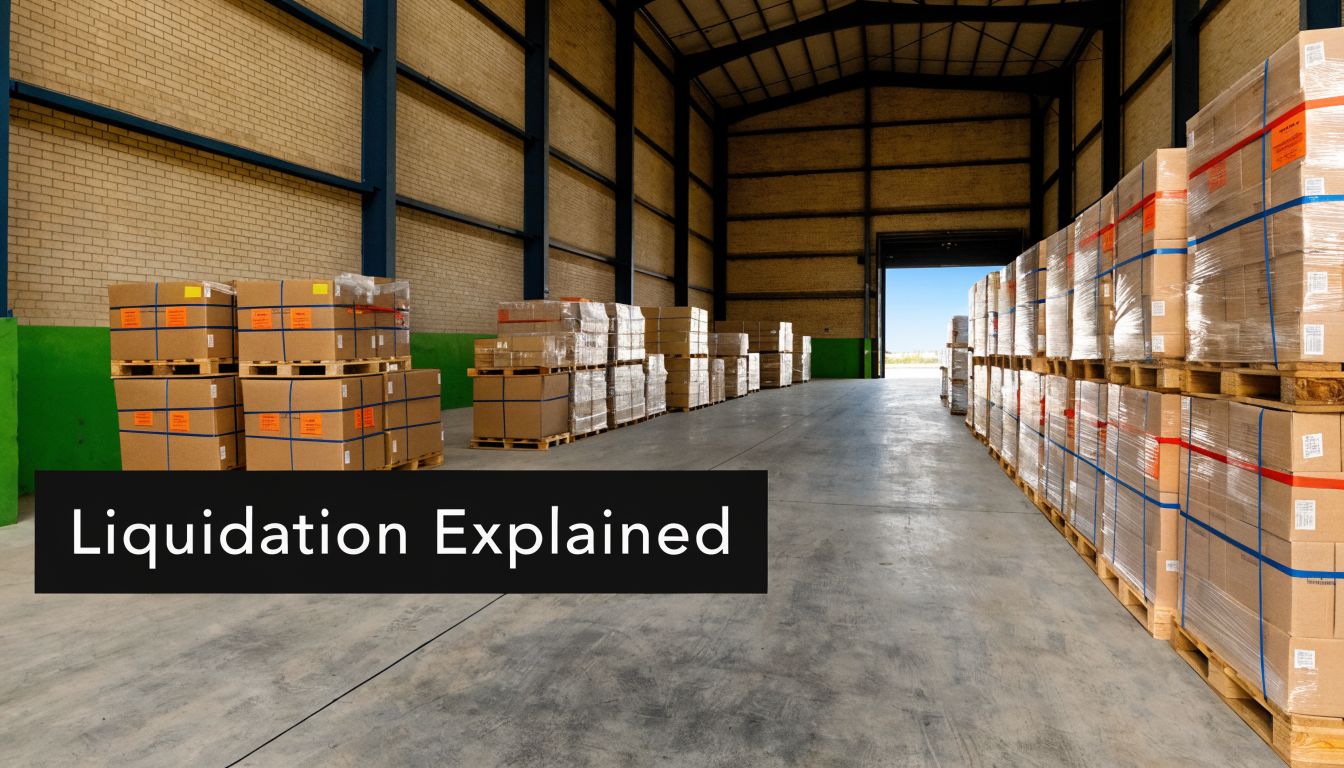
Think of Walmart liquidation like a river with several feeder streams. Product enters through normal retail sales. It exits standard retail channels when Walmart no longer wants to hold, restock, or re-merchandise it. That inventory then gets bundled and routed into secondary channels.
The main streams are straightforward:
For the reseller, these streams are not equal. Overstock and shelf-pulls usually behave differently from customer returns. Returns require more labor and tighter grading. Shelf-pulls often need less repair but more relabeling or packaging cleanup. End-of-life goods can be strong if you know where to sell them and weak if your channel relies on current-model demand.
The most important operator in this ecosystem is B-Stock because it handles Walmart’s official B2B auction process. That matters for one reason. Standardization.
Official channels usually give you better structure around manifests, lot descriptions, and business verification. That doesn’t eliminate risk, but it lowers the chance that you’re buying picked-over inventory from someone upstream who already removed the easiest profit.
That same discipline applies across adjacent categories too. If you already source retailer returns elsewhere, this guide to Amazon warehouse return pallets is useful for comparing how different liquidation streams behave once they hit your warehouse.
A lot of founders underestimate the scale here because they’re still viewing liquidation through a flipping lens. That misses the point. Walmart’s size creates consistency of flow, even if the contents of any individual lot are messy.
The business implication is simple. You’re not looking for one perfect pallet. You’re trying to plug into a continuous supply of inventory classes your team can process better than the next buyer.
The operators who last in liquidation don’t win because they guess better. They win because they sort faster, grade tighter, and route inventory to the right sales channel with less waste.
That’s the ecosystem. Walmart needs to clear product. Platforms structure that clearance. Resellers with operational discipline turn imperfect inventory into resale-ready stock.
Buying well is where most liquidation programs are either built or broken. Not because the buying itself is complicated, but because weak buyers focus on sticker price while strong buyers focus on recoverable value.
The basic composition of most lots is well understood. Pallets often include customer returns, overstock, and shelf-pulls, with typical costs ranging from $200-$1,000. Manifests show item conditions and estimated retail values, but resellers still need to account for 30-50% defect rates in returns pallets, which is why fixed-price manifests tend to be more predictable for ROI forecasting, as outlined in Direct Liquidation’s Walmart pallet guide.
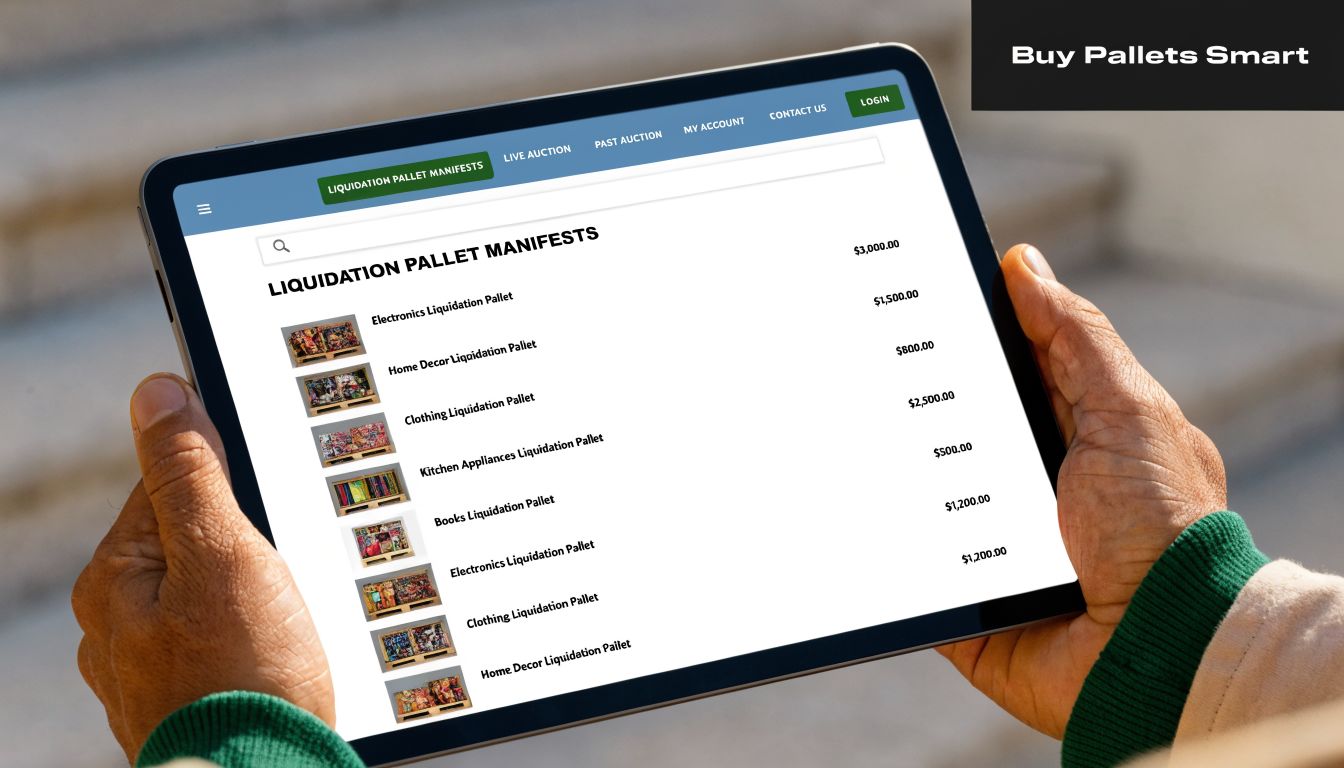
A manifest is not a list of hopes. It’s a rough underwriting document.
When I look at a lot, I’m not impressed by estimated retail value on its own. I want to know what percentage of those items fit my channels, what condition spread I’m likely dealing with, and how much labor will be required before anything goes live.
The key fields matter for different reasons:
This decision should match your stage, not your ego.
Auctions can work well when your team already knows how to evaluate lots quickly, stay disciplined on maximum bids, and walk away. Fixed-price lots usually make more sense when you want cleaner planning, less bidding volatility, and a more repeatable buying rhythm.
Here’s how I’d separate them:
| Acquisition model | Best use | Strength | Main weakness |
|---|---|---|---|
| Auction lots | Experienced buyers with strict bid discipline | Can produce better entry pricing | Easy to overpay when competition heats up |
| Fixed-price manifested lots | Teams building repeatable procurement | Better forecasting and easier internal planning | Less upside from opportunistic bidding |
A lot of teams should start with fixed-price manifested inventory even if auctions feel more exciting. Excitement is expensive.
If you’re tightening your broader procurement discipline, these strategic sourcing best practices apply directly to liquidation as well. Supplier validation, landed cost thinking, and category-based buying rules matter just as much here.
You need a scorecard before you need more pallets. Keep it simple enough that your team will use it.
A practical scorecard might include:
Channel fit
Can your current sales channels absorb this category without forcing a new workflow?
Labor intensity
Will this lot require deep testing, cleaning, bundling, or parts replacement?
Condition risk
How exposed are you to incomplete units, cosmetic damage, or nonfunctional items?
Capital efficiency
How quickly can inventory from this lot realistically convert back into cash?
Disposal burden
Are you likely to end up with a meaningful salvage pile that clogs space?
Buying rule: If your team can’t explain in one sentence where most of the lot will be sold, don’t buy it.
That one rule saves a lot of money.
A strong acquisition process also means vetting the seller or platform itself. You want business verification, clear lot data, shipping clarity, and a dispute process that exists outside of an email thread. If a seller gives vague descriptions, weak manifests, or inconsistent answers on condition, move on.
Here’s a useful walkthrough for teams that want a visual on how online pallet sourcing looks in practice:
The point isn’t to win more lots. It’s to buy lots your operation can monetize with fewer surprises.
Most liquidation profits are made after delivery. The purchase only sets the stage.
At scale, truckloads priced between $10,000-$50,000 for 24-26 pallets require 1,000+ sq ft of warehouse space for unloading and handling. Results vary sharply by category. Electronics pallets can achieve 50-70% sell-through at 3x ROI, but only after factoring in 15-25% refurbishment costs and 10-20% unsellable waste, according to B-Stock’s overview of Walmart auction economics.
The bad version of this business is opening pallets, making piles, and hoping someone figures it out. The good version looks more like a small refurbishment line.
You need designated flow from inbound receipt to outbound listing. Every touch costs money. Every uncertain item sitting on a cart for three days costs money. Every product that gets tested twice because nobody labeled it correctly costs money.
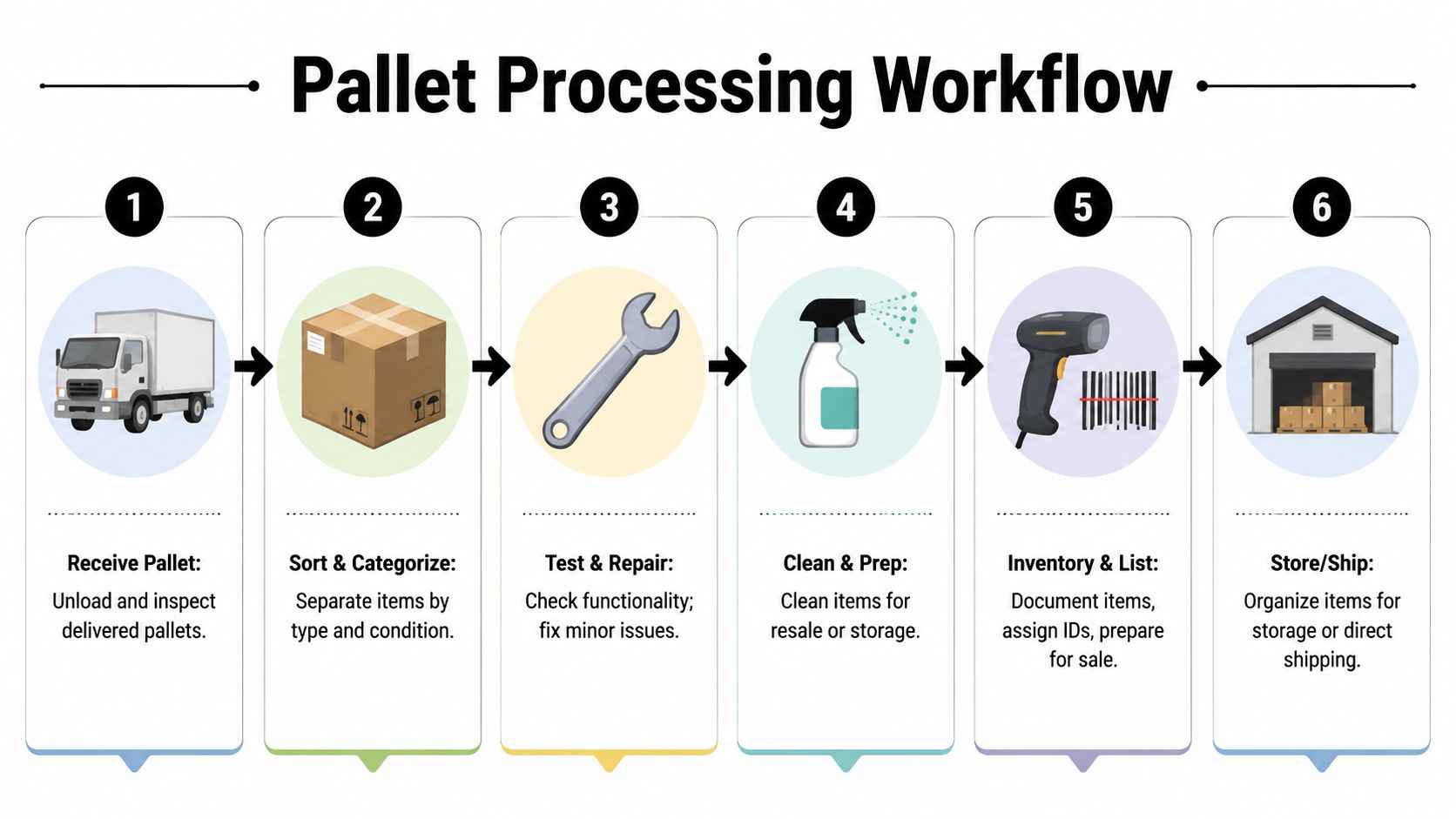
Use a fixed sequence. Don’t let team members improvise the path.
Start with intake discipline. Count pallets, inspect visible damage, and document anything that looks freight-related before product gets mixed into your normal flow. If you wait, accountability disappears.
Move fast on the first pass. Your first decision is not exact resale price. It’s routing.
Typical first-pass buckets:
Electronics, powered appliances, and anything with moving parts should go through a standard check. Don’t rely on “looks new.” That phrase creates returns.
A tight grading system usually matters more than a complex one. Teams often overcomplicate this. What you need is consistency buyers can trust across channels.
Operator note: If two employees would list the same item in two different conditions, your grading rules are too vague.
This sounds minor until you’ve processed volume. It isn’t. Open-box inventory that’s clean, complete, and repacked sells differently from inventory that still looks like it came off a returns cart.
Focus on simple prep tasks that improve sellability:
A liquidation warehouse usually stalls for one of three reasons.
| Bottleneck | What it looks like | What fixes it |
|---|---|---|
| Intake congestion | New pallets arrive before prior lots are cleared | Set inbound caps and scheduled processing windows |
| Testing backlog | High-value items sit untouched waiting for a technician | Separate quick-check inventory from deep-diagnosis inventory |
| Listing friction | Processed items pile up because cataloging is too slow | Create SKU templates and channel-specific listing rules |
The best teams remove ambiguity. They don’t ask, “What should we do with this?” very often. They already know.
If you’re serious about walmart liquidation pallets, your warehouse needs to behave like a conversion machine. Inventory comes in messy. Your operation turns it into clean, graded, sale-ready stock. That’s where the margin lives.
Once the product is graded, the next decision is channel strategy. Many liquidation operators, however, leave money on the table concerning this. They treat every item like it belongs on the same marketplace.
It doesn’t.
Different channels reward different attributes. Amazon favors catalog fit and operational compliance. eBay rewards breadth and used-item tolerance. A DTC site gives you the most control, but only if you can create buyer trust around open-box or refurbished inventory. If your team is building a broader resale engine, this primer on buying bulk and reselling is a useful companion framework.
The smart move is routing inventory based on condition, brand sensitivity, and effort required to close the sale.
Here’s the practical comparison:
| Channel | Best For | Pros | Cons |
|---|---|---|---|
| Amazon | Clean catalog-matched items, stronger brands, tested products with clear condition grading | Large buyer pool, faster movement on the right SKUs, can support operational scale | Higher compliance pressure, brand restrictions, condition disputes can hurt quickly |
| eBay | Open-box, used, odd-lot, discontinued, mixed-condition inventory | Flexible listing formats, buyers are used to imperfect goods, broad category coverage | More hands-on listing work, slower for some categories, photography and description quality matter a lot |
| DTC site | Curated open-box or refurbished collections, niche category assortments | Greater control over presentation, pricing, and customer experience | You have to generate your own traffic and trust, which takes process and positioning |
Amazon works best when your processing standards are already tight. If condition notes are sloppy or serial-linked returns create authenticity questions, Amazon becomes the wrong first destination.
For operators who are using Walmart as both a sourcing and sales ecosystem, there’s also an opportunity to scale Walmart advertising profitably once you understand which products can support paid demand. That matters more when you’re pairing liquidation with open-box or excess inventory strategies across channels.
eBay is usually the easier home for imperfect inventory that still has clear resale value. Buyers tolerate cosmetic flaws better when you disclose them clearly. Bundles, incomplete units, replacement-part listings, and older models also make more sense there.
The advantage isn’t glamour. It’s flexibility.
You can move:
Sell the inventory where the listing format matches the truth of the product. Don’t force liquidation inventory into a channel that expects retail-perfect presentation.
A direct-to-consumer site can produce strong economics, but only if the inventory feels intentional. “Random returns for sale” is not a brand. “Open-box kitchen gear,” “tested home tech deals,” or “certified refurbished tools” can become one.
The winning DTC approach usually includes:
That channel isn’t for every operator. But if you already have owned traffic, email reach, or a recognizable storefront, DTC can become the highest-control outlet for the cleanest portion of your liquidation inventory.
The best liquidation businesses don’t ask which channel is best. They ask which channel is best for this item, in this condition, at this time.
Liquidation gets dangerous when founders use simple gross margin math on inventory that carries hidden operational costs. A pallet can look great on paper and still produce weak net results once you include labor, refurb work, disposal, platform fees, and the drag of slow-moving leftovers.
That’s why you need a full operating model, not a flipping spreadsheet.
For serious founders, manifested truckloads in the $10k-$50k range are generally the better path than cheaper unmanifested buys. Unmanifested inventory carries meaningful legal and platform risk, and reseller surveys found 12-18% of high-volume flippers faced account suspensions related to policy violations on platforms such as Amazon FBA, according to SellerApp’s review of Walmart return pallet risk.

A proper liquidation model should separate inventory margin from processing efficiency. If you blend everything together, you won’t know whether buying is the problem or operations are.
Track at least these buckets:
What matters is contribution after all the friction. That’s the only number you can scale confidently.
Estimated retail value is useful for rough orientation, not for decision-making. The number that matters is what your operation can realize after grading and channel routing.
If your team wants a stronger framework for this, it’s worth reviewing how to automate net realizable value calculations. The concept fits liquidation well because it forces you to think in expected recovery, not sticker-price illusion.
Here’s the sequence:
That process sounds basic. Most operators still skip it.
Liquidation sellers get in trouble when they assume all resale channels tolerate all forms of inventory equally. They don’t.
Brand restrictions, warranty limitations, condition misclassification, and serial-linked returns can all create problems. Even when a product is legally resellable, a marketplace may still reject how it’s listed or how its condition is represented.
Risk principle: If you can’t defend an item’s condition, origin, and resale status in writing, don’t send it into a high-compliance marketplace.
That’s one reason manifested inventory matters so much. It gives you a cleaner paper trail, clearer item-level awareness, and fewer surprises when your team starts listing at volume.
Before buying or listing, run a fast screen:
| Risk area | What to ask |
|---|---|
| Condition accuracy | Can the team grade this consistently and document defects clearly? |
| Marketplace policy | Is this category likely to trigger restrictions, complaints, or authenticity scrutiny? |
| Brand sensitivity | Does this brand historically create resale friction or listing vulnerability? |
| Operational fit | Can your current warehouse process this lot without backlog or confusion? |
When founders say liquidation “stopped working,” the issue usually isn’t liquidation. It’s that they scaled buying faster than they scaled controls.
Walmart liquidation can become a strong sourcing lane. It can also become a slow-moving pile of semi-sellable inventory that eats labor and distracts your team from better opportunities.
The difference is fit.
If most of these are true, the model is worth serious consideration:
This model is usually a bad fit when these issues are present:
The right time to add walmart liquidation pallets is when your business can turn uncertainty into process. Not before.
Can your company process imperfect inventory better than the average buyer who has access to the same lot?
If the answer is yes, liquidation can become a defensible source of margin. If the answer is no, you’re just buying complexity.
The strongest operators treat this as a business unit with clear sourcing rules, intake capacity, channel routing, and compliance controls. They don’t chase every pallet. They define what a good lot looks like, buy inside that box, and let weaker buyers overpay for noise.
That’s the key playbook. Buy with discipline. Process with consistency. Sell through the right channel. Protect the downside first.
If you’re building at that level and want to compare playbooks with serious operators, Million Dollar Sellers is where high-performing e-commerce founders share what’s working across Amazon, DTC, and omnichannel growth.
Join the Ecom Entrepreneur Community for Vetted 7-9 Figure Ecommerce Founders
Learn MoreYou may also like:
Learn more about our special events!
Check Events