Chilat Doina
March 5, 2026
When you land on an Amazon product page, your eyes are immediately drawn to one spot: the box on the right with the big ‘Add to Cart’ and ‘Buy Now’ buttons. That’s the Amazon Buy Box.
Think of it as the ultimate prize for sellers. It’s the express checkout lane that drives more than 82% of all Amazon purchases, making it the most valuable piece of digital real estate on the entire platform.
Imagine walking into a department store where, instead of seeing shelves crowded with the same product from ten different brands, there’s just one item on a pedestal with a single "buy" button. Behind the scenes, the store manager has already vetted all the options and picked the absolute best one for you based on price, shipping speed, and their track record.
That’s exactly how the Amazon Buy Box works. It cuts through the noise and simplifies the decision for the shopper, presenting them with what Amazon's algorithm decides is the best overall offer available.
For sellers, this changes everything. Winning the Buy Box doesn't mean you're just one of several options; it means you become the option. When a customer clicks that "Add to Cart" button, the sale automatically goes to whichever seller is currently holding that spot. It’s like a silent, around-the-clock auction where Amazon awards the sale to the most competitive and trustworthy seller in that moment.
To give you a clearer picture, we've put together a quick summary.
This table breaks down the core concepts of the Buy Box, highlighting its incredible impact on sales and the basic requirements for sellers who want a shot at winning it.
In short, if you're not eligible or consistently losing the Buy Box, you're missing out on the lion's share of potential sales for your products.
At its core, the Buy Box is the engine that powers Amazon’s massive e-commerce machine. It was built from the ground up to do one thing: remove friction from the buying process. Instead of asking shoppers to sift through a list of sellers and compare offers, it hands them a single, trusted choice on a silver platter. This is a game-changer for conversion rates.
The sheer scale of its impact is hard to wrap your head around. Amazon processes something like $17 million in sales every single hour, and the Buy Box is the main channel for almost all of it. Recent analysis shows it’s responsible for anywhere from 82% to 90% of all sales. For any serious entrepreneur, that's why mastering the Buy Box isn't just a good idea—it's essential for scaling an Amazon business. You can find more insights on the Buy Box's power over on Adnabu's blog.
Here’s what the Amazon Buy Box looks like on a standard product page. All the critical elements that funnel a customer toward a purchase are right here.
This image perfectly captures the featured offer, showing the price, shipping info, and those all-important action buttons that send sales directly to one seller.
The Buy Box is a powerful mechanism designed for one purpose: to give the customer the best possible experience by instantly connecting them with the best offer. It’s a game of trust, performance, and value—not just price.
Ultimately, understanding what the Amazon Buy Box is marks your first step. It’s not just some feature on a webpage; it’s the primary gateway to sales on the world’s biggest online marketplace. For sellers, winning it is the trophy you get for running your business like a well-oiled machine.
So, what’s really going on behind that powerful "Add to Cart" button? It's not a lottery. Amazon uses a sophisticated, constantly-running algorithm to decide who wins the Buy Box. Its sole purpose is to pick the one seller who offers the absolute best customer experience for that specific product.
Think of it like a lightning-fast manager hiring for the most important job in the world: the sale. It scans every eligible seller in real time, weighs their qualifications, and gives the job to the one who provides the most value and inspires the most confidence.
This algorithm is the engine that directs the vast majority of Amazon's sales, creating a clear pecking order between the Buy Box winner and everyone else.
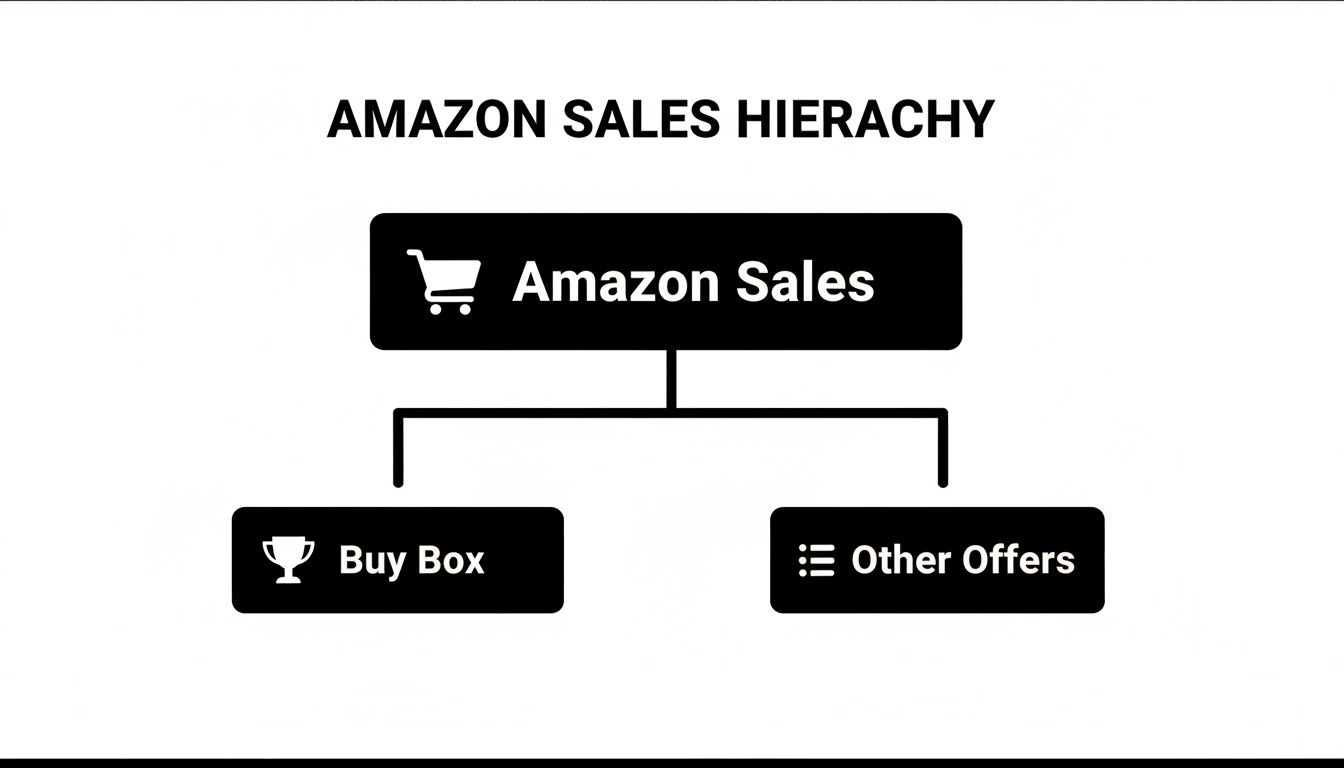
As you can see, the sales are split between the Buy Box and the "Other Offers" list, but it's not an even split. Not even close. The algorithm is designed to make this very distinction, rewarding the seller it predicts will make the customer happiest.
Amazon’s system is a bit of a black box, but we know what it values most. It doesn’t just look at one thing; it weighs a combination of factors to predict which seller will deliver the smoothest purchase.
While the exact formula is a trade secret, the algorithm consistently focuses on three core areas:
Each of these areas is made up of different data points that feed the algorithm. Let's break down how each one plays its part.
By far, the most important factor is your fulfillment method. Amazon's own network, Fulfillment by Amazon (FBA), is given the highest possible score in this category. It makes sense—Amazon controls the entire process, so it can guarantee fast shipping, perfect tracking, and its own world-class customer service.
When you use FBA, you automatically get top marks for shipping time, on-time delivery, and inventory depth because Amazon is handling it all. This gives FBA offers a massive advantage, often letting them win the Buy Box even if they're priced higher than a competitor fulfilling orders themselves.
If you’re not using FBA, your fulfillment game has to be flawless to even stand a chance. That means offering fast, free shipping and maintaining a near-perfect on-time delivery record. You can learn more in our guide on what FBA is and why it's such a game-changer.
While FBA is king, price still matters. A lot. But the algorithm isn’t just looking at the item price you set. It’s looking at the landed price—the total amount a customer pays to get the item delivered.
Landed Price = Item Price + Shipping Cost
This is exactly why offering free shipping is so important. A product listed for $20.00 with $4.99 shipping is seen by the algorithm as a $24.99 offer. A competitor using FBA who lists the same item for $24.00 with free Prime shipping is viewed as the better, cheaper, and more convenient deal. They'll almost always win.
Finally, the algorithm looks at your reputation. It digs into your account health metrics to see if you’re a trustworthy seller who consistently delivers a good experience.
It keeps a close eye on your key performance indicators, including:
These numbers tell the story of how well you run your business. A seller with perfect metrics can sometimes beat out a slightly cheaper offer from a seller with a spotty record. At its core, the algorithm is built on customer trust, and it will always favor the seller who has proven they can keep their promises.

If you want to consistently own the Amazon Buy Box, you have to build your entire strategy around three fundamental pillars. These aren’t just suggestions; they’re the core operational principles the algorithm scrutinizes when it decides who gets the next sale.
Think of it like a three-legged stool. If any one leg is weak—be it your fulfillment, your price, or your seller reputation—the whole thing topples over. Let's break down each one.
Your fulfillment method is, without a doubt, the most powerful lever you can pull. Amazon is utterly obsessed with the customer experience, and nothing defines that more than fast, reliable shipping. This is where Fulfillment by Amazon (FBA) becomes your unfair advantage.
When you enroll in FBA, you’re essentially letting Amazon handle your logistics. That one decision instantly gives you a perfect score on several key Buy Box metrics.
This is exactly why FBA sellers tend to dominate the Buy Box. Data consistently shows that FBA sellers can hit 75-85% win rates, completely overshadowing the typical 10-25% win rate for merchants fulfilling their own orders. Prime eligibility alone can boost conversion rates by 20-40%. With Amazon’s own on-time delivery rate at a staggering 98.9%, FBA is the closest thing to a silver bullet you'll find.
While fulfillment is king, price is a very close second. But here’s the thing: Amazon’s algorithm doesn’t just look at your item’s price tag. It cares about the landed price—the total amount the customer pays to get that item to their door.
Landed Price = Item Price + Shipping Cost
This is why “free shipping” is such a powerful psychological and algorithmic tool. An offer for a $25 product plus $5 for shipping is a $30 deal in the eyes of both the customer and Amazon. A competitor using FBA might list the same item at $29 with free Prime shipping and will almost always win that matchup. Their landed price is lower, and the customer experience is superior.
The goal isn't always to be the absolute cheapest seller on the listing, though. The key is being priced competitively in relation to your other metrics. An FBA seller with perfect account health can often win the Buy Box even if they are priced slightly higher than a merchant-fulfilled seller with a less-than-perfect record.
For high-volume sellers, this is where automated repricing tools become essential. They adjust your prices in real time based on what competitors are doing, helping you stay in that sweet spot without having to manually monitor hundreds of listings. You can dive deeper into crafting a winning Amazon pricing strategy in our dedicated guide.
Your Account Health is the final pillar, and it’s essentially your reputation score with Amazon. The platform needs to trust that you’re a reliable seller who delivers on promises and keeps customers happy. A few key metrics are non-negotiable.
To be a top contender for the Buy Box, you must keep these metrics well within Amazon's strict targets:
Beyond the numbers, the overall quality of your product listing—including the use of high-quality product images that drive conversions—also sends positive signals. A listing that converts well tells Amazon that customers like what you're offering, which can indirectly boost your standing.
Nailing these three pillars isn't a "set it and forget it" task. It requires constant attention. But by mastering your fulfillment, pricing, and account health, you become the exact type of seller Amazon wants to promote—making you the obvious choice for that all-important Buy Box.
You can't improve what you don't measure. For any serious Amazon seller, that measurement starts and ends with your Buy Box Percentage. Think of it as your single most important scorecard for how you stack up against the competition on any given product.
This number tells you exactly how often your offer is the one a customer sees—and buys. A high percentage means you’re dominating the listing. A low one is a flashing red light that your competitors are beating you on price, shipping speed, or seller reputation. It's a direct line to your revenue.
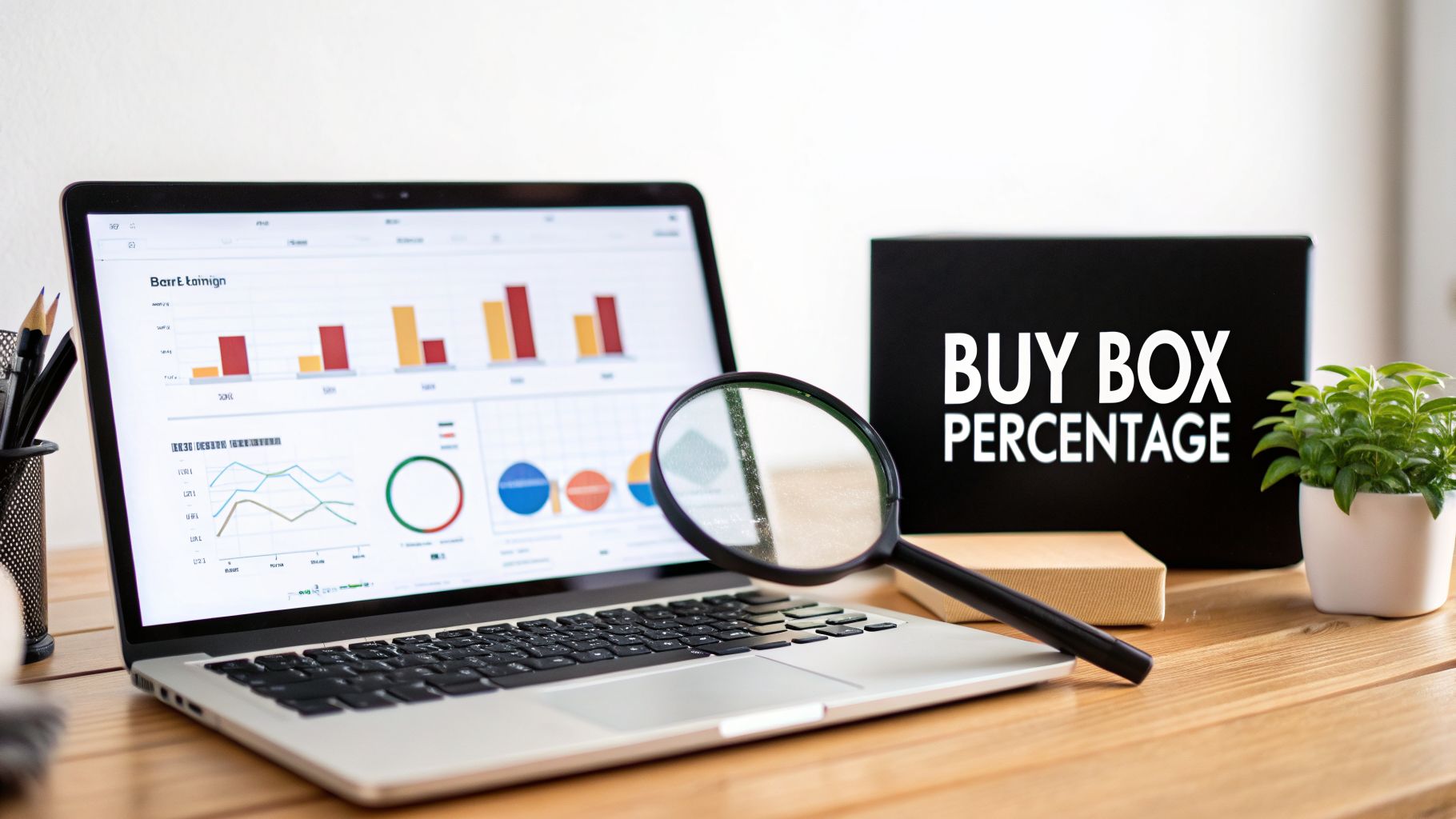
Thankfully, Amazon doesn't hide this number. You can find your Buy Box Percentage right inside Seller Central.
Just head over to your "Manage Inventory" page and customize the columns to show it. Amazon gives you a daily breakdown, so you can track your performance over the last 2, 7, or 30 days.
So, what’s a good number? Top sellers consistently aim for 80% or higher on their most important ASINs. With third-party sellers now accounting for over 60% of all sales on the platform, competition is fierce. Even a small drop in your percentage can mean a significant hit to your sales.
Seeing your percentage drop is one thing; knowing why it dropped is where the real work begins. This is where you need to get good at diagnostics.
When you're losing the Buy Box, it usually comes down to a handful of core issues. Instead of guessing, you need a systematic way to pinpoint the problem and apply the right fix.
Here’s a quick checklist I use to troubleshoot a dip in my Buy Box share. It helps you connect the problem to the specific metric you need to investigate and, most importantly, tells you what to do about it.
This table turns a frustrating sales drop into a clear, actionable to-do list. Work through it whenever you see a problem, and you'll solve issues before they seriously damage your revenue.
Winning the Buy Box isn't a "set it and forget it" task. It's a constant cycle of monitoring, diagnosing, and adjusting. The best sellers live in this loop.
The Loop: Monitor your Buy Box percentage daily. Diagnose why you're losing it using the checklist above. Implement the right fix. Then, Track the results to see if your percentage climbs back up.
This process turns you from a reactive seller, who only notices a problem when sales have tanked, into a proactive one who is always fine-tuning.
Part of this loop is keeping an eye on the other players. You need to know their moves. It's smart to regularly spy on your competitors to understand their pricing and inventory levels, which helps you stay one step ahead.
By making an 80%+ Buy Box percentage your goal and using this diagnostic approach, you take the guesswork out of the algorithm and turn it into a predictable path to more sales.
Once you’ve got the hang of fulfillment, pricing, and keeping your account health in the green, it’s time to shift your thinking. You're no longer just competing for the Amazon Buy Box—you’re aiming to completely dominate it.
For established, high-volume sellers, this means rolling out more sophisticated tactics. We’re talking about moves that protect your brand, lock in your share of sales, and snuff out costly problems before they can even start. These are the strategies that separate the top 1% of sellers from everyone else.
So, what happens when multiple sellers on a listing are all-stars? You’ve all got great prices, slick fulfillment, and stellar performance metrics. Amazon doesn’t just flip a coin. Instead, it kicks off a process called Buy Box rotation.
Think of it like a timeshare for the "Add to Cart" button. The algorithm splits ownership of the Buy Box among the top-tier sellers, giving each one a percentage of the day's customer eyeballs. It isn't always an even split, so your job is to do everything so perfectly that you're always in that elite group and snag the biggest possible slice of the pie.
Getting the lion's share of the rotation all comes down to consistency. Even a tiny dip in your performance metrics or a brief price disadvantage can get you kicked out, handing those precious sales straight to your competitors. This is where the pros play differently.
High-volume sellers use automated repricing tools not just to win the Buy Box, but to stay in the rotation even without the absolute lowest price.
For instance, a smart algorithmic repricer can tell when you're rotating with another FBA seller and will start to slowly nudge your price up. It's testing the waters to see how high it can go before you lose the Buy Box, squeezing every last drop of profit out of a sale while still securing a huge chunk of the rotation. That’s a whole different ballgame than a simple race to the bottom.
One of the most maddening things you can run into is a Suppressed Buy Box. This is when Amazon yanks the "Add to Cart" and "Buy Now" buttons from the page entirely. Shoppers are forced to click an extra button just to see who’s selling the item, which absolutely murders impulse buys and sends conversion rates plummeting.
This almost always happens for one reason: Amazon’s algorithm thinks the price is too high. This could be because it’s priced above the Manufacturer’s Suggested Retail Price (MSRP) or because Amazon’s bots found it selling for less on another website.
To get your Buy Box back, you have to tackle the price problem head-on.
For brands with their own high-powered logistics, Seller Fulfilled Prime (SFP) can be a game-changing alternative to FBA. SFP lets you get that coveted Prime badge on your products while shipping from your own warehouse. The performance standards are incredibly demanding, but it gives you way more control over your inventory and can be cheaper for certain types of products.
Finally, you have to defend your home turf. Nothing stings more than losing the Buy Box on your own product to some unauthorized reseller. This is where Amazon Brand Registry becomes your most powerful weapon.
Brand Registry gives you the power to control your product listings, report counterfeiters, and remove unauthorized sellers who are damaging your brand's reputation or violating your pricing policies. It's the ultimate defensive strategy for protecting your hard-earned Buy Box share on your own turf.
Using these tools lets you not only outmaneuver third-party competitors but also shield your brand's integrity from bad actors. When you combine a strong Brand Registry defense with a smart advertising plan, you create a fortress around your listings.
To put all the pieces together, check out our complete guide to a winning Amazon advertising strategy and see how it works hand-in-glove with your Buy Box efforts.
Even after you get the hang of the Buy Box, some questions always seem to pop up in the day-to-day grind of selling on Amazon. Let's cut through the noise and get you some straight answers to the most common puzzles sellers face.
We’ll tackle everything from eligibility hurdles and pricing myths to the dreaded suppressed Buy Box.
It's a classic head-scratcher for new sellers. You’ve signed up for a Professional Seller account, but you’re still not eligible to win the Buy Box. What gives?
The simple truth is, Buy Box eligibility isn't something you just get with a subscription—it's earned. Amazon needs to see a proven track record before it will trust you with its customers.
Your account is likely too new. Amazon's algorithm is data-hungry, and it needs time to see that you're the real deal. The main reasons you're on the sidelines usually boil down to:
Your mission is to focus on getting those first sales, shipping them out perfectly, and keeping your account health spotless. Eligibility almost always follows once you’ve proven you’re a reliable seller over a few weeks or months.
Absolutely. This is probably the biggest myth out there. While your price is obviously a huge factor, the algorithm isn't just looking for the cheapest offer. It’s searching for the best overall value for the customer.
Amazon's goal is to create the best possible buying experience. A slightly higher price from a seller with flawless fulfillment and a sterling reputation is often seen as a better, safer bet for the customer than a cheaper offer from a less reliable seller.
Think about it from Amazon's perspective. An FBA seller with a 99% feedback score can often price their product a few percentage points higher than an FBM seller with slower shipping times and still own the Buy Box. Why? Because the trust and convenience that come with FBA and a great seller history often outweigh a small price difference.
The goal is to be competitively priced, not necessarily the cheapest.
Running out of stock is painful, and unfortunately, getting the Buy Box back isn't instantaneous. A stockout is a negative signal to Amazon’s algorithm—it suggests you might not be a reliable source for that product. When you finally do restock, the system needs a moment to verify that your inventory is actually there and ready to go.
The recovery time can be anywhere from a few hours to several days. How quickly you bounce back really depends on a few things:
The best defense here is a good offense. Use solid inventory management tools to avoid stocking out on your bestsellers in the first place.
A "Suppressed Buy Box" is what happens when Amazon removes the ‘Add to Cart’ and ‘Buy Now’ buttons from a product page entirely. Instead, customers see a button that says "See All Buying Options." This extra click is a conversion killer. It’s a serious problem that needs to be fixed fast.
This usually happens when Amazon thinks the price is too high. Its algorithm constantly compares your price to external benchmarks, like the Manufacturer's Suggested Retail Price (MSRP) or prices on other sites like Walmart or even your own brand website. If your price is out of whack, Amazon pulls the plug.
To fix a suppressed Buy Box, you have to get your price back to what Amazon considers fair market value. The quickest way is to lower your price in small increments until the Buy Box reappears. It's also a good idea to double-check the MSRP in your product's backend settings to make sure it's accurate and not causing the problem.
At Million Dollar Sellers, our members navigate these challenges daily, sharing strategies that keep them ahead of the competition. If you're a high-volume seller ready to scale with insights from the top 1% of e-commerce entrepreneurs, find out if you qualify for our exclusive community. Learn more at milliondollarsellers.com.
Join the Ecom Entrepreneur Community for Vetted 7-9 Figure Ecommerce Founders
Learn MoreYou may also like:
Learn more about our special events!
Check Events