Chilat Doina
March 30, 2026
Let's be blunt: if you're thinking of launching on Amazon in 2026 with a "find a product, throw it up, and get rich" mindset, you're about five years too late. Success on this platform isn't about blind ambition anymore. It’s about a cold, hard look at the data and a strategy built to navigate a hyper-competitive, mature marketplace.
You're not just finding a product; you're carving out a defensible position against millions of other sellers. It means understanding market saturation, where the real revenue is flowing, and what the top players are actually doing to stay on top.

Before you invest a single dollar, you need to look past the influencer hype and see the battlefield for what it is. This isn't a get-rich-quick scheme; it's a strategic briefing on the real-world numbers and the unwritten rules of engagement for experienced founders.
The scale of Amazon is staggering, but the numbers tell a very specific story of concentrated success. Let’s get into the specifics you need to know.
To put the competitive field into perspective, here's a snapshot of the most crucial metrics for 2026.
MetricFigureSignificance for SellersActive US Sellers1.1 millionThe US is the most lucrative and most competitive market. You need a clear differentiator to stand out.Annual Revenue >$300k~11% of sellersThe majority of sellers make far less. This is the first major milestone for a serious business.Monthly Revenue >$100k~2% of sellersThe top tier is an exclusive club. Reaching it requires systems, branding, and relentless optimization, not just a good product.3P Seller Services Revenue$172.17 billion (2025)Amazon's business is to help you sell. This massive number shows they are heavily invested in the tools and services you'll use to grow.Prime MembershipOver 200 millionThis is your target audience. Accessing them is non-negotiable, and FBA is the only reliable key to that door.
These figures aren't meant to scare you off—they're meant to focus you. The path to the top is narrow, but it's well-defined. You can get more details on these Amazon seller statistics to see just how competitive the field is.
The sellers living in that top 2% aren't relying on secrets. They've just mastered the fundamental pillars of the Amazon ecosystem.
First, deep FBA integration. Let's be clear: Fulfillment by Amazon (FBA) isn't optional if you're serious about growth. It’s the gatekeeper to the Prime badge, which is your ticket to over 200 million members who filter for 2-day shipping by default. Simply enrolling in FBA can give you a sales lift overnight.
Second, it’s about brand building, not just selling products. The most successful operators don't just list widgets; they build defensible brands. That means getting a trademark, enrolling in Brand Registry, and using every tool in the box—like A+ Content and branded Storefronts—to create an identity. A real brand builds trust and creates a moat that copycats can't easily cross.
The question is no longer "Can I sell on Amazon?" but "Can I build a defensible brand on Amazon?" The top 2% of sellers focus on creating assets, not just flipping products.
For a new business entering this space, this data is your roadmap. Your goal isn't just to launch. It’s to launch in a way that positions you to climb into that top tier of sellers. It demands a complete mindset shift from chasing short-term hacks to building long-term enterprise value.
Your initial strategy has to be surgical. It's about finding a niche where you can not only compete but dominate and establish a real brand. This means going deeper on market research, building a bulletproof supply chain, and executing a sophisticated launch and marketing plan from day one.
When you understand the landscape from this perspective, you stop building a simple Amazon store and start building a scalable, profitable, and ultimately sellable business.
When you're building an Amazon business with your sights set on a massive exit, your initial setup is everything. It’s not just paperwork; it’s the blueprint for your future valuation.
Amateur sellers just pick a business name and get started. Professional brand builders, on the other hand, architect a business entity designed for asset protection, future investment, and a clean, profitable exit. This is the first, most crucial step in separating yourself from the hobbyists.
Choosing between an LLC (Limited Liability Company) and an S-Corp isn't just about taxes. It's a strategic move that dictates how you shield your personal assets from business liabilities—an absolute must in the often-litigious world of e-commerce. For most founders, an LLC provides a simple, direct path to liability protection and pass-through taxation.
But as you grow, electing S-Corp status can unlock major payroll tax savings, something that becomes incredibly relevant once your profits start to climb. Getting this right from day one impacts your ability to bring on investors or execute a seamless sale down the road.
A personal checking account is a non-starter. If you’re serious about building a brand, you need a scalable financial stack from the get-go. This means setting up a dedicated business bank account and securing business credit lines immediately.
This isn’t just for clean bookkeeping. It builds a financial track record that lenders and, more importantly, future buyers will comb through during due diligence.
Your brand is your single most valuable asset. Protecting it legally isn't optional.
A strong brand acts as a multiplier on your exit valuation. Acquirers buy systems and brands, not just products. The foundational work you do here translates directly into a more defensible—and far more valuable—business.
Sales tax compliance can turn into an absolute nightmare if you ignore it at the beginning. The 2018 Supreme Court ruling in South Dakota v. Wayfair, Inc. gave states the power to tax purchases from out-of-state sellers, creating what's known as sales tax nexus.
For Amazon sellers, nexus can be triggered just by having inventory stored in an FBA warehouse in a given state. Trying to track this manually is a recipe for disaster.
Integrating a tool like TaxJar or Avalara from day one automates the whole collection and remittance process, keeping you compliant as you scale. Ignoring this can create huge hidden liabilities that will absolutely derail a future sale. For a deeper dive, check out our guide on creating a business exit strategy plan from the start.
To truly scale, you also have to understand the minefield of international expansion. Countless great products have fizzled out because their founders failed to build a structure that could support growth beyond their home market. Building that solid operational and legal foundation is the key, as laid out in this excellent expansion playbook for Amazon sellers.
Thinking about these bigger-picture complexities on day one is what paves the way for a successful seven- or eight-figure exit.
Look, anyone can spot a trending product. The real money on Amazon, especially if you're building a brand with a future exit in mind, isn't in chasing the next fidget spinner. Amateurs hunt for trends; professionals build fortresses.
Your approach to product research has to shift from chasing fleeting demand to owning a profitable, evergreen niche. Success in 2026 is found in the gaps. It's about spotting underserved customers, identifying weaknesses in the top listings, and finding a corner of the market where you can build a brand that lasts.
Tools like Helium 10 and Jungle Scout are table stakes, but most sellers barely scratch the surface of what they can do. Don't just glance at the estimated monthly revenue. That's a rookie move. Use these tools as your launchpad for some serious competitive digging.
Here's how to go deeper:
True market opportunity isn't just high demand. It’s high demand combined with solvable customer pain points and beatable competition. Your first product should be a direct answer to the negative reviews of the current best-sellers.
This mindset turns you from a trend-chaser into a problem-solver. That's a much stronger position to be in when you're building a brand worth a damn.
One of the most common—and costly—mistakes I see is a complete miscalculation of profitability. Sellers get excited about the landed cost versus the sale price and totally forget about the army of fees waiting to eat their margins. To get a real number, you have to account for everything.
Your real profit calculation needs to include:
A product that looks like a winner on a simple spreadsheet can quickly turn into a money pit. Understanding these numbers is also key to sizing up the competition. You can learn more about how to conduct competitor analysis to spot these financial weaknesses in other brands and find your angle of attack.
The final layer of pro-level research is looking beyond a single product to evaluate the entire niche. This is how you build an actual business, not just a successful listing.
Before you pull the trigger, think about these strategic factors:
For instance, instead of launching "a yoga mat," you frame the niche as "eco-friendly travel yoga accessories." Suddenly, you have a clear roadmap for your next products: a cork yoga block, a carrying strap made from recycled materials, and an organic mat cleaner. This is how you build an Amazon business that’s designed to scale from day one.
Your Amazon business is only as strong as your supply chain. Full stop. The top sellers I know aren't just masters of marketing; they're obsessed with the systems they build to source, produce, and move their products without a hitch. A solid supply chain is your best defense against the things that kill Amazon businesses: stockouts, declining quality, and shrinking margins.
This is a world away from just firing off a few inquiries on Alibaba. It demands a strategic hunt for real partners who can scale with you. Building what we call an "anti-fragile" supply chain is how you insulate your business from the inevitable chaos of global trade, whether it’s a port strike or a sudden spike in shipping costs.
Finding a factory is easy. Finding the right factory is the hard part. Your goal here isn't a transactional, one-off order; it's to build a strategic alliance. That whole process kicks off with some serious vetting.
Don't just take their word for it or rely on a slick online profile. Get samples. Insist on live video tours of the factory floor. And for your first few production runs, always hire a third-party inspection service. It's cheap insurance against a container full of duds.
Once you have a couple of solid contenders, it’s time to talk terms. Price is obviously a factor, but it shouldn't be the only one. Getting favorable payment terms can be worth far more to your business's health.
A strong supply chain is all about having options. When you have multiple vetted suppliers, you control your destiny. When you only have one, they control yours.
To really nail this, you need a system. Our guide on the essential supplier vetting checklist gives you a repeatable process for making sure you’re only working with reliable, high-quality partners.
The language of international shipping can feel like alphabet soup, but you absolutely have to understand Incoterms. These are the universal rules that spell out who is responsible for the goods—and who pays for what—at every step of the journey.
IncotermWho Pays for Main FreightRisk Transfer PointBest ForEXW (Ex Works)You (the Buyer)At the factory doorExperienced importers who want full controlFOB (Free on Board)You (the Buyer)Once goods are on the shipMost common; a good balance of cost and controlDDP (Delivered Duty Paid)The SupplierAt your destination warehouseBeginners; simple but often highest cost
DDP looks tempting because it's so simple, but you're almost always paying a hidden premium for that convenience. We find that FOB usually hits the sweet spot. It gives you control over the most expensive leg of the journey (the ocean or air freight) without forcing you to deal with local trucking in the origin country.
To make this happen, you'll need a great freight forwarder. Think of them as the quarterback for your logistics. They'll coordinate everything from factory pickup and customs clearance to the final delivery at an Amazon FBA center. A good forwarder doesn’t just move boxes; they save you money and prevent catastrophic delays.
The last piece of the supply chain puzzle is getting your products to customers. The choice between Fulfillment by Amazon (FBA) and Fulfillment by Merchant (FBM) will have a huge impact on your costs, customer service, and ability to scale.
Fulfillment by Amazon (FBA) is the go-to for most sellers. You ship your inventory in bulk to Amazon’s warehouses, and they take care of everything else: storage, picking, packing, and shipping. The biggest win here is getting the Prime badge on your listing, which is a powerful driver for conversions. The downside? FBA fees can eat into your margins, especially for items that are big, heavy, or slow to sell.
Fulfillment by Merchant (FBM) means you're in the driver's seat. You store and ship everything yourself, or you hire a third-party logistics (3PL) company to do it for you. You get more control over your inventory and branding, but it’s tough to compete for the Buy Box unless you qualify for Seller Fulfilled Prime (SFP), which has incredibly strict performance metrics.
As a business matures, many sellers land on a hybrid model. They keep their fastest-selling products in FBA to get that Prime boost and fulfill larger or more niche items via FBM or a 3PL to keep costs down. This strategic approach lets you optimize for both sales velocity and profitability right from the start.
A successful Amazon launch isn't a happy accident. It’s a full-on, meticulously planned campaign designed to grab momentum from the get-go and build a position that’s tough for competitors to attack. For experienced founders, this is where you weaponize your data and capital to carve out market share, fast.
Forget just “going live.” We’re talking about a high-speed sequence that pulls together listing optimization, review generation, and aggressive PPC to dominate from day one. This is the playbook that separates the seven-figure sellers from everyone else.
Think of your product listing as your top salesperson, working 24/7 without a coffee break. Before you even think about driving traffic, that page has to be engineered for one purpose: turning visitors into buyers. This goes way beyond just writing a few bullet points.
This entire launch hinges on a solid supply chain. Without product on the shelves, the best marketing in the world is useless.
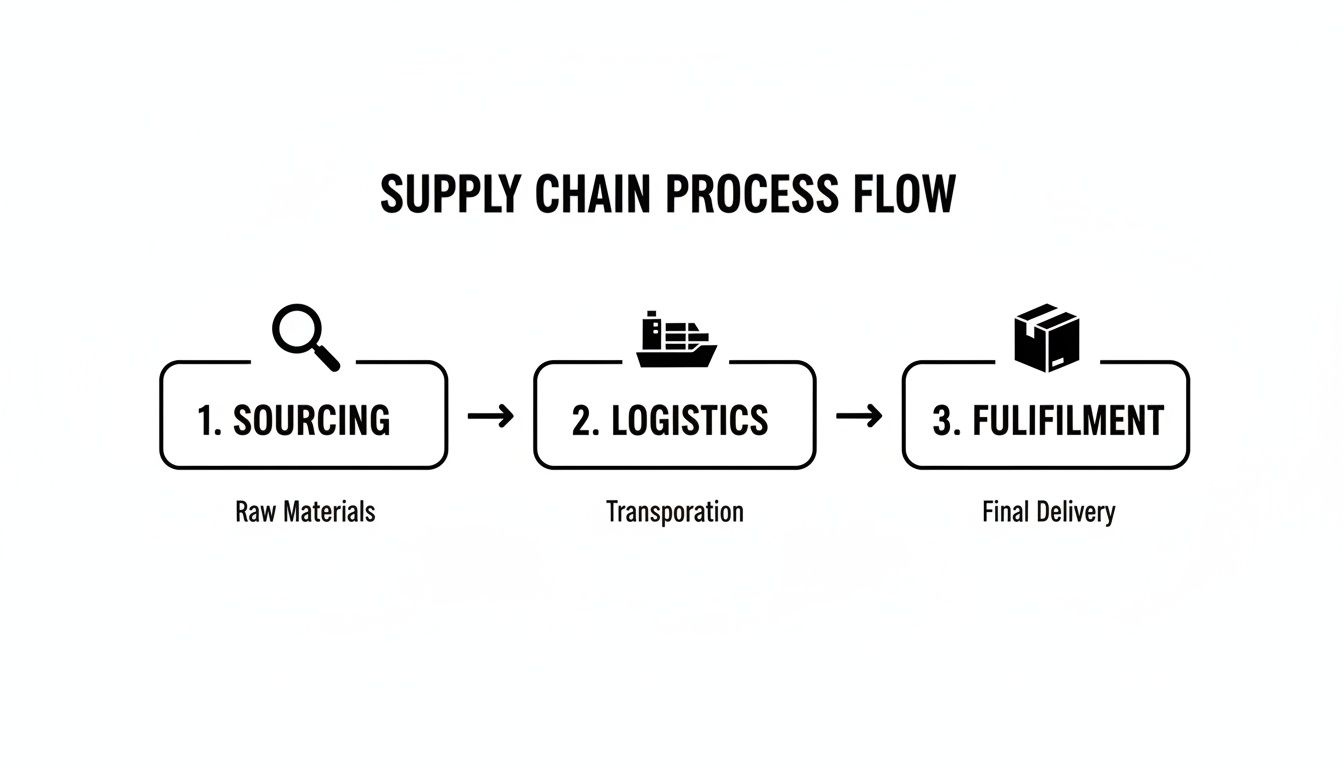
As you can see, a great launch is just the final step. It’s the culmination of smart operational decisions, from sourcing your product to making sure it gets where it needs to go. A stockout during launch can kill all your momentum.
Okay, time to pour some fuel on the fire. PPC on Amazon isn't what it used to be. You can't just set up an "auto" campaign and cross your fingers. The game has changed, and the top sellers have adapted. The goal now is to use PPC to find what works, prove it, and then scale it profitably.
Here’s a foundational structure that just works:
Campaign TypePurposeBidding StrategyAuto CampaignBroad discovery of new customer search terms.Low bids to gather data cost-effectively.Research CampaignTest promising keywords from the auto campaign.Moderate bids to gauge performance.Proven CampaignScale high-converting, profitable keywords.Aggressive bids to dominate top-of-search.
This "keyword graduation" process stops you from burning cash. You use the auto campaign as a cheap research tool, validate the search terms in a controlled environment, and then put your budget behind the proven winners. For a deeper dive, check out our complete guide to Amazon Ads campaign structures.
With your foundation in place, it’s time to get surgical. The most successful sellers are using advanced tactics to outplay the competition, especially as ad costs continue to climb.
And they are climbing. Advertising revenue shot up by 22-23% to $21.3 billion in just one quarter of 2025. That means more competition and higher ad costs squeezing your margins. With Amazon owning about 40% of all US e-commerce, mastering advertising is non-negotiable.
Here are a few pro-level tactics you should be using:
Ad Spend / Total Sales, shows you the real impact PPC is having on your overall growth. If your ACoS is rising but your TACoS is falling, that’s a great sign—it means your ads are successfully driving organic sales.The ultimate goal of PPC isn't just to make ad-driven sales; it's to feed the algorithm. By sending targeted, high-intent traffic to a listing that converts well, you're teaching Amazon that your product is a winner. This boosts your organic rank and creates a powerful flywheel of growth.
By combining a listing built to convert with a sophisticated, layered PPC strategy, you're not just launching a product. You're executing a formula to aggressively and profitably seize market share, building a strong foundation that your competitors will find incredibly difficult to challenge.
Even if you've built successful e-commerce brands before, jumping into the Amazon ecosystem brings up a whole new set of questions. It's a different beast.
Let's cut through the noise and address the big-picture concerns we see from experienced founders every day.
This is always the first question, and the honest answer is: it depends entirely on your product, your launch budget, and how aggressively you play the game. Profitability on Amazon isn't a switch you flip; it's a ramp you build.
The data gives us a realistic timeline. As of early 2026, a solid 58% of sellers hit profitability within their first year. Getting there means you're not just taking profits home; you're funneling cash back into inventory and PPC to build that crucial momentum.
With a median product margin of 28.5%, the potential is definitely there. But you have to treat it like a long-term investment. You can see more on this in a recent in-depth marketplace analysis.
Scaling on Amazon in 2026 is a far more sophisticated challenge than it was just a few years ago. The opportunity is still massive, but so are the hurdles.
The number one pain point for almost every seller is the relentless rise in ad costs. Amazon’s ad platform is a revenue-generating machine, which means you're paying more for every click. You can't just "set it and forget it" anymore; you need a razor-sharp PPC strategy.
Beyond ads, these are the roadblocks that will define your ability to scale:
The real challenge of scaling on Amazon is shifting your mindset from being a "product seller" to a "systems builder." Your growth will be determined by your ability to create efficient, repeatable processes for cash, inventory, and marketing.
This is one of your first major decisions, and it sets the foundation for your entire operation. Fulfillment by Amazon (FBA) and Fulfillment by Merchant (FBM) each have their place, but the right choice depends on your product and your team's capabilities.
For most sellers serious about growth, Fulfillment by Amazon (FBA) is the only way to go. Why? Because over 82% of top sellers use it for one simple reason: the Prime badge.
That little badge is your key to Amazon's 200 million+ Prime members, who are trained to expect fast, free shipping. The boost in conversion rate you get from being Prime-eligible is something you just can't ignore.
That said, FBM isn't dead. It makes sense for specific situations:
Many 7- and 8-figure brands actually use a hybrid approach. They keep their best-sellers in FBA to maximize sales velocity and use FBM or a 3PL for the rest of their catalog. It’s a smart way to get the best of both worlds.
At Million Dollar Sellers, our members navigate these high-stakes decisions every day, sharing real-world data and strategies that drive multi-million dollar growth. We are the trusted, private community where top e-commerce founders come together to solve complex challenges and build truly scalable brands. If you're an established seller ready to join an elite peer group, MDS is your next step. Learn more at https://milliondollarsellers.com.
Join the Ecom Entrepreneur Community for Vetted 7-9 Figure Ecommerce Founders
Learn MoreYou may also like:
Learn more about our special events!
Check Events