Chilat Doina
January 7, 2026
Finding the right wholesale suppliers for Amazon is less about just sourcing products and more about building a real, scalable business from the ground up. The sellers who truly crush it don't just jump on the phone with a supplier. They meticulously define a profitable niche, map out a rock-solid business strategy, and get all their legal ducks in a row before ever making that first contact.
Diving headfirst into supplier outreach without a clear plan is a surefire way to burn through time and cash. Think about it from the supplier's perspective: top-tier brands and distributors want to partner with serious, organized businesses, not just another random reseller asking for a price list.
So, before you even think about drafting that first email, you need to build the foundational pillars of a legitimate wholesale operation. This upfront work is what separates the amateurs from the seven-figure sellers.
The wholesale model is a proven powerhouse for scaling on Amazon. In fact, in 2023, a massive 26% of Amazon sellers were running on the wholesale model. It's a testament to its power for creating predictable inventory and healthier profit margins. For sellers in elite communities like Million Dollar Sellers—where members pull in over $8 billion in annual sales—this model is a core growth driver.
You can't be everything to everyone. The very first step is to lock down a profitable niche where you can genuinely compete and add value. Forget broad categories like "kitchen gadgets." You need to drill down into specific sub-niches, like "premium coffee brewing accessories for home baristas" or "eco-friendly food storage solutions."
A focused strategy lets you:
A huge part of wholesale success comes from strategically buying products in larger quantities to pump up your margins. This means you need to master some effective strategies for buying in bulk for resale to make sure you're getting the best possible terms from your suppliers.
This simple diagram breaks down the three core pillars you need in place before you even start sourcing.
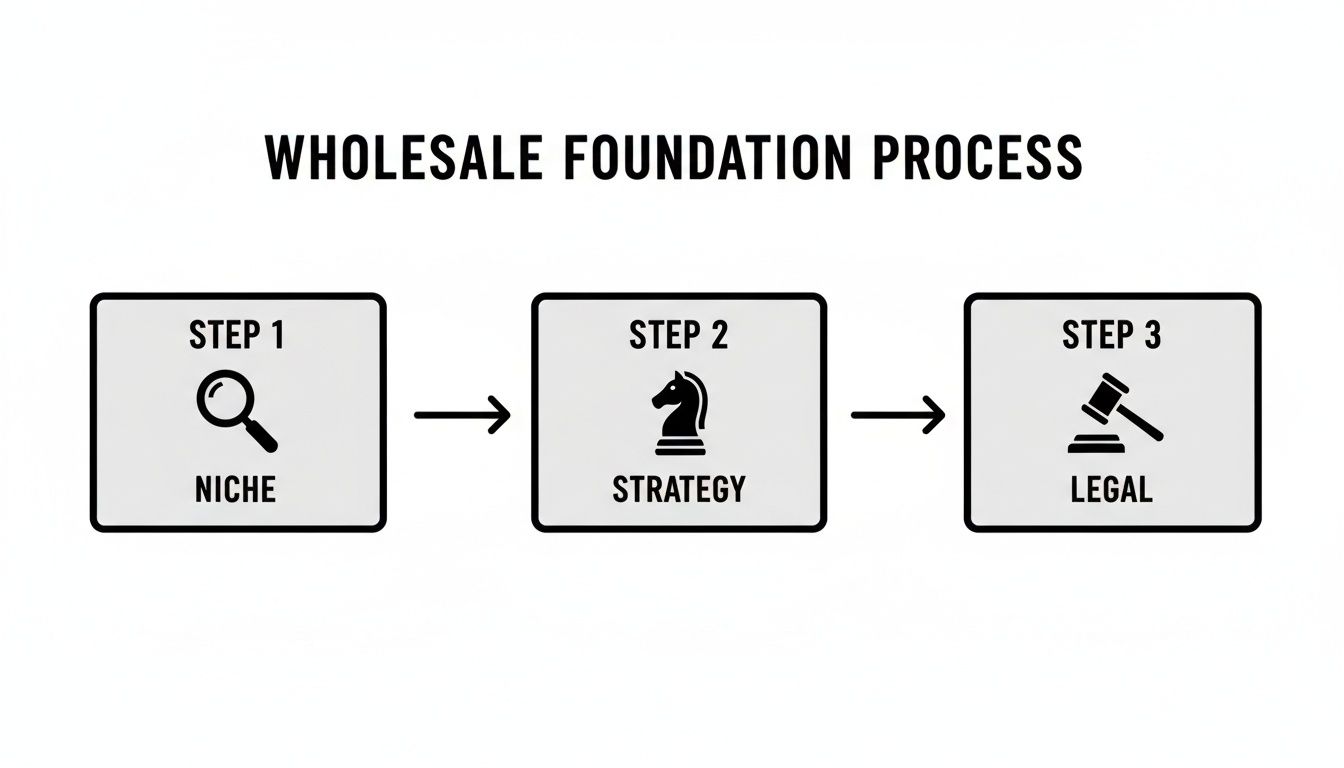
As you can see, niche selection and strategic planning have to come before anything else—including the legal setup and supplier outreach.
Once you have a clear strategy, it's time to make your business official. This isn't just about ticking a compliance box; it’s about looking like a professional. No serious supplier will even talk to you without the proper credentials.
Before you contact a single potential supplier, have your business license, EIN, and reseller permit ready to go. These documents are non-negotiable. They are your proof that you're a legitimate business ready to place real wholesale orders.
Having these documents on hand shows you're organized and serious, which immediately builds trust and makes the whole account-opening process smoother. Honestly, it's the bare minimum to get your foot in the door with reputable distributors. Without this groundwork, your search for wholesale suppliers for Amazon will just be a frustrating dead end.
If your whole strategy for finding wholesale suppliers for Amazon is just typing things into Google, you're leaving a ton of money on the table.
Seriously. The best, most profitable suppliers aren’t the ones with flashy websites and great SEO. They’re too busy fulfilling massive orders for established distributors to worry about showing up on page one.
To find these suppliers, you need to go where the pros go. It’s less about your keyboard and more about tapping into curated networks, showing up at industry events, and doing a little detective work to see who your competitors are really buying from.
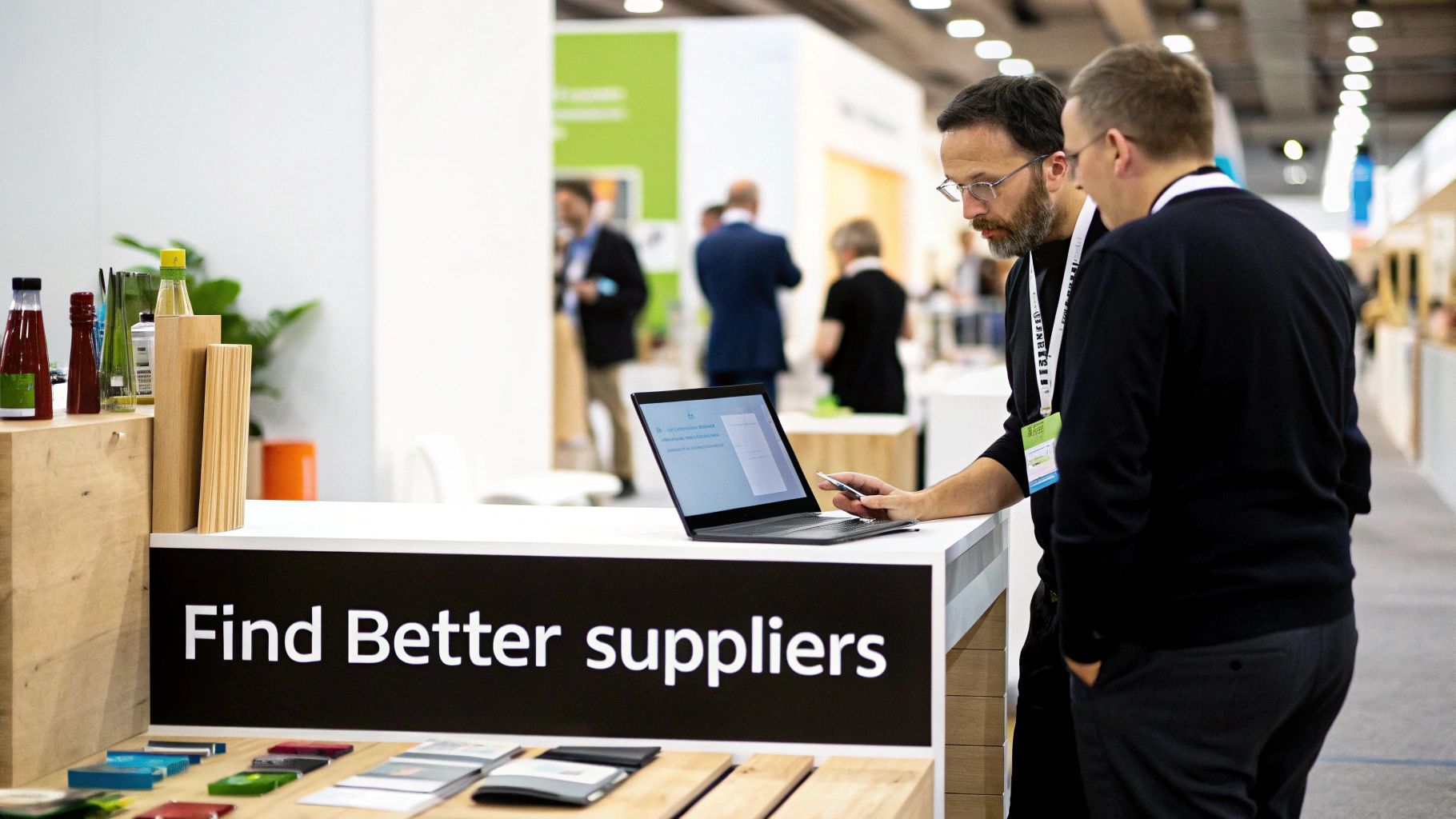
Honestly, trade shows are probably the single most powerful way to find high-caliber wholesale partners. Think about it: hundreds of manufacturers, brands, and distributors all packed under one roof, with decision-makers ready to talk.
But you can't just wander in and expect to walk out with amazing deals. Walking into a major show like ASD Market Week or the Canton Fair without a plan is a classic rookie mistake. You need to treat it like a mission.
The real goal at the show is to build rapport. Ask smart questions about their best-selling products, their specific policies for Amazon sellers, and what their minimum order quantities (MOQs) look like. This is your shot to make a real human connection that a cold email could never achieve.
While a generic Google search is a dead end, paid B2B directories are curated goldmines of pre-vetted suppliers. Platforms like ThomasNet, SaleHoo, and Worldwide Brands have already done the hard part for you, weeding out the sketchy operators and giving you detailed profiles on legitimate companies.
The real power here is the ability to search with surgical precision. You can filter suppliers by:
It’s no surprise that third-party sellers, powered by these exact supply chains, generated $36.51 billion in sales in Q1 2025 alone. For sellers in communities like Million Dollar Sellers, relying on directories to lock in US-based suppliers often translates to much better margins—sometimes up to 31% higher than other sourcing models—and far more reliable logistics.
These B2B online marketplaces are mission-critical tools, but you have to know how to use them to get the best results.
Pro Tip: Don't just search for a specific product in a directory. Instead, look for distributors who carry entire brands you want to sell. Landing one account with a major distributor can instantly give you access to dozens, sometimes hundreds, of profitable product lines for your Amazon store.
Going straight to the source—the manufacturer—is the ultimate wholesale power move. You cut out the middleman (the distributor), which immediately lowers your product costs and sends your potential profit margins through the roof. This is how you build a real, defensible business.
Now, finding the manufacturer isn't always easy. Many brands have exclusive deals with distributors and won't even talk to individual retailers. But you can often figure out who they are by checking the product packaging, digging around the brand's official website, or using import/export data tools like Jungle Scout's Supplier Database.
When you do reach out, your pitch has to be perfect. You need to position yourself as a valuable partner who can grow their sales and protect their brand on Amazon. It's more work, for sure, but the payoff is a supply chain your competitors can't touch. To build out your list of potential partners, it helps to look beyond the obvious, and this guide on finding the best wholesale suppliers is a great place to start.
Choosing where to focus your energy depends a lot on your business model, capital, and how much time you can invest. Each channel has its distinct advantages and disadvantages.
Below is a quick breakdown to help you decide which path makes the most sense for you right now.
Sourcing ChannelBest ForProsConsTrade ShowsSellers who want to build strong, personal relationships and find exclusive deals.• Direct access to decision-makers• Discover new and unique products• Negotiate better terms in person• Requires travel and investment• Can be overwhelming without a plan• Time-consumingB2B DirectoriesNew and established sellers looking for a wide, pre-vetted list of reliable suppliers.• Efficient and scalable• Access to verified supplier info• Precise filtering options• Subscription fees required• Less exclusive; competitors use them• Impersonal communicationDirect to Mfr.Experienced sellers aiming for the highest margins and building a long-term, defensible brand.• Lowest possible product costs• Greater control over supply chain• Exclusive product access• High MOQs are common• Difficult to get approved• Requires a very professional approach
Ultimately, the most successful sellers often use a hybrid approach. You might use directories for initial research, meet those suppliers at a trade show to solidify the relationship, and eventually graduate to a direct-to-manufacturer account once you've proven your volume.
Once you've shortlisted a few promising wholesale suppliers, the real work begins. Your first contact is a make-or-break moment that sets the tone for the entire relationship. A generic, low-effort email will get you deleted in a heartbeat, but a professional, value-driven approach opens the door to a profitable partnership.
The goal here isn't just to snag a price list. It's to position your business as a serious distributor who can move their products and fiercely protect their brand on the chaotic Amazon marketplace. So, ditch any template that screams, "I'm a brand new Amazon seller!" Your outreach needs to be sharp, concise, and focused on what you bring to the table.
Whether it's an email or a phone call, your initial contact has to be professional and straight to the point. Introduce your business and clearly state your interest in becoming an authorized retailer. This isn't the time for your life story or your entrepreneurial origin myth.
Instead, get right to the good stuff—showcasing your value with concrete points:
This approach completely flips the script. You’re not just asking for something; you’re offering them a skilled partner who can help them grow their Amazon channel. It’s a subtle but powerful shift in positioning.
Getting the account is just the beginning. The real art is in the negotiation, and trust me, it’s about way more than just the cost per unit. The best suppliers often have firm pricing, but they might be flexible on other terms that are just as vital for your cash flow and profitability.
The best wholesale relationships are built on mutual benefit. Aim to negotiate terms that protect your cash flow as much as your profit margin. Securing a Net 30 account is often more valuable than an extra 2% discount on the unit price.
Focus your energy on negotiating these key areas:
A smart negotiator sees things from the supplier's perspective and frames requests as win-win scenarios. If you want to dive deeper into building leverage, check out these advanced techniques for negotiating with suppliers. It can give you a serious competitive edge.
When you contact a potential supplier, you're not just another Amazon seller; you're a potential long-term partner. Frame your entire proposal around that idea.
Explain how you manage your inventory, your process for handling customer service, and your ironclad commitment to upholding their brand’s reputation and MAP (Minimum Advertised Price) policies. This shows them you get the challenges brands face on Amazon and that you're equipped to be a solution, not another problem.
By mastering your outreach and thinking strategically about negotiation, you lay the foundation for a resilient and seriously profitable wholesale business.
After you’ve opened a line of communication with a promising supplier, it's easy to get excited. You want to place that first big purchase order. But hold on—this is a massive mistake.
Rushing in and choosing the wrong partner can absolutely torpedo your business. We're talking defective inventory, a flood of negative reviews, and even putting your Amazon account at risk. A rigorous vetting process isn't just a box to check; it’s your primary defense against costly, time-wasting partnerships. This is where you separate the professional, reliable wholesale suppliers for Amazon from the pretenders who can’t deliver on their promises.

This due diligence has never been more critical. Amazon's seller base exploded to 9.7 million globally by 2025, with wholesale sourcing powering a whopping 26% of these entrepreneurs. How did they succeed? By using rock-solid vetting strategies to secure reliable inventory, which led to an incredible 4.5 billion items sold in the US alone in 2023. You can discover more about these key Amazon seller statistics to see just how crucial supplier quality is at this massive scale.
First things first: confirm you’re dealing with a legitimate, established business. Don't just take their website or a smooth-talking sales rep at face value. A truly professional supplier will have zero problem providing the documents to prove they're the real deal.
Start by asking for their business license and tax ID (EIN). You can cross-reference this info with state business registries to make sure they are who they say they are. Next, ask for trade references—other businesses they currently supply. A reputable wholesaler will gladly give you a few contacts.
When you call these references, ask targeted questions:
A few quick phone calls can reveal more about a supplier’s day-to-day reliability than any website ever could. If a supplier gets cagey or outright refuses to provide this information, see it as the major red flag it is and walk away.
Here’s a hard truth: not all wholesale suppliers are built for the Amazon marketplace. Some have policies that make it nearly impossible to turn a profit. You have to dig into their specific rules for Amazon resellers before you commit to anything.
The most critical policy is their Minimum Advertised Price (MAP) policy. This is the lowest price a retailer can advertise a product for. A supplier with a strictly enforced MAP policy is your best friend—it prevents nasty price wars and protects your profit margins from bottom-feeding sellers.
Ask them directly: "How do you enforce your MAP policy?" A good supplier will have a dedicated team that actively monitors listings and boots violators. A weak or nonexistent MAP policy is just a recipe for a race to the bottom, and your profits will evaporate in the blink of an eye.
A supplier might have fantastic products, but if their warehouse operations are a train wreck, they become a huge liability. You need to get a clear picture of their ability to handle the logistical side of your business, especially if you’re using Fulfillment by Amazon (FBA).
Ask pointed questions about their operational chops:
If a supplier offers FBA prep, it can be a game-changer, saving you tons of time and money. But if they aren’t experienced with it, their mistakes can lead to costly shipment rejections from Amazon. Understanding these details is essential for figuring out your real costs. To get a handle on all the variables, it's smart to learn more about how to calculate landed cost for your products.
Pro Tip: Always, always order samples before placing a large PO. Get the product in your hands. Check the quality, inspect the packaging, and make sure it matches the listing perfectly. This small investment can save you from a massive inventory headache later.
To help you stay organized, here's a simple checklist to run through with every potential supplier.
Use this table as your guide to ask the right questions and spot potential problems before they become your problems. A thorough approach here is the foundation of a stable, profitable Amazon business.
Vetting CategoryKey Questions to AskRed Flags to Watch ForBusiness LegitimacyCan you provide your business license and EIN? Do you have trade references I can contact?Hesitation to provide documents. No references or only new, unverifiable ones.Amazon PoliciesWhat is your MAP policy? How strictly is it enforced? Do you have a list of authorized Amazon retailers?No MAP policy or one that's clearly not enforced. Vague answers about enforcement.Pricing & TermsWhat are your wholesale price tiers? What is the MOQ? What are the payment terms (Net 30, prepay)?Unwillingness to negotiate. Unreasonably high MOQs for a first order. Requiring wire transfers only.Operational CapacityWhat are your average lead times? Do you offer FBA prep services? What are the associated costs?Long, inconsistent lead times. No experience with FBA requirements. Hidden fees for prep services.Product QualityCan I order samples? Where are the products manufactured? What is your return/refund policy for defective items?Refusal to provide samples. No clear policy for handling defects. Poor quality of the samples you receive.
This checklist isn't just about avoiding bad suppliers; it's about confidently choosing the right partners who will help you grow. Don't skip these steps—your future self will thank you.
Getting that first wholesale account feels incredible. It's a huge milestone, for sure. But the real secret to building a dominant Amazon business isn’t just landing that first account—it’s what you do after the paperwork is signed. The most successful sellers don't just place orders. They actively cultivate their supplier relationships, turning simple vendors into strategic partners.
This shift in mindset, from transactional to partnership-focused, is what unlocks better pricing, exclusive access to new products, and a level of support your competitors can only dream of. It’s about nailing the day-to-day operations while building a foundation for mutual, long-term growth.
Consistency is the bedrock of any solid supplier relationship. A chaotic, last-minute ordering process tells a supplier you're disorganized, and that erodes their confidence in you. A smooth, predictable workflow, on the other hand, shows you're a professional they can rely on.
First thing’s first: create a standardized purchase order (PO) template. Every single PO you send should clearly spell out:
This simple step cuts out the guesswork and dramatically reduces the chance of expensive mistakes. The same goes for logistics. Decide on a consistent process and stick to it. Whether you're shipping directly to Amazon FBA, using a third-party logistics (3PL) provider, or prepping in your own warehouse, give your supplier the same clear instructions every time. Your goal is to make fulfilling your orders as easy as humanly possible for their team.
A great supplier relationship is built on making your business easy to work with. If your POs are always clear and your logistics are handled professionally, you instantly become a preferred customer. Suppliers prioritize partners who don't create extra work or confusion.
Placing orders is just one piece of the puzzle. You need to establish a regular communication rhythm that goes beyond the basics. This doesn’t mean calling your sales rep every day, but it does mean having scheduled, purposeful conversations about the business. One of the best ways to do this is with a quarterly business review, or QBR.
A QBR is just a short meeting to discuss performance, roadblocks, and what’s coming down the pipeline. It’s your chance to step back from day-to-day issues and talk strategy.
Here are a few key topics to cover in a QBR:
These reviews show them you're a real partner in their success. You're not just another customer account number; you're actively helping them grow their brand on Amazon. This is how you get the inside scoop on new lines and better terms down the road.
Every supplier has their favorites. You know, the customers they call first when a hot new product lands or when they have overstock to move at a deep discount. Your goal is to be on that short list.
Getting there isn't just about how much you buy. It’s earned through a combination of professionalism, reliability, and fantastic communication. Pay your invoices on time, every single time. Give them valuable feedback on how their products are selling and what you're seeing in the market. And always, always respect their MAP policies. No exceptions.
When you consistently prove that you are a low-maintenance, high-value partner who helps their business grow, you stop being just another account. You become an indispensable asset. This is the ultimate competitive advantage when sourcing from wholesale suppliers for Amazon, turning your supply chain from a cost center into a powerful engine for growth.
As you get deeper into the wholesale game, you're going to hit some roadblocks and have a ton of questions. It's totally normal. Let's run through some of the most common ones that pop up for sellers trying to scale their business, with answers straight from real-world experience.
Sooner or later, you'll find a great brand only to be told they have an exclusive deal with another big Amazon seller. It's frustrating to get that "no," but don't just walk away. It’s not always a dead end.
Try a different angle. Ask them if they have other products or even entire product lines that aren't part of that exclusive agreement. A lot of times, a brand's newer or less popular items are still up for grabs. This can be the perfect way to get your foot in the door and prove what you can do for them.
Another play is to simply circle back in six months or a year. These exclusive deals don't always last forever. If the current seller is underperforming, the brand might be looking for a change. A polite, professional follow-up shows you’re serious and keeps you on their radar.
The trick is to hear an exclusivity rejection as a "not right now" instead of a flat-out "never." Your goal is to stay top of mind and position yourself as the obvious next choice if their situation changes.
Running into a brand without a Minimum Advertised Price (MAP) policy is a massive red flag. A brand that doesn't enforce MAP is practically inviting a "race to the bottom," where every seller on the listing just keeps dropping their price by a penny until nobody is making any money.
If it's a brand you really want to work with, your best bet is to try and educate them. Explain how a solid MAP policy protects their brand’s image and stops their products from looking cheap and devalued online. You have to frame it as a win for them, not just for you.
But if they aren't willing to put a MAP policy in place, you should seriously consider walking away. The headache of constant price wars and razor-thin margins just isn't worth it. Chasing profits on a listing without MAP is a losing battle.
Ah, the classic question. You have to hit their Minimum Order Quantity (MOQ), but you don’t want to sink all your cash into a product you haven't tested yet. Think of your first order as data collection, not a massive payday.
Your goal is to order the smallest amount you possibly can that still meets the supplier's MOQ. You want just enough inventory to last about 30-45 days. That gives you enough time to see how well the product actually sells on Amazon without tying up too much capital.
This careful approach cuts your financial risk way down while you gather the sales data you need to make smarter reordering decisions. It’s all about protecting your cash flow.
This one is a hard, unequivocal no. Buying products from Target or Walmart to resell on Amazon is called retail arbitrage, which is a totally different business model from wholesale. It is absolutely not a legitimate way to source for a wholesale business.
True wholesale sourcing means you're buying directly from the brand or one of their authorized distributors. Amazon requires legitimate invoices from these official wholesale suppliers, not receipts from a retail store. If you try to use a retail receipt to prove your product's authenticity, you’re risking listing takedowns and even getting your entire account suspended. Stick to the proper channels—it's the only way to build a real, sustainable business.
Ready to stop guessing and start scaling with a network of proven e-commerce founders? Million Dollar Sellers is an exclusive, invite-only community where top entrepreneurs share the exact strategies they use to build 7-, 8-, and 9-figure brands. Learn more and see if you qualify at https://milliondollarsellers.com.
Join the Ecom Entrepreneur Community for Vetted 7-9 Figure Ecommerce Founders
Learn MoreYou may also like:
Learn more about our special events!
Check Events