Chilat Doina
October 14, 2026
You check the detail page before bed and see the number moving in the wrong direction. A colleague posts a screenshot in Slack. Someone suggests a discount, someone else wants more ad spend, and the conversation quickly turns a relative ranking into a verdict on the business.
That reaction is understandable, but it often sends operators toward the wrong lever. Amazon Best Sellers Rank is useful, public, and easy to misread. It can reveal whether an ASIN is gaining momentum against products in its category, but it doesn't tell you unit sales, profitability, product quality, or search position by itself.
The better approach is to treat BSR as a market signal. Read it beside ordered units, traffic, conversion, Buy Box performance, inventory, and catalog structure. Once you make that shift, a rank change becomes a question to diagnose rather than a reason to panic.
A worsening BSR doesn't automatically mean your product stopped selling. It means your product's relative position weakened inside the relevant category or subcategory. Competitors may have accelerated, a category-wide event may have changed the pace of sales, or your ASIN may be competing in a different browse-node context than you assumed.
The first mistake is treating the number like a standalone health score. A rank of 500 isn't a universal performance grade, because the comparison group changes by category and subcategory. A strong position in a narrow subcategory can coexist with limited visibility in the broader department.
The second mistake is confusing BSR with Amazon search ranking. BSR communicates relative sales performance within a category, while search placement uses query relevance and other ranking signals, as described in reporting on Amazon's search visibility and Best Sellers Rank. A product can have a healthy BSR and still rank poorly for an important customer query.
Practical rule: Never change price, ads, or inventory policy because of one BSR screenshot. First identify whether the change came from your sales, your competitors, your category context, or your catalog.
This guide rebuilds the metric from the ground up. You'll learn what BSR measures, why recent sales matter, which inputs it doesn't use, how to pair it with internal data, and how to investigate a missing rank before spending money to create demand that may already exist.
Start with a simple analogy. A marathon finishing position tells you where you placed among the runners in that race. It doesn't tell you your exact pace, your profit from running, or whether you would place the same way in another race with a different field.
Amazon Best Sellers Rank works similarly. It is a product-level ranking displayed on Amazon detail pages and organized by product category or subcategory. The number shows an ASIN's relative sales performance among the products in that comparison group, not an absolute score that means the same thing everywhere.
A rank of 500 in Pet Supplies and a rank of 500 in Office Products are not automatically equivalent. Each category has its own products, demand patterns, competitive intensity, and seasonal behavior. Even within one department, a narrow subcategory can produce a much more flattering rank than the broader category.
That creates a common interpretation error. A product may look dominant in a small subcategory while remaining a minor player in the main department. The subcategory rank isn't false. It answers a narrower question.
BSR also isn't a direct statement of:
The distinction from search ranking matters operationally. Search placement responds to query relevance and other ranking signals, while BSR describes relative sales performance inside a category. A product can sell well enough to hold a strong BSR but still lack visibility for a strategically important keyword.
For a broader framework on how product pages, site structure, and discoverability work together, Helbling Digital Media's SEO roadmap provides useful context. You can also connect marketplace behavior with customer and brand reporting through Amazon Brand Analytics, rather than reading one public ranking in isolation.
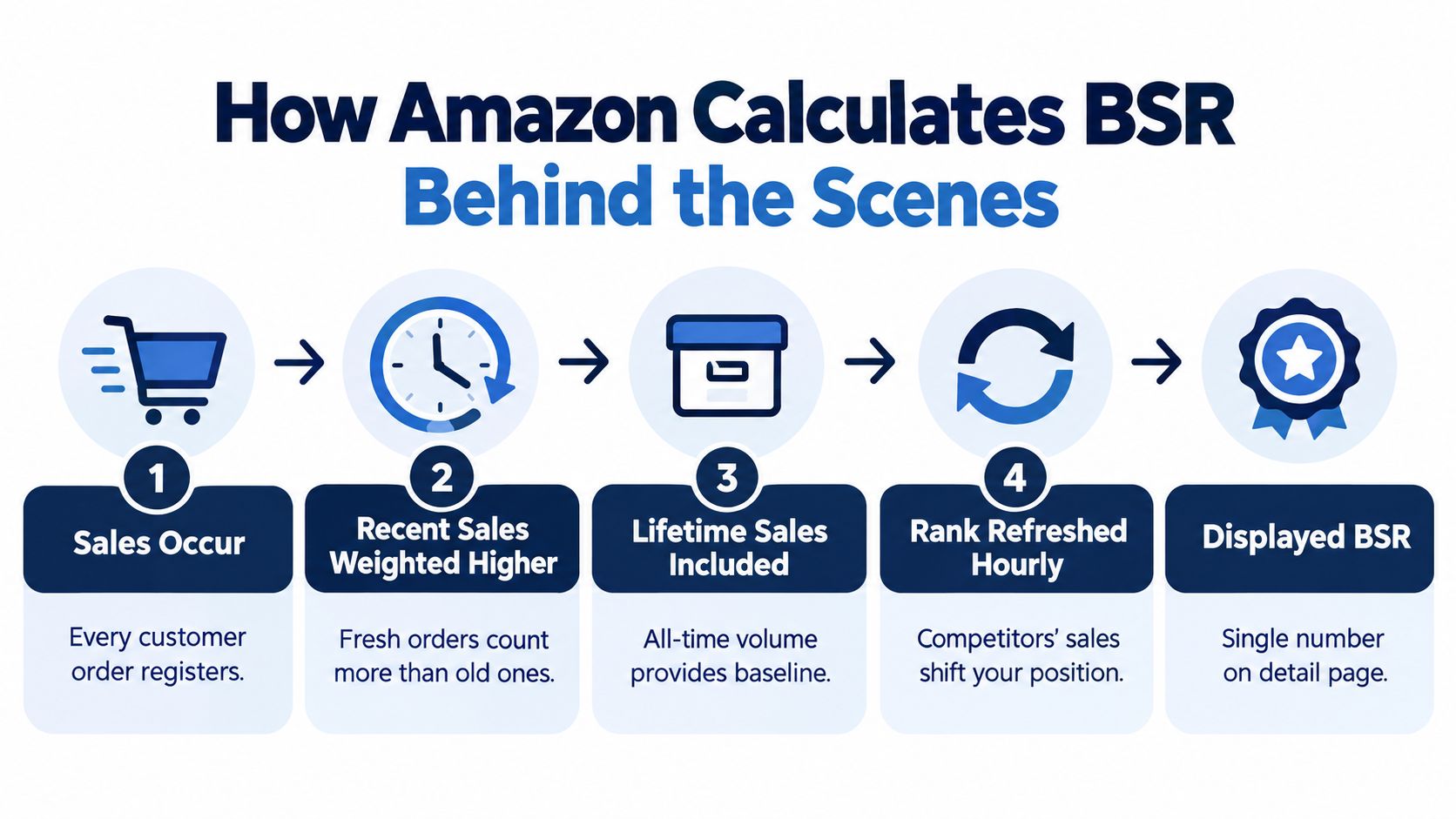
Amazon doesn't present BSR as a transparent formula with a fixed exchange rate between rank and units. What it does state is enough to build a reliable operating model: the calculation uses an ASIN's order data, combines lifetime and recent sales, and gives greater weight to recent activity. Amazon's official Sales Rank guidance also makes clear that rankings are relative.
Think of BSR as a race with memory. Lifetime sales give the system a baseline for the product's established sales history. Recent sales matter more because Amazon wants the ranking to respond to current customer activity rather than preserve an old position indefinitely.
That last point is where many forecasts fail. Suppose your product sells more units than it did previously, but several competitors increase their sales faster. Your absolute sales rose, yet your BSR worsened. The ranking reports your place in the field, not your personal improvement in a vacuum.
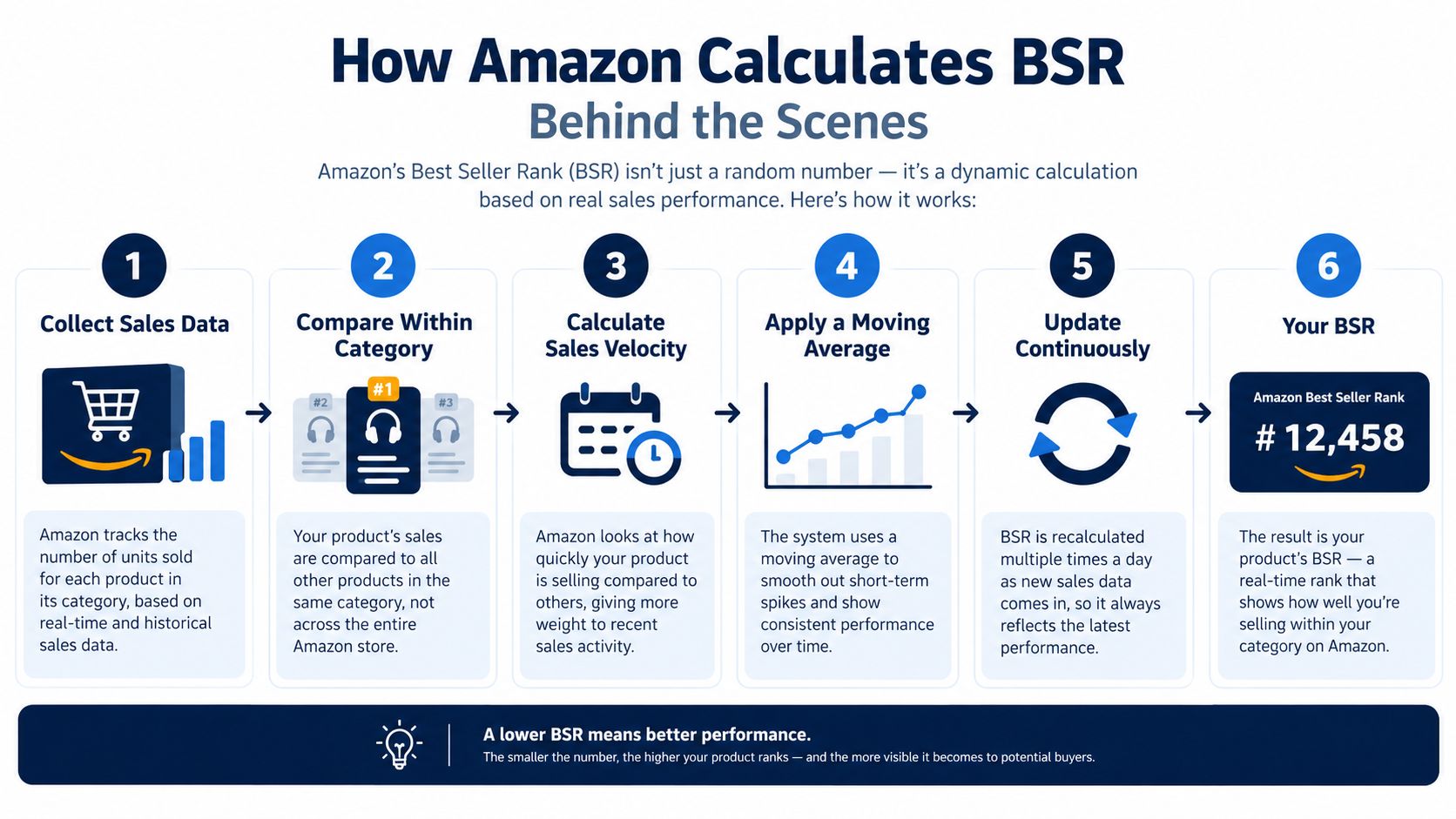
This is why a short promotion can create an impressive-looking move without proving durable demand. The promotion may increase recent order velocity, but the rank can drift back when the event ends. Consistent availability and repeatable sales velocity usually tell you more about the underlying business than an isolated spike.
BSR is a position in a moving field, not a fixed conversion table. A better rank means your relative position improved. It doesn't tell you how much absolute demand changed.
The cleanest way to interpret BSR is to separate the forces that create order velocity from signals that merely accompany it. The central input is sales activity within the ASIN's relevant category context. Several operating conditions determine whether that activity can continue.
Unit velocity is the direct commercial input. When an ASIN generates more orders relative to competing products in its category, its position can improve. The opposite can happen when competitors accelerate faster, even if your own unit volume remains healthy.
Category and subcategory placement define the comparison group. A rank is only meaningful when you know which browse node produced it. A narrow subcategory may provide useful competitive insight, but it can also make a product appear stronger than it is in the broader department.
Stock availability controls whether customers can keep ordering. A stockout interrupts sales velocity and can give competing ASINs the opportunity to capture demand. Inventory doesn't create BSR directly, but unavailable inventory prevents the orders that support it.
Buy Box consistency affects whether your offer is the one customers can purchase smoothly. If the featured offer changes or your offer loses visibility, customer demand may flow to another seller or offer. Read rank movement beside Buy Box share and offer-level sales data.
Competitive intensity changes the threshold for every position. More aggressive competitors, stronger promotions, and category-wide demand shifts can move your rank without a corresponding change in your listing quality.
Amazon states that reviews aren't included in the Best Sellers Rank calculation. Reviews can influence conversion and therefore may affect orders indirectly, but review count isn't a direct BSR input. The same logic applies to page views and perceived quality.
| Drives BSR | Does Not Drive BSR |
|---|---|
| Relative order velocity | Review count as a direct input |
| Recent sales activity | Star rating as a direct input |
| Lifetime sales history | Page views as a direct input |
| Category and browse-node context | Perceived product quality |
| Availability that enables orders | Conversion rate as a direct input |
| Competitive sales movement | A fixed market-share percentage |
Static rank-to-sales tables deserve caution too. The same rank can represent different demand across categories, seasons, marketplaces, and competitive conditions. Use BSR to detect direction and relative movement, then validate the commercial meaning with your own ordered units and contribution margin.
A screenshot answers one narrow question: where was the ASIN at that moment? It doesn't explain whether the product is strengthening, losing ground, recovering from a stockout, or merely moving with category demand.
Build a record that lets you compare BSR with the business events behind it. At the ASIN level, log the relevant main-category and subcategory ranks alongside ordered units, sessions, conversion rate, Buy Box share, inventory availability, pricing, promotions, and ad-attributed sales.
The most useful interpretation comes from comparing BSR with internal performance:
Sample more frequently when you need to understand a launch or a promotion, and use a steadier daily record once the product reaches a stable operating pattern. The precise schedule matters less than consistency and the ability to align changes with price edits, campaigns, stock events, and listing changes.

Don't turn BSR into a sales forecast using a static category table. Those tables can mislead founders because category demand, seasonality, marketplace size, and competitive pace change the relationship between position and units. Your own historical ordered-unit data gives you a more credible calibration for your catalog.
For sellers who need product and niche research beyond manual snapshots, Trendlytic's research tool for print-on-demand sellers can add structured market context. It still shouldn't replace account-level validation. Public rank is a comparative clue, while your reports show what the ASIN sold.
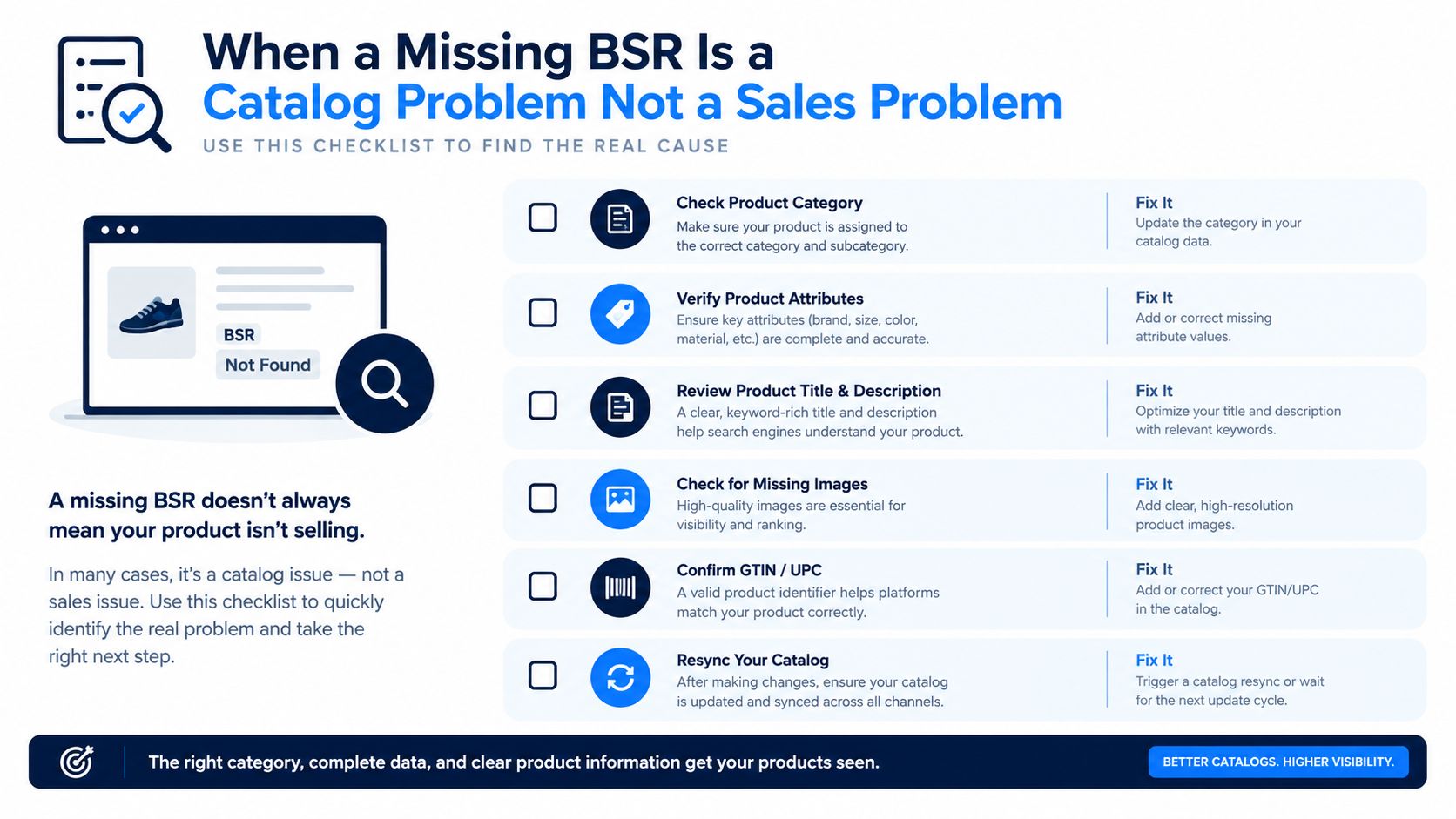
A blank BSR often triggers the wrong response. Sellers assume the product needs more orders, so they lower the price or increase advertising. That may create unnecessary cost if the actual issue is catalog architecture, category eligibility, or marketplace-specific listing data.
Seller reports connect BSR visibility with the browse nodes and categories assigned to an ASIN. Parent-child variation assignments, display groups, category changes, and low activity in a main category can affect whether a rank appears at all, as discussed in seller reports about missing BSR visibility.
Check the following in order:
This order prevents a metadata defect from becoming a demand-generation project. It also protects variation families from rushed changes that may create additional catalog inconsistencies.
A catalog audit should examine identifiers and offer presentation alongside ranking fields. Operational references such as this guide to Amazon order archiving can help teams understand how historical order records fit into their broader data checks, while the FNSKU labeling guide is useful when fulfillment and inventory identity are part of the investigation.
Don't spend against a missing number until you know the number is supposed to be present for that ASIN, category, variation structure, and marketplace. The cheapest fix may be a catalog correction, not a larger campaign.
Durable BSR improvement comes from repeatable order velocity, not from making the number look good for a brief window. Start with the factors that keep producing orders after a promotion ends.
First, protect availability. A product that can't be purchased can't sustain sales velocity. Second, improve organic conversion. Clear positioning, accurate images, useful content, and a competitive offer help turn qualified traffic into orders. Third, stabilize the Buy Box. Pricing theatrics are less valuable than a reliable path to purchase.
Category selection belongs near the top of the list. A better browse-node fit can make the rank more useful and improve competitive comparability. Keyword changes may improve search visibility, but they shouldn't be treated as a direct BSR lever.

| This week | This quarter |
|---|---|
| Restore in-stock availability | Improve replenishment planning |
| Resolve Buy Box disruptions | Strengthen listing conversion |
| Validate price and promotion changes | Reassess category and variation architecture |
| Check a sudden competitor move | Build a calibrated BSR and unit-sales baseline |
| Fix obvious catalog errors | Improve contribution margin and repeatable demand |
A promotion can move recent sales quickly, but its commercial value depends on margin, repeatability, and what happens after the event. Judge the tactic by the quality of the demand it creates, not by the temporary rank screenshot it produces.
Carry three truths into your weekly business review.
BSR is relative. It tells you where the ASIN sits among products in its category, not how many units it sold or how profitable those units were.
BSR is recency-weighted. Recent sales matter more than older sales, but lifetime sales remain part of the calculation. A short spike and a stable sales pattern can produce different operating outcomes.
BSR is category-bound. A rank only becomes meaningful when you identify the category, subcategory, browse node, marketplace, and competitive field behind it.
Turn those truths into three habits:
Your Monday workflow can be simple. Review the trend, compare it with absolute sales, mark operational events, inspect competitor movement, and confirm that the ASIN's catalog context hasn't changed. Then act on the cause, not the number.
Million Dollar Sellers offers invite-only peer access, strategy sharing, and practical insights from serious ecommerce founders operating across Amazon, DTC, and omnichannel brands. If you want experienced operators to challenge how you interpret BSR, growth, and marketplace performance, visit Million Dollar Sellers and explore the community.
Join the Ecom Entrepreneur Community for Vetted 7-9 Figure Ecommerce Founders
Learn MoreYou may also like:
Learn more about our special events!
Check Events