Chilat Doina
October 23, 2026
U.S. Business Prime is an annual organization membership: Duo is free when linked to an eligible personal Prime membership, Essentials is $179 for up to 5 users, Small is $499 for up to 20, Medium is $1,299 for up to 200, and Enterprise is $10,099 for unlimited users. Your Amazon Prime Business cost depends on the plan you choose, but whether it's worth paying depends on who does the buying and which purchasing controls you use.
You're staring at a supplies invoice with mailers, samples, printer paper, and a replacement warehouse tool on it. The purchases make sense individually. What's less clear is whether your Prime charge supports a deliberate buying process or a personal shopping habit that became company infrastructure.
The problem isn't necessarily the membership charge. It's that you can't tell who owns the buying process.
You buy packaging from your phone. Your operations lead needs equipment. Someone forwards a receipt to finance without explaining which order it belongs to. Before you upgrade anything, separate the cost of delivery from the cost of managing those purchases.
Amazon describes Business Prime as a membership for business purchasing, with eligible delivery benefits and tools for controlling and understanding organizational spending. It isn't just a personal membership with your company name attached, as Amazon's Business Prime overview explains.
That distinction changes your decision. You're not just asking whether the next box arrives without a shipping charge. You're asking whether employees can buy what they need without creating work for whoever reconciles the card.
Treat the annual subscription as a procurement expense. Then assign responsibility for making it earn its place in your operating budget.
A founder buying supplies alone has a different problem from an operations team ordering across locations. The former may need a cleaner account setup. The latter may need visibility into purchases before finance discovers them on a statement.
Those are purchasing decisions, not entertainment decisions. Keep personal viewing or listening preferences outside the procurement calculation.
Practical rule: Don't buy a larger membership to make an unclear purchasing process feel organized. Define the process first, then pay for the tools that support it.
Your objective is straightforward: match capacity to your buyers, distinguish convenience from control, and decide whether the fee is cheaper than the administrative work you can realistically remove.
Cost per active buyer is the number that belongs beside the annual fee. A plan's advertised capacity tells you how many users it can accommodate, not how many people will generate value from it.
The pricing map below uses Amazon's published membership tiers and user limits. The full-cap figures are annual membership fees divided by maximum user capacity, rounded where appropriate.
| Tier | Annual price | User cap | Approx. cost at full cap |
|---|---|---|---|
| Duo | Free with eligible personal Prime membership | 1 | No additional Business Prime fee |
| Essentials | $179 | 5 | $35.80 per user |
| Small | $499 | 20 | $24.95 per user |
| Medium | $1,299 | 200 | $6.50 per user |
| Enterprise | $10,099 | Unlimited | Depends on active user count |
The full-cap figures are benchmarks, not guaranteed costs per buyer. For capped plans, they represent the lowest average membership cost you can reach by filling every available seat. Empty seats push your effective cost upward.
That's an important correction to the usual pricing comparison. You don't receive an economic benefit just because your plan has room for more employees.
Use this calculation when comparing plans:
Annual membership fee ÷ active buyers = annual membership cost per active buyer.
Define an active buyer as someone who places legitimate business orders during the period you're reviewing. Don't count dormant invitations, former employees, or people who only need to submit purchase requests.
A larger organization pays more in total while gaining substantially more user capacity. That can support centralized procurement, but only if people use the account and follow the purchasing process.
Enterprise's effective cost can become very low at substantial usage, but that observation isn't a reason to select it. Your comparison should start with the smallest plan that accommodates your actual buyers and the controls you need.
Don't confuse lowest advertised cost per available seat with lowest cost per person who orders. The second measure is the one you can manage.
Business Prime isn't consumer Prime with more logins. Amazon explicitly distinguishes its business delivery, purchasing controls, and spend analytics from consumer entertainment benefits, and states that Prime Video and Prime Music aren't included in its explanation of Business Prime benefits.
Use that distinction to evaluate what changes in your daily buying workflow.
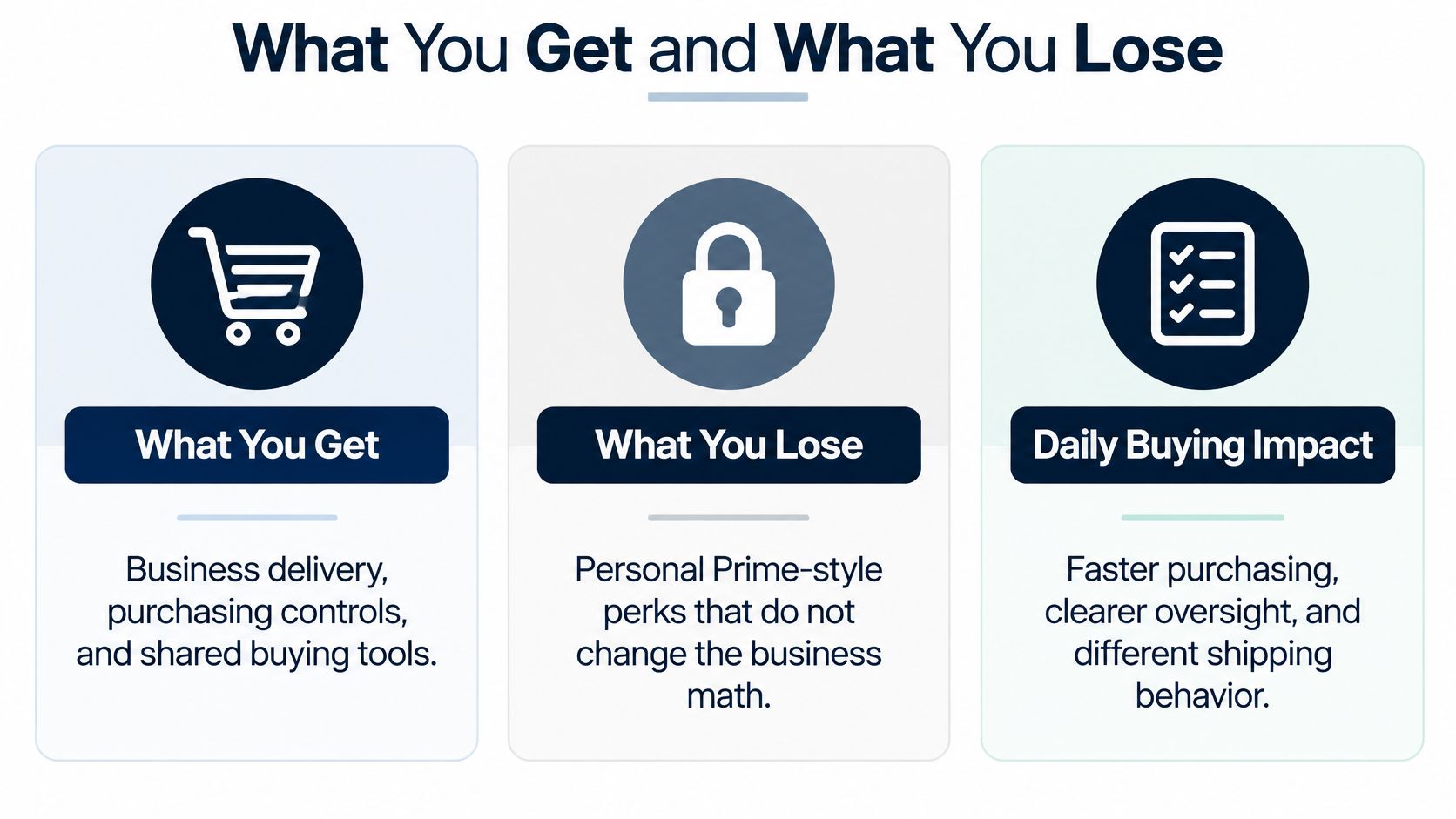
A personal Prime workflow keeps the purchasing decision centered on the individual. If you use that approach, decide how you'll distinguish business orders, preserve receipts, and keep company records accessible without treating a personal login as shared infrastructure.
Duo is the route to evaluate when a sole buyer wants the eligible business membership arrangement without paying for multi-user capacity. Its dependence on an eligible personal membership still belongs in your account-ownership discussion.
A paid Business Prime plan deserves consideration when purchasing involves other employees and requires oversight. Amazon's plan materials describe access to Spend Visibility, Guided Buying, and, in some cases, extended Pay by Invoice terms, with availability depending on the plan and approval.
The broader Amazon Business benefits are useful context, but your checklist should stay tied to what you'll configure.
Before upgrading, write down who can order, what they can buy, and who handles exceptions. Then verify that your candidate plan supports the process you want.
The gain you're testing is shared purchasing with rules and visibility. If nobody reviews spending or maintains the buying policy, don't assign those features a theoretical value just to justify the subscription.
Start with your replenishment basket, not the membership page. List the exact mailers, labels, supplies, and equipment you expect to buy, then compare their delivered cost across realistic purchasing alternatives.
Eligible members can receive free expedited delivery, including Two-Day and, where available, Same-Day or One-Day options. Business-only prices and quantity discounts apply only to selected items and quantities, and prices can change, as Amazon's pricing and shipping guidance explains.
Use the following process to organize the comparison, while keeping shipping benefits separate from actual cash savings.
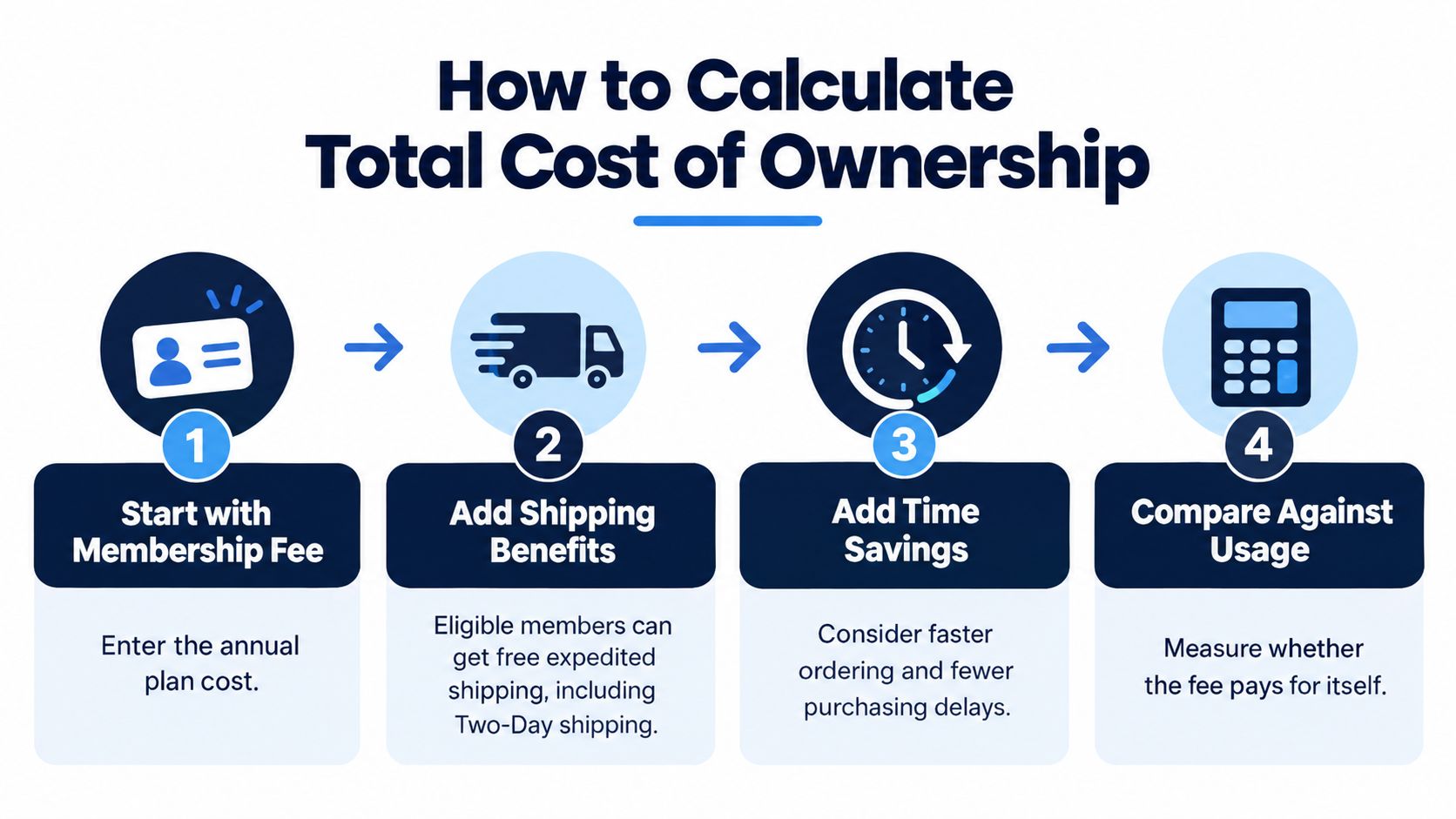
Annual membership fee ÷ annual eligible orders = required average savings per eligible order.
Apply that threshold to each recurring SKU or comparable basket. Compare Amazon's delivered price against your negotiated supplier, distributor, or consolidated freight option, using equivalent specifications and quantities.
For the Small plan in the pricing table, verified annual logistics and procurement savings must at least equal its annual fee to reach purchasing-only break-even. Count a discount only when it appears on products you need, in quantities you'll use.
The underlying logic is the same as calculating a break-even point: define the cost, identify the measurable contribution, and find the usage level that covers it.
Keep separate records for:
Shipping savings can miss the annual fee while the membership still makes sense. The difference must come from documented operational value, not optimism.
If you're also reviewing seller software, AccountShare's resource to compare Helium 10 subscription plans provides a separate subscription comparison. Keep that decision outside this calculation so software value doesn't accidentally subsidize your procurement justification.
Finally, subtract setup and ongoing administration from your estimated benefit. A control that requires staff attention isn't free to operate, even when access to it comes with the membership.
Run your own numbers through the three situations below. Each applies published tier pricing to a stated set of assumptions, so treat the dollar figures as worked examples, not results at specific companies.

You place every order yourself: poly mailers, insert cards, samples, occasional replacement equipment. Eligible Amazon spend runs about $9,000 a year.
Duo is the first test because it adds no fee on top of the personal Prime behind it. If documented freight savings on your repeat items come to roughly $260 a year, Duo captures all of that at zero added cost. Paying $179 for the entry paid tier only makes sense if it delivers measurable value on top, and with one buyer there is no delegation or approval control to pay for. My recommendation: stay on Duo and revisit if a second person starts ordering regularly.
Three people now buy: the founder, an operations lead, and an assistant. The $179 tier works out to about $60 per active buyer per year.
Say your documented basket and freight savings total $110. That misses the fee by $69. The deciding question is whether the controls close the gap. If spend controls stop one duplicated $180 order, or a few off-spec purchases your team would otherwise absorb, that documented control value turns a $69 shortfall into a net gain. This is the case where a paid tier still wins even though shipping savings alone don't cover it.
A larger buyer group runs the same math at $499. Divide the fee by the people who order, not headcount.
Forty employees, six regular purchasers. Priced against the full roster, a $1,299 plan looks like roughly $32 a head. Priced against the six people who order, it's about $216 per active buyer. That second number is the honest one.
If governance requirements genuinely demand the wider capacity, pay for it. Otherwise a smaller tier priced per active buyer usually wins. Either way, keep procurement membership costs separate from the costs of selling on Amazon so the buying and selling decisions stay distinct.
Choose the buying setup that solves your current problem at the lowest defensible total cost. Don't assume the answer must be a paid Amazon membership, and don't assume keeping the existing arrangement is free of administrative costs.
Your alternatives should include both account choices and purchasing channels.
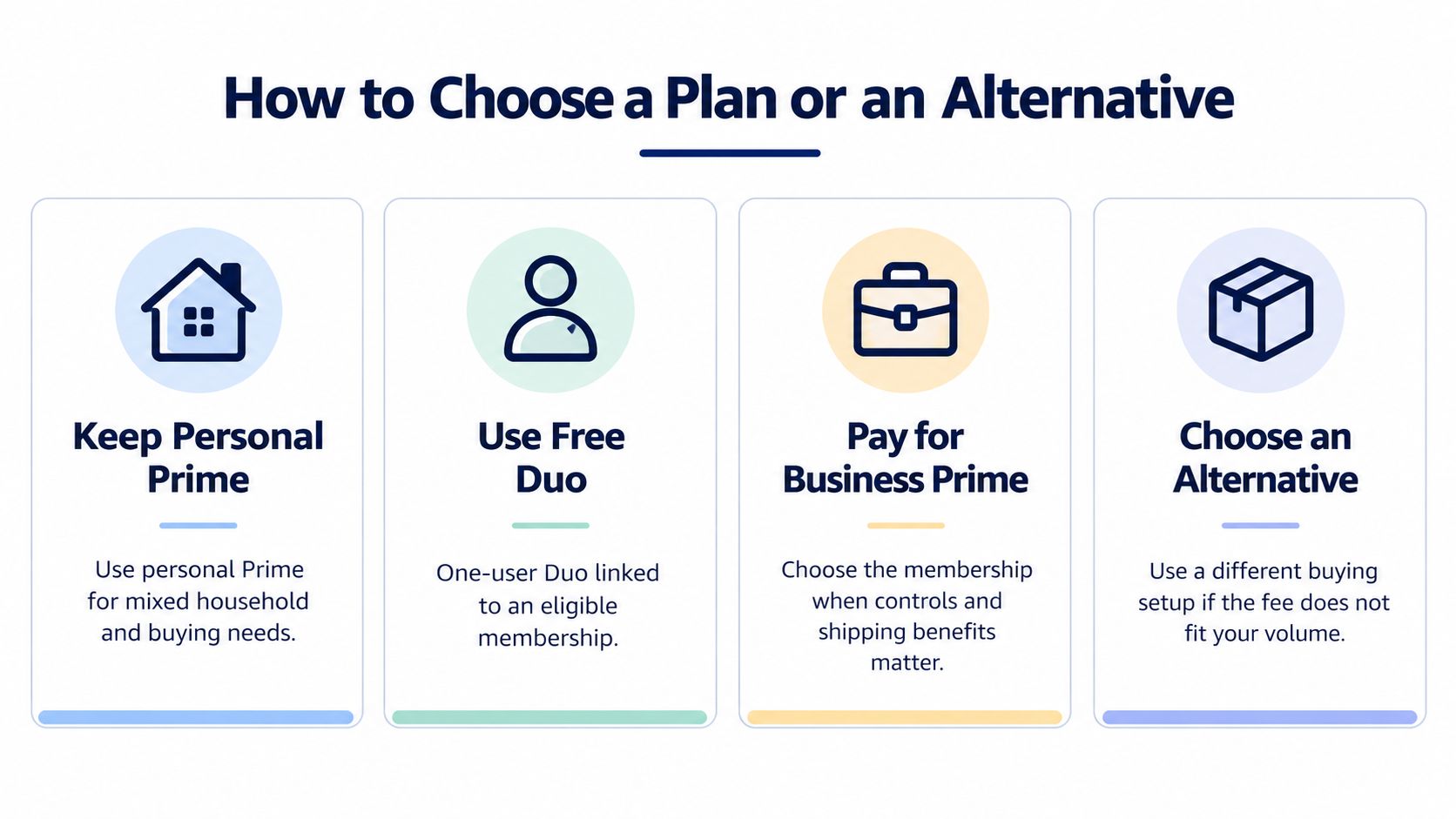
You don't need to route every purchase through the same channel. A negotiated supplier may suit predictable packaging replenishment while Amazon remains an option for irregular operational purchases.
That split deserves a comparison of its own. Include the extra work of maintaining suppliers and reconciling purchases rather than assuming the lowest product price automatically wins.
Ask an operator with a similar purchasing workload how they manage employee access, product specifications, and exceptions. Useful peer feedback is specific: which controls they maintain, who reviews purchases, and what work remains manual.
Avoid copying another founder's tier without understanding their process. Their buyer count, order mix, and need for oversight may differ from yours even if your businesses look similar.
Decision test: Would you still choose this plan if you had to explain the renewal using order records and a written purchasing policy?
If your answer depends on unused seats, unconfigured features, or discounts you haven't verified, choose the simpler route. Upgrade when the evidence changes.
The best plan isn't the one with the most headroom. It's the one whose capacity and usable controls fit how your team buys.
Pay only when verified purchasing savings and the documented net value of controls exceed the annual fee for the people who place the orders. That's your renewal rule, whether you're evaluating a new membership or reviewing an existing one.
Pull your most recent quarter of Amazon receipts for packaging, samples, supplies, and equipment. Group comparable products, identify the buyers, and mark which purchases would have qualified for the benefits you're evaluating.
Don't divide an annual fee by a quarter's orders and call the result an annual break-even rate. Use the quarter to understand buying patterns, then build a realistic annual eligible-order estimate that reflects replenishment cycles and seasonal demand.
Compare that estimate against available history. Keep unusual equipment purchases separate from recurring supplies so an exceptional cart doesn't determine your ongoing membership decision.
If the net benefit is negative, stay with the simpler eligible setup or move repeat purchases to a better supplier. Don't force the calculation to work by counting discounts on products you wouldn't otherwise buy.
If the result supports an upgrade, configure the controls that justified it. Give finance a clear process for receipts and exception handling, and make sure buyers understand the purchasing policy.
Run the basket comparison this week. You should finish with a chosen route, an accountable owner, and a record of why the decision makes sense, not just another subscription charge on the company card.
Million Dollar Sellers offers ecommerce founders a vetted peer network, private forums, mastermind calls, and curated events for sharing operating detail. Visit Million Dollar Sellers to explore the community and compare purchasing practices with founders who can help you pressure-test supplier choices, buying controls, and membership renewals.
Join the Ecom Entrepreneur Community for Vetted 7-9 Figure Ecommerce Founders
Learn MoreYou may also like:
Learn more about our special events!
Check Events