Chilat Doina
September 24, 2026
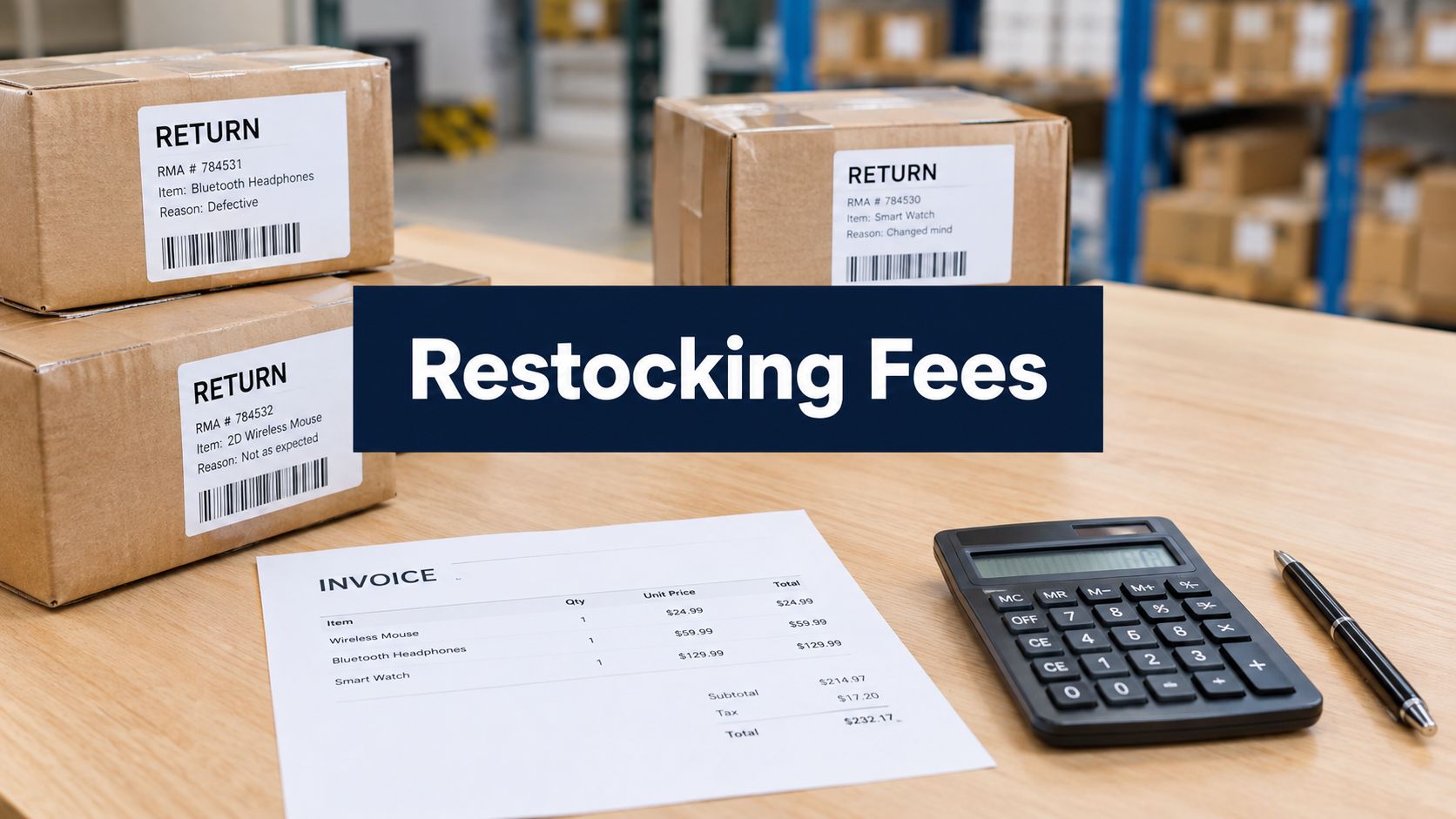
Monday morning starts with a return pile, not a sales report. A carrier drops a mixed carton at the dock, and your team finds a kitchen scale marked “smaller than expected,” a blender returned because its color didn't suit the buyer's counters, wireless earbuds that arrived late, and a baby stroller missing a wheel bracket.
At retail, the stack looks like lost sales. On the profit sheet, it's worse. Fulfillment, reverse logistics, condition downgrades, and customer refunds all hit different lines, while the Amazon restocking fee only recovers part of the damage when the return qualifies.
The right question isn't, “How much can I charge?” It's, “Which losses can I recover, which ones can't I recover, and why are these units coming back at all?”
A large FBA seller doing $18,000 in weekly revenue can receive a return shipment that looks manageable until every unit is inspected. In this Monday example, 42 returned units carry a combined retail value of $3,100. That headline number gets attention, but it doesn't describe the actual margin loss.
The kitchen scale may be perfectly sellable after a buyer changes their mind. The blender may also return to stock if the box and accessories are intact. The earbuds arrived late, which points to a service or delivery issue rather than a condition problem. The stroller, missing a wheel bracket, is a different financial event entirely. It may require liquidation, parts replacement, or disposal.
A qualifying late return can support a deduction of up to 20% of the item price, under Amazon's current seller guidance on restocking fees. On $3,100, a 20% recovery would equal $620, but that doesn't mean every unit qualifies or that the fee covers the full cost of the return.
The seller still has to account for outbound fulfillment already incurred. Reverse logistics can add another cost, and a damaged unit may lose its new-item resale value. In this scenario, $890 of returns fall below the 20% trigger and receive a clean refund, while return shipping deductions and handling leave the week's actual margin roughly $1,300 lower.
That's the operator's reality. A restocking fee can reduce the bleed, but it doesn't reverse the transaction. The fee applies only where Amazon's rules permit it, and it never turns a preventable return into profitable revenue.
Operator's rule: Treat every return as a unit-economics problem first and a policy problem second.
The useful Monday review separates four questions: why the buyer returned the unit, whether the item remains sellable, whether a deduction is permitted, and what operational change could prevent the next return. If your team only records the refund amount, you're measuring the smallest part of the loss.
An Amazon restocking fee is a deduction from a buyer's refund when the returned item falls outside the condition or timing rules for a full refund. Amazon's framework treats the fee as a percentage of the item's price, not shipping. The allowable ceiling depends on whether the return is late, used, damaged, or materially different.
Keep three financial buckets separate:
The fee doesn't replace return shipping, and it isn't an additional invoice sent to the customer. It reduces the refund. That distinction matters because sellers often overestimate recovery by adding the fee to shipping deductions, then discover that Amazon's actual refund workflow treats each amount differently.
Amazon sets the marketplace boundaries. Sellers apply the permitted deduction through the refund and return process for eligible seller-fulfilled situations, while Amazon-managed returns follow Amazon's own workflows. The platform can also retain a portion of the fee under specific conditions, so the amount a seller sees recovered may not equal the headline percentage.
That's why your accounting system should record the actual recovered amount, not multiply item price by a policy ceiling. For a broader view of fulfillment economics, compare the fee with Amazon FBA fees and their effect on margins.
The cleanest mental model is simple: the refund is the customer-facing amount, shipping is the logistics expense, and the restocking fee is a conditional loss recovery inside the refund. Don't describe it to your team as a surcharge or a penalty. That language encourages aggressive deductions and creates avoidable disputes.
Amazon's published structure uses four ceiling rates, 20%, 25%, 50%, and 100%, tied to return timing and condition. The exact application depends on the return facts, the product, and the marketplace workflow, so the inspection record must support the selected tier.
| Fee % | Condition Trigger | Typical Categories | Seller Recoverable? |
|---|---|---|---|
| 20% | Return arrives outside the applicable return window | General merchandise | Yes, when Amazon's conditions are met |
| 25% | Item is returned used with minor damage | Eligible merchandise under Amazon's condition rules | Yes, with appropriate evidence |
| 50% | Item shows severe damage or substantial degradation | General merchandise, electronics, and other affected products | Yes, when documented |
| 100% | Buyer returns a materially different item | Serialized goods, mismatched products, or materially different returns | Potentially, subject to Amazon review |
The most important boundary is the one many sellers miss: an item returned within the policy window and in original condition isn't eligible for a restocking fee. Amazon's current guidance makes the fee conditional rather than universal. A buyer who changes their mind and returns a complete, resalable unit on time should receive the eligible refund without a restocking deduction.
Original condition doesn't always mean untouched factory shrink-wrap. A buyer may need to open packaging to inspect or test a product. The practical test is whether the unit remains complete, functional, clean, and suitable for resale as new under the applicable product requirements.
Check the details that destroy resale value:
Don't assign a tier because the carton looks opened. Assign it because the returned unit's condition supports the deduction. That approach protects margin and gives you a defensible record if Amazon or the buyer challenges the refund.
A higher restocking deduction won't survive on a vague note that says “used.” Amazon's enforcement became procedural. Sellers charging at or above 20% for a damaged, missing, or materially different return must upload a photo of the item, according to Amazon's seller-forum guidance on documentation and fee eligibility.
Build the process around evidence, not memory.
When the unit arrives, record the return reason, order details, delivery timing, and physical condition. Photograph the product from several angles, including the serial number when applicable, missing components, damage, contamination, packaging condition, and the shipping label.
Your inspection record should answer one question: What changed between the outbound unit and the returned unit? If you can't show that change, a higher deduction is difficult to defend.
The workflow should include:
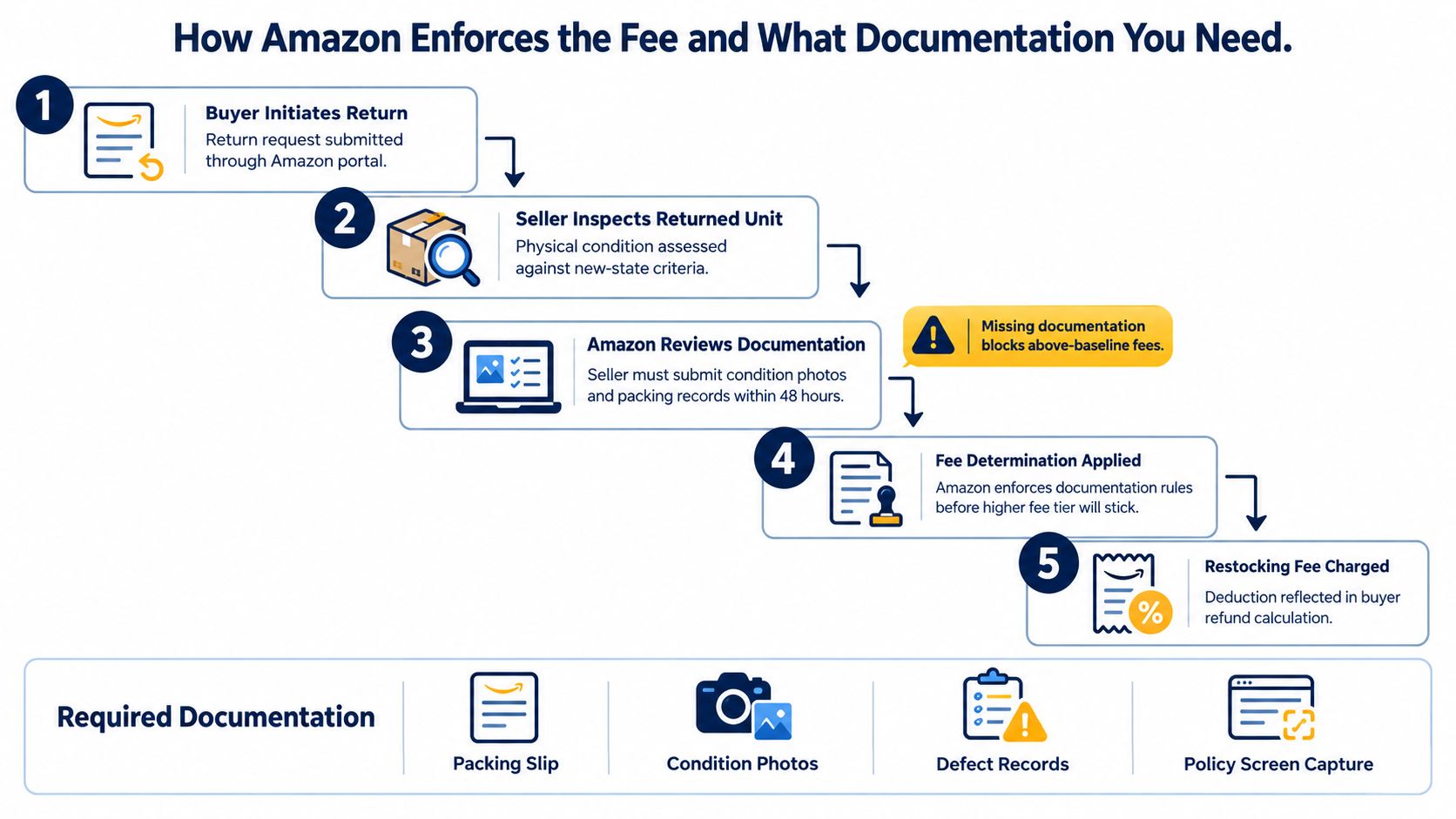
The operational mistake is treating documentation as something you assemble after a dispute. Capture it at intake, while the evidence is visible. A photo of a missing bracket taken weeks later is not useful if your team can't connect it to the specific order and return.
Amazon's policy also reinforces a broader lesson for global operators. The same core structure appears across regional marketplaces, with late returns, used or damaged items, and materially different returns handled through condition-based rules. Standardize your internal inspection checklist, then validate the current local workflow before applying it.
Restocking fees look more attractive in a policy table than they do on a contribution-margin report. The following examples use the return values and costs supplied for each scenario, so the arithmetic shows recovery, not profit.
| Scenario | Item Price | Condition on Return | Fee Tier Applied | Fee Charged | FBA + Return Costs | Net P&L Impact |
|---|---|---|---|---|---|---|
| Kitchen gadget | $24.99 | Opened, missing parts | 50% | $12.49 | About $13 | About $0.51 loss |
| Headphones | $149 | Original sealed condition | No fee | $0 | Outbound shipping absorbed by Amazon | Full refund, with fulfillment cost exposure |
| Apparel item | $39.99 | Used and stained | 100% | $39.99 | About $11 | About $28.99 recovery before other account effects |
The $24.99 gadget comes back opened with parts missing. A 50% deduction recovers $12.49, but roughly $13 in FBA fulfillment and return costs consumes slightly more than the fee. The seller still loses money, even though the highest practical recovery band helped.
This is the classic false win. The fee reduced the loss, but the transaction didn't become profitable.
The $149 headphones return sealed and in original condition. No restocking fee applies, so the buyer receives the eligible refund. The seller still faces the economics of the outbound transaction, including Amazon's handling of the shipment, but trying to force a deduction would create policy and dispute risk without a condition-based justification.
A clean return is a recovery opportunity through resale, not through a fee.
The $39.99 apparel item returns used and stained. A 100% fee can forfeit the full item refund when Amazon's materially different or severely degraded conditions apply, recovering the item value. Against roughly $11 in reverse logistics, that leaves about $28.99 before other account effects.
Documentation matters most. A stain must be visible, attributable to the returned unit, and recorded consistently. If your team writes “worn,” the recovery may not hold.
A restocking fee isn't revenue in the commercial sense. It's a partial offset against a transaction that already created costs.
The seller paid to pick, pack, and ship the original order. The customer then initiated a return, Amazon or the seller processed it, and the unit may no longer qualify for new-condition resale. The fee recovers only what Amazon's policy permits, and the permitted amount may be smaller than the combined logistics and inventory loss.
Record the fee as recovered return cost, not as a sales line. That classification keeps your contribution margin honest and prevents an account manager from celebrating higher fee collections while the underlying ASIN continues to generate expensive returns.
A product with frequent returns can remain unprofitable even when the team applies every eligible tier. Fees scale with problematic returns, not with healthy revenue. As return volume rises, inspection labor, customer service work, resale downgrades, and inventory disruption rise with it.
The fee is the bandage. The return reason is the diagnosis.
The worst operating model is to optimize for maximum deductions while leaving the product page, packaging, and quality controls untouched. A buyer who receives the wrong color, can't understand the dimensions, or finds a broken component doesn't become a profitable customer because the seller withholds part of the refund.
Use the fee when the evidence supports it. Don't build forecasts around it. Your forecast should assume eligible returns are handled according to policy, then measure actual recovery separately from the work required to earn it.
The best return is the one your warehouse never has to inspect. That requires a weekly operating loop connecting return reasons to listing changes, packaging decisions, and product quality.
Start with the listing because buyer expectation errors are often visible before the first shipment leaves the fulfillment center.
Rewrite the first bullets around the reasons buyers cite. If shoppers say a kitchen scale is too small, show its footprint next to familiar objects and state the dimensions in the images. If apparel comes back because the fit is unclear, add garment measurements, model measurements, and a comparison chart rather than relying on generic size labels.
For products where fit creates confusion, a resource on reduce returns with Robosize can help your team evaluate sizing technology alongside stronger product-page content.
Packaging solves a different problem. Use double-walled cartons for fragile products, protective inserts around electronics, and separate bags for apparel that can be stained by loose components. Packaging won't fix a misleading listing, but it can prevent a transit-damage return from becoming a condition loss.
| Return Reason | Mitigation Habit | Expected Reduction |
|---|---|---|
| “Smaller than expected” | Add dimension overlays, scale references, and comparison images | Qualitative improvement in expectation accuracy |
| Fit or size confusion | Publish garment measurements, fit notes, and measurement video | Fewer avoidable fit-related returns |
| Damage in transit | Strengthen cartons, add inserts, and audit pack-out photos | Fewer packaging-related returns |
| Missing accessory | Add a pack-out checklist and accessory photograph | Fewer incomplete-unit returns |
| Care-related dissatisfaction | Include care instructions and post-purchase guidance | Fewer preventable use and maintenance complaints |
A short follow-up message can surface defects before the buyer opens a return. A care card, sizing insert, or setup guide gives the customer a practical answer at the moment confusion starts. Track the outcome in your return-reason dashboard, then use the ecommerce return reduction process to connect weekly changes to SKU-level performance.
The habit that matters most is consistency. Review return reasons by SKU, not just at account level, and give the highest-value offender a defined owner. A fee policy can recover a damaged unit once. A corrected image or stronger insert can prevent the same failure across every future order.
Disputes work when your evidence is specific, dated, and tied to the order. They fail when the seller argues from frustration, quotes a policy without proving the condition, or submits generic warehouse photographs that don't identify the returned unit.
If a buyer files an A-to-z claim against a legitimate deduction, open the relevant case in Seller Central under the return-issue workflow and respond within the platform's stated deadline. The supplied operating plan uses 14 days for opening a case after the buyer's claim, so treat that as an internal escalation target, not a reason to delay.
Attach the original condition photos, return reason, tracking information, inspection log, and packaging evidence. If the buyer claims the item arrived damaged, show the outbound condition record and the returned-unit photographs. If the buyer returned a materially different product, show serial numbers, model labels, and the mismatch clearly.
Your file should contain:
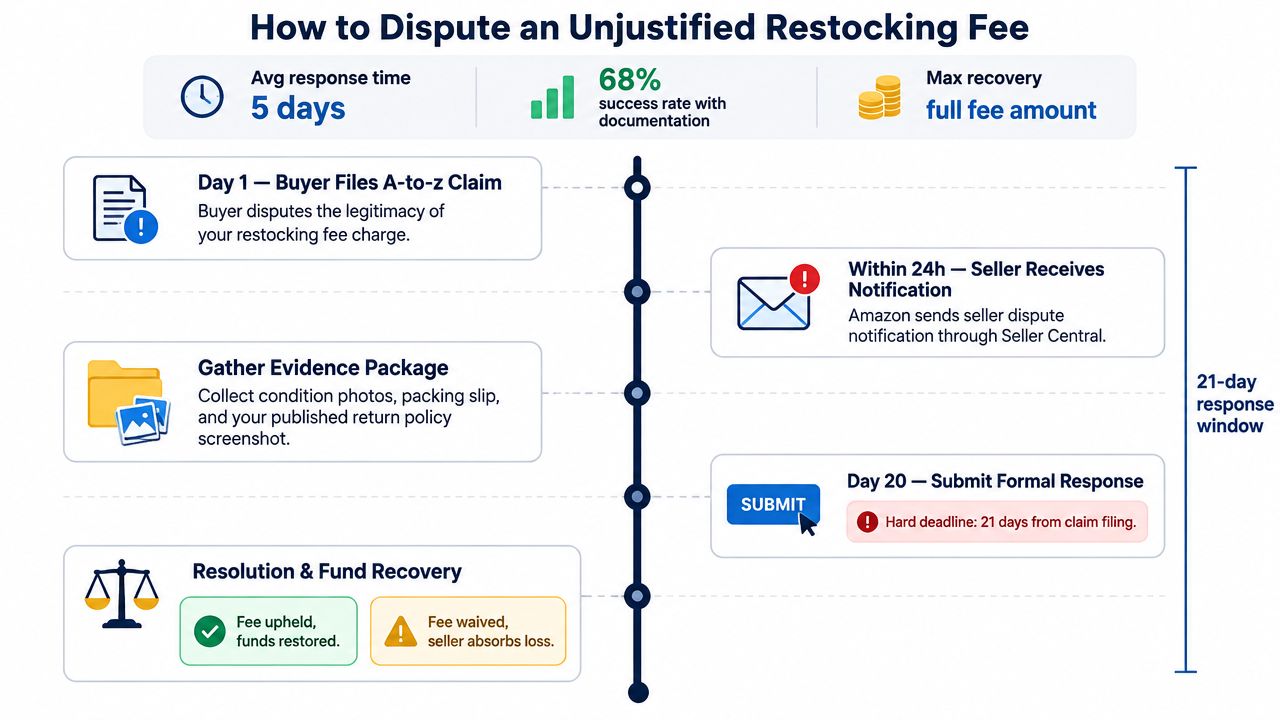
If the first response is unfavorable, request a Selling Partner Support phone callback and ask for manager review. Reference the applicable Amazon restocking-fee policy section, but lead with evidence. Policy language tells Amazon what can happen. Your photographs and inspection trail show why it should happen in this case.
For repeated disputes on one SKU, escalate the pattern through a Voice of Seller ticket if your account structure provides that route. Brand-registered sellers can also raise the issue through their account-management channels. Log every case ID, response, timestamp, and submitted attachment.
Don't confuse a fee dispute with a returnless refund decision. Review what a returnless refund on Amazon means separately, because the economics and evidence path differ.
Week one, pull the last 90 days of return reasons from the Returns dashboard and identify the SKU creating the greatest return burden. Week two, rewrite that listing and add a comparison chart or new main image if the problem is expectation or size confusion. Week three, upgrade packaging for products showing damaged-in-transit returns above 2%, then add a care or sizing insert. Week four, compare the updated return behavior with the baseline and keep only the changes that improve the economics.
I won't pretend the fee is the growth strategy. The operator who fixes the highest-volume return reason will usually create more value than the operator who spends the month perfecting deductions. Recover what Amazon permits, document every exception, and make the product page and pack-out process do the heavy lifting.
Million Dollar Sellers gives serious Amazon operators access to private peer insight, strategy sharing, and practical lessons from founders scaling complex e-commerce businesses. Visit Million Dollar Sellers to learn how the community can help you improve return economics and make sharper operating decisions.
Join the Ecom Entrepreneur Community for Vetted 7-9 Figure Ecommerce Founders
Learn MoreYou may also like:
Learn more about our special events!
Check Events