Chilat Doina
October 16, 2026
Most Amazon seller advice is a checklist disguised as a strategy. Add keywords, launch PPC, collect reviews, lower the price, reorder inventory. That approach creates busy operators, not durable businesses. Amazon seller optimization is one integrated P&L system in which traffic, conversion, pricing, fulfillment, customer experience, advertising, and cash flow affect one another.
The marketplace has changed materially since Amazon launched Marketplace in November 2000. Independent sellers have generated more than $2.5 trillion in sales through Amazon's store over the following 25 years, and they now account for more than 60% of store sales (Amazon's marketplace history and seller growth). You aren't optimizing a product page in isolation. You're managing a retail operation where every impression has a cost, every stockout has an opportunity cost, and every sale can either produce contribution profit or consume it.
The most popular advice fails because it treats each lever as independent. A keyword can increase impressions but attract shoppers who don't convert. A discount can increase orders while destroying margin. A PPC campaign can produce excellent ROAS while scaling a SKU that loses money after fees, fulfillment, returns, and coupons. More traffic isn't progress if the product can't remain in stock or arrive when promised.
Amazon optimization works when you connect the entire commercial loop:
A listing with weak conversion may need better content. It may also have the wrong price, poor reviews, a slow promise date, or cold paid traffic. Editing the title first is often an attempt to treat a symptom without identifying the constraint.
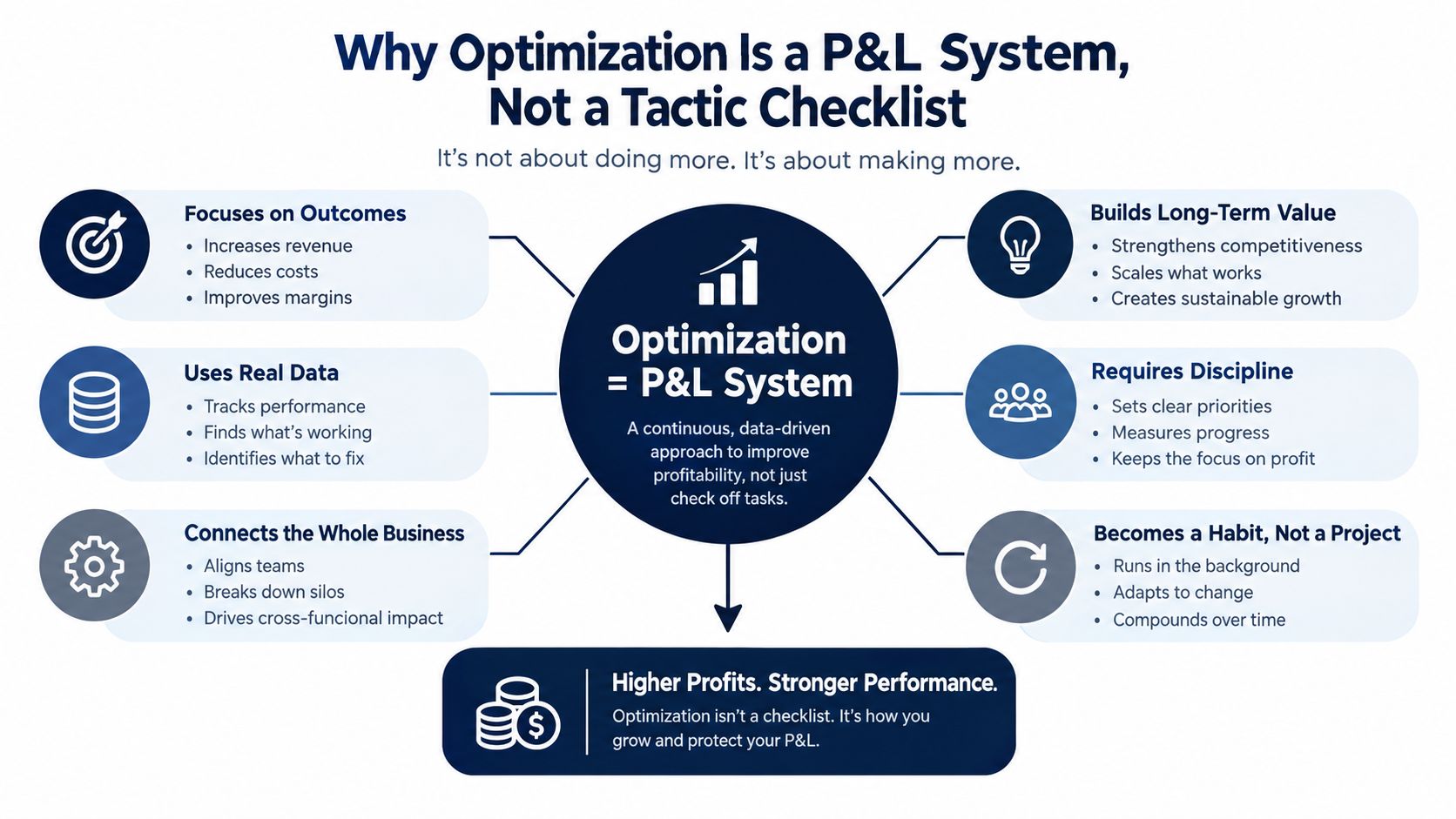
Your operating dashboard should therefore connect retail signals to financial outcomes. The profit and loss statement guide is useful for keeping Amazon revenue, variable costs, operating expenses, and contribution profit in the same conversation rather than letting marketplace metrics dominate the meeting.
Operator rule: Never approve a growth tactic because it improves a marketplace metric alone. Approve it when it improves incremental contribution profit without creating an operational constraint.
Customer trust belongs inside this system too. Review collection, service recovery, and sentiment monitoring influence conversion and retention, so tools that help you sync Amazon ratings easily can support the operating loop. The point isn't to accumulate tactics. It's to make every decision answer one question: does this create profitable, repeatable demand?
Before changing a title, bid, coupon, or price, establish the baseline. Senior operators do not optimize from yesterday's sales screenshot. They segment performance, identify the binding constraint, and run one controlled change at a time.
Start with four operating views.
Conversion by traffic source separates a listing problem from a traffic-quality problem. Calculate Unit Session Percentage as orders divided by sessions, then split organic and paid sessions. Combining them can make a listing appear weaker because advertising often brings colder shoppers. Directional benchmarks put broad organic conversion near 8% to 12%, with paid traffic typically converting 20% to 40% lower than organic conversion. Treat those figures as context, not targets. Category, price, brand strength, and search intent change the denominator (marketplace conversion benchmarks).
CX health shows whether Amazon can confidently present the offer. Review price competitiveness, delivery speed, and inventory supply for each ASIN. Amazon's CX dashboard identifies 95% price competitiveness, 75% delivery within two days for standard-size products, and 70% inventory supply for standard-size products as core inputs (Amazon CX dashboard guidance). Use them as operating signals, not promises that apply equally across categories.
Account health protects your ability to keep selling. Monitor order defect rate, cancellation rate, late shipment rate, valid tracking, and on-time delivery using the correct reporting windows. Amazon calculates ODR over a 60-day period, while seller cancellation rate uses a seven-day order window. Comparing those metrics without preserving their windows produces misleading conclusions.
SKU contribution margin exposes what revenue and ROAS conceal. Begin with selling price, then subtract referral fees, FBA or fulfillment costs, storage, returns, discounts, coupons, inbound freight, duties, and advertising. Include expected stockout and working-capital costs where they affect the decision. A high-revenue SKU can still destroy cash.
Use a 30-, 60-, or 90-day window to reduce daily noise. For every ASIN, assign one primary constraint: low conversion, weak visibility, a suppressed Featured Offer, ad waste, stockout risk, delivery friction, or margin erosion. Change one high-impact variable while holding price, inventory, and campaign structure stable.

Short tests mislead low-volume ASINs. Seasonal demand, promotions, and stockouts can invalidate comparisons, so judge results across enough sessions and orders to make the signal useful. Scale a change only when conversion and contribution margin improve together. That rule keeps catalog growth tied to profit instead of marketplace optics.
Listing content has two jobs. It must help Amazon understand where the product belongs, and it must help a shopper decide whether the product solves the problem. Keyword stuffing fails both jobs. It muddies indexing, lowers readability, and pushes the click to sellers with cleaner copy and stronger creative.
Treat the detail page like a revenue asset, not a copywriting exercise. Every field should earn its place in the P&L system. The title captures the core query and establishes product identity. Bullets remove friction before it shows up as a lost conversion. Images answer objections faster than text. A+ Content should increase decision confidence, not decorate the page.
Put the highest-intent phrase and the product's plain-English identity in the title first. Then add the differentiator that matters. If the title reads like a search-term dump, fix it. Shoppers should know what the product is, who it serves, and why it deserves attention without translating awkward phrasing.
Bullets should do selling work in a deliberate order. Lead with the outcome, then support it with the feature. Clarify the buyer and use case. Explain the difference that changes the purchase decision. Cover practical friction points such as size, compatibility, materials, setup, care, or limits. End with details that reduce risk, including what is in the box and what the buyer should expect in use.
Backend search terms are for missing relevance, not duplication. Add alternate language, attribute terms, and the phrases customers use when they do not know the exact product name. Do not waste the field on repeated visible keywords, competitor brands, or traffic that does not convert.
The main image wins the click. The rest of the image stack should close the gap between interest and purchase. Show scale, use, included components, comparison context, and the answers to common objections. If your team treats image slots as isolated graphics, performance stalls. Use a structured sequence. This Amazon listing images design guide is a practical reference for building that sequence.
A+ Content should extend the sales argument. Use it to explain the product system, compare variations, show the item in context, and reinforce a brand position that makes adjacent ASINs easier to sell. Brand Story matters for the same reason. It helps customers buy into a catalog instead of judging each SKU as a commodity.

Refresh content with control. Preserve terms that already attract qualified traffic. Record the version you are replacing. Test one primary variable at a time, usually starting with the main image, then title order, then A+ or supporting creative. Do not rewrite the whole listing at once and pretend you learned something. At catalog scale, that destroys attribution and weakens AI governance because no one can trace what changed or why.
The lowest price is rarely a strategy. It often signals that the seller has no stronger way to win.
Pricing influences the Featured Offer, conversion, contribution margin, perceived quality, and inventory velocity. A blunt cut can raise clicks while attracting low-intent shoppers, teaching customers to wait for discounts, and removing room for advertising. Treat pricing as a P&L decision for each SKU, not an isolated Buy Box tactic.
Price competitiveness remains one of the CX inputs covered in the diagnostic section, so treat it as a visibility gate, not a pricing strategy.
For every SKU, define three boundaries:
Keep repricing inside those boundaries. Rules can respond to competitor price, Featured Offer status, fulfillment method, inventory position, and contribution margin. They should not undercut the market automatically.
Shoppers evaluate the combined value of base price, coupon, shipping, delivery promise, subscription terms, pack size, and seller reliability. Compare the complete landing offer, not only the visible price. A larger pack, bundle, or virtual bundle can improve perceived value without forcing the single-unit price into a destructive race.
Margin rule: If a price cut increases orders but lowers total contribution profit, it is not optimization. It is subsidized volume.
Run price changes as controlled experiments. Hold advertising and inventory stable, record Featured Offer share and conversion response, and judge the result by contribution profit rather than revenue. A higher price may reduce low-intent traffic while increasing contribution per order. That is the stronger growth decision when the SKU's economics improve.
PPC should buy profitable demand, not decorate a dashboard. ACOS and ROAS are useful operating metrics, but neither tells you whether the incremental order produced money after Amazon fees, fulfillment, returns, discounts, and the cost of the ad.
Amazon reported that more than 75,000 independent sellers surpassed $1 million in sales in 2025, a 36% increase from 2024, while U.S. independent sellers averaged more than $375,000 in annual sales, nearly 30% higher than the prior year (Amazon's 2025 small business report). Scale is concentrating among sellers who can connect traffic acquisition to execution. More spend won't compensate for weak economics.
Use defensive campaigns for branded demand and proven ASINs. Use discovery campaigns to find search terms and product targets. Use conquest campaigns selectively when the offer, economics, and differentiation justify the fight. Harvest converting search terms into tighter campaigns, and add irrelevant terms as negatives.
Evaluate each target against the SKU's contribution margin. A target with acceptable ROAS may still be unprofitable if the product has thin margin. A target with poor last-click ROAS may deserve investment if it creates valuable branded demand, but that conclusion requires evidence rather than optimism.
For teams managing external traffic, retail media attribution guidance provides useful context for connecting off-Amazon activity to marketplace outcomes. Apply the same economic standard to Meta, Google, TikTok, influencers, and email. Amazon Attribution should help you compare channels against the Amazon baseline, not create a separate vanity scoreboard.
The following matrix keeps decisions tied to economics:
| ROAS vs Target | Contribution Margin | Action |
|---|---|---|
| Above target | Positive and improving | Scale gradually while monitoring inventory and marginal efficiency |
| Above target | Negative | Reduce, restructure, or fix SKU economics before scaling |
| Below target | Positive with strategic value | Test creative, targeting, landing experience, or bid limits |
| Below target | Negative | Pause or narrow the target unless a documented launch objective justifies it |
For deeper campaign architecture and execution support, an expert Amazon Ads optimization resource can complement internal testing. Your decision rule remains internal: scale only when incremental contribution profit survives the next unit of spend.
Reviews answer the buyer's private question: “Will this product work for someone like me?” They also reveal failures your internal reports may miss, including misleading expectations, weak packaging, compatibility problems, and poor service.
Run review generation as a controlled, compliant process. Use Amazon's Request a Review workflow where available, provide useful post-purchase education, and make packaging clear without steering customers toward positive sentiment. Never offer incentives for favorable reviews, ask only satisfied buyers to review, or pressure customers to remove criticism.
A negative review is evidence about the offer, not merely a conversion obstacle. It may point to a misleading image, confusing setup, fragile packaging, inaccurate dimensions, or a recurring quality defect. Group complaints by root cause, then assign the fix to the listing, product, packaging, customer service, or quality-control team.
Service recovery should resolve the customer's problem without trying to manipulate the review. If the complaint exposes a recurring expectation gap, update the detail page so shoppers understand the product before purchase. Clearer qualification can reduce short-term conversion while improving returns, satisfaction, and contribution profit.
Brand-side proof can support Amazon performance when it produces better-informed shoppers. Demonstrations, creator content, expert education, and customer stories may increase branded search. Measure that activity through attributable traffic where possible, but do not treat every branded order as proof that the external campaign caused it.
An unavailable offer cannot convert. Paid demand can accelerate a stockout, weaken delivery promises, and force the listing to rebuild momentum later. Inventory therefore belongs in the marketing decision, not only in the operations report.
Review inventory by ASIN every week:
The 70% inventory-supply input from Amazon's CX dashboard, covered earlier, is the visibility floor here. The operating rule is simple: do not fund demand you cannot fulfill.
A review program cannot rescue a product that arrives late, arrives damaged, or disappears from stock.
For established brands, connect review themes, returns, customer contacts, inventory coverage, and contribution margin in one weekly meeting. If the same complaint appears across those views, fix the offer before buying more traffic. Trust is a product and fulfillment outcome, not a copywriting project.
AI can produce listing drafts, summarize search behavior, propose creative, cluster customer feedback, and identify catalog opportunities. The problem isn't output speed. The problem is allowing an automated recommendation to change a profitable business without proving that the change improved economics.
Amazon has introduced an agentic Seller Assistant that can analyze sales patterns, customer behavior, product opportunities, advertising strategies, and international expansion. Amazon also describes Creative Studio as a way to turn conversational prompts into ad concepts in hours rather than weeks (Amazon's Seller Assistant and Creative Studio announcement). Those capabilities make governance more important, not less.
Let AI lead low-risk discovery work such as clustering search terms, summarizing review themes, identifying duplicate claims, drafting variants, and prioritizing ASINs for human review. Keep human approval for claims, regulated categories, premium positioning, price architecture, brand voice, and changes that affect product expectations.
Every proposed change needs a record:
Use a control group whenever the catalog permits it. Select comparable ASINs, change one material variable, and hold price, inventory, campaign structure, and promotion constant. For a single listing, use a meaningful 30-, 60-, or 90-day window when volume and seasonality require it. Amazon's Manage Your Experiments can support controlled content comparisons, but the measurement standard should remain contribution profit.
Test the main image, title, price, coupon, A+ Content, or review-generation workflow separately. Don't let an AI system rewrite every listing at once. A catalog-wide rollout can hide a negative result inside an attractive aggregate.
Track incremental gross profit per catalog change, not content velocity. Watch for AI bias toward short-term conversion, historical patterns, generic brand language, unsupported claims, and recommendations that increase ad volume while weakening repeat purchase or differentiation.
Million Dollar Sellers offers an invite-only peer environment where established ecommerce founders share operating experiences across Amazon, DTC, and omnichannel businesses. For founders building a governed, profit-first optimization system, visit Million Dollar Sellers to learn how the community approaches scale, experimentation, and execution.
Join the Ecom Entrepreneur Community for Vetted 7-9 Figure Ecommerce Founders
Learn MoreYou may also like:
Learn more about our special events!
Check Events