Chilat Doina
March 31, 2026
Ask any new Amazon seller what they want to know, and the answer is almost always the same: "What's the single most profitable item to sell on Amazon?"
It's a fair question, but it's the wrong one. The answer isn't a specific gadget, a trending supplement, or a viral kitchen tool. The real money on Amazon is made by finding a type of product that ticks a very specific set of boxes: high demand, manageable competition, killer profit margins, and room to build a real brand.
Successful sellers don't get lucky finding a magic product. They follow a repeatable system to spot opportunities others miss.
Everyone's looking for that one "golden goose" product. This hunt often leads people to trendy lists filled with the latest hot items, but chasing trends is a fool's errand. It’s a guaranteed race to the bottom on price, where you’re just one of dozens of sellers fighting over scraps.
The honest truth? The most profitable item is the one you uncover through smart, strategic analysis—not the one you stumble upon. Think of yourself less like a treasure hunter, hoping to dig up a buried chest, and more like a savvy investor. A good investor doesn't just throw money at a "hot" stock; they dig into the fundamentals, study the market, and assess its long-term potential. That's the mindset we're building here.
The most successful 7- and 8-figure sellers I know think differently. They're not hunting for one-hit wonders. They're building a "profitability engine"—a system they can use over and over again to find and launch winners.
This entire framework is built on four core pillars. Before you even think about sourcing a product, you need to be able to answer "yes" to each of these.
Here’s a quick breakdown of what those pillars look like in practice:
PillarWhat It MeansWhy It Matters for ProfitStrong DemandReal people are actively searching for this product consistently.No demand means no sales, no matter how great your product is. Consistent search volume is the foundation of predictable revenue.Manageable CompetitionThe top sellers aren't untouchable giants with tens of thousands of reviews.You need a fighting chance. Entering a market dominated by massive brands is a quick way to burn through your cash.Solid Unit EconomicsAfter all costs (sourcing, shipping, Amazon fees), there’s a healthy net profit left.This is non-negotiable. High revenue means nothing if fees eat all your profit. You're in business to make money, not just to move units.Brand PotentialIt's not a generic commodity. You can improve it, differentiate it, and build a brand around it.This is your moat. A strong brand builds loyalty, commands higher prices, and protects you from copycat competitors.
Mastering these four pillars is what separates the hobbyists from the pros.
The goal isn't just to sell a product on Amazon; it's to build a defensible business asset. True, sustainable profitability comes from creating real value that competitors can't easily copy—not just finding some undiscovered gadget.
This disciplined approach is a cornerstone of modern e-commerce. If you're mapping out your broader entrepreneurial path, having a solid grasp of the basics is crucial—this guide on how to start an online business offers a great foundation.
This guide is designed to give you that exact methodology. We're going to skip the fluff and give you the real-world tools to analyze any product idea like a seasoned pro. By the time you're done, you'll stop asking, "What's the most profitable item?" and start asking, "Does this product fit my profitability framework?"
That shift right there? That's the key to building an Amazon business that lasts.
Let’s be honest. Finding the "most profitable" item on Amazon isn't about some secret, magical product. It’s about mastering the numbers behind any product you choose to sell. Big revenue numbers look great on a dashboard, but they’re just a vanity metric if your profits are razor-thin or, even worse, non-existent.
I’ve seen it a hundred times. A new seller spots a product selling for $40. They find a supplier who can make it for $10 and think they’re about to pocket a cool $30 on every sale. They dive in, order thousands of units, and then watch in horror as that "profit" gets eaten alive by fees they never saw coming.
The real key to a sustainable Amazon business is getting intimately familiar with your unit economics—the profit and loss for every single unit you sell.
To figure out if a product has real potential, you have to account for every single penny it costs to get it from the factory floor into your customer's hands. Think of it like a restaurant menu. The price of the steak isn't just the cost of the beef; it also covers the chef's salary, the rent, the electricity, and the server's time.
Your first major cost is the landed cost of goods sold (COGS). This is way more than just what you pay your supplier. It’s the total cost to get one unit ready for sale at an Amazon warehouse, and it includes:
Once your inventory lands at Amazon, a whole new set of fees kick in. These are non-negotiable and can absolutely make or break your margins.
This is the delicate balancing act every seller has to manage.
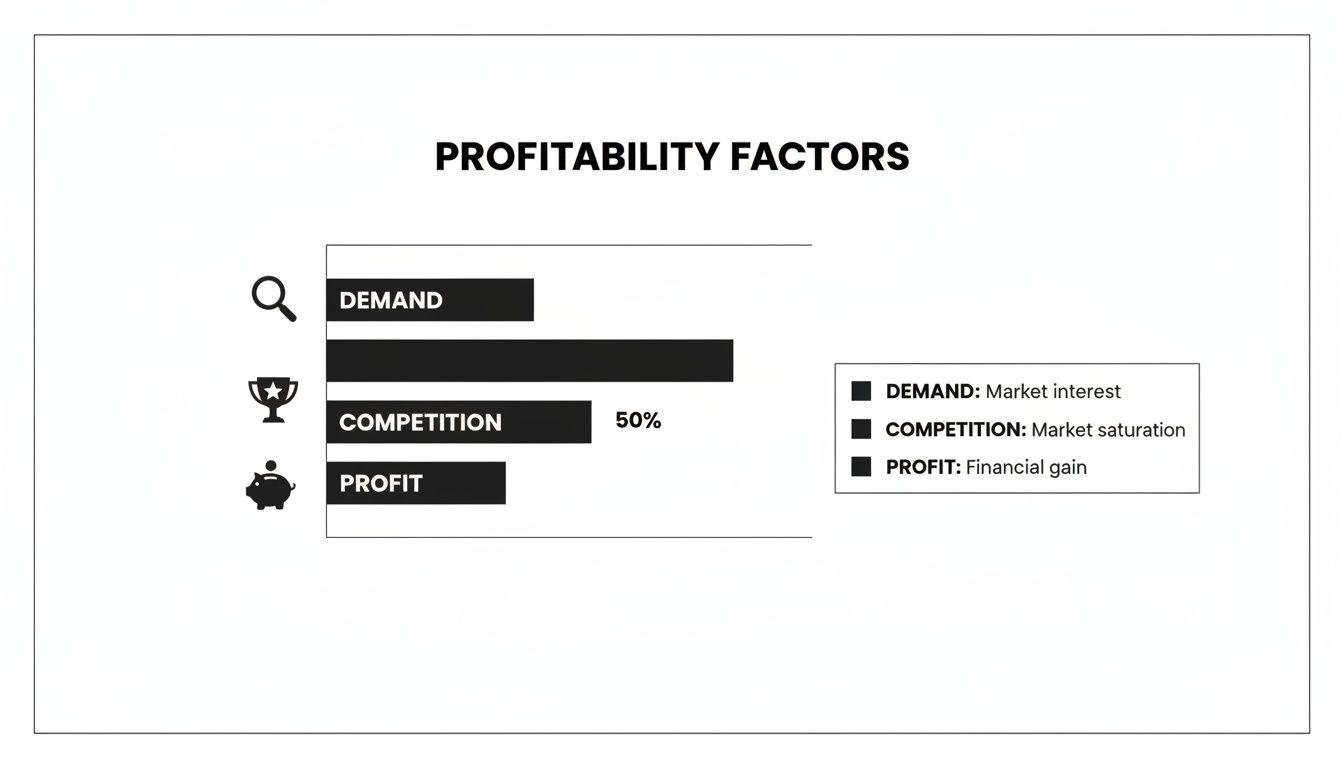
You're constantly weighing the market's demand against the competition, all while trying to protect that final profit number.
So, how can you tell if the numbers are good without getting lost in a spreadsheet for hours? Many top sellers lean on a simple benchmark called the 40/30/30 Rule for a quick gut check on a product's financial health.
It’s a clean, easy-to-remember framework for what a healthy profit structure looks like.
Let's See It In Action:
Now, this isn't a rigid law, but it’s an incredible starting point. If your landed cost is already 60% of your target sale price, that’s a massive red flag. It leaves almost no room for marketing, unexpected costs, or, you know, actual profit. You can model out your own specific numbers with the formulas in our guide to building an Amazon FBA profit calculator.
Let's pull this all together with a real-world example. Imagine you want to sell a set of premium silicone baking mats for $34.99.
Expense CategoryDescriptionCost Per UnitLanded COGSManufacturing, shipping, and tariffs.$9.50Amazon Referral FeeAmazon's 15% commission on the sale.$5.25FBA Fulfillment FeeAmazon's cost to pick, pack, and ship.$4.75Monthly Storage FeeProrated cost for warehouse space.$0.20Advertising (PPC)Estimated ad spend to get one sale.$4.00Total CostsThe true cost to sell one unit.$23.70
Now for the simple, beautiful math:
In this scenario, your net profit margin is 32.3% ($11.29 ÷ $34.99). This fits perfectly within our 40/30/30 framework and signals a product with strong financial legs. Doing this math before you ever cut a check to a supplier is what separates a calculated business decision from a costly gamble.

Let's clear up a common myth. Finding the most profitable item to sell on Amazon isn't some treasure hunt for a completely undiscovered product. The real money is made by finding the sweet spot where customer demand is high, but the current sellers are dropping the ball. These are the "opportunity gaps" every seasoned seller lives for.
Here’s how I like to think about it: you’re a real estate developer. You wouldn't build a skyscraper in the middle of nowhere, right? And you definitely wouldn’t try to wedge one in right next to the Empire State Building. The smart money is on finding a hot neighborhood where the buildings are a bit old and a modern upgrade would instantly stand out.
That’s exactly what we’re doing on Amazon. We’re moving past the big, bloody-knuckle keywords like "yoga mat." Instead, we’re drilling down into specific sub-niches where buyers know exactly what they want and the competition is far less intimidating.
First things first: you need to prove people are actually looking for what you want to sell. Your gut instinct is great for ideas, but it’s a terrible business plan. We need hard data. This is where product research tools become your best friend, giving you the numbers to back up your hunch.
A great starting point is the monthly search volume for your core keywords. You're looking for a healthy range, something like 3,000 to 50,000 searches per month. This signals there's genuine interest, but it's not so massive that you’ll be drowned out by mega-sellers. Go lower, and you might not make enough sales. Go higher, and you’re walking into a warzone.
Next, you have to verify that searches are turning into sales. Take a look at the sales volume for the top products. Using a tool like Jungle Scout or Helium 10, check out how many units the top 5-10 listings are selling. If the main players are each moving 300+ units a month, you've just confirmed you’re in a market with hungry buyers.
Okay, so you've found a crowd of eager customers. Now it's time to see who you're up against. The goal isn't to find a niche with zero competition—that's a ghost town. You want to find a place where you have a real shot at getting on the first page and making a name for yourself.
The secret isn't finding a market with no competition. It’s finding one with imperfect competition. You're looking for flaws you can exploit—lazy listings, a pile of negative reviews, or just plain boring products.
Here’s what you need to be investigating:
To truly nail this, you need to understand who you're selling to. Learning how to identify a target audience is a critical skill that makes spotting these competitive weaknesses feel like second nature.
For a much deeper look into this discovery process, our complete guide on how to find winning products lays out the entire framework step-by-step. When you combine solid demand data with a sharp eye for competitive gaps, product research stops being a guessing game and becomes a repeatable strategy.
Everyone wants to find that one "most profitable item to sell on Amazon." It's a tempting shortcut, but experienced sellers know that's not how it works. The real secret is knowing where to start your hunt. Certain categories are just naturally fertile ground, consistently spitting out profitable opportunities because of how their markets are built.
Think of it like a seasoned fisherman choosing a well-stocked lake over a random pond. It’s not about luck; it's about understanding the "why" behind the success. These categories plug directly into core consumer needs and buying habits, creating the perfect environment for profit. You get to stand on the shoulders of established market trends instead of starting from absolute zero.
The Home & Kitchen category is a titan on Amazon for one simple reason: its demand is evergreen. People will always need to cook, clean, organize, and decorate their homes. Unlike categories driven by short-lived fads, this space is powered by constant replacement cycles, life events like moving or getting married, and the universal desire to make a living space better.
This constant need gives you a stable sales floor. Even better, it's a category ripe for differentiation and bundling. A generic garlic press is just a commodity, a race to the bottom on price. But a beautifully designed, easy-to-clean garlic press sold with a matching silicone peeler? That's a unique solution that justifies a higher price and can start building a real brand.
The numbers back this up. Home & Kitchen frequently tops the charts for seller revenue, accounting for around 35% of SMB Amazon sales. The category's strength is that constant refresh cycle, driving a huge piece of the $120 billion spent on home goods around the world each year. For sellers, that translates into real profit—margins on popular items like cookware and storage solutions often hit that sweet spot between 30-45%. You can explore detailed profit findings on SellerSnap.io for a deeper dive into top-performing categories.
The Beauty & Personal Care category plays a different, but just as powerful, game: consumability and repeat purchases. When a customer discovers a face serum, shampoo, or pimple patch they love, they don't just buy it once. They buy it over, and over, and over—often on a subscription.
This completely flips the script on profitability. Your customer acquisition cost isn't for a single transaction; it's an investment that can pay you back for months, even years.
A single happy customer in the beauty space can be worth 10x their initial purchase value over their lifetime. The goal isn't just to make one sale; it's to earn a permanent spot on their bathroom counter.
This creates a massive opportunity for brands that can deliver on quality and build genuine trust. To win here, you need to focus on a few key things:
Patio, Lawn & Garden might look seasonal on the surface, but it's actually packed with high-margin, niche opportunities. Sure, the competition for "patio furniture" is brutal, but the market for specialized products like "vertical herb garden kits," "heavy-duty grill covers," or "pet-safe pest control" is often wide open.
This category is driven by passion and problem-solving. Gardeners and homeowners are happy to spend a little more on products that solve a nagging problem or upgrade their favorite hobby. The trick is to think past the obvious. Don't just sell another garden hose. Develop a lightweight, kink-proof hose with a patented nozzle designed specifically for delicate flowers.
These top-performing categories all share a few common threads that align with our core principles of profitability. They offer a great mix of high demand, clear paths to differentiation, and solid margin potential. By starting your product research in these proven arenas, you dramatically improve your odds of finding something that isn't just sellable, but genuinely profitable.
Finding a winning product isn't just about what you sell; it's about how you buy it. Your ability to build a truly profitable business is often locked in long before a customer ever clicks "Add to Cart." While everyone else is fixated on sales price, the top 1% of sellers know the supply chain is their secret weapon for creating an unbeatable financial edge.
Think about it. Every single dollar you can shave off your landed cost—the all-in price to get one unit from the factory to an Amazon fulfillment center—is a dollar of pure, unadulterated profit. Trying to squeeze another 10% out of your sales price in a crowded market is tough. But finding a 10% cost reduction through smarter sourcing? That’s often achievable behind the scenes, and it’s how you build a real fortress around your margins.
One of the biggest rookie mistakes is paying a supplier 100% upfront. This move is a massive drain on your cash flow, tying up capital you desperately need for marketing or your next inventory order. It’s also just plain risky.
Instead, your goal should always be to negotiate split payment terms. A completely standard and fair arrangement is 30% upfront and 70% upon completion, right before the goods are shipped. This simple structure does two powerful things:
Don't ever be afraid to ask for these terms. It's a normal part of doing business, and any factory worth its salt will be ready for the conversation.
Relying on a single factory for your best-selling product is like building your dream house on a single pillar. If that pillar cracks—whether from factory shutdowns, a sudden drop in quality, or even political turmoil—your entire business can come tumbling down.
This is why smart sellers always have a bench of qualified suppliers. Even if you have a great relationship with your primary factory, you should have at least one or two others already vetted and ready to step in if disaster strikes.
Pro Tip: Never, ever give a new supplier 100% of your production volume on the first go. Start with a smaller test order to see their quality and reliability for yourself. This simple step can save you from a catastrophic financial loss if they don't deliver.
This is a core pillar of building a resilient brand. For a masterclass in building a rock-solid supply chain, our guide on strategic sourcing best practices dives even deeper.
Here’s one of the easiest wins in the entire sourcing process: optimizing your packaging to hit a smaller Amazon FBA size tier. Amazon’s fulfillment fees don’t scale smoothly; they take huge jumps the second your product crosses a specific size or weight threshold.
For example, simply knocking half an inch off your box's longest side could drop your product from the "Large Standard" tier down to "Small Standard." That tiny change could instantly save you $1 to $2 in FBA fees on every single unit sold. Multiply that by thousands of sales, and you’re talking about a serious boost to your net profit.
Work with your supplier to create custom-fit or "frustration-free" packaging that's as small and light as possible without compromising protection. It’s free money, just waiting for you to claim it.
All the theory in the world doesn't mean a thing if you can't put it into practice. It’s time to take everything we’ve talked about and forge it into a disciplined, repeatable process you can use on any product idea that crosses your desk.
Think of this less as a simple list and more as a scorecard. It’s your system for making data-driven decisions and, just as importantly, killing bad ideas before they drain your bank account.
Finding that winning product is all about systematically checking off the boxes. Use this checklist to score your next idea with cold, hard numbers. A string of "yes" answers is a great sign. A few too many "no's"? It’s time to head back to the drawing board.
First up, we run the numbers. If the math doesn't work on paper, it will absolutely never work in the real world. This is your most critical filter.
Next, we size up the competition and the market itself. You need to prove that a hungry audience already exists and that you have a clear shot at getting on page one.
A product with perfect financials is worthless if you can't get any eyeballs on it. You're looking for an active market with imperfect competitors, not an empty field or an impenetrable fortress.
Fire up your product research tools and answer these questions with data, not your gut feeling.
This checklist turns product research from a guessing game into a methodical evaluation. By working through these points one by one, you stop chasing shiny objects and start building a real portfolio of products selected for one reason: their genuine potential to become a truly profitable item to sell on Amazon.
Even with the best game plan, some questions always come up on the hunt for a winning Amazon product. Let's tackle the ones I hear most often from sellers who are just starting to put these strategies into practice.
You should be aiming for a net profit margin of 25% or higher. That’s the cash you have left after every single cost—fees, ads, shipping, you name it—is paid.
Sure, some sellers in high-volume categories can get by on less, but targeting that 25-35% range gives you a crucial safety net. It’s a buffer that protects you when Amazon inevitably raises fees, ad costs spike, or you need to run a promotion to stay competitive. A product with a 10% margin is living on the edge; one unexpected cost can completely erase your profits.
There's no single answer, but a realistic starting point is somewhere between $3,500 and $7,500. This gives you enough runway to cover your first inventory run, initial marketing, and the tools you need without being under a ton of financial pressure right away.
So, where does that cash go?
Starting with too little cash is one of the most common ways new sellers fail. It forces you to cut corners on marketing or, even worse, go out of stock right when your product starts to get traction.
Trying to launch a private label product on Amazon with less than a few thousand dollars is like trying to win a car race on a bicycle. You might get off the starting line, but you won't have the fuel to compete.
For new sellers, the sweet spot is almost always a product you can sell for between $25 and $75.
Anything under $20 usually has paper-thin margins once Amazon takes its cut. You’d have to sell an enormous volume just to make a decent profit. On the flip side, products over $100 demand a massive upfront investment and customers take longer to decide, which means a slower sales cycle. The $25-$75 range is the perfect balance of healthy profit-per-sale and a manageable starting investment.
Absolutely. "Saturated" doesn't mean "impossible"—it just means you need to be smarter and more specific. Instead of going head-to-head with the category kings, you need to find an underserved niche sub-market.
For example, don't just launch another "dog bed." Think about who the big players are ignoring. What about "orthopedic dog beds for large breeds with washable covers"? The more you niche down, the less direct competition you’ll have. Success in a crowded market is all about finding a specific customer problem the leaders have overlooked and creating the perfect solution just for them.
At Million Dollar Sellers, we move beyond the basics. Our members are the 7-, 8-, and 9-figure founders who have mastered these principles and are now defining what's next in e-commerce. If you're an established seller ready to scale with a network of proven experts, MDS is where you belong. Learn more and see if you qualify at https://milliondollarsellers.com.
Join the Ecom Entrepreneur Community for Vetted 7-9 Figure Ecommerce Founders
Learn MoreYou may also like:
Learn more about our special events!
Check Events