Chilat Doina
November 9, 2026
You hired a designer on Tuesday. By Thursday you had three logo lockups, two hex codes that do not match the Amazon main image, and a support macro that still uses last year's tagline. The agency is waiting on "the brand doc." Your marketplace lead is waiting on title formulas. Nobody can point to one file that settles either question.
That file is a brand playbook PDF, and it is not a folder of logos. It is a short operating document that tells a writer, a photographer, and a marketplace manager what they may decide alone and what they must escalate. I would start with the decisions that already cause rework, not with a color palette. If the homepage promise and the listing bullets disagree, matching hex codes will not fix the customer experience.
Open the Amazon listing, the DTC homepage, and the mailer insert side by side. The listing leads with a keyword stack, the homepage leads with a lifestyle line, and the insert still quotes a discontinued bundle. A PDF of logo files and color codes does not catch that. It fails the moment those three surfaces tell three stories.
The scale problem is approval, not taste. A Lucidpress and Demand Metric study, as reported by Omnibound, found that 81% of companies struggle to create content that remains on brand, and 71% of brand professionals say seven or more people are needed to approve a single on-brand asset. Every vague line in the playbook becomes another review round.
Use this eight-row skeleton as the document itself. Copy it into your own file, one heading per row. No ready-made download is linked here, so the table is the template.
| Section | Question it answers | Owner | Review trigger |
|---|---|---|---|
| Brand purpose and promise | Why do customers choose us over alternatives? | Founder | Annual, or a change in mission |
| Target customer | Who is this for, and who is it not for? | Brand lead | New product line or new market |
| Positioning and differentiation | What do we claim that competitors cannot easily copy? | Founder and brand lead | Competitor shift or repositioning |
| Voice and messaging | How do we sound in a listing, an email and a support reply? | Brand lead | New channel or new writer |
| Visual identity | Which logo, color, photo and layout rules apply? | Creative lead | New packaging or new asset type |
| Claims and compliance | Which product claims need proof, and what proof is on file? | Legal or compliance reviewer | Any new claim or regulator update |
| Channel rules | What must stay identical on each channel, and what can adapt? | Marketplace manager | New marketplace or retail partner |
| Decision rights and approvals | Who signs off on what, and when is escalation needed? | Founder | Team growth or new agency |
The visual row should point at working files, not paste them. A practical brand style guide belongs in those linked files. If you still need help to build a practical brand style guide, use that for logo, type, and color, then come back and write the other seven rows.
Length test: A new hire should be able to read the whole PDF in one afternoon. If it takes longer, you copied assets instead of linking them.
A 32-month academic brand-positioning project in SAGE Journals ran through inspiration, ideation and iteration, and implementation. It insisted on real user needs, trial and error, a tangible artifact, and a test in live operating conditions. The same paper argued that bringing decision-makers in early raises the chance they will use the result. Put the founder, creative lead, marketplace owner, and compliance reviewer in the first workshop. Do not hand them a finished PDF to rubber-stamp.
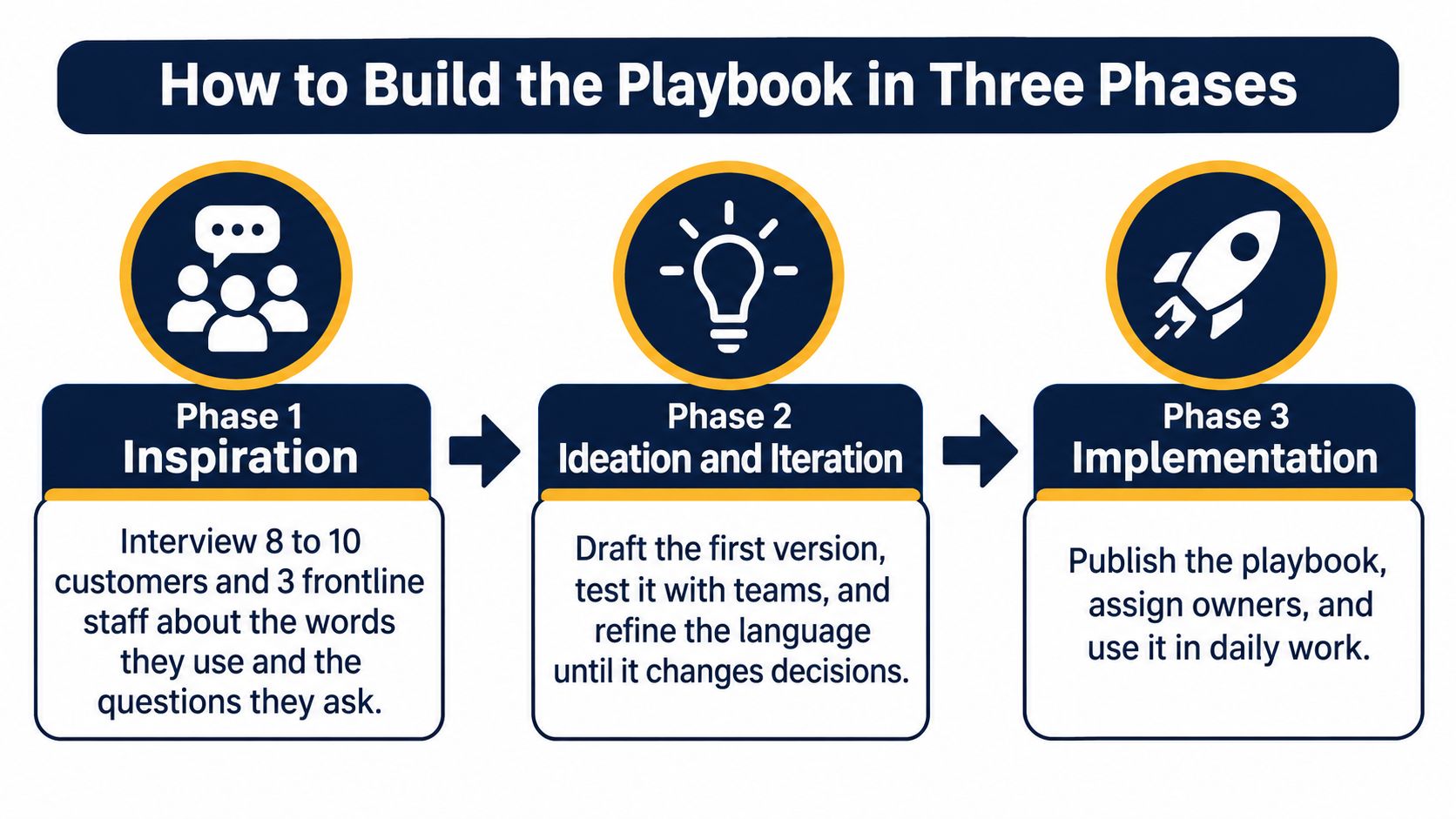
Interview 8 to 10 customers and 3 frontline staff (support, fulfillment, marketplace ops). Ask for the words they use and the questions that stall an order. The slip is interviewing only fans of the brand and writing a promise nobody in the warehouse recognizes.
Test two or three positioning claims on live Amazon listings and DTC pages for two weeks. Record which version converts and which draws returns or complaints. The slip is declaring a winner from a creative review with no orders behind it.
Draft voice, image, and claim rules from the winning examples, not from adjectives like "premium" or "playful." The slip is writing the rule before you have a page that already worked.
Publish executable rules for Amazon, DTC pages, packaging, paid media, email, and retail, with one example per channel. The slip is one master paragraph that ignores how a bullet, a subject line, and a shelf carton get made.
Audit live assets at 60 and 90 days against conversion and brand complaints, then rewrite any rule people routinely break. The slip is treating the PDF as a finished design deliverable. That version goes stale within a quarter.
Early workshops feel slower than a one-pass brand book. They are faster than a quarter of assets nobody will follow.
Every entry has to change a decision someone makes on Monday morning. "Premium quality" does not. A writer can still title the listing any way they like, and legal still has nothing to file.
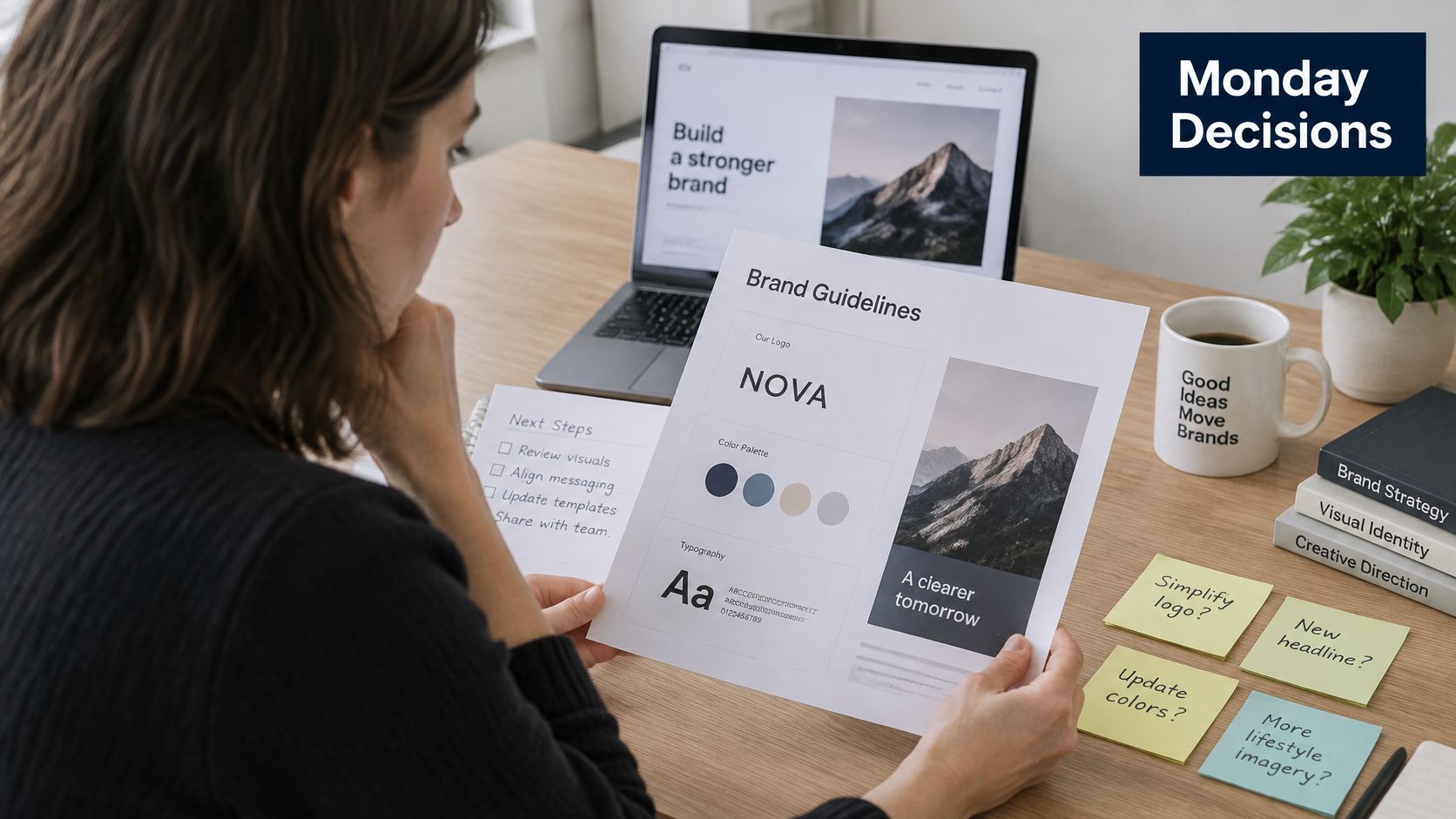
Say the team writes positioning as "premium quality." Rewrite it in the meeting: "The only foldable frame that ships pre-assembled in under 10 minutes." Now the listing lead knows the first bullet, the photographer knows to show the clock, and a competitor claim is specific enough to defend or drop.
| Element | Weak entry | Usable entry |
|---|---|---|
| Positioning | Premium quality | The only foldable frame that ships pre-assembled in under 10 minutes |
| Target customer | Busy parents | First-time parents buying online at night who read reviews before checkout |
| Voice | Friendly and fun | Plain sentences, material and size first, no superlatives, address the reader as you |
| Claims | Eco-friendly packaging | Mailer is 100% paper-based, supplier spec sheet on file, reviewed quarterly |
| Product images | Clean, high-quality photos | Longest side at least 1000 pixels; one lifestyle image and one white background per listing |
Brand purpose, as a rule: "We sell a stroller frame a first-time parent can open and use the night it arrives, without tools." Owner: founder. Example: the homepage hero and the A+ opening both lead with that sentence, not with a lifestyle adjective.
Decision rights, as a rule: Marketplace manager may change keyword order inside Amazon bullets. They may not change the pre-assembled claim. Escalation goes to the founder the same day a claim would change. A rule with no named approver cannot be enforced, because everyone assumes someone else signed off.
Photo crop, as a preference: Creative lead prefers a three-quarter angle on lifestyle shots. A marketplace manager can use a straight-on crop when the zoom fails. Mark it "preference" so nobody treats it like a compliance block.
The image row is a rule because Amazon zoom breaks below a usable pixel size, and a missing white background gets the listing flagged. "Clean photos" is a preference pretending to be a rule. Attach one approved listing URL next to every rule so a contractor can copy the pattern instead of interpreting the sentence.
Adobe's 2025 retail research found that 75% of shoppers consider a consistent experience across websites, apps, email, social media, and stores important, yet only 41% of brands meet that expectation. The same work points to disconnected tools and silos as the reason teams cannot act on one customer view. Your channel section exists to close that gap without forcing identical copy everywhere.
Consistency means a recognizable promise. It does not mean the same sentence on a search bullet, a homepage module, and a club-store carton. Offers, creative, and merchandising should move with the channel.

What stays fixed
What can adapt
| Element | Fixed or adaptable | Approver |
|---|---|---|
| Brand promise | Fixed | Founder |
| Core product claims | Fixed | Legal or compliance reviewer |
| Voice principles | Fixed | Brand lead |
| Visual identity | Fixed | Creative lead |
| Amazon bullet structure and keyword placement | Adaptable | Marketplace manager |
| DTC bundle offers | Adaptable | Brand lead |
| Retail packaging size | Adaptable | Creative lead |
| Email subject-line tests | Adaptable | Brand lead |
Settle three questions in the PDF. Which elements never change? Who approves a marketplace-specific adaptation? How will you tell whether consistency lifts conversion without freezing tests? Compare conversion and return notes before and after a rule, on one channel at a time.
An acquired brand or a new sub-brand needs its own line: inherit the parent playbook, or keep a separate promise with shared claims review. Leaving that blank is how two logos end up on one unboxing. For the wider operating picture, read this omnichannel strategy and management guide, and look at apps for unified online and retail sales when catalog data is split across tools.
Teams skip a playbook when every asset needs another sign-off. Adobe's notes on brand consistency at scale cite research in which 59% of brand professionals say content is often published before the approval process is completed. Adding reviewers is the move that creates that bypass. The same body of consistency research associates consistent presentation with revenue gains of up to 33%. Treat that as a benchmark, not a result your PDF will produce on its own.
Build governance in this order, and stop when the daily assets no longer need a meeting.
Reserve a human review for high-risk launches: a new health or sustainability claim, or a major price change. Title formulas, image dimensions, tone, and prohibited claims should already be encoded, so most assets never enter a queue. For a fuller read on what "on brand" means in practice, see this piece on what brand consistency is.
| Metric | What it shows | How to start |
|---|---|---|
| First-pass approval rate | Share of assets approved without rework | Baseline over 30 days, then set a target |
| Median approval time | How long an asset waits for sign-off | Track by asset type, not as one average |
| Off-brand defect rate | Share of live assets that break a rule | Sample live listings and pages each month |
| Template usage | Share of new assets built from approved templates | Count templates in use by team |
| Conversion by channel | Whether consistency is helping or hurting sales | Compare before and after each rule change |
Take a 30-day baseline before you set targets, and reread the playbook each quarter against those five numbers. If template usage is high and defects are low, you do not need another approver.
The playbook fails when reviews outnumber rules.
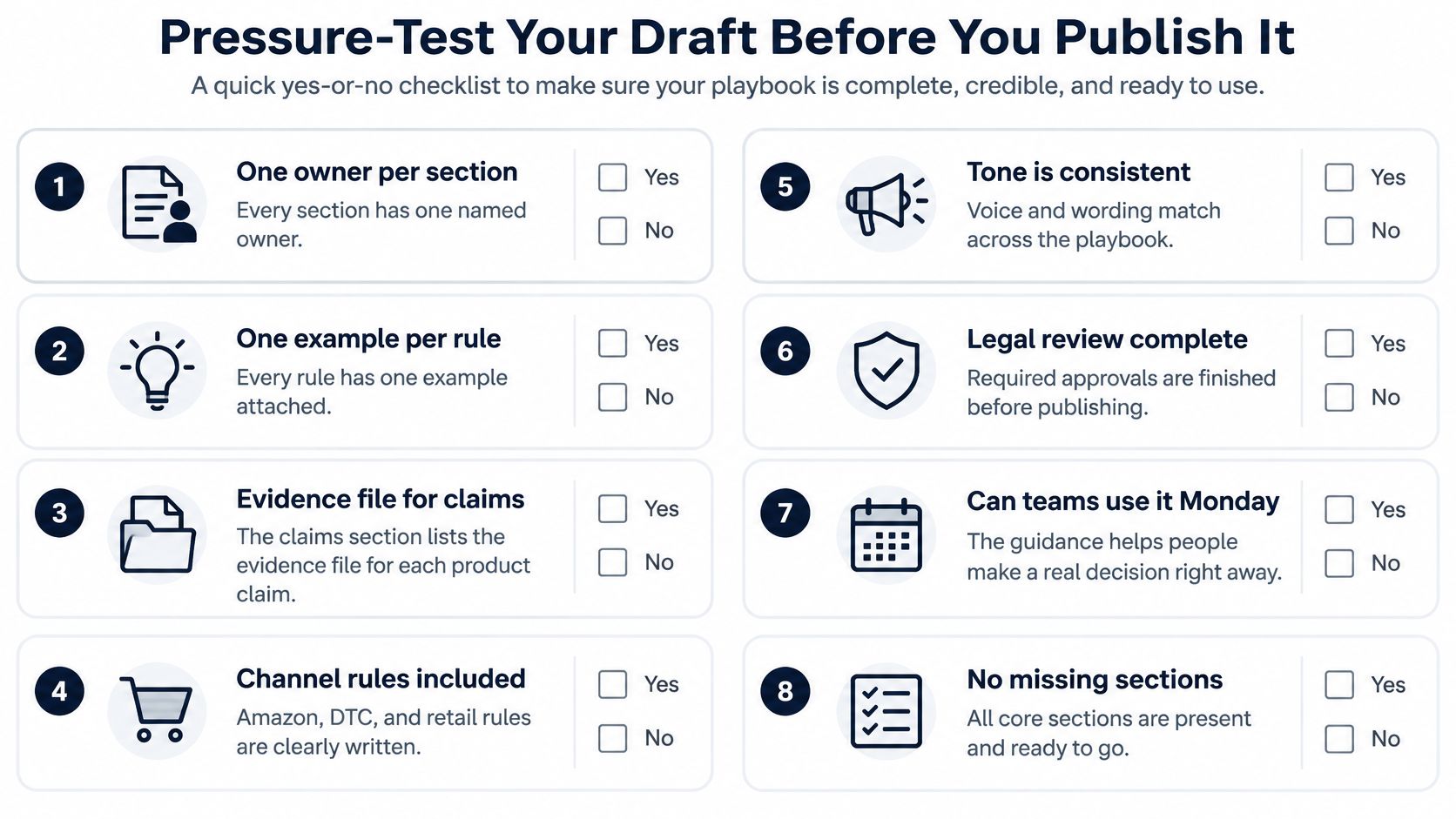
A PDF can look finished and still fail on first contact with a real asset. Run eight yes-or-no checks before it goes out. Any "no" sends that row back to its named owner.
Give the draft to three people outside the writing group: a support lead, a marketplace manager, and a designer. Ask each to apply one rule to a real asset this week. A support macro, a live listing, and a paid banner are enough to surface every vague line.
Watch for the tell: the support lead asks whether "friendly tone" allows exclamation points, or the designer guesses at image dimensions the rule never pinned down. When someone has to ask what a rule means, the rule is the problem. Rewrite it, then hand the same asset back to the same person. Log each change with a date on the cover so the next version is obvious.
When the PDF is ready to share, create a URL for your PDF so agencies open one current link instead of an attachment from March. Keep edit rights with the founder and view rights for everyone else.
For a harder read than an internal review, put the draft in front of founders running brands at your stage. Million Dollar Sellers is an invite-only community for omni-channel, DTC, and TikTok brands. Joining takes $1M trailing-twelve-month website revenue and a founder or substantial equity stake, and the membership includes 500+ member SOPs and templates to measure your rules against. Check whether your brand qualifies at Million Dollar Sellers.
Join the Ecommerce Community for Founders Scaling from 7 to 9 Figures
Learn MoreYou may also like:
Learn more about our events!
Check Events