Chilat Doina
October 31, 2026
In 2025, omnichannel shoppers spent 1.5 times more per month than single-channel shoppers, according to Deloitte Insights' 2025 Retail Industry Outlook. That's the number brands use to justify the next marketplace, the next retail door, and the next connector. It's also where the logic usually stops, because spend tells you what a shopper paid, not what you kept after fees, picking, shipping, returns, and the stockout you created somewhere else.
Say you're a marketplace-heavy brand doing healthy volume and you open a DTC site, then wholesale, then a second marketplace. Each launch has its own revenue chart, so growth looks obvious. Underneath, all four storefronts are promising the same hero SKU, the warehouse can't tell which units are already spoken for, and returns land wherever it's convenient for the customer rather than where your system can see them.
Omnichannel strategy and management is the commercial plan and the daily operating control for selling through marketplaces, DTC, and retail without losing track of inventory, orders, or contribution margin. Think of it as adding checkout lanes that all draw from one stockroom. Another lane raises sales only if someone can see what's already promised, what's on the shelf, and what each lane costs to run.

Most brands are already in this position whether they've planned for it or not. In DHL eCommerce's 2025 survey of 4,050 e-commerce businesses across 19 global markets, 63% of retailers sold on three or more platforms and 68% sold on Amazon. In the MIT Center for Transportation & Logistics 2025 survey of 647 leaders, 60% said their organizations were already implementing an omnichannel strategy.
You're not deciding whether to be omnichannel. Your customers already move between channels, and your listings already compete with each other. You're deciding which channel motions earn a share of your inventory and your customer data, and which ones don't.
A polished experience can still be a bad business. If a marketplace order carries referral and fulfillment fees, pulls a unit that would have sold at full margin on DTC, and comes back as a return you pay to process, the shopper's higher spend paid everyone except you. Work to align DTC and marketplace sales starts with that arithmetic, not with matching banners across storefronts.
You'll leave with four working tools. A five-layer operating map of what one brand has to share. A stop-or-share rule for each channel motion. A journey measurement set that replaces isolated conversion rates. And a named owner for identity, consent, and the right to kill a launch.
Founder rule: a channel earns inventory and data only after it clears a profit test and has a named owner. Everything else is a storefront looking for a subsidy.
Use the operating map first. Before you approve the next integration, check which layer it depends on and whether that layer still has two sources of truth.
Start from the shopper, because shoppers got there first. Zebra Technologies reported that an estimated 73% of consumers were omnichannel shoppers and 41% of consumers worldwide used two or more channels during the purchase process. Their fulfillment choices crossed the same line, with 64% of online shoppers receiving orders at home, 34% picking up orders in stores, and 15% shipping purchases to an alternate location.
Companies were behind. Only 39% of surveyed organizations believed they were operating at an omnichannel level, even though 76% of retailers used store inventory to fulfill online orders. Inventory accuracy averaged approximately 66%, and 55% of organizations still used pen and paper to manage at least part of omnichannel logistics. Those are late-2010s figures, so treat them as a starting diagnosis rather than a current benchmark, but the gap they describe is still the one that breaks launches. A shopper crosses channels in one purchase while the brand hands her off between systems that don't share identifiers.
Catalog and price come first. One product ID, one set of attributes, one price rule per channel policy. The miss is a hero SKU showing two prices or two ingredient lists, so the shopper has to decide which version of your brand is lying.
Customer and order identity is next. A persistent customer or household key lets service see a marketplace order and a DTC order as one relationship. Without it, your agent tells a repeat buyer she has no history with you. Some brands use digital loyalty passes for retail shoppers as one way to carry that identity into a store visit, but the pass only helps if the order record behind it is the same one your other channels read.
Available-to-promise inventory is where money leaks. A store count that includes units already sold on a marketplace isn't inventory, it's an oversell waiting for a refund. The fulfillment promise follows from it, since the delivery or pickup window you quote is only honest if the node you picked holds the unit and has labor to pick it. Returns eligibility closes the loop, and it's the layer shoppers test in person, at a counter, while your associate explains why a return the website accepted can't be processed here.
A polished product page still fails if checkout, delivery, or post-purchase status breaks continuity. Shoppers don't score your layers separately.
Shared layers of an omnichannel operating system
| Layer | Shared object | What the shopper hits | Control metric |
|---|---|---|---|
| Catalog and price | One product ID and price rule | Two prices or specs for the same SKU | Price variance rate |
| Identity and orders | Persistent customer or household key | Service cannot see marketplace and DTC history | Order-status sync latency |
| Available inventory | Available-to-promise by node | Oversell or a unit that is not really there | Inventory accuracy |
| Fulfillment promise | Node choice and delivery or pickup window | Split shipments or a missed pickup | Promise kept rate |
| Returns | Eligibility, refund path, and disposition | A return accepted in one channel and refused in another | Share of orders with uniform returns |
Don't launch a channel whose required layer still has two sources of truth. If your catalog lives in one spreadsheet for Amazon and another for DTC, adding a third storefront gives you three versions of the same product to reconcile during your busiest week.
Fund a channel motion only if it adds profit after the costs it creates. That's the whole test, and it has four steps you run in order before anything goes live.
1. Build fully loaded contribution per order. Take the selling price and subtract channel fees, pick and pack, last-mile delivery, payment costs, and expected returns at your real return rate for that SKU. Then compare it with the same SKU sold through DTC. If you can't produce that number, you don't have a channel proposal, you have a revenue hope.
2. Test whether the order is incremental. A new channel often just moves an existing buyer from a richer sale to a poorer one. Use repeat-purchase cohorts rather than the first order alone, and ask whether these customers buy again, buy more, or buy in a place where you keep less.
3. Write the inventory rule. For each hero SKU, choose a shared pool or a protected buffer, and set the buffer from sales velocity and replenishment lead time. Write it down before launch, because nobody negotiates a fair buffer during a stockout. Practical detail on setting shared and protected inventory pools across channels helps here, but the decision itself is yours.
4. Define the stop condition. Name the point where stockouts, labor, or service cost on your primary channel exceeds the new contribution, and agree who can pull the plug.
This isn't new complexity. A 2015 survey of retailers reported by DC Velocity found 63% of respondents fulfilled e-commerce orders through a traditional distribution center that also handled other operations, 43% fulfilled orders from stores, and 36% shipped directly from manufacturers or suppliers, with 69% operating e-commerce and traditional fulfillment at the same facility. Shared facilities and shared stock were already the norm a decade ago. What's usually missing is the rule that governs the sharing.
Store pickup and ship-from-store look free because you already pay rent. They aren't. Store labor picks the order, someone counts the unit, the returns desk absorbs the mistakes, and a miscounted shelf turns into a cancelled pickup in front of a customer who drove over. You've turned a store into an unpaid warehouse and charged none of it to the channel that caused it.
When a channel may share inventory
| Motion | Share inventory | Main profit leak | Stop when |
|---|---|---|---|
| Marketplace fulfilled by the platform | No, keep a separate buffer | Referral, fulfillment, and removal or return fees | Net contribution trails the DTC order after fees |
| Marketplace merchant fulfilled | Only surplus above a protected buffer | Late-ship penalties and split shipments | Stockouts hit the higher-margin channel |
| DTC shipped from the DC | Yes, this is the primary pool | Last mile and returns | Repeat purchase does not cover acquisition and service |
| Buy online, pick up in store | Yes, only units already in that store | Store labor and miscounted units | Missed pickups or labor exceed the shipping saved |
| Ship from store to home | Only high-accuracy stores | Pick labor and reships | Error rate creates replacements or refunds |
| Supplier or manufacturer dropship | Do not pull store or DC stock into it | Slow delivery and weak tracking | The delivery experience misses the brand promise |
I would reject any channel request that arrives without a contribution line and an inventory rule. It isn't ready to build, and building it first just means you discover the economics at full volume.
Unified customer data is an operating control, not a trophy. The diagram below maps where that control breaks down when nobody owns it.
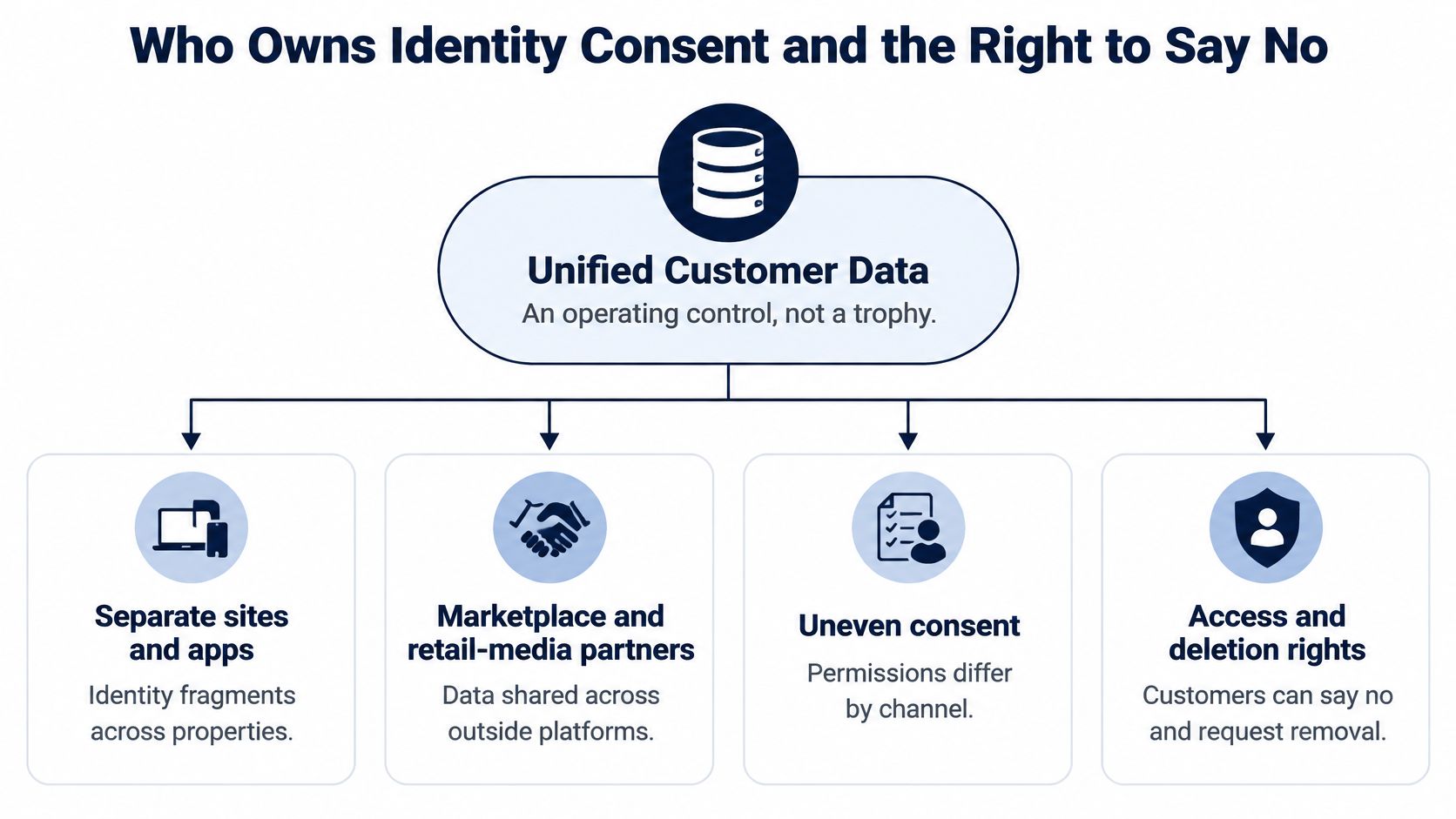
Grant Thornton's analysis of retail's expanding digital touchpoints describes a growing risk surface built from independently built sites, apps, third-party ecosystems, inconsistent consent practices, legacy systems, and unclear ownership, alongside access-management weaknesses, account takeover, bots, and synthetic identities. That's not an IT problem. Every item on that list is a decision a channel team made to move faster.
One role owns identity resolution and consent across Amazon, DTC, retail media, email, and stores. Channel managers don't each keep a private definition of a customer. That owner decides which identifiers may be matched, which may not, and how long a match survives. If you're working through the compliance side, a practical overview of data privacy obligations for ecommerce brands is a reasonable starting point for the conversation.
Consent travels with the profile, and purpose limits use. If someone gave you an email for delivery updates, that isn't permission to feed her browsing history into a personalization model. If a shopper refuses tracking, keep an anonymous session and don't stitch it later from a guessed email match. She said no. Honor it in the data, not just in the banner.
Write the conflict rule before you need it. When attribution sources disagree, the order channel and fulfillment node decide profit reporting, because that's where fees and shipping costs landed. The first paid touch stays a hypothesis you can test, not a number you pay bonuses on.
Watch the walkthrough below for how these ownership questions play out when a brand tries to stitch identities together.
Consider a retail associate app that surfaces a customer's lifetime value and full purchase history to anyone holding the store tablet. The associate needs to know whether this order is eligible for return. She doesn't need the rest, and giving it to her creates exposure with no service benefit. Access should follow the task, not the org chart.
Back the assignments with process. One owner for the canonical product and order model. A weekly channel council that can reject a launch, with finance in the room looking at contribution rather than top-line channel growth. Move each channel manager's bonus from channel revenue to a shared contribution and promise-kept score, or they'll keep optimizing for the lane they own.
Don't start a personalization project until you've named a data owner, a consent fallback, and a written conflict rule.
A channel's own conversion rate is the wrong scoreboard, because the shopper didn't stay in that channel. The five-step flow below shows where the effect actually travels.
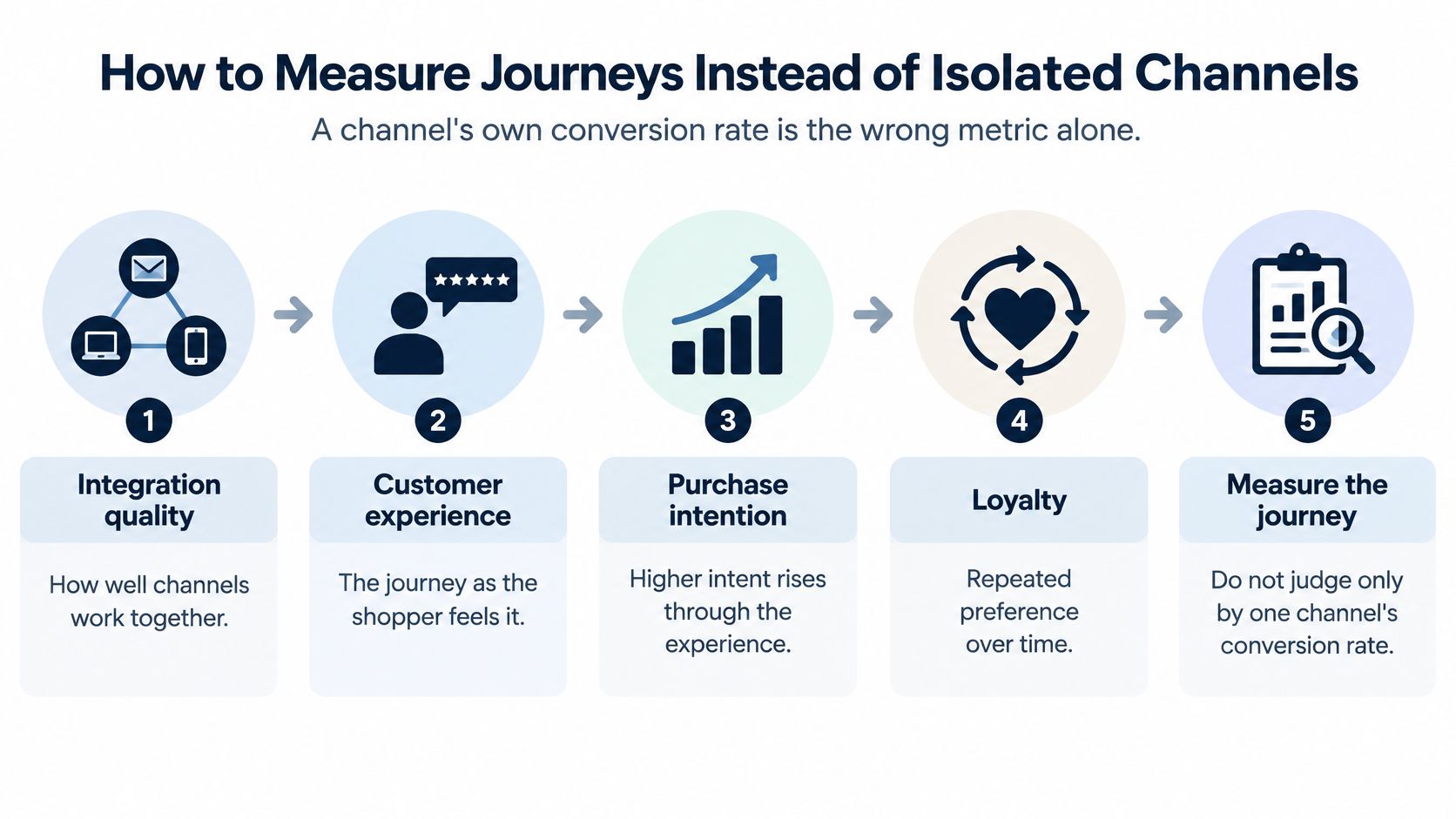
A meta-analytic structural equation model synthesizing 41 publications and 44 studies found that omnichannel integration quality positively affects both purchase intention and customer loyalty, with customer experience acting as a mediator. Integration pays through the quality of the journey the shopper lives through. Measure the journey, then, not the touchpoint.
Keep a persistent customer or household key. It doesn't have to be perfect. It has to be consistent, so the same buyer isn't three people in three reports.
Stamp the events. Record time-stamped interactions across paid media, marketplace listings, DTC sessions, customer service contacts, and store visits. Then reconcile those events to orders and returns, because an order that came back isn't revenue. If you're tightening the reporting layer generally, a grounded approach to ecommerce analytics and reporting covers the plumbing, but the key decision is which questions the report has to answer.
Report journey outcomes, not session outcomes. Track assisted conversion, repeat purchase, cross-channel retention, channel-switch abandonment, and customer lifetime value by first touch and by the node that fulfilled the order. That last cut matters more than many expect, since a customer acquired cheaply but fulfilled expensively isn't cheap.
Then add consistency checks that prove your shared layers are real rather than aspirational:
Say a shopper discovers you on a marketplace, reads reviews, buys on DTC, and returns one item at a pop-up. The marketplace session shows no conversion, so a channel report calls it waste. Ninety days later she's bought twice more and her contribution is healthy. Reverse it and the marketplace looks like a star while it stole a DTC order you'd have won anyway, at a fee.
Judge a channel by what it does to 90-day contribution and repeat purchase, not by whether it closed the session it started.
Culture changes these relationships, so don't copy one market's dashboard into another. Retune targets for local payment habits, privacy expectations, delivery norms, and how people use stores. Add one journey metric this month beside same-channel conversion. One is enough to change the argument in the room.
Brands don't fail at omnichannel in general. They fail in a specific pattern, usually at a predictable seam.

This brand knows its hero SKUs well and treats the marketplace as a demand sensor. Good looks like a protected buffer on those SKUs, a DTC offer built on bundles or replenishment rather than copying every marketplace coupon onto the site, and pricing discipline that doesn't train buyers to wait for a discount. It breaks when the new site gets celebrated for revenue that shifted off the marketplace, the buffer was never funded, and the first stockout hits the channel with the best margin. Some of the sharpest thinking on making a new storefront earn its place comes from UX lessons for e-commerce brands, particularly on giving shoppers a reason to buy direct that isn't a cheaper price.
Here the temptation is to announce pickup and ship-from-store on day one because competitors offer it. Treat early doors as media and pickup points instead. Don't promise ship-from-store until counts are accurate and a returns desk exists with staff who know the policy. It breaks when the first stores become a warehouse for online orders, associates spend their shifts picking instead of selling, and the ecommerce team still owns an inventory target the store team never agreed to.
This one doesn't need another storefront. It needs a freeze. Stop launching until catalog, price, and order status share one model, then pick one region and build a payment and delivery setup that fits how people there buy instead of forcing the home-market journey everywhere. It breaks when each new marketplace gets its own spreadsheet, its own promotions calendar, and its own definition of a customer, so nobody can answer a simple question about what a SKU costs to sell.
Repurchase response isn't universal across shoppers, either. A time-pressed buyer wants the fastest reliable option and a novelty-seeking buyer wants something new to try, so forcing both through the same pickup flow or subscription pitch wastes the offer on one of them.
Whatever your pattern, the first 90 days should produce the same three proofs of control. One shared inventory rule that's written down. One journey metric reported beside channel conversion. One person who can stop a channel promotion when it would drain a buffer. Circle the pattern that matches your next twelve months and check whether you have those three things today.
Take the integration already sitting on your roadmap and score it against four gates. Don't score the idea you'd like to have. Score the one your team is about to build.
Gate scoring for the next integration
| Gate | Pass test | Unknown means |
|---|---|---|
| Incremental contribution | Positive after fees, pick and pack, last mile, and returns, and not a shift from a richer DTC or retail sale | Do not build |
| Inventory buffer | A written protected buffer or shared pool for each hero SKU | Do not build |
| Returns and service owner | One named person accountable for returns eligibility and service status | Do not build |
| Identity and consent owner | One named person accountable for identity resolution and consent across channels | Do not build |
Any gate you can't answer means the build waits. Spend that cycle getting the number or the name instead, which is cheaper than unwinding a live channel that's bleeding margin. Use the four-step profit test to produce the contribution figure for the first gate rather than estimating it in a meeting.
Three actions for this month, in order. Run one live motion through the share-or-stop table and see whether it survives its own stop condition. Add one journey metric beside same-channel conversion in the report your team already reads. Appoint the canonical data owner before any new personalization work starts.
Be wary of buying another connector because a channel partner is pushing it. A connector moves data faster. It answers none of the four gates, and moving bad inventory counts faster just makes the oversell happen sooner.
It helps to pressure-test your score against operators who've already paid for these mistakes. Million Dollar Sellers is an invite-only peer community of ecommerce founders across Amazon, DTC, and omnichannel brands where members compare what an integration did to contribution, which is a useful check on your own numbers, though it doesn't replace running the gates yourself.
Connect the layer that removes a known stock, margin, or service failure. Leave the rest unconnected until it clears the same test.
If you're about to fund a new channel or integration, bring your four-gate score to people who run these motions at volume and will tell you where the margin leaked. Million Dollar Sellers is an invite-only community of Amazon, DTC, and omnichannel founders who share what's working across their channels, from inventory rules to contribution reporting. Visit the site to see whether you qualify and start pressure-testing your next launch before you build it.
Join the Ecom Entrepreneur Community for Vetted 7-9 Figure Ecommerce Founders
Learn MoreYou may also like:
Learn more about our special events!
Check Events