
Chilat Doina
November 3, 2026
Your content calendar is full, but the answer to a basic question is missing: which asset brought in a customer who wouldn't have bought otherwise? Your team ships blog posts, updates Amazon A+ Content, publishes Reels, and sends the promotional email. Everyone can show completed work. Nobody can confidently connect that work to additional profit.
A useful content marketing strategy for ecommerce starts somewhere less glamorous than a publishing schedule: the proof a shopper needs, the product facts an AI assistant can interpret, and the test that tells you whether an asset deserves more money.
Say your brand already has an agency, a content manager, and a spreadsheet packed with deadlines. Monday is a buying guide. Wednesday is an Amazon listing refresh. Friday brings a Reel and a promotional email.
Ask what each asset is supposed to change, and the answers get vague. Build awareness. Improve engagement. Stay consistent.
Those aren't operating instructions. A creator needs to know whether the clip should introduce an unfamiliar problem, settle a product objection, or prompt an existing customer to reorder. Without that decision, your team can produce polished work that answers the wrong question.
Treating video as soft awareness is particularly limiting. In 2025, 46% of shoppers said short-form video content influenced their purchases, according to Bazaarvoice's Shopper Preference Report, as cited by Fit Small Business.
That doesn't mean every Reel deserves a production budget. It means the format alone tells you little about its commercial role. A product demonstration can help someone evaluate an item or purchase it immediately, while an entertaining clip might generate no qualified interest.
The missing connection looks like this:
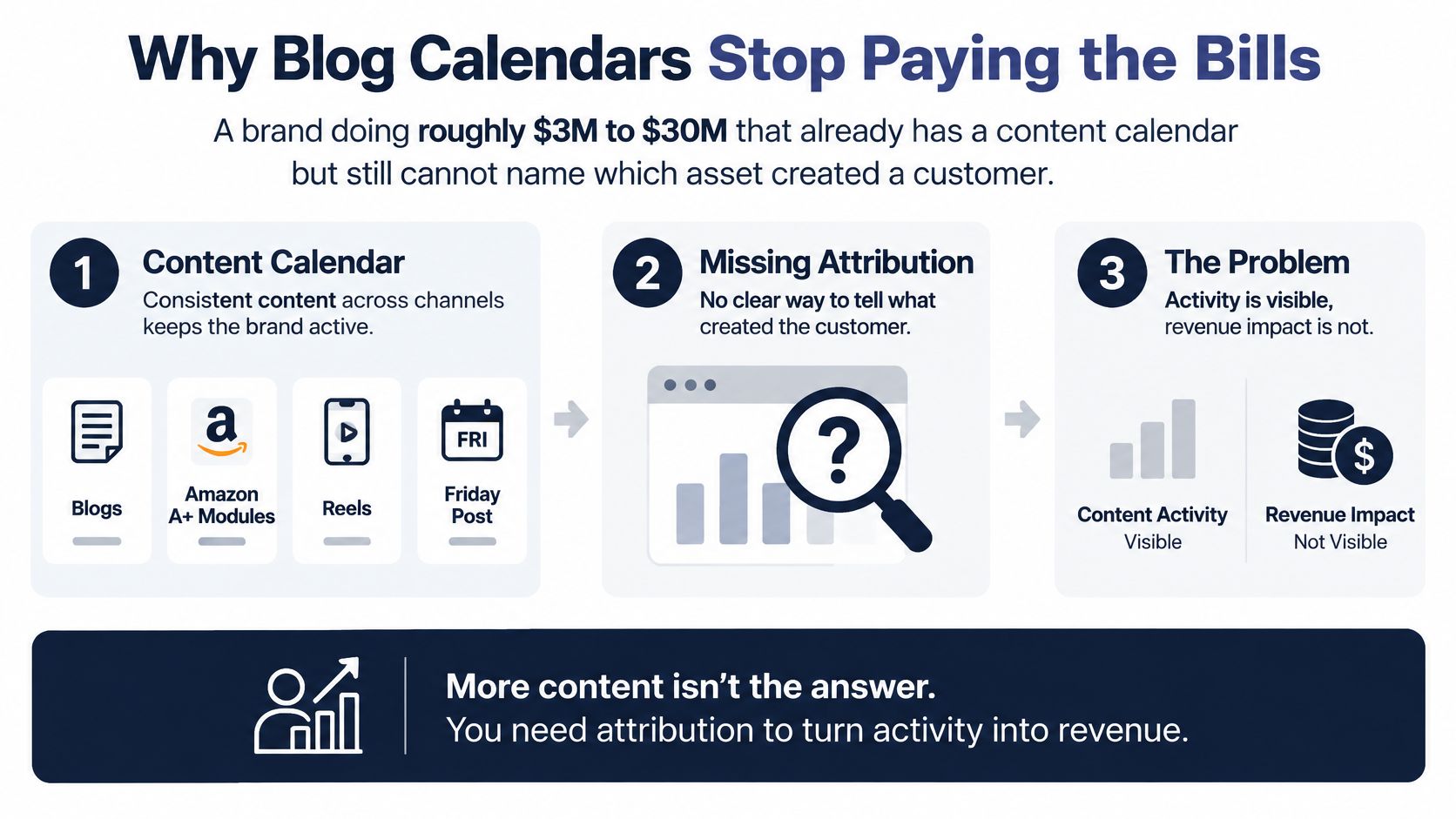
For founders and ecommerce leads selling through Amazon, DTC, or both, the problem isn't a shortage of formats. It's a shortage of decisions about what those formats must accomplish.
Two other gaps deserve attention: reviews shoppers may not fully trust, and product information that generative AI may misunderstand. Neither gets fixed by adding another generic article to the queue.
Give your team a revenue map before approving production. Build around substantiated claims, carry a coherent product story across channels, and test whether the work creates demand rather than collecting credit.
That also changes the budget conversation. Instead of asking whether the team published enough, ask what buying obstacle remains and which asset is best equipped to remove it.
Budget rule: A format that can't name its revenue job hasn't earned next quarter's funding.
Keep the calendar for coordination. Don't mistake it for the strategy.
| Revenue job | Best format | Home channel | Read this first | Do not trust alone |
|---|---|---|---|---|
| Discovery | Short demo or creator clip | TikTok, Instagram, YouTube Shorts | Product-page visits or branded search | Likes and views |
| Evaluation | Photo reviews, comparison, objection FAQ | PDP and Amazon listing | Review depth and add-to-cart | Star rating alone |
| AI-readable proof | Specs, policies, use-case FAQs kept in sync | Catalog, help center, PDP | Accurate assistant answers plus rating and review volume | Blog traffic |
| Conversion | Shoppable tag, offer module, bundle guide | Social checkout, PDP, Amazon | Orders and contribution margin | Last-click ROAS |
| Retention | Post-purchase how-to, replenishment story | Email, SMS, Amazon follow-up | Repeat rate and time to second order | Open rate |
| Demand creation | Problem-led education | YouTube, blog, podcast, creators | Branded-search lift or a holdout | Assisted conversions |
Use this ecommerce content jobs, formats, and signals map before anyone proposes another channel. Assign each asset a primary job, even when it supports other stages.
Discovery introduces the product to a relevant shopper. A short demonstration should make the use case recognizable and provide a clear route to the item.
Evaluation answers whether that item fits the buyer's situation. Put comparisons, customer photos, and objection-handling answers near the purchase decision, not behind a chain of blog links.
AI-readable proof deserves its own operational lane. In Bazaarvoice's 2025 Shopper Experience Index announcement, 24% of consumers surveyed across the United States, United Kingdom, Germany, France, Australia, and Canada had used generative AI instead of a search engine, rising to 41% among consumers aged 18–34.
Don't respond by commissioning pages of AI-oriented promotional copy. Make essential facts explicit: dimensions, materials, compatibility, care instructions, intended uses, exclusions, shipping conditions, and return policies.
A comparison needs identifiable product versions. A performance claim needs supporting evidence. A policy needs accessible text rather than an image with tiny lettering.
Treat accurate assistant answers as a diagnostic, not a guaranteed acquisition channel. Ask realistic shopping questions, record incorrect answers, and check whether your published information is incomplete or contradictory. You can improve the underlying evidence without controlling every recommendation.
Conversion is the shoppable moment. The content must make the selected variant, offer, and next action clear enough that the shopper doesn't have to reconstruct the deal.
Retention teaches customers how to get further value from something they already own. That could mean cleaning instructions, another legitimate use, or a replenishment reminder tied to consumption rather than an arbitrary promotion.
Demand creation addresses a problem before someone starts searching for a SKU. For example, a storage brand might explain how to organize an awkward cupboard before introducing its organizer.
Use the ecommerce sales funnel to check that each transition has a useful next step. For search-led work, Wispra's guide to ecommerce SEO that drives sales is a relevant planning resource when connecting educational intent to commercial pages.
A blog with no place on the map doesn't need a writer yet. It needs a better brief.
Production should follow the offer, not outrun it. Start with a product worth explaining and a buying decision your team can describe precisely.
Use this process visual as a coordination aid, then give each move an accountable owner.
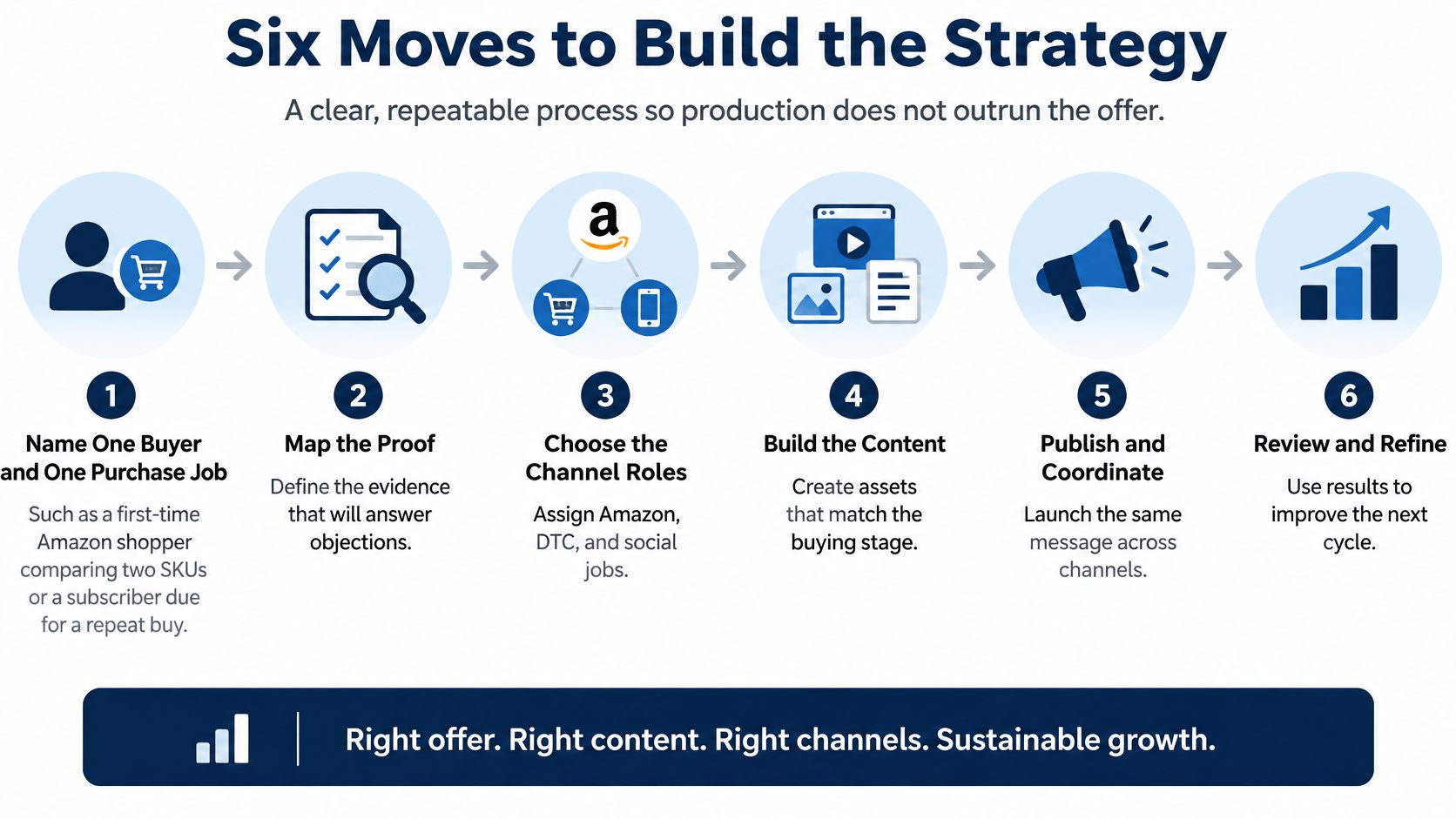
1. Name the buyer and purchase job. “People interested in fitness” is too broad. “An Amazon shopper deciding which resistance band suits assisted pull-ups” gives a writer something concrete to solve.
For a repeat purchase, the task changes. A subscriber deciding whether to refill needs usage guidance and replenishment clarity, not another introduction to the brand.
2. List the claims and required proof. Build a claim register in a shared sheet. Record the proposed wording, evidence location, applicable SKU, limitations, approver, and review trigger.
A material claim needs a specification. A fit claim needs measurements or a clear compatibility reference. A customer outcome needs authentic testimony with enough context to avoid implying a universal result.
If nobody can substantiate a sentence, remove it before filming. Editing an unsupported promise out of every derivative is avoidable work.
3. Collect reviews as evidence, not decoration. In a U.S. adult survey published in December 2016, Pew Research Center found that 82% consulted online ratings or reviews at least sometimes when buying a product for the first time, while only 51% of review readers generally believed reviews accurately represented product or business quality.
Those historical findings highlight a distinction, not a current benchmark: consulting reviews isn't the same as trusting them. Ask neutral questions about the customer's use case, result, drawback, and comparison with what they used before.
Request photos where appropriate, obtain permission before republishing, and follow each platform's review rules. Don't filter requests to happy customers or rewrite mixed feedback into unqualified praise.
4. Synchronize the facts. Maintain approved product information in your catalog system or a controlled master sheet. Assign someone to update the PDP, Amazon listing, and help center when the product or policy changes.
Check variant-level details carefully. A capacity or accessory included with one version shouldn't appear as a family-wide promise.
5. Plan around a hero story. As a working template, organize a quarterly calendar around a monthly buyer problem, then derive a demonstration, evaluation asset, and lifecycle message from the same approved evidence.
This is a planning choice, not a mandatory publishing quota. If the evidence is weak, fix it before filling the calendar.
Outrank's guidance can help you develop a growth-focused content plan, but your production queue still needs product-specific inputs rather than topic ideas alone.
6. Assign an owner and a stop decision. Every hero asset needs a person responsible for factual accuracy, distribution, and performance review. Set a review date before publishing, with a clear choice to keep, revise, replace, or pause.
Use the video below as a team discussion prompt, with your claim register and draft brief open alongside it.
The handoff should fit on a usable brief:
A writer shouldn't need another meeting to discover what the product actually does.
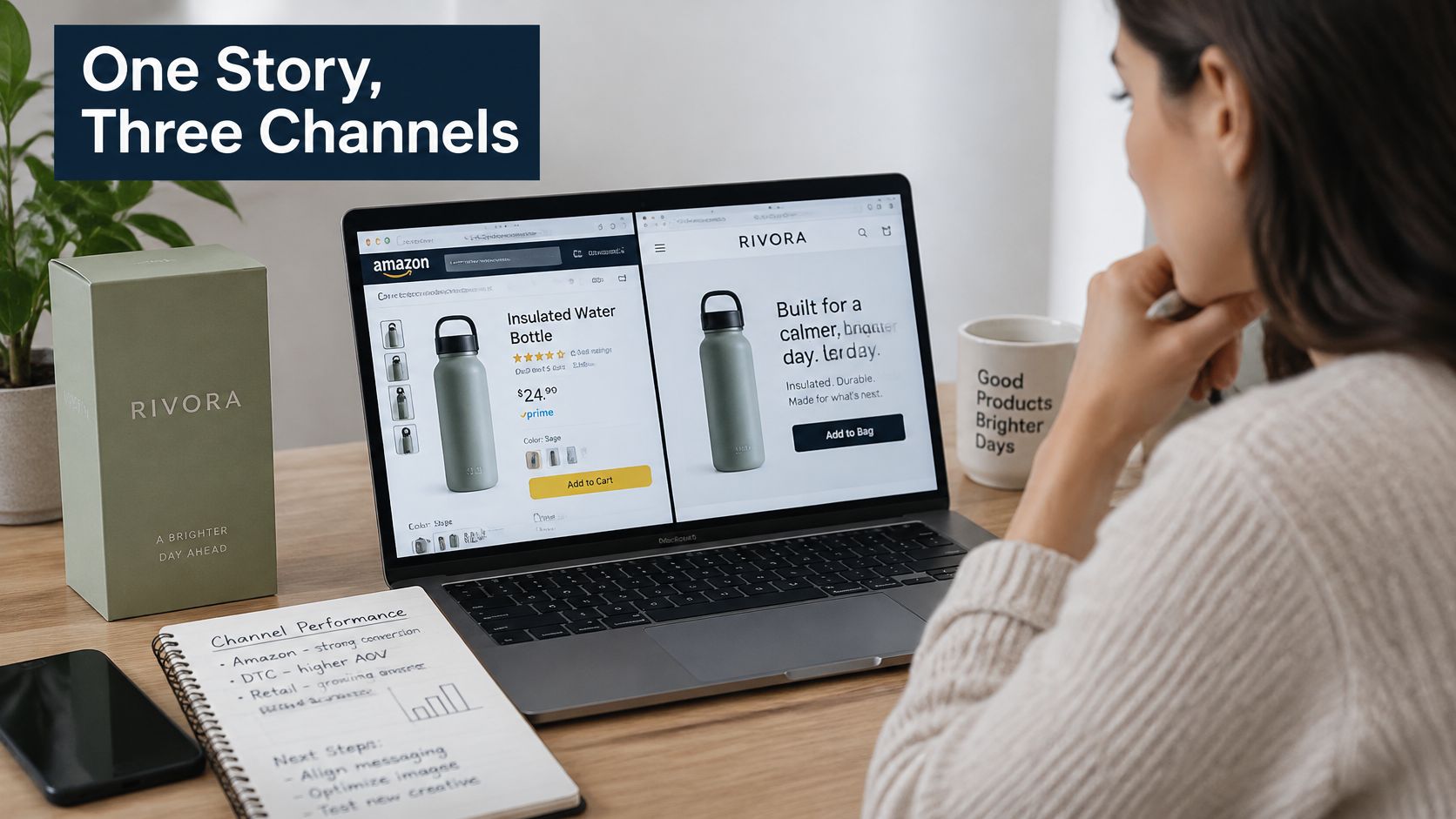
Say you sell a reusable bottle with a removable lid assembly. Your approved story is about straightforward cleaning, supported by a disassembly demonstration, care instructions, and customer feedback. The honest limitation is that the lid still needs attention around its seal.
Don't turn that into separate promises for separate channels. Give each channel a distinct assignment using the same underlying evidence.
Use the listing to answer practical evaluation questions: what comes apart, how to clean it, which replacement parts fit, and what's included. A+ Content can show the assembly visually, while a comparison module distinguishes the relevant models.
The concrete cut is an annotated cleaning image with matching instructions in accessible copy. Use the Brand Story and brand store for context and navigation, not as substitutes for facts on the listing.
A shopper comparing variants shouldn't have to browse your entire store to learn whether the lid components differ.
On the product detail page, place the disassembly demonstration beside the care information. Add a comparison module that helps the customer choose the appropriate bottle rather than automatically pushing the most expensive option.
After purchase, send an instructional email that explains the first clean and correct reassembly. That's more useful than immediately offering another discount before the customer has used the product.
Review the experience across destinations, not just the creative files:
Lead with the lid coming apart, not a brand animation. Show the cleaning action, acknowledge the seal, and make the product identifiable before introducing the purchase prompt.
According to ShipStation's 2025 benchmark report, 21% of consumers reported completing a purchase through a social-media platform during the previous twelve months, while 46% of online retailers supported social commerce. That gap supports testing shoppable demonstrations, not assuming that more posting will produce orders.
Film the complete use sequence and limitation in a master recording. From it, produce a short demonstration, a still image for the PDP, and a compact instructional email.
If wholesale or retail partners carry the product, give buyers the same approved comparison sheet and care guidance. Channel-specific packaging is useful; channel-specific truth isn't.
The trade-off is less creative freedom around claims. In return, your team spends less time resolving contradictions, and shoppers can recognize the product they saw when they reach a different storefront.
Attribution can make the wrong content look productive. In a 2025 study combining conversion-lift testing and marketing-mix modeling, Meta campaigns using incremental attribution produced up to 57% better ROAS, while traditional click-based reporting showed less than a 3% difference, according to Marketing Beat's coverage.
That's a finding about those campaigns, not a promised lift for your content. The practical implication is narrower: changing what you measure can change what you decide to fund.
A buying guide can look successful because it intercepts existing shoppers. A creator demonstration can look unsuccessful because customers later search for the brand and purchase on Amazon.
| Signal | What it usually means | Better test |
|---|---|---|
| High blog traffic, flat new customers | May be harvesting people already shopping | Split branded and non-brand demand, or hold out a category |
| Strong last-click email revenue | May be capturing buyers already in market | Suppress email for a randomized slice over a planned test window |
| Creator views and no social orders | Demand may be showing up on Amazon or the site | Examine new-to-brand orders and branded search in the same window |
| Click reports barely move | Last-click may be missing incremental demand | Run conversion lift or a geo test before scaling |
| AI assistants misstate the product | Specs and review proof may be thin or out of sync | Fix facts and review FAQs, then recheck answers |
These are diagnostic hypotheses, not verdicts. Start with market research for products when the underlying buyer problem is uncertain; attribution software won't rescue an irrelevant proposition.
For search diagnostics, comparing SE Ranking or Semrush through Keyword Kick can help you choose a monitoring tool. Use it to distinguish brand interest from broader category visibility, not to label every ranking improvement incremental revenue.
For email, randomly withhold a campaign from an eligible control group while keeping transactional messages intact. Compare customer-level orders and contribution after accounting for discounts, returns, and campaign costs.
Set the test window around the purchase cycle and available order volume. A short pilot can expose implementation problems, but it may not produce enough evidence to justify a budget decision.
Creator activity is harder to isolate because audiences overlap. Where feasible, stagger comparable activations across markets or product groups, document other promotions, and monitor both marketplace and website outcomes.
At larger spend levels, consider a geo experiment or platform conversion-lift study. Define the decision threshold and minimum meaningful effect before launch, and don't stop the test early because a dashboard looks encouraging.
Measurement discipline: Branded-search movement is a clue. A well-designed holdout is stronger evidence of causation.
Never average Amazon and DTC ROAS into a content score. Examine each channel's costs, then assess total contribution without double-counting attributed orders.
Keep an asset when credible testing supports additional demand, or when a page experiment shows that it removes a specific purchase obstacle. When the result is indistinguishable from noise, don't declare failure or success: revise the test, reduce exposure, or pause discretionary expansion.
For a lean team, protect the essentials:
Before the next budget meeting, name the unrelated blog cadence, generic engagement posts, and indiscriminate promotional sends you'll pause. Put a dated holdout test on the calendar, with an owner, eligible audience, primary outcome, and decision rule.
At Million Dollar Sellers, we focus entirely on ecommerce operators, with members who are brand founders and leaders, not gurus or info marketers. Our public Inspire conference offers tactical workshops, hot seats, and mastermind tables where you can work through decisions like content allocation and measurement. Visit Million Dollar Sellers to explore the community and bring a specific content investment question to the conversation.
Join the Ecommerce Community for Founders Scaling from 7 to 9 Figures
Learn MoreYou may also like:
Learn more about our events!
Check Events