Chilat Doina
April 4, 2026
Amazon advertising services are a suite of tools that let you put your products and brand front-and-center for millions of shoppers, both on and off Amazon. Think of them less as "ads" and more as the digital lifeblood for any serious brand on the platform. They are what fuel your sales and get you noticed.
For sellers pulling in serious revenue, treating Amazon’s ad platform as just another marketing channel is a huge mistake. It’s no longer optional; it’s the main arena where you either win or lose market share. The incredible scale and rapid growth of these ad services tell the whole story—this is essential for any brand thinking about market dominance, not just a few extra clicks.
The platform's explosive growth is all the proof you need.
To put this in perspective, let's look at the numbers. Amazon's ad business has been on an absolute tear, solidifying its place as a global advertising powerhouse.
| Year | Annual Ad Revenue | Year-Over-Year Growth | Global Rank |
|---|---|---|---|
| 2024 | $56.25 Billion | 21.5% | #3 |
| 2025 | $68.63 Billion | 22.0% | #3 |
| 2026 (proj.) | $82.35 Billion | 20.0% | #3 |
As the data shows, Amazon is now firmly planted as the third-largest digital ad platform in the world, right behind Google and Meta. This isn't a trend that's slowing down. Our own Amazon advertising revenue research confirms this trajectory is only continuing upwards.
Years ago, you could find success on Amazon with organic ranking alone. Those days are long gone. Today, the marketplace is a pay-to-play environment where ad spend directly impacts sales velocity, which then boosts your organic rank. This creates a powerful cycle known as the "flywheel effect."
Investing in Amazon advertising doesn't just drive ad sales; it actively fuels your organic visibility. This relationship is at the heart of modern Amazon success, making smart ad management a core part of any growth plan.
What this really means is that if your competitors are advertising and you're not, you aren't just missing out on sales. You are actively becoming less visible and losing ground in the search results every single day.
For established brands, the conversation about Amazon ads has moved way beyond just managing your ACoS (Advertising Cost of Sale). It’s now about making strategic investments to hit specific business goals. The real game is played at a higher level, focusing on:
At the end of the day, getting good at Amazon’s ad platform isn’t just about running campaigns anymore. It’s about building a defensible moat around your brand, driving real growth, and cementing your spot as a leader in your category on the world's biggest online store.
To really get a handle on Amazon Advertising, you have to stop seeing the different ad formats as separate options. Think of them as a specialized toolkit. Each one is a unique tool built for a very specific job.
You wouldn't use a sledgehammer to hang a picture frame, right? In the same way, you shouldn't use a big, broad awareness campaign when what you really need are immediate, high-intent sales. Knowing which tool to pull out—and when—is what separates the sellers who are just treading water from the ones who are truly scaling.
The numbers don't lie. Amazon's ad business is a behemoth, and it's still growing at a shocking pace.
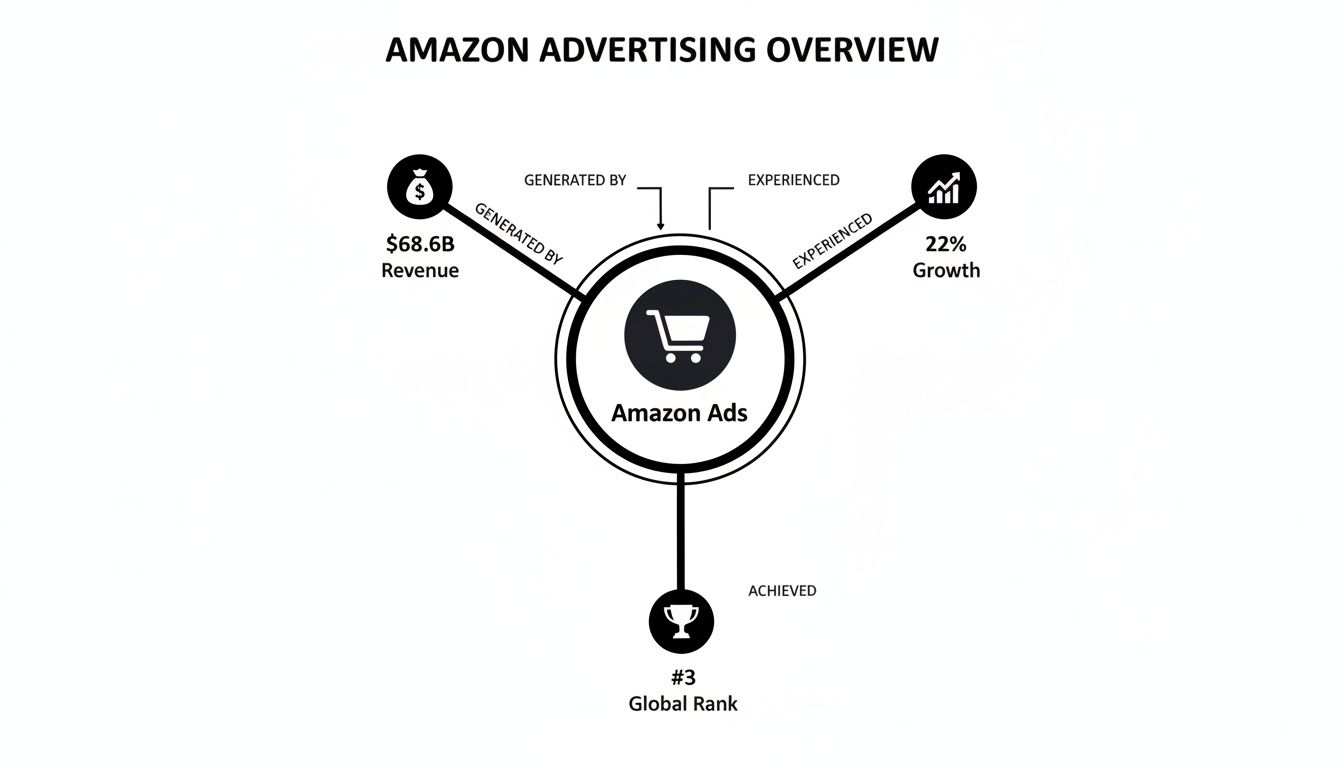
With a war chest of nearly $68.6 billion and 22% year-over-year growth, mastering these tools isn't a nice-to-have anymore. It's the cost of admission if you want to compete at the highest level on the platform.
Let’s break down the core ad types you'll be working with: Sponsored Products, Sponsored Brands, and Sponsored Display. These three are the foundation of most strategies, and each plays a distinct role.
Sponsored Products are the undisputed workhorses of Amazon advertising. Think of them as your go-to hammer—the tool you'll use constantly for the essential job of driving sales right from the search results. They pop up within shopping results and on product pages, hitting shoppers who are actively looking for products just like yours.
Their main job is to convert. It's that simple. When someone types "noise-canceling headphones," they're not just browsing; they're ready to buy. A Sponsored Product ad puts your headphones right in their line of sight at that exact moment of decision.
If Sponsored Products are the hammer, Sponsored Brands are the massive, high-visibility billboard you see at the entrance of the store. These ads usually show up as a banner at the very top of the search results, featuring your logo, a custom headline, and a curated collection of your products.
Their job is to build brand awareness and stake your claim on valuable digital real estate. Owning that top-of-search spot means your brand is the very first thing a shopper sees. You become the category leader in their mind before they even start scrolling.
Sponsored Brands ads are your chance to tell a quick brand story. You can group complementary products together—like a camera, lens, and tripod—to show off your catalog's depth and nudge up that average order value.
When you're building out creatives for these ads, using tools for AI ad generation can be a game-changer. They help you quickly produce eye-catching visuals that can stop a shopper mid-scroll and make your brand message stick.
Sponsored Display ads are your brand's boomerang. They’re designed to find shoppers who have left and bring them right back to your products. These ads can follow users both on and off Amazon, letting you re-engage people who viewed your products but didn't pull the trigger.
This is your go-to retargeting tool. But it’s more versatile than that. You can also use Sponsored Display to target shoppers checking out your competitors' pages or people who have shown interest in related categories. It’s a fantastic tool for both defense and offense.
Finally, we have Amazon DSP (Demand-Side Platform). This isn't just another tool in the kit; it's the master blueprint for building complex, full-funnel advertising strategies. While the other ad types are great for capturing existing demand on Amazon, DSP lets you create new demand. You can reach audiences across the web, on Amazon-owned sites like IMDb, and even through connected TV.
This is an advanced platform for scaled brands that want to run sophisticated audience-building and awareness campaigns that go way beyond simple keyword targeting. If you're ready to explore what it can do, our comprehensive guide to Amazon DSP advertising dives into all the details. It's the ultimate play for brands aiming to build a massive, loyal audience from the top of the funnel all the way down to the purchase.
Alright, you know what all the different Amazon ad types are. But the million-dollar question is knowing which ones to use, when to use them, and how to combine them to actually hit your business goals.
Running a successful ad strategy isn't about just turning on campaigns. It’s about deploying the right ads with the right budget to nail specific targets. This is where we move from just knowing the tools to mastering the craft.
Think of it like a campaign playbook. You have different plays for different situations—one for launching, another for scaling, and a completely different set for defending your turf. Let's walk through them.

To help you connect these playbooks to your specific goals, here’s a quick-reference table matching objectives to the right ad types and KPIs.
| Business Objective | Primary Ad Type | Secondary Ad Type | Key Performance Indicator (KPI) |
|---|---|---|---|
| New Product Launch | Sponsored Products (Auto) | Sponsored Brands | Impressions & Sales Velocity |
| Increase Market Share | Sponsored Brands | Sponsored Display | New-to-Brand Metrics & Share of Voice |
| Improve Profitability | Sponsored Products (Manual) | Sponsored Display (VCPM) | Advertising Cost of Sale (ACoS) & TACOS |
| Defend Brand/Listings | Sponsored Products (Product Targeting) | Sponsored Display (Product Targeting) | Clicks & Conversions on your own ASINs |
| Liquidate Inventory | Sponsored Products | Sponsored Brands | Sales Volume & Sell-Through Rate |
This table gives you a starting point, but the real magic is in the execution. Now, let’s dive into the play-by-play for each core scenario.
When you're launching a new product, your mission is simple: get seen and get sales. You need to blast your product in front of as many relevant shoppers as possible to generate those first crucial sales and start stacking up reviews.
This is not the time for timidness. Your launch calls for an aggressive push to gather data and build momentum. The go-to combo here is Sponsored Products and Sponsored Brands, working in tandem.
The Launch Budget: Brace yourself. Your initial Advertising Cost of Sale (ACoS) will be high, often in the 50-100% range. You're not buying profit yet; you're buying data and sales velocity. Your main KPIs are impressions and total sales, not efficiency.
Once your product has its footing—some solid sales history and a decent number of reviews—the game changes. The focus shifts from all-out growth to smart, profitable scaling. It’s time to refine your targeting, dial in your bids, and make every ad dollar count.
Your strategy now becomes much more precise and data-driven.
This pivot is absolutely critical for long-term, sustainable growth. Over 56% of all product searches now start on Amazon, and with ad revenues projected to soar past $60 billion in 2026, the competition is fierce. Efficient spending is the only way to win. You can see the latest ad revenue projections on eMarketer.com.
As you climb the ranks and become a category leader, a new battle begins. Competitors will start bidding to place their ads directly on your product detail pages, trying to poach your customers right at the point of purchase.
Your final playbook is all about building a defensive moat around your listings. The best defense is a good offense.
By filling this ad space yourself, you make it far more expensive and less effective for a competitor to advertise on your page. Your primary KPI here becomes Share of Voice on your own turf. The goal is to dominate the ad slots so the only brand a customer sees is yours.
Let's get down to it. Your approach to bids and budgets is where the real money is made—or lost—on Amazon. This isn't just about pinching pennies. It’s about strategically fueling your growth. The best sellers I know don't see ad spend as an expense; they see it as a calculated investment in their brand's future.
That shift in perspective is everything, especially now. The marketplace is more crowded than ever, and with the average Cost Per Click (CPC) hitting $1.12 in 2025—a 15.5% leap from the year before—you can't afford to be sloppy. The top-tier sellers we work with aren't just winging it. They are obsessed with total growth, often aiming for an ACoS of 25% or less, which is far below the industry average. You can dig into more of these Amazon advertising statistics and trends on SequenceCommerce.com.
For a long time, Advertising Cost of Sale (ACoS) was the be-all and end-all metric. And look, it’s still useful for measuring how efficient a specific campaign is. But it only paints part of the picture.
This is where Total Advertising Cost of Sale (TACoS) comes in. This metric stacks your ad spend against your total revenue, which includes both your ad-driven sales and your organic ones. It answers the one question that truly matters: "Is my ad spend actually growing my entire business, or am I just buying sales?"
TACoS is your true north for scaling. If your TACoS is trending down while your total sales are climbing, you’ve hit the jackpot. It means your ads are creating a "halo effect," lifting your organic sales and building real brand value over the long haul.
What’s a good TACoS? It depends entirely on your goals. A brand going all-in on a new product launch might be comfortable with a higher TACoS. A more established brand, on the other hand, will be focused on bringing that number down.
Your budget shouldn't be a number you pull out of thin air. It needs to be tethered directly to your revenue goals. For brands serious about scaling, a fantastic approach is to reinvest a set percentage of your total revenue right back into your ads.
The goal is to have a budget that empowers your strategy, not one that holds it back. If you want to take a closer look at this, we have a complete guide to controlling your Amazon advertising cost that gets into the nitty-gritty.
Okay, you've got your budget. Now, how do you spend it wisely? Amazon gives you a few dynamic bidding strategies that adjust your bids on the fly based on how likely you are to get a sale. Getting a handle on these is non-negotiable if you want to make every dollar count.
Dynamic Bids - Down Only:
This is your safest bet. With this setting, Amazon will only lower your bid if a click seems less likely to convert. It's the perfect training wheels for new campaigns or for anyone on a tight budget.
Dynamic Bids - Up and Down:
This is where things get interesting. You're giving Amazon permission to raise your bid (by as much as 100%) for placements that are prime for conversion and lower it for the duds. It's an incredibly powerful tool for fueling aggressive growth because it helps you win the clicks that matter most.
Fixed Bids:
Just like it sounds, your bid stays put. This gives you absolute control, but it also means you have to be in there constantly monitoring and tweaking things yourself. This is really for the seasoned pros who are targeting very specific, predictable keywords and know exactly what they're doing.
Ultimately, your bidding strategy has to line up with what you're trying to achieve with your campaign—are you chasing efficiency, pure volume, or total control? When you nail both your budget allocation and your bidding tactics, you turn your ad spend into a predictable, powerful engine for growth.
If you're a high-volume seller, relying on the standard Amazon ad reports is like flying a plane with only half the instruments working. You can see you’re moving, but you have no real clue how you got to your current altitude or where you're actually headed. To get a true picture of how your Amazon advertising services are performing, you have to look way beyond that last click.
This is exactly where full-funnel attribution comes into play. It’s all about mapping out the entire customer journey, from the very first time a shopper lays eyes on your brand to the moment they finally hit "Buy Now."
Out of the box, most Amazon ad reports operate on a last-touch attribution model. It's simple: 100% of the credit for a sale goes to the very last ad a customer clicked before they bought your product. While this is clean and easy to read, it can be dangerously misleading.
Think about it. A customer might see your brand for the first time in a Sponsored Brands video ad. A few days later, they see one of your Sponsored Display ads while browsing another site. Then, a week later, they finally search for your product, click a Sponsored Products ad, and make a purchase.
With last-touch, that Sponsored Products ad gets all the credit. The other two ads, which were absolutely critical for building awareness and consideration, are treated like they did nothing. You might even be tempted to turn them off, thinking they're wasting money.
Getting a real handle on your performance means understanding different attribution models. This becomes even more critical as you start layering in more sophisticated ad types.
To get the full story, the biggest sellers are turning to a much more powerful tool: Amazon Marketing Cloud (AMC). Think of AMC as a secure, private data clean room where you can analyze how all your ads work together across the entire buying journey. It lets you move past last-touch and see the true, combined impact.
With AMC, you can finally measure the "halo effect" of your advertising. This is when an ad for one of your products ends up driving the sale of a completely different product from your catalog.
For example, a shopper clicks an ad for your high-end coffee grinder. They browse a bit but ultimately decide to buy your premium espresso machine and a bag of coffee beans instead. Standard reporting would show zero sales from that grinder ad, but AMC reveals its true value in driving a much larger, more profitable purchase.
This kind of holistic view is a game-changer, especially for justifying your spend on upper-funnel campaigns like those on Amazon DSP. You can finally connect the dots between an awareness-building ad someone saw weeks ago and the sale that just came through today, proving the total ROI of your entire strategy.
By using these advanced measurement tools, you can start answering the questions that really matter—the ones that basic reports can't even begin to address:
Answering these questions means you can stop guessing and start making decisions backed by solid data. You can allocate your budget with confidence, optimize your campaigns for total business growth, and build a marketing engine that delivers results across every single stage of the customer journey.
Once your brand starts gaining real momentum, you’ll hit a major crossroads: who exactly is going to manage your ad spend? This isn't just a simple task to delegate; you're handing over the keys to one of your most important growth engines. Deciding between building an in-house team, hiring an agency, or maybe even a mix of both will define how your brand scales on Amazon.
There’s no magic answer here. The right move comes down to your size, your budget, and where you want to be in a few years. Let's break down the pros and cons of each path.
Bringing your Amazon advertising services in-house gives you the highest level of control and focus. An internal team lives and breathes your products. They know your margins inside and out and can pivot on a dime when inventory levels change or a competitor makes a move. Their success is your success—it's their only job.
But make no mistake, building a strong internal team is a serious undertaking. You’re not just hiring an "Amazon person." You’re building a specialized unit. A truly effective team needs a few key players:
The biggest win is total integration. Your ad team can walk down the hall (or jump on a Slack call) with the inventory and marketing folks, making everything run like a well-oiled machine. The catch? It's expensive, and finding true Amazon experts is tough. Hiring and keeping them is a real challenge.
For a lot of brands hitting their stride, bringing on a specialized agency is simply the smarter, faster path to growth. A good agency gives you immediate access to a whole team of veterans who manage millions in ad spend across countless categories. They’ve already made the mistakes, seen what works, and can apply those hard-won lessons to your account from day one.
The real value of a great agency isn't just running campaigns; it's the strategic depth they bring. They should be the ones pushing you, questioning your assumptions, and presenting fresh ideas. Their focus should be on your total business health (TACoS), not just a flashy metric like ACoS.
When you're vetting potential partners, transparency is everything. You need an agency that gives you clear reports, communicates openly, and feels like a genuine extension of your own team. If you're weighing this option, our guide on choosing from the top Amazon PPC agencies gives you a solid framework for making the right choice.
Sometimes, you don't have to choose one or the other. A hybrid approach can offer the perfect balance. In this setup, you might have an in-house brand manager or e-commerce director who owns the overall strategy and acts as the main point of contact.
They then partner with an agency to handle the day-to-day grind—the bidding, the technical optimization, and all the time-consuming campaign management. This model keeps strategic oversight in-house but taps into the specialized skills and efficiency of an agency. For many brands scaling past the seven-figure mark, this is the sweet spot.
Once you’ve mastered the basics of Amazon ads, a new set of questions always pops up. These are the higher-level strategic puzzles that separate the big sellers from the biggest ones.
Let's tackle some of the most common questions we see from experienced sellers looking to protect their gains and find that next level of growth.
There's no single magic number for a "good" Total Advertising Cost of Sale (TACoS). Anyone who tells you otherwise doesn't understand the game. The right answer depends entirely on what stage your brand is in.
If you're in an aggressive growth phase, you're playing offense. You’re buying data, visibility, and future organic sales. In this mode, a TACoS between 12-18% is not just acceptable—it's a smart investment. You're building the momentum you'll cash in on later.
For a mature, profitable brand, the game changes. Now, it's all about efficiency and protecting your margins. A TACoS of 8-12% (or even lower) signals a healthy, well-oiled machine. The real indicator of success, though, is the trendline. If your total sales are climbing while your TACoS is steadily dropping, you've hit the sweet spot.
You make the leap to Amazon DSP when your goal switches from capturing existing demand to actively creating new demand. It’s the next logical move when you feel like you’ve squeezed every last drop out of your on-Amazon search campaigns.
Think about DSP when you've pretty much maxed out what Sponsored Products and Sponsored Brands can do. You have a solid brand, and you're ready to start reaching shoppers before they even search on Amazon. It’s built for brands spending over $30,000 a month on ads and who need sophisticated, full-funnel strategies to keep growing.
The best defense for your product detail pages is a good offense. You can't put up a wall to block competitors, but you can absolutely make it more expensive and far less appealing for them to set up camp on your turf.
Here’s the playbook:
When you do this, you’re controlling the ad inventory on your own listings. You're ensuring that a shopper who is one click away from buying from you sees another one of your products, not a tempting offer from a competitor.
At Million Dollar Sellers, our members share advanced tactics like these every day to dominate their categories. If you're a 7-figure seller ready to scale with a network of proven entrepreneurs, find out if you qualify for our exclusive community. Learn more at Million Dollar Sellers.
Join the Ecom Entrepreneur Community for Vetted 7-9 Figure Ecommerce Founders
Learn MoreYou may also like:
Learn more about our special events!
Check Events