Chilat Doina
October 21, 2026
The most popular advice in DTC is also the most expensive. Find a winning ad, push budget into it, and scale whatever reports the best ROAS. That playbook made sense when traffic was cheap and attribution was cleaner. It doesn't survive in a market where auctions are crowded, tracking is partial, and a platform can claim credit for a customer who was already coming back. If you're still allocating capital from a dashboard, you're not doing growth marketing. You're renting revenue and calling it strategy.
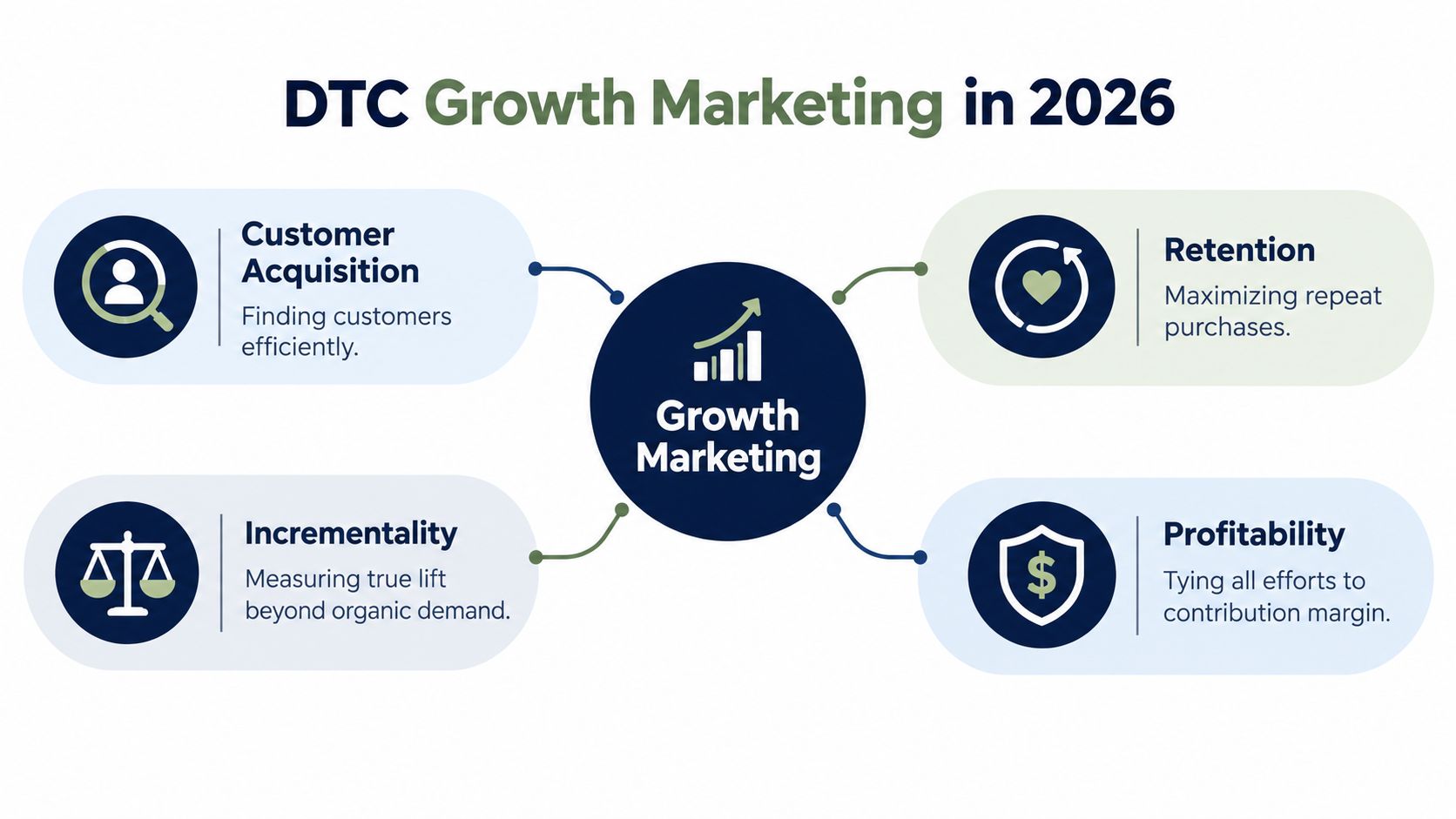
DTC growth marketing is the system you use to acquire customers, convert them on a storefront you own, and earn repeat purchases without depending entirely on wholesale or a marketplace. The channels are familiar. Paid social, search, email, SMS, creators, affiliates, and SEO all feed the same machine. What separates a scaled brand from a busy one isn't the channel list. It's whether you can prove each dollar creates incremental contribution profit.
That distinction matters because you're no longer building inside a tiny channel. The U.S. Census Bureau quarterly series via FRED shows e-commerce reached $300.1 billion in the third quarter of 2024, up 7.4% year over year and representing 16.2% of total U.S. retail sales, while total retail grew only 2.1%. Online buying is mainstream, established, and fiercely competed for.
A seven-figure founder can sometimes grow on instinct and one strong product. A larger brand can't. Once you spend seriously every day, creative fatigue, audience saturation, returns, discounting, and fulfillment costs change the answer. A campaign can lift revenue and still destroy cash if it pulls forward repeat buyers, cannibalizes organic demand, or attracts customers who return at a punishing rate.
Practical rule: Judge growth after media, discounts, returns, fulfillment, and support costs. Revenue that doesn't survive that math isn't growth.
That's the reframe. DTC growth marketing in 2026 is a capital-allocation discipline with creative and channels inside it. Your job isn't to be everywhere. Your job is to fund what's provably incremental, fix what leaks margin, and kill what only looks efficient because a platform graded its own homework.
Start by separating demand creation from demand capture. Teams blur the two, then wonder why branded search looks brilliant and prospecting looks wasteful. They're different jobs, and you shouldn't judge them with the same ruler.

Paid social is still the main discovery engine for most consumer brands. It's where a cold buyer first understands the problem, sees proof, and clicks. It's also where rising auction pressure punishes weak creative fastest. U.S. ecommerce-focused digital ad spending rose 207% between 2019 and 2024, from $12.5 billion to $38.4 billion, even as CPMs climbed 26% year over year and new-customer growth fell 5.1%, according to Whop's ecommerce statistics roundup. More money is chasing fewer net-new buyers. That's why thumb-stopping creative, clear offers, and fast landing pages aren't cosmetic work. They're your media efficiency.
Paid search captures intent that already exists. Non-brand search can expand reach, but branded search mostly defends demand created elsewhere. Fund it, but don't mistake its reported return for new growth.
Creators and affiliates work when the product needs demonstration, social proof, or a trusted voice. Pay for usable content and trackable behavior, not vanity reach. A small creator who shows the product in real use will often outsell a polished placement nobody believes.
SEO and owned content compound slowly, then protect you when auctions spike. A useful example is how a niche product can still convert when the page answers a specific buying question directly, like in California Cowboy's shirt guide. The lesson isn't the niche. It's specificity. Content that matches a concrete use case earns qualified clicks that broad brand content doesn't.
Keep the hierarchy simple. Use paid social and creators to create demand, search to capture it, and email, SMS, and SEO as owned assets that lower your dependence on auctions. If a channel can't explain which job it performs, it doesn't deserve budget.
Founders who track everything usually decide nothing. A useful funnel gives each stage one governing metric, one owner, and one budget consequence.
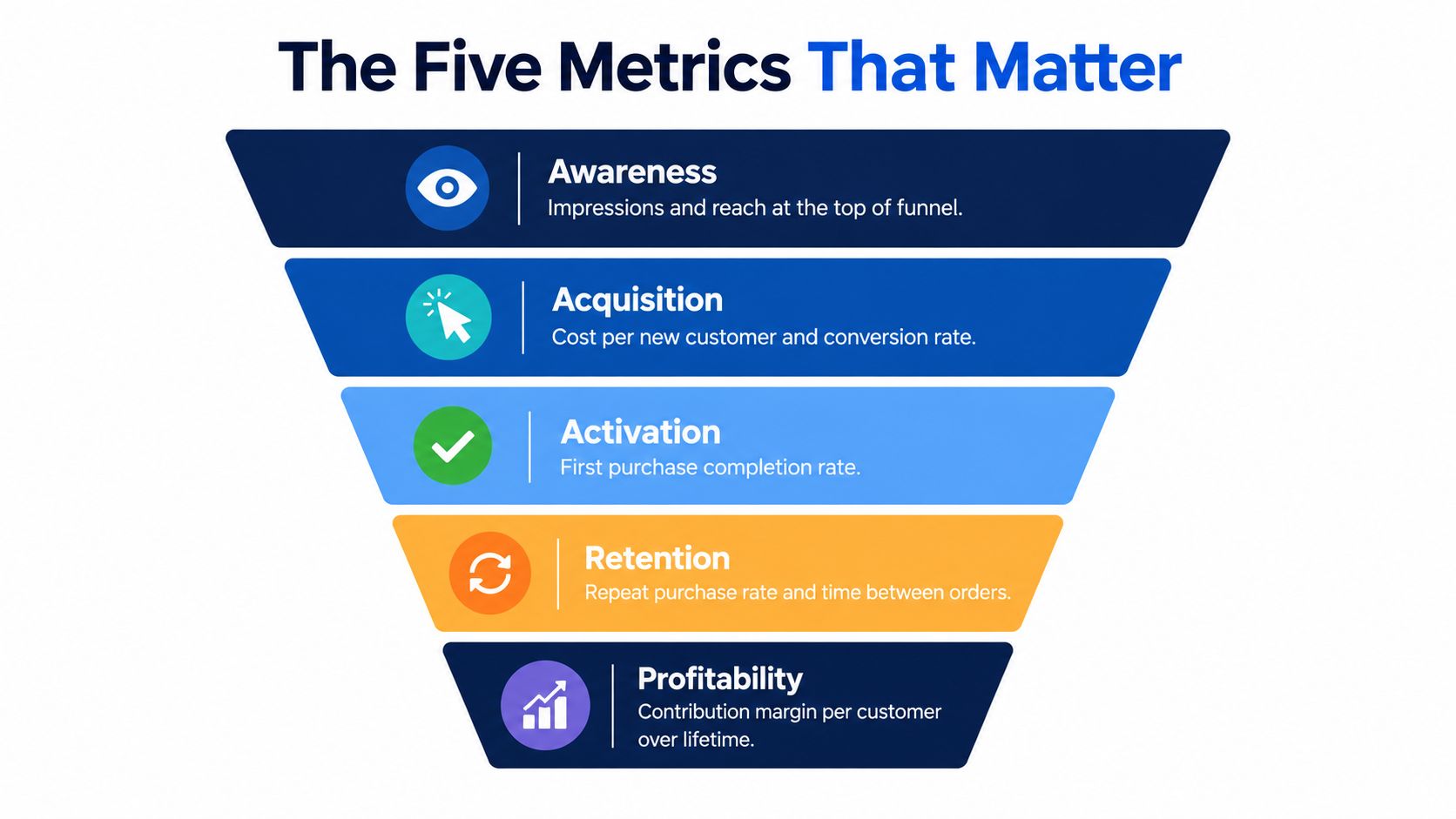
At the top, you're buying attention. Watch hook rate and thumb-stop rate on video, plus click-through rate by creative concept. Don't average winners and losers together. Segment by angle, format, and audience so you know whether the problem is the offer, the first seconds, or the page after the click.
In the middle, watch add-to-cart rate and product-page conversion by traffic source. A cold social visitor and a branded search visitor arrive with different intent. Blending them hides weak landing pages and lets high-intent traffic subsidize bad prospecting.
Checkout deserves its own owner because small friction at peak intent wastes every dollar spent upstream. Baymard's mobile checkout research found 33% of benchmarked mobile sites didn't show the total order cost before requesting payment details, creating a preventable information gap at the highest-intent stage. That's not a design detail. That's a trust failure.
Measure checkout completion rate by device, not just sitewide conversion. Desktop performance can mask a broken mobile flow. Break results by country, payment method, new versus returning customer, and source before you declare a winner. Our guide to building an ecommerce sales funnel maps these stages in more detail.
A metric earns its place only if a change in that metric changes a decision.
After purchase, the governing numbers become contribution margin per order, payback period, and repeat purchase timing. Use leading indicators to diagnose. Use contribution profit to allocate. Never let a cheap click excuse an unprofitable customer.
Once you scale, platform ROAS becomes a confident liar. It doesn't fabricate clicks. It over-claims causality. Retargeting gets credit for loyal buyers, branded search gets credit for demand your social team created, and view-through windows claim people who were already headed to checkout. Privacy limits and cross-device behavior make user-level attribution even less complete.
The image below reflects the operational reality behind the dashboard: media decisions ultimately show up as inventory movement, fulfillment cost, and cash.

Google's Meridian GeoX documentation describes a methodology that produces incremental conversions, percentage lift, confidence intervals, and p-values using counterfactual time-series modeling, and positions MMM as measuring marketing-driven incremental sales against baseline revenue over longer horizons. Use geo tests for specific campaign decisions. Use marketing-mix modeling when you need longer-term, cross-channel effects that last-click can't see.
The short walkthrough below is worth watching before you design your first serious holdout, especially for the discipline around test setup.
This matters even more once retail and marketplaces enter the mix, which is why our breakdown of retail media attribution is relevant beyond retail media itself. Scale a channel only when incremental profit clears your hurdle rate. If a campaign merely claims demand you'd have captured anyway, cut it and move the money.
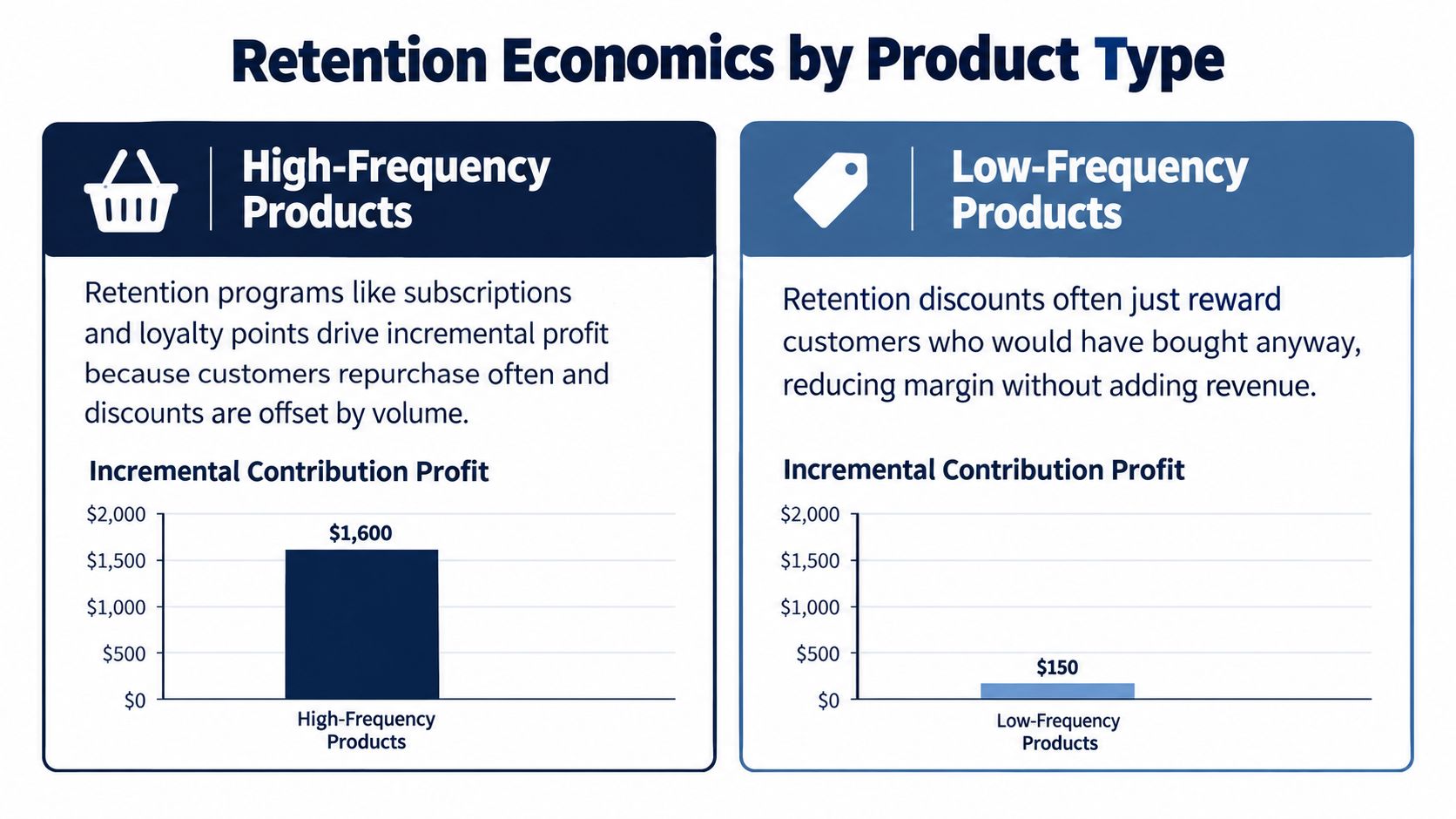
"Increase retention" is bad advice until you specify the product. A replenishable consumable and a durable good don't share a repeat clock, a margin structure, or a reason to buy again. Treating them the same is how brands discount loyal customers, annoy happy ones, and report rising lifetime value while cash payback gets slower.
Average ecommerce retention sits around 30% in 2025 reporting, with substantial variation by category, while conversion rate, CAC, CLV, and AOV have become leading KPIs for measuring retention in dollars, according to Attribuly's 2025 retention strategies overview. That category variation is the point. A single benchmark can't tell you which lever to fund.
For supplements, food, personal care, pet products, and other replenishable goods, the winning question is simple. Did you reach the customer right before they ran out, with stock available and checkout effortless?
Separate organic repeat rate from campaign-driven repeat rate in your cohorts. If subscribers would've reordered anyway, your flow didn't create value. It bought revenue you already owned. Compare subscription churn with one-time reorder behavior, and net out discounts, support contacts, refunds, and shipping subsidies.
For furniture, appliances, premium apparel, luggage, and other long-cycle products, frequent discount emails teach buyers your launch price was fake. They also burn trust with people who may become your best referral source.
Fund different assets instead. Prioritize review generation, care content, warranty registration, referrals, and wait-list capture for the next launch. Measure advocacy and second-category adoption, not just a forced repeat order inside an arbitrary window.
Operator test: If reported CLV rises but cash payback slows, your retention program is probably subsidizing behavior, not creating it.
The broader set of customer retention strategies only works when matched to replacement cycle, gross margin, refund rate, and payback constraint. Fund the lever that creates incremental contribution fastest. For consumables, that's usually timing. For durables, it's trust and referral surface area.
Don't copy another brand's split. Their margin, repeat cycle, price point, and channel mix aren't yours. Use a starting allocation tied to funnel role, then move money only when the governing metric and incremental profit both say so.
Sample Budget Allocation for a Mid-Market DTC Brand
| Stage | Budget Share | Primary Output Metric |
|---|---|---|
| Discovery | Largest share | Incremental new-customer contribution |
| Capture | Meaningful secondary share | Non-brand conversion and blended CAC |
| Conversion | Dedicated operating share | Checkout completion by device |
| Retention | Funded by product cycle | Incremental repeat contribution |
| Testing reserve | Protected minority share | Validated lift with uncertainty range |
Those shares are a starting structure, not a promise. A consumable brand with strong replenishment economics can justify heavier retention investment. A durable brand should protect discovery, conversion, reviews, and referrals instead of forcing lifecycle discounts. A brand entering retail or Amazon needs a testing reserve because channel-level reports will hide cannibalization.
When CPMs rise, don't automatically cut prospecting and load retargeting. That's how you shrink tomorrow's demand while making today's dashboard prettier. First check creative fatigue, landing-page conversion, and offer clarity. Then run or refresh a holdout to see whether prospecting still creates demand.
When contribution margin slips, audit the order before the ad account. Discount depth, return reasons, shipping zones, packaging, and support burden can turn a healthy campaign unprofitable. Fixing checkout transparency or delivery expectations may recover more profit than another audience test.
Review allocation on a fixed cadence with finance in the room. Bring blended CAC, contribution margin after fulfillment and returns, payback period, and cash conversion. Leave platform screenshots out of the decision unless they're paired with a counterfactual. Budgets should follow evidence, not whichever channel manager argues loudest.
One DTC-only brand looked efficient because a single paid channel reported strong returns month after month. The owner finally netted out returns, fulfillment, and discount costs and found the celebrated campaigns were barely covering their full cost. Worse, retargeting was taking credit for repeat buyers. The team cut the weakest prospecting, held out regions to test what remained, fixed total-cost visibility at checkout, and pushed harder on owned capture. Revenue became less exciting on screenshots. Cash profit became real.
An omnichannel brand had the opposite problem. DTC, Amazon, and wholesale each reported wins, but total growth stalled. Paid campaigns were shifting sales between channels instead of creating enough new demand. A longer-horizon model helped the team see baseline revenue, cross-channel effects, and where media lifted the whole business. That's the work operators now demand. Deloitte's 2025 consumer products outlook reports 70% of consumer-products executives view precision analytics as a way to improve marketing ROI, even as Meta accounted for more than 72% of tracked ad spend across surveyed brands. Concentration makes measurement discipline essential.
Two strategies backfire most often. First, scaling the channel with the best reported ROAS without an incrementality test. Second, pouring discounts into retention for products with naturally long replacement cycles. Both feel data-driven. Both transfer margin to platforms or customers who didn't need the incentive. Stop funding claimed growth. Fund proven growth.
If you're scaling a serious DTC or omnichannel brand and want peer-level pressure on decisions like incrementality testing, budget allocation, and retention economics, Million Dollar Sellers brings together experienced ecommerce operators who share what's working across their businesses. Apply to join the conversation, compare your numbers with founders facing the same constraints, and build a growth system based on profit you can prove.
Join the Ecom Entrepreneur Community for Vetted 7-9 Figure Ecommerce Founders
Learn MoreYou may also like:
Learn more about our special events!
Check Events