
Chilat Doina
April 12, 2026
You’ve probably felt this already.
The store is healthy on paper. Revenue is real. The team is bigger than it used to be. You’ve figured out product, channel fit, and enough operations to stop calling the business a side project. But the next jump feels murky.
What used to work stops working effectively at scale. Paid media gets less predictable. Inventory mistakes get more expensive. Hiring one wrong operator hurts for months. You can’t bring every hard decision to your team, and many people outside the business have no idea what it means to carry payroll, manage cash flow pressure, handle channel risk, and meet customer expectations all at once.
That’s where an ecom community stops being a nice-to-have and becomes an operational advantage.
A lot of founders hit the same wall around the low-to-mid 7-figure range. The first climb was about hustle, product instincts, and learning faster than everyone else. The next climb is different.
Now the questions get sharper.
Should you expand into another channel or fix margin first?
Should you bring in senior talent or keep a lean team?
Should you push growth on a hero SKU or cut back because contribution is weaker than the topline suggests?
Those decisions are hard partly because the impact is greater, and partly because the founder role gets lonely fast.

Employees need confidence from leadership. Family wants reassurance. Friends don't understand channel concentration, TACoS pressure, freight swings, or why a profitable month can still feel fragile.
So founders keep more to themselves than they should.
That’s when progress slows. Not because the founder got less capable, but because they’re making bigger decisions with limited feedback. You can only get so far by googling, listening to podcasts, or asking in broad public groups. These groups are often full of people operating at a completely different level.
A common bottleneck usually isn’t effort. It is access to better pattern recognition.
The opportunity is massive, but so is the competition. Global eCommerce sales reached $6.42 trillion entering 2026, with projections to reach $8 trillion by 2027 according to Flowlu’s eCommerce statistics roundup. In a market that large, no founder stays ahead by relying only on personal trial and error.
The operators who keep moving usually have one advantage. They’re plugged into people who are seeing the same shifts in real time.
That’s why strong communities matter. They shorten the learning curve on decisions that are too expensive to learn alone.
There’s another layer founders miss. The right community doesn’t just help you solve problems. It sharpens how you communicate, how peers perceive you, and where opportunities come from.
If you want to become the kind of operator people remember, refer, and invite into better rooms, it helps to think intentionally about reputation. This guide on how to create a personal brand is useful because it frames personal brand as clarity and trust, not just posting content.
In practice, that matters inside every serious ecom community. The founders who get the most value aren’t always the loudest. They’re the ones known for good judgment, clean execution, and being worth helping.
A real ecom community isn’t an audience.
It’s not your follower count, your email list, or a Slack full of people dropping surface-level wins. Those things can create visibility. They don’t automatically create trust, candor, or usable decision support.
A real community works more like a private board of operators who happen to be in the trenches at the same time you are.
The best way to think about a strong ecom community is this. You’re entering a room where members exchange strategic capital.
That includes:
An ecom community is an ecosystem built on trust, where members exchange strategic capital, not just tips, but practical insight across operations, finance, marketing, and team building.
That’s why a good answer in a founder community often saves months. It doesn’t just tell you what tool to use; it tells you what broke, what worked, what the trade-off was, and what they’d do differently now.
Founders blur these two all the time. They shouldn’t.
Here’s the clean distinction:
| Asset | What it gives you | What it doesn’t give you |
|---|---|---|
| Audience | Reach, awareness, distribution | Honest peer feedback |
| Community | Trust, reciprocity, pattern recognition | Passive scale without participation |
An audience watches. A community responds.
That response matters when you’re deciding whether to launch a new product line, restructure your ad account, hire a COO, or unwind a bad wholesale relationship. Public content can educate. Community gives you context.
Most founders join groups expecting instant value. That’s the wrong posture.
The strongest communities run on contribution. You don’t need to be the smartest person in the room, but you do need to be useful. Share vendor experiences. Post lessons from a failed launch. Explain how your team solved a reporting problem. Ask precise questions instead of vague ones.
That’s how trust forms.
A helpful reference on this point is this piece on ecommerce community, which frames community as an active business asset rather than a passive membership.
A community becomes valuable when four things are present:
Members say what is happening, not what sounds polished.
The people in the room are facing similar constraints, not random internet problems.
The culture rewards giving before asking.
Not every voice should carry equal weight. Operator-led rooms outperform noisy ones.
If those elements are missing, you don’t have a community. You have content with comments.
“Networking” is too soft a word for what a high-quality ecom community can do.
At scale, the value is less about meeting people and more about making better decisions with less drag.

Most revenue plateaus aren’t caused by a lack of ambition. They come from unresolved bottlenecks.
One founder is underpricing shipping complexity. Another is scaling spend on weak contribution margin. Another keeps hiring executors when the business needs an operator who can own a function. On your own, these issues can stay blurry for too long.
Inside a strong peer group, someone usually spots the pattern quickly.
You describe the problem. They ask two or three sharper questions than you’ve been asking yourself. Suddenly the issue isn’t “growth slowed.” It’s “our reporting hides weak SKU economics” or “our offer stopped matching the traffic source.”
That kind of compression matters.
The bigger the business, the more dangerous untested moves become.
A founder considering international expansion doesn’t just need encouragement. They need to hear what happened with tax complexity, customer support load, inventory allocation, and channel mix after launch. A founder evaluating a large software migration needs implementation reality, not just the sales demo.
That’s where community earns its keep.
Practical rule: If a decision is expensive, irreversible, or distracting, don’t make it without speaking to operators who’ve already lived through it.
Finding good partners in ecom takes time. Finding honest signal on those partners takes longer.
A serious community speeds that up. You get direct feedback on agencies, 3PLs, Amazon consultants, media buyers, recruiters, finance teams, and software stacks from people who’ve used them under pressure.
That doesn’t guarantee a fit. It does remove a lot of bad options early.
A poor recommendation from a broad public group usually sounds like this: “They were great for us.”
A useful recommendation sounds like this:
That’s the difference between chatter and operator signal.
The brands that adapt fastest usually hear about changes first through peers.
When a marketplace changes enforcement, when ad platform behavior shifts, when a checkout issue starts hitting multiple stores, community becomes a live radar system. You don’t have to wait for a polished postmortem. You hear what people are seeing now.
That matters because timing matters. A delayed response turns a manageable issue into a quarter-long drag.
There’s one benefit that doesn’t fit neatly into a spreadsheet, but it still affects growth.
Founders need spaces where they can drop the posture.
Not with employees. Not with customers. Not in public. With peers who understand what a bad week means, and who won’t confuse revenue with control.
That kind of room reduces bad decision-making. It helps you think clearly when fatigue starts disguising itself as strategy.
It’s not:
The payoff comes when strong operators use the room well. Ask better questions, contribute useful detail, and apply what you learn with discipline.
Not every ecom community is built for the same founder, same stage, or same problem.
That’s where most advice goes wrong. It treats all communities like interchangeable networking containers. They’re not. A mastermind, a forum, a cohort, and an an invite-only operator network serve different purposes.
Choose the wrong one and you waste time. Choose the right one and the business moves faster with less friction.
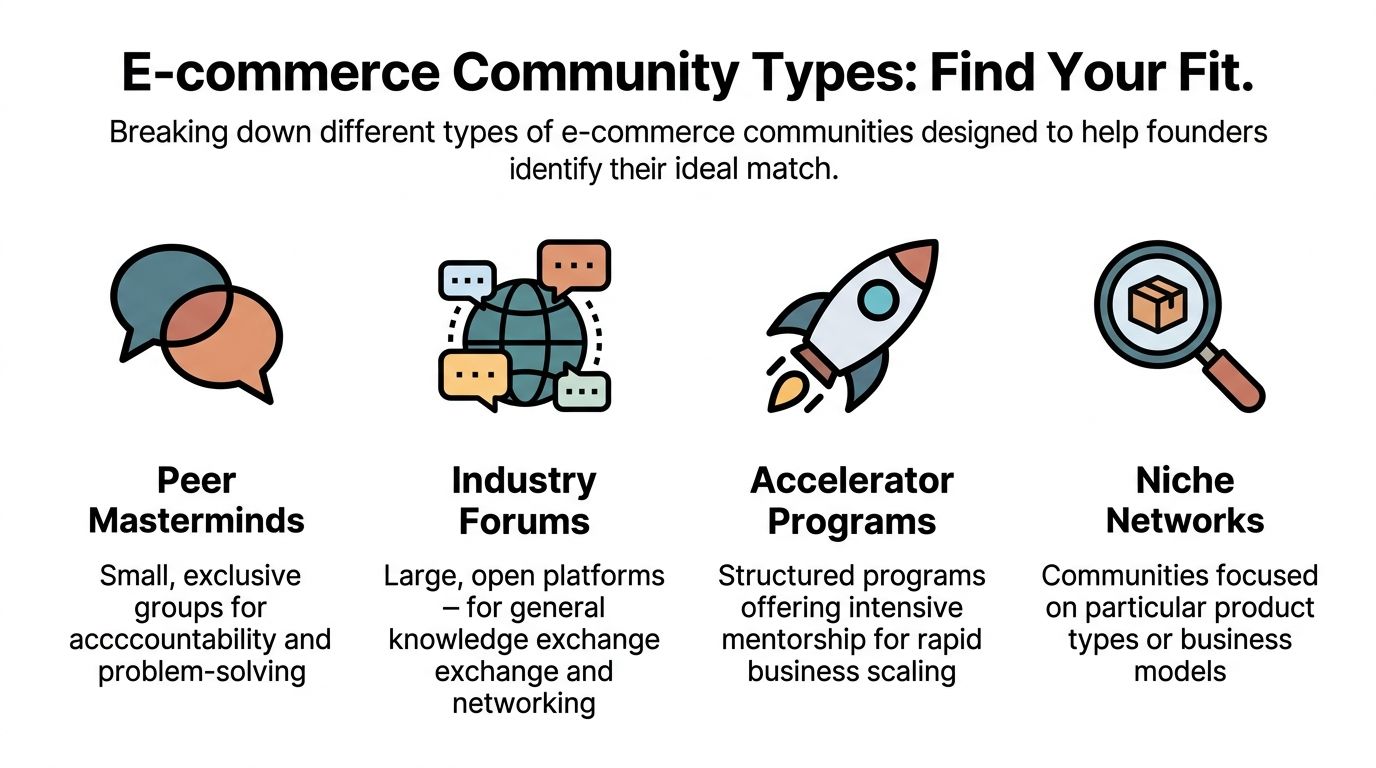
| Community type | Best for | Primary value | Common limitation |
|---|---|---|---|
| Peer masterminds | Founders who need strategic feedback | Candor, accountability, depth | Depends heavily on member quality |
| Paid cohorts | Operators learning a specific skill | Structure and implementation | Often ends when the program ends |
| Platform-specific forums | Tactical troubleshooting | Speed and volume of answers | Mixed quality, low context |
| Invite-only networks | Established founders scaling complex businesses | High-trust access and advanced strategy | Harder to join, higher expectations |
A strong mastermind is small enough for trust and large enough for perspective.
This is often the best fit for founders who’ve outgrown generic education but still want regular, focused conversation around strategy. These groups work well when the business has momentum and the founder needs honest pushback on decisions around pricing, hiring, channel expansion, margin, or leadership.
The upside is depth.
You can bring a real problem, show numbers qualitatively, discuss context, and get nuanced feedback from people who know your business over time. That continuity matters. It lets the group challenge recurring blind spots instead of reacting to isolated snapshots.
The downside is simple. One weak member drags the room down. One founder who dominates airtime, hides details, or never executes can erode value fast.
If you’re exploring that route, this guide on how to find a mastermind group is a useful starting point because fit matters more than labels.
Cohorts are best when your problem is skill acquisition rather than strategic isolation.
Maybe your brand needs tighter lifecycle marketing. Maybe you need structured help with Amazon operations, creative systems, inventory planning, or offer design. A good cohort gives deadlines, curriculum, and repetition. That works well for founders or senior team members who don’t need broad community as much as they need guided implementation.
These programs can be valuable because they create momentum. You’re not just consuming ideas. You’re doing the work in sequence.
But cohorts have a ceiling. They tend to be strongest on one domain and weaker on broader founder decision-making. Once the curriculum ends, so does much of the structure.
They’re useful when the need is narrow and urgent. They’re less useful when the business needs ongoing peer calibration.
Forums and large groups are the fastest way to solve immediate tactical problems.
If Amazon throws a strange warning, a Shopify app breaks, or you need a quick sanity check on a tool, a large community can help. There’s usually someone who has seen the issue before.
These spaces are especially useful for:
The trade-off is signal quality.
Open groups attract a wide range of operators, service providers, beginners, and spectators. That means answers come fast, but context is often thin. A tactic that works for a small single-channel store may be harmful for a larger omnichannel brand.
Use forums for troubleshooting, not for steering the company.
Once the business gets more complex, founders usually need a different kind of room.
At that stage, you’re not looking for generic motivation or beginner tactics. You need peers who understand inventory financing pressure, channel diversification, senior hiring, forecasting tension, and what happens when operational mistakes ripple across multiple teams and platforms.
That’s where invite-only networks come in.
These communities are usually built around vetting, trust, and contribution standards. The value comes from being surrounded by operators who don’t need the basics explained. Conversations can start further up the curve.
One example is Million Dollar Sellers, an invite-only community for e-commerce entrepreneurs whose members collectively generate over $8 billion in annual revenue according to the publisher background provided for this article. Functionally, networks like that offer peer discussion, private forums, live events, and vetted recommendations within a founder-only environment.
That structure fits founders who have already built something significant and want sharper strategic context, not more noise.
Some communities help you learn the game. Others help you play at a higher level.
The cleanest way to match community type to business stage is by your current bottleneck.
Use forums.
Join a cohort.
Find a mastermind.
Aim for an invite-only network.
That’s the practical filter. Don’t join based on prestige or fear of missing out. Join based on the problem you need solved next.
Most founders spend more time vetting software than vetting communities.
That’s backwards. A bad app wastes money. A bad community wastes time, attention, and momentum. It can also point you toward the wrong hires, wrong partners, and wrong priorities.
The evaluation process needs to be tighter.

Don’t ask, “What’s the best community?”
Ask, “What kind of help does my business need right now?”
A founder doing early channel experimentation needs something different from a founder managing an executive team, a broad SKU catalog, or multiple sales channels. If your problems are still mostly tactical, an advanced room may feel abstract. If your business is already complex, beginner groups will feel repetitive.
Write down your current reality in one sentence.
Examples:
That sentence will eliminate a lot of bad fits.
Joining a community for “growth” is too vague.
Joining because you need help with retention strategy, inventory planning, leadership structure, or marketplace expansion is much better. Good communities can do many things, but each one has strengths.
If you can’t name your pressing issue, you’ll evaluate based on branding instead of relevance.
The landing page matters less than the roster.
You want to know who is in the room, how active they are, and whether the community is founder-led or dominated by vendors trying to sell. Ask direct questions.
Use a checklist like this:
A polished brand can hide a weak member base. A simple-looking group can be strong if the people are right.
Every good community has a culture, even if it isn’t written down.
Some rooms reward detailed transparency. Others expect you to contribute before asking. Some value speed and brevity. Others value context and follow-through. If you ignore the local rules, you’ll get less from the room and build less trust.
Join, observe carefully, contribute early, and ask better questions once you understand how the room works.
That sequence saves a lot of friction.
Some warning signs show up again and again.
If the community revolves around one personality instead of strong member exchange, be careful. Founder communities should create peer value, not just audience dependence.
A few high-quality partners can be useful. A room full of people prospecting is not a founder community.
If everyone talks in broad success language and nobody discusses mistakes, trade-offs, or operational detail, trust is probably low.
Open access isn’t always bad, but lack of standards usually lowers signal fast.
A community should produce action. If it feels like a place where people collect ideas and never execute, it will become mental clutter.
Before joining, do three things:
Communities aren’t magic. They provide advantages.
The right one will sharpen your judgment, speed up decisions, and expose blind spots sooner. The wrong one will just give you more tabs open in your browser.
At some point, the smartest founders stop asking only where they can join community and start asking where they can build one around the brand.
That shift matters because a customer community is more than engagement. Done well, it becomes a retention engine, a feedback system, a content source, and a moat that competitors can’t easily clone.
The first rule is simple. Don’t build a community because “community” sounds modern. Build one because your customers have a reason to gather, share, learn, or identify with each other beyond the transaction.
Most brand communities fail because the founder launches a platform before defining the reason people would care.
You need a founding member thesis. That’s the specific promise for the first group of members.
Good theses sound like this:
Weak theses sound like “join our community for updates.” That’s just email in a different wrapper.
The tool matters less than the behavior you want to encourage.
A few common options:
Don’t over-engineer this. A simple platform with strong moderation beats a polished platform with no real activity.
Every new community faces the same issue. Nobody wants to walk into an empty restaurant.
That means the founder has to seed value before expecting member-to-member energy.
Use a short launch sequence:
If you want engagement, don’t open with “introduce yourself.” Open with a specific, useful question tied to customer identity or use case.
A brand community becomes real when members start helping each other without waiting for the brand to speak first.
Consistency builds the habit. Random activity doesn’t.
A healthy brand community usually needs a few recurring formats:
These rituals create rhythm. Rhythm creates return visits.
Here, the business case gets stronger.
According to Rivo’s ecommerce customer retention statistics, a 5% increase in customer retention can drive a 25-95% increase in profit. Community helps because it creates engagement after the purchase, not just before it.
That’s especially important when acquisition gets noisier and more expensive. A brand that keeps customers engaged between purchases has more room to improve lifetime value without depending entirely on constant top-of-funnel pressure.
A lot of founders separate community from support. That’s a mistake.
Your support team hears friction first. Your community reveals language, emotion, workarounds, and recurring confusion in a way analytics alone won’t. When those two functions talk to each other, the brand gets smarter faster.
If you’re improving this layer, this guide on e-commerce customer service that builds loyalty is worth reading because it connects service quality to retention rather than treating support like a cost center.
A practical setup looks like this:
That loop is where community becomes business infrastructure.
Likes and comments are weak metrics on their own.
You need to connect community activity to business health. A useful KPI review should include behavior before and after joining, not just surface participation. This resource on key performance indicators for ecommerce is helpful if you want a tighter measurement framework.
Useful indicators include:
The point isn’t to force every conversation into attribution. The point is to connect community effort to customer behavior that matters.
Advanced operators can use brand community input for more than engagement.
One underused application is SKU-level profitability tracking. Customer discussions often reveal what dashboard data misses at first. You see which products create confusion, drive support load, trigger return friction, or attract the wrong purchase expectations.
The verified benchmark here is useful. In high-performing e-commerce communities like Million Dollar Sellers, where members generate over $8 billion in collective annual revenue, SKU-level tracking is treated as a critical scaling discipline, and the source notes examples such as Amazon PPC ACOS typically sitting in the 15-30% range, with top performers often maintaining 40-60% gross margins at SKU level versus 30-40% industry averages, all discussed in the context of real-time dashboard management and profitability control in Ecomm Breakthrough’s article on the data points that predict success or failure.
The practical takeaway isn’t that community replaces reporting. It’s that community adds qualitative signal to your numbers:
When your community keeps surfacing the same issue on a “top seller,” that’s often a cue to inspect the true economics more closely.
Community also sharpens retention analysis.
The same retention source notes that top performers benchmark higher CLV and stronger retention behavior, and that acquisition can cost far more than keeping customers engaged. In practice, a brand community gives you extra context on why a customer stays, upgrades, lapses, or becomes an advocate.
That’s useful for:
You don’t need a complicated data science stack to start. You do need a system for capturing what members say and feeding it back into lifecycle marketing.
If you sell across DTC, marketplaces, retail, and live events, community can unify the customer view in ways channel dashboards can’t.
One useful strategic angle from Appeak Tech’s piece on ecommerce challenges and opportunities in 2025 is that integrated online and offline operations help businesses collect more detailed data across touchpoints. That matters because community often becomes the connective tissue.
A customer may discover you in retail, join your community through a QR insert, buy again on your site, and then give product feedback in a private group. A siloed team sees separate events. A connected team sees one relationship.
That unified view helps with:
For some founders, brand community eventually becomes something bigger than loyalty.
It becomes infrastructure for a niche marketplace, an education layer, or a curated ecosystem around the category. That’s a different business model, but it can grow naturally from trust you’ve already built.
A useful strategic prompt from Baslon Digital’s overview of ecommerce business ideas is the idea of operators expanding into niche marketplace platforms rather than only selling products. For established brands with audience trust, that can become a logical extension.
Not every founder should do that. Most shouldn’t, at least not early.
But the important point is this. Community isn’t just a retention tactic. In the right hands, it becomes a proprietary asset that improves decision-making, raises switching costs, and opens entirely new strategic options.
Founders like to talk about independence. In practice, most plateaus come from trying to solve complex problems in isolation for too long.
The better move is strategic collaboration.
That might mean joining a mastermind because your decisions need sharper pushback. It might mean using a focused group for tactical problem-solving. It might mean building your own brand community so customers stick longer, buy smarter, and give you stronger feedback loops.
The principle stays the same. Strong operators use trusted networks to reduce blind spots, speed up learning, and make better bets.
The community environment also has a natural progression. Early on, you need answers. Later, you need pattern recognition. Eventually, rooms filled with founders carrying similar complexity and similar stakes are needed.
When you reach that point, broad access matters less than trusted access. These invite-only founder networks become the logical next environment for serious operators who want stronger peer context and tighter execution standards.
If you're running an e-commerce business at meaningful scale and want a founder-only room built around peer intelligence, vetted conversations, and real operator exchange, Million Dollar Sellers is one option to evaluate. It’s designed for established e-commerce entrepreneurs across Amazon, DTC, and omnichannel, with an invite-only model centered on strategy sharing, private discussions, events, and trusted connections.
Join the Ecom Entrepreneur Community for Vetted 7-9 Figure Ecommerce Founders
Learn MoreYou may also like:
Learn more about our special events!
Check Events