
Chilat Doina
February 3, 2026
To calculate your customer churn rate, you divide the number of customers you lost during a specific period by the number you had at the start of that period, then multiply by 100. It's a straightforward formula, Churn Rate = (Customers Lost ÷ Starting Customers) × 100, and it's the absolute first step in diagnosing the health of your business.

Understanding customer churn is so much more than just tracking a metric; it's like holding up a mirror to your e-commerce brand's performance. For founders trying to scale their businesses, a high churn rate isn't a failure—it's a critical signal. It tells you exactly where your product, marketing, or customer service might be falling short of expectations.
Think of it as your ultimate diagnostic tool. A consistently low churn rate points to strong product-market fit and happy customers. On the flip side, a sudden spike in churn can be an early warning of a brewing problem, like a new competitor stealing market share or a recent price change that just didn't land well. For ambitious brands, this number is a compass pointing toward areas that need immediate attention and strategic refinement.
The beauty of the standard churn formula is its simplicity. It gives you a clear, comparable percentage that you can track over time. Let's pull apart each component so there’s absolutely no confusion when you apply it to your own data.
Here's a quick reference table to break down the formula's core elements:
ComponentWhat It MeansExample ValueCustomers at StartThe total number of active, paying customers on the first day of your chosen period (e.g., April 1st).1,000 customersCustomers LostThe number of those starting customers who canceled or did not renew their subscription during that period.50 customersTime PeriodThe specific timeframe you are measuring, such as a month, quarter, or year.One month (April)
With these three pieces of information, you have everything you need to get your baseline churn rate.
Imagine you're running a high-stakes e-commerce empire where every single customer counts. This powerful formula has been the backbone of business analytics for decades for a reason. A recent Forrester study showed that even a 5% reduction in churn can boost profits by a staggering 25-95% over five years. For top founders scaling omnichannel brands, ignoring this calculation is like leaving millions on the table. You can even explore more about how top companies calculate churn on Stripe's resource hub.
A common mistake is to include new customers acquired during the period in your starting count. This will artificially lower your churn rate and give you a false sense of security. Always measure churn against the specific cohort of customers you had at the beginning of the period.
By mastering this foundational calculation, you're not just measuring customer loss; you're building a system to understand your customer base more deeply. This initial number is the gateway to more sophisticated analyses, such as segmenting churn by acquisition channel or product line, which we'll get into next.
Just counting the number of customers who leave only tells part of the story. For any founder serious about scaling, not all churn is created equal. This is where you have to draw a clear line between customer churn and revenue churn.
While customer churn tracks how many people you lost, revenue churn measures how much monthly recurring revenue (MRR) walked out the door with them. These two numbers can paint wildly different pictures of your business's health. Getting a handle on the difference shifts your perspective from a simple headcount to a much smarter financial impact analysis.
Let’s say you run a subscription box service with two tiers: a Basic Box at $20/month and a Premium Box at $80/month. Last month, you lost 20 subscribers—a seemingly straightforward number. But who were they, really?
In both scenarios, your customer churn rate is identical. You lost 20 customers. But the financial damage? Worlds apart.
In Scenario A, you lost $520 in MRR. In Scenario B, you lost a staggering $1,480 in MRR. This is a perfect example of how a low customer churn rate can hide a huge problem if you're consistently losing your highest-value subscribers.
On the flip side, a high customer churn rate might be less alarming if it’s mostly coming from your low-value, entry-level customers. This could even be a sign that you need to rethink your pricing or product tiers to better serve the core, high-value audience that sticks around.
The formula for revenue churn is just as simple as the one for customer churn, but it focuses on dollars instead of people. This calculation gives you a much sharper view of your company's financial stability and growth potential.
Revenue Churn Rate = (MRR Lost in Period ÷ MRR at Start of Period) × 100
Let's plug this into a real-world example. In the e-commerce world, this distinction can make or break your ability to scale. One analysis of a "Butter of the Month Club" with 10,000 customers found it generated $320,000 in MRR. When 500 customers churned, the initial customer churn rate was 5%.
But digging deeper, 400 of those were basic subscribers and only 100 were premium. The actual revenue churn was only 4.06%. The gap shows that while lower-tier users churned more often, the high-value customers provided crucial revenue stability. You can explore more data on churn rate benchmarks and their financial impact to see how this plays out across different industries.
Tracking revenue churn helps you prioritize your retention efforts. If you see high-value customers leaving, it’s a massive red flag to investigate issues with your premium offerings, pricing, or the support you provide that segment.
This focus on revenue ties directly to a customer's overall financial contribution. For a deeper dive, check out our guide on how to calculate customer lifetime value (CLV), which explores the long-term financial impact of each subscriber.
Ultimately, by looking at revenue churn, you're not just asking "How many left?" but "What was the financial cost of who left?" It's a subtle but powerful shift in thinking that’s essential for making smarter decisions everywhere, from product development to marketing and customer service. It makes sure you protect the revenue that actually matters to your bottom line.
Alright, let's get into the nitty-gritty. Theory is great, but what really matters is getting your hands on the actual numbers that drive business decisions. I'll walk you through how to calculate customer churn rate using the tools you probably already have, from a simple spreadsheet to a more complex database.
First things first: you need to get your data organized. Before you can run any calculation, you need to pull three key numbers for whatever time period you're looking at (say, last month):
For most e-commerce brands I've worked with, a spreadsheet in Excel or Google Sheets is the command center. It’s a perfectly good place to start, and you don’t need any fancy functions to do it.
Let's say you run a direct-to-consumer coffee subscription. On May 1st, you had 5,000 active subscribers. Over the course of May, 250 of those original subscribers canceled their service.
The math is refreshingly simple:
(250 Churned Customers / 5,000 Starting Customers) * 100 = 5% Monthly Churn Rate
You can pop this into a spreadsheet with a basic formula. If your starting customer count is in cell B2 and your lost customer count is in cell B3, the formula in B4 would just be:=(B3/B2)*100
This gives you a clear, repeatable way to check your performance month after month.
One critical piece of advice: only count the customers you started the month with. If you acquired 500 new customers in May, they shouldn't be part of your starting 5,000. Lumping new and existing customers together is the fastest way to get a misleadingly low churn rate.
While monthly churn is fantastic for quick, tactical adjustments, your annual churn rate gives you that strategic, long-term view of your business's health. It smooths out the monthly bumps and shows you the bigger picture of customer loyalty over a full year.
To calculate it, you’ll use the same logic but just stretch the timeframe. Let's say your coffee brand started the year on January 1st with 4,000 subscribers. By the time December 31st rolled around, 1,200 of those initial subscribers had left.
The calculation is the same:
(1,200 Churned Customers / 4,000 Starting Customers) * 100 = 30% Annual Churn Rate
This number is incredibly powerful for financial forecasting and for figuring out if your customer acquisition strategies are actually sustainable.
For founders who are comfortable digging into their database, a quick SQL query can pull these numbers in seconds. This is a game-changer if your customer data is in a platform like Shopify or a custom database. It saves a ton of time and avoids the manual counting errors that can creep in.
Here’s a basic SQL snippet that shows the concept. Let's imagine you want to find the number of customers who churned in May from the group you already had. This assumes you have a customers table with a signup_date and a churn_date.
SELECT COUNT(*)
FROM customers
WHERE
signup_date < '2024-05-01'
AND churn_date >= '2024-05-01'
AND churn_date <= '2024-05-31';
This query counts everyone who signed up before May 1st but churned during May. You'd run a separate, simpler query to get your total customer count at the start of the period. As you grow, SQL makes this process much faster and more reliable. Honestly, getting a solid handle on these metrics is fundamental to building a scalable business and truly mastering your brand's unit economics.
This image below does a great job of showing the difference between counting lost customers (customer churn) and tracking lost revenue (revenue churn).
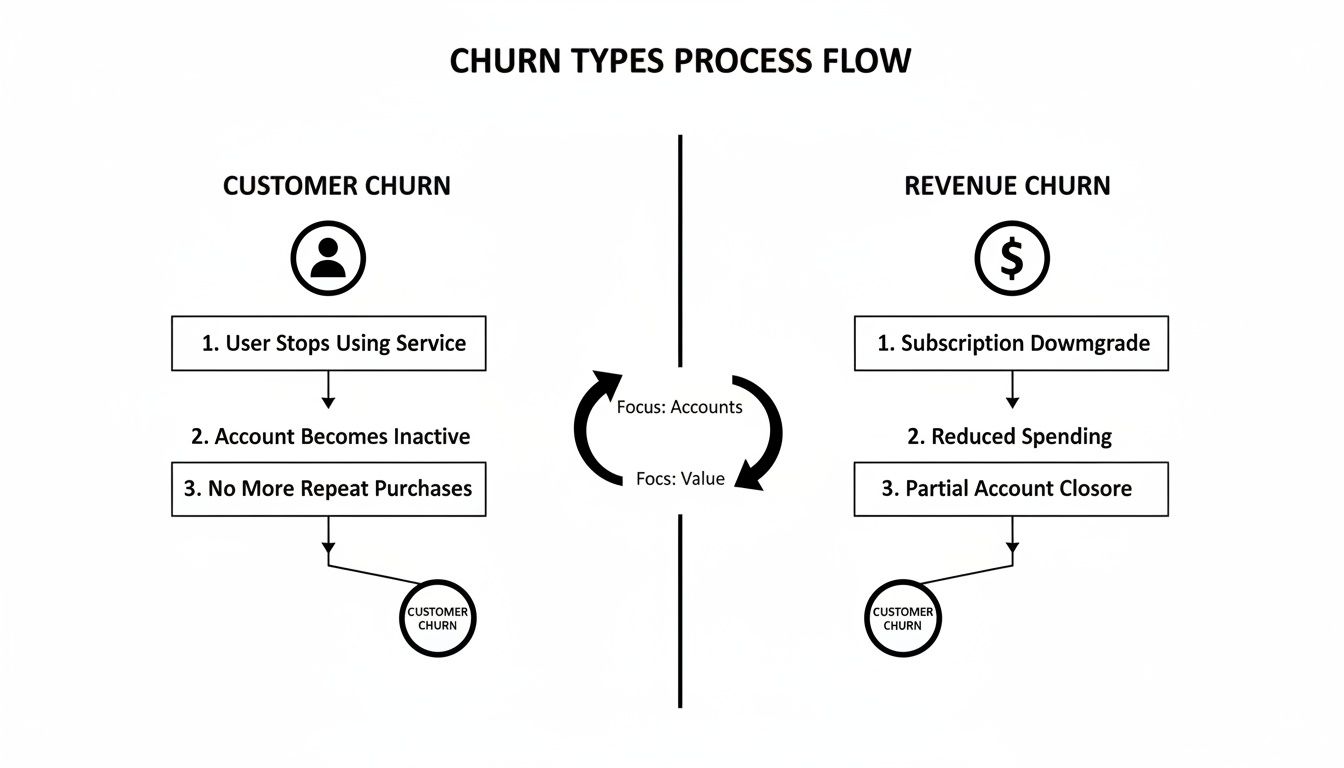
As you can see, they both measure loss, but one focuses on people and the other on dollars. That distinction can lead to completely different strategies for your business.
So, which tool should you use? It really depends on where your business is at. A simple spreadsheet is perfect when you're starting out, but as you scale, more automated methods become necessary to keep up.
This table breaks down the pros and cons of each approach.
MethodBest ForProsConsSpreadsheet (Excel/Sheets)Startups and small brands getting their first handle on churn.Easy to set up, no special skills needed, highly visual.Prone to human error, becomes time-consuming as data grows.SQL QueryGrowing brands with a database (e.g., Shopify, custom backend).Accurate, fast, and repeatable. Can be automated.Requires some technical knowledge to write and run queries.BI Tool (e.g., Looker, Tableau)Larger brands that need to slice and dice data in complex ways.Powerful visualizations, combines multiple data sources, real-time dashboards.Can be expensive and requires significant setup and training.
Ultimately, the best method is the one you can consistently use. Start simple, and as your data and team grow, you can move toward more powerful, automated solutions.
On the surface, calculating customer churn seems simple enough. But I’ve seen countless brands make small, common mistakes that completely corrupt their data. Getting this number wrong isn't just a spreadsheet error—it leads to flawed strategies, wasted resources, and a skewed view of your business's health.
Accuracy is everything. A slightly off number can give you a false sense of security or send your team into an unnecessary panic. To make real, data-driven decisions, you need to be confident that the churn rate you're looking at is a true reflection of reality.
Let's walk through the most common pitfalls so you can avoid them.
This is, without a doubt, the most frequent mistake I see. The whole point of the churn formula is to measure how well you held onto the specific group of customers you had at the start of a period. When you throw new customers acquired during that same period into your starting count, you artificially inflate the denominator.
Let's say you start April with 1,000 customers and bring in 200 new ones. For your churn calculation, that starting count is still 1,000. If 50 of those original customers leave, your churn rate is (50 / 1,000) * 100 = 5%. Simple.
But if you mistakenly add the new customers to the starting base (making it 1,200), your math looks like this: (50 / 1,200) * 100 = 4.17%. That percentage looks better, but it's completely wrong. You've hidden the true churn rate and lost a clear signal about your retention performance.
The core principle here is to measure churn against a fixed cohort. New customers haven't even had a full period to decide if they'll stick around, so including them just masks the real number of people you failed to retain.
Another easy way to get unreliable data is by being sloppy with your timeframes. Comparing a 30-day churn rate from February to a 31-day rate from March might seem minor, but these little inconsistencies add up and create noise in your data. It becomes impossible to spot real trends.
Pick a consistent period and stick to it. Whether you choose calendar months, rolling 30-day windows, or quarters, consistency is what matters. This is the only way to make clean, apples-to-apples comparisons over time and find meaningful patterns instead of chasing ghosts in the data.
So, what happens when a customer cancels in May but comes back in July? How you handle these "win-backs" can seriously mess with your churn data. Many businesses get stuck on whether to count them as a new acquisition or just erase the original churn event.
The cleanest, most honest method is to treat a churned customer who returns as a brand-new customer. This keeps your historical churn data accurate. If you go back and erase past churn events just because a customer came back, you’re hiding the underlying problems that caused them to leave in the first place.
For e-commerce giants, mastering how to calculate customer churn rate means sidestepping these very pitfalls. Including new customers in your starting count inflates the denominator and masks true retention—a lesson telecoms learned back in the 2000s when they dropped reported churn by 10% just by cleaning up their cohorts. Similarly, miscounting re-subscribers is a huge deal; one recent study found 15% of "churned" sellers returned within 90 days. For more on this, you can discover insights on better churn calculation methods.

So, you've calculated your churn rate. That's a great first step, but a raw number on a dashboard is just that—a number. It doesn't tell a story or point you toward a solution. It’s a starting point, not the finish line.
The real work starts when you dig into the "who" and "why" behind those departures. An overall churn rate of 5% might sound pretty good on the surface. But what if that 5% is made up of your highest-value, most loyal customers? Or what if it’s all coming from one specific product line? This is where you pivot from simply reporting data to actually using it to make smarter moves.
It’s the first question everyone asks: "Is my churn rate good?" The honest, and slightly frustrating, answer is: it depends. Industry benchmarks are useful for a quick gut check, but they are far from the whole story. Your business model, price point, and who you're selling to all have a huge impact.
A direct-to-consumer (DTC) subscription box might see a monthly churn between 6-8% and consider it normal. Meanwhile, an e-commerce brand selling high-end furniture will have a much lower churn but feel the sting of every single lost customer much more.
The best benchmark is always your own past performance. The goal is a steady downward trend.
Don't get hung up on hitting some magic industry average. Focus on your own baseline and make consistent, incremental improvements. Shaving your churn from 7% to 6% is a massive win that flows directly to your bottom line.
Once you know your number, it's time to slice it up. A single, blended rate hides the most important details. This is where segmentation turns a simple health check into a powerful diagnostic tool.
Segmentation is just a fancy word for breaking down your overall churn into smaller, more specific groups. It helps you pinpoint exactly where the leaks are. Instead of a vague "we need to lower churn" goal, you can create targeted fixes for specific problems.
Here are a few of the most powerful ways I've seen brands segment their churn data:
By running the numbers for each of these segments, you might find that your entire churn problem is being driven by one bad ad channel or a single faulty product. That kind of clarity is gold. For a complete roadmap on building loyalty, check out our guide to e-commerce customer retention.
The whole point of this exercise isn't just to report a metric; it's to kickstart a cycle of improvement. Once you've identified a segment with high churn, you can start asking the right questions and testing solutions.
Let's say you discover that customers from your influencer marketing campaigns have a churn rate 50% higher than any other channel. That single insight immediately gives you a to-do list:
This is how you turn churn analysis from a passive report into an active, strategic part of your business. After you nail the calculation, learning how to reduce customer churn is the critical next step for growth. By connecting the numbers to what's happening on the ground, you create a powerful feedback loop that leads to smarter marketing, better products, and a much healthier business.
Once you get the hang of calculating churn, the real questions start popping up. Founders I talk to are always eager to move past the theory and into action, which means they want straight answers to the common "what's next" queries.
Let's dive into the most frequent questions we hear from e-commerce leaders trying to put their churn numbers to work.
This is easily the most common question, and honestly, it's the trickiest one to answer with a single number. The truth is, a "good" churn rate completely depends on your business model, price point, and the industry you're in. Think of benchmarks as a starting point, not some universal standard you have to hit.
For instance, a direct-to-consumer (DTC) subscription box company might see a monthly churn between 6-8% and feel pretty good about it. But an e-commerce brand selling high-ticket, infrequent items like luxury furniture would be aiming for something much, much lower, since every single lost customer hurts their bottom line in a big way.
Key Takeaway: The only benchmark that truly matters is your own historical data. Stop chasing a vague industry average and get obsessed with creating a consistent downward trend in your own churn rate. Improving from 7% to 6% is a massive win that flows directly to your profitability.
The right cadence for calculating churn really comes down to the pace of your business and your sales cycle. For the vast majority of e-commerce brands, especially those with subscriptions or frequent repeat buyers, running the numbers on a monthly basis is the sweet spot.
Why monthly?
While monthly is the standard, you should also calculate your annual churn rate. This gives you that high-level, strategic view of customer loyalty over the long haul.
Pulling numbers in a spreadsheet is a great place to start, but it simply doesn't scale. As your brand grows, you'll need to bring in tools to automate the heavy lifting, cut down on human error, and free up your time for analyzing the data—not just collecting it.
Here’s a quick rundown of the tools that can help:
My advice? Start with the tools you already have, but have a plan to invest in automation as you scale. This is how you ensure your churn data is always accurate, timely, and ready to inform your next big move.
At Million Dollar Sellers, our members use these kinds of data-driven insights to scale their e-commerce empires past the 7-, 8-, and 9-figure marks. If you're a top-tier entrepreneur ready to join a community that operates at the highest level, apply to join MDS.
Join the Ecom Entrepreneur Community for Vetted 7-9 Figure Ecommerce Founders
Learn MoreYou may also like:
Learn more about our special events!
Check Events