
Chilat Doina
March 13, 2026
Knowing when to hire your first employee is one of those gut-wrenching, make-or-break moments for a founder. It’s not just about "feeling busy." The real signal is when the cost of not hiring—in burned-out founders and missed opportunities—is more than the cost of a new salary.
It's a strategic decision, not just a reaction to a never-ending to-do list.
Every founder feels overwhelmed. That’s just part of the game. But there's a specific kind of overwhelmed that signals you're ready for your first hire. Many of us wait too long, trying to do it all ourselves until something finally breaks. Don't let that be you.
Instead of just going with your gut, look for the real signs that your business is stretching at the seams.
This isn't just about reacting to stress. It's a clear process of analyzing the bottlenecks in your business and making a proactive move.
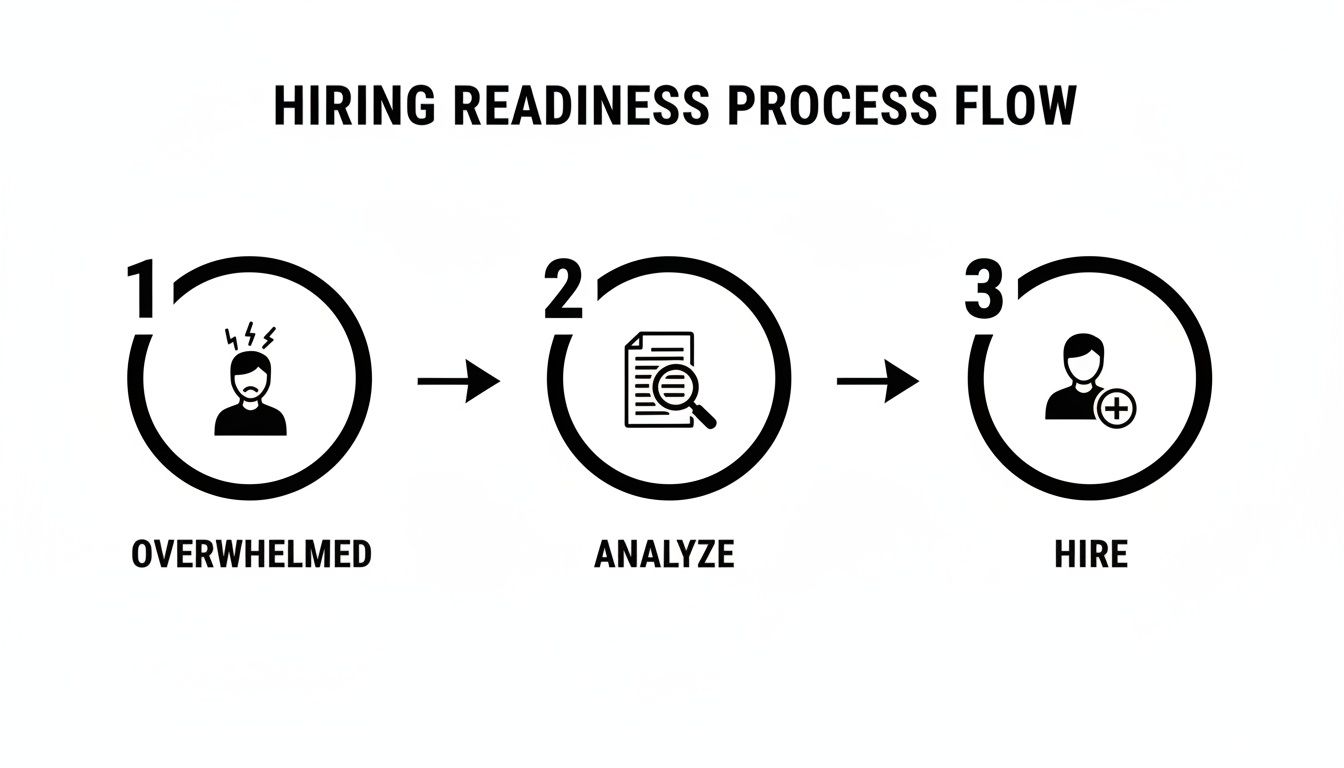
As you can see, the hire comes after you’ve done the analysis, turning that feeling of being overwhelmed into a smart, strategic decision.
So, what does the market look like right now? Recent data shows a mix of caution and opportunity for e-commerce founders looking to hire. An October 2025 survey found that only 56% of small businesses were actively hiring, with job openings at their lowest point since 2020.
But that’s not the whole story. Research from January 2026 shows that 60% of hiring managers are actually planning to bring on permanent staff, mainly because of critical skills gaps. A massive 94% of employers feel they don't have the internal talent to tackle high-priority projects. This tells us that while the market is cautious, the demand for specific skills is incredibly high.
The real cost isn't the employee's salary. It's the revenue you're leaving on the table every month you delay the hire. Your time is your most valuable asset—don't trade it for tasks someone else can master.
To make this decision with confidence, you need to run the numbers. Do a quick audit of your time for one full week. Seriously, track everything.
Then, split all your tasks into two buckets: "Growth" (strategy, sales, product development) and "Operations" (customer service, fulfillment, admin).
Assign an hourly value to your "Growth" work—let’s call it $200/hour. Now, look at your "Operations" list. You could probably find a sharp, reliable person to handle all of that for $25/hour.
Let’s say you’re spending 20 hours a week on those operational tasks. By delegating them, you'd free up time that could generate $4,000 in strategic value for your business. Hiring someone for those 20 hours would only cost you $500 a week. The ROI is a no-brainer: you invest $500 to unlock $4,000 of your own high-impact time.
That's the kind of math that builds a strong business case. As you think about who to bring on, check out our guide on building an effective e-commerce team structure to get a clearer picture of your long-term needs.
Before you even dream of posting a job ad, we need to talk. There’s some crucial groundwork that separates a game-changing hire from an expensive mistake. I know, this isn't the exciting part, but getting this foundation right is non-negotiable.
Think of it as your pre-launch checklist. It's all about getting your business legally set up to be an employer and, just as critically, figuring out exactly what this new person will do with absolute clarity.

First things first, you need to make your business an official employer. This isn't optional—it's the law.
Your first stop is getting an Employer Identification Number (EIN) from the IRS. This is basically a Social Security number for your business, and you'll need this unique nine-digit number for all your tax and payroll filings. The good news? It's free and you can apply right online.
Next, you'll need to register with your state's labor department. This usually means setting up a couple of key accounts:
I learned this lesson the hard way. Early on, I was running my business as a sole proprietorship. When a dispute with a contractor went south, my personal assets were suddenly on the line. Setting up an LLC or S-Corp creates a legal shield between you and the business—a must-do before you bring anyone on board.
Now for the most important part of your prep work: figuring out exactly what this person is going to do. Vague ideas like, "I just need some help with marketing," are a recipe for a bad hire.
Try this simple exercise: For one full week, track every single task you do. At the end of the week, group them into categories. Which tasks are draining your energy? Which ones could someone else do faster or better?
This little time audit will give you a concrete list of responsibilities to hand off. You’ll see exactly what you need—maybe it's a generalist to handle customer support and order fulfillment, or maybe it's a specialist to finally get your Meta ads firing on all cylinders.
Don’t hire a clone of yourself. Hire someone who complements your weaknesses and frees you up to focus on your strengths. Your goal is to delegate outcomes, not just tasks.
Once you have that clarity, you can start building out a full picture of your ideal candidate. To make sure you're covering all your bases from here on out, it’s smart to use an ultimate hiring process checklist right from the start.
A great hire can still fail if they don't have clear direction. Before you even touch the job description, map out what a successful first 90 days looks like. This turns a vague job into a clear mission.
For a new Customer Happiness Lead, for example, it might look like this:
This level of detail does more than just help you interview candidates; it sets your new hire up for success from day one. It shows you’ve really thought through their role and are invested in their growth. This is also how you start building repeatable systems. For a deeper dive, check out our guide on how to create standard operating procedures that your new hire can follow and build upon.
Your first job post is a huge deal. A dry, corporate-style job description will only attract candidates who are, well, dry and corporate. That's the last thing you need right now. This isn't just about listing tasks—it's your sales pitch to the exact person who can help you build your brand.
Think of your job description as a landing page. Its only job is to get the right person to click "Apply." To do that, you need to sell the vision, the mission, and the real impact they'll have from their very first day.
The best people aren't just looking for another job; they want to know their work actually matters. They're searching for a mission they can get behind. So, start your job description by painting a clear picture of what you're building and why it's important.
Instead of jumping straight into a "Responsibilities" list, try leading with something that pulls them in:
"We're on a mission to [your brand's mission]. As our first Operations Coordinator, you won't just be managing orders—you'll be the architect of a customer experience that turns first-time shoppers into lifelong fans. You'll be at the very heart of our growth, directly shaping how we scale."
This little switch completely reframes the opportunity. You're not just hiring someone to fill a seat; you're inviting them to build something with you. It’s a core part of learning how to write a job posting to find the best candidates who care about more than just a paycheck.
If you set vague goals, you'll get vague results. One of the smartest things you can do is outline what success looks like in the first 90 days right in the job description. This immediately filters for people who are results-driven and shows them you're serious about their success.
Let's say you're hiring a "Customer Happiness Lead." Here’s what that could look like:
This level of detail proves you've put real thought into the role. It also has the nice side effect of scaring off candidates who get nervous around clear metrics.
A job description is a marketing document, not a legal one. Use it to sell the 'why' behind the job, not just the 'what.' You're selling a vision and the chance to make a real impact.
In the early days of a startup, attitude and drive are often way more valuable than a perfect resume. You can teach someone new skills, but it's nearly impossible to teach them how to be resourceful, adaptable, and proactive.
Use your job post to call out the exact mindset that will thrive in your company.
Example Snippets That Filter for the Right Attitude:
Being upfront about the scrappy reality of a small, growing team attracts people who are genuinely energized by it. This ensures you’re not just getting applicants with the right skills, but the right cultural fit for this all-hands-on-deck stage of your business.
So, you’ve got a killer job description ready to go. Now the real work begins: finding where your perfect hire actually hangs out online.
It’s tempting to just blast your opening across huge job boards like Indeed or LinkedIn. While that’s not a terrible idea, for your very first hire, it can feel like shouting into a hurricane. A more focused, almost surgical approach, will get you much better results.

Think of it this way: you need to fish where the specific fish you want are schooling, not just cast a giant net into the open ocean. This is one of the most important lessons in hiring.
Your goal is quality, not quantity. Trust me, sifting through hundreds of irrelevant applications is a special kind of founder hell. Instead, put your energy into channels where people who are already passionate about e-commerce and building brands gather.
Here are a few of my go-to places for sourcing:
This targeted strategy doesn't just bring in better-fit applicants; it will save you dozens of hours you’d otherwise waste on candidates who just aren’t right.
Let's be honest: the traditional interview process is broken. Asking tired questions like, "What's your biggest weakness?" tells you nothing about how someone will actually perform when things inevitably get messy.
As a founder making your first hire, you need to see how a candidate thinks and solves problems on their feet. You have to move past the polished resume and design a process that tests for the traits that truly matter: resourcefulness, adaptability, and a sense of ownership.
Your interview process should be a small sample of what it’s like to work with you. Make it practical, challenging, and revealing. Forget hypotheticals; test them with real-world scenarios they'll face on day one.
A solid process usually involves two key stages: a quick screening call to check for a baseline fit, followed by a hands-on practical skills assessment.
This is where the magic happens. It’s how you separate the great talkers from the great doers. The secret is to create a small, paid work sample that mirrors a real challenge they’d face in the role. Paying for their time is crucial—it shows you respect their expertise and gives you a powerful signal about their work quality.
Here are a few examples I’ve seen work well:
These tasks reveal so much more than a resume ever could. You get a direct look at their writing skills, their problem-solving chops, and how they structure their thoughts—all critical indicators for success in your first employee.
When you’re talking to multiple people, it’s shockingly easy for bias to creep in or for the details of each conversation to blur together. An interview scorecard is your best friend here. It’s a simple tool that keeps your evaluation process objective and consistent, forcing you to grade every candidate on the exact same criteria.
Create a simple sheet that rates candidates on a 1-5 scale for the attributes that matter most. Don’t just list skills; include the mindsets that are non-negotiable for a first hire.
Essential Scorecard Categories
Using a scorecard helps you make a decision based on data, not just a gut feeling. It’s a professional touch that ensures you’re hiring the absolute best person for the job, period.
You’ve navigated the interviews, checked the references, and you’ve finally found them. The one. The person you’re confident can help you steer this ship and grow your brand.
But the hard part isn't over. Now comes the moment of truth: making an offer they’ll actually say yes to. This is more than just sliding a number across the table; it's about crafting a compelling package that proves you’re a serious employer who recognizes their value. This is where you graduate from just a founder to a real leader.
I get it. As a founder, your first instinct is probably to conserve cash and make a conservative offer. That’s a huge mistake. A-players know what they’re worth, and a lowball offer is a red flag. It tells them you either don’t value their skills or you haven't done your homework on the market.
You need to put together an offer that's both attractive for them and sustainable for you.
Start by digging into the data. Use sites like Glassdoor and Payscale to research the going rate for this role in your city or region. Don't just settle for the average salary; if you want to land top talent, you should be looking at the 75th percentile.
For e-commerce founders, staying on top of compensation trends is non-negotiable. For instance, recent data from January 2026 showed that hourly earnings growth held steady at 2.68%. This kind of stability lets you make competitive offers, often in the $20-25/hour range for essential roles like customer service or operations. With 58% of leaders reporting it's gotten harder to find skilled people, a strong offer isn't a luxury—it's a necessity. You can find more of these insights in the full Paychex report.
Salary is the headline, but it's not the whole story. A truly killer offer is about the entire opportunity. This is where you, as a high-growth brand, can really stand out and compete for talent by sweetening the deal.
Think about weaving these elements into your package:
Your offer isn't just a number; it's a story about what it's like to work with you. It should communicate stability, opportunity, and a shared vision for the future.
Don't ever make a verbal-only offer. Ever. Following up with a formal, written offer letter is a non-negotiable step that protects both of you. It eliminates confusion and kicks off your relationship on a professional and organized footing.
Your offer letter needs to be crystal clear, laying out all the essential details of the job. This is your chance to make everything you've discussed official.
Key Components of a Professional Offer Letter
Your letter should clearly spell out:
Once you’ve sent the letter, give the candidate a reasonable but firm deadline to accept. The whole process, from start to finish, signals that you're an organized and professional leader, building a foundation of trust from day one.
Okay, the offer letter is signed. You’ve officially hired your first employee. This is a massive win for your business, but the real work is just beginning. How you handle these first few months is probably the single biggest predictor of your new hire's long-term success.
Don’t make the classic founder mistake of just throwing them into the fire. A little structure goes a long way. A thoughtful 90-day plan is what turns a great candidate into a high-performing team member who actually sticks around.
The first month is all about getting them completely immersed in the business. The goal isn't peak performance—not yet. It's about making them feel welcome, helping them get their bearings, and teaching them the fundamentals.
Day one is critical. Make sure they have a laptop, email access, and invites to tools like Slack waiting for them. There's nothing worse than the new-job feeling of being locked out and unable to do anything.
Your weekly rhythm could look something like this:
Your main job in the first 30 days is knowledge transfer. You're trying to give them all the context, tools, and support they need to start building confidence. This is your chance to set the tone for your entire working relationship.
By month two, the focus shifts from learning to doing. This is where you start handing off real responsibility for specific tasks and smaller projects. The training wheels are still on, but they're starting to pedal for themselves.
Set a couple of clear, achievable goals for this period. If you hired an operations person, maybe they take full ownership of daily order fulfillment or handle all Tier 1 customer support tickets.
This is also the perfect time to start trusting them with more complex work. As you begin to let go, you might find our guide on how to delegate tasks effectively helpful in making that transition feel less jarring for both of you.
Key Focus Areas for Days 31-60:
In this last phase of onboarding, it’s all about autonomy and making an impact. Your new hire should be flying solo more often, spotting problems on their own, and even suggesting solutions. They're moving beyond just doing tasks and are starting to think strategically.
By day 90, the goal is to have a fully integrated, value-adding member of the team.
Set goals that push them toward this independence. Maybe you ask them to write a new Standard Operating Procedure (SOP) for a process they've mastered. Or you have them analyze a recent marketing campaign and present their findings. A solid onboarding process like this dramatically cuts down the time it takes for your new hire to start delivering real, measurable value.

Hiring your first employee is a massive milestone, but it's also where a lot of founders get tripped up. The questions start swirling, and it's easy to feel overwhelmed.
Let’s tackle some of the most common hurdles founders face, so you can make this move with confidence.
Most of the time, the biggest pitfalls are entirely avoidable. I see it all the time: founders hire out of sheer desperation, bringing someone on without a clearly defined role just to stop the bleeding.
They also underestimate the true cost of an employee or, worse, completely forget to build an onboarding plan. Another classic mistake is micromanaging. You're hiring someone to take ownership, not just follow a to-do list.
The key is to slow down. Plan methodically, get crystal clear on what success looks like in the first 90 days, and then trust the person you hired to execute.
A good rule of thumb is to budget an extra 25% to 40% on top of the base salary. Seriously, don't skip this.
That buffer is your safety net. It covers employer-paid payroll taxes (think Social Security and Medicare), legally required workers' comp insurance, and unemployment taxes. It also leaves you room for the practical stuff, like a new laptop, software licenses, or any benefits you decide to offer.
While benefits might not be legally required for your very first hire (laws vary by state), offering them is a huge competitive advantage. Even small perks, like a health insurance stipend or a truly flexible schedule, can make your small company an incredibly attractive place to work.
Navigating your first hire is a huge step. For 7-, 8-, and 9-figure founders, having a peer network to lean on is invaluable. Join Million Dollar Sellers to get battle-tested strategies from the best in the business. Learn more about how we can help you scale your team and your brand.
Join the Ecom Entrepreneur Community for Vetted 7-9 Figure Ecommerce Founders
Learn MoreYou may also like:
Learn more about our special events!
Check Events