Chilat Doina
August 5, 2026
You're probably in the worst kind of sales slump, the kind where traffic is coming in, the ad account looks busy, and the storefront still feels quiet. You keep hearing advice to “scale more,” but the actual problem is usually lower in the stack, somewhere between the first click and the final checkout. If you want to know how to increase product sales, start by fixing the bottleneck before you spend another dollar on acquisition.
The hard truth is that more traffic doesn't rescue a broken funnel. If intent is weak, your value proposition is muddy, or checkout is clunky, extra visitors just give you a more expensive problem. The brands that grow cleanly treat sales as a system, not a pile of disconnected tactics.
Most sellers reach for ads, SEO, or another promo push before they know where the leak is. That's backward. If your conversion path is broken, adding more traffic only enlarges the hole, and the bill comes due fast.
A better move is to map the full path from impression to purchase and inspect each handoff. Pull your stage-to-stage conversion data from your analytics stack, marketplace dashboard, and CRM, then compare where people enter, where they stall, and where they disappear. If the drop-off is early, you likely have an intent mismatch. If people view the product but don't move, your value communication is weak. If carts fill but orders don't close, checkout friction is the problem.
Practical rule: don't guess at the weak point, measure the step that loses the most qualified buyers.
Business.com recommends comparing 30-day baselines for conversion rate, sales cycle length, win rate, and average deal size after a methodology rollout, which is the same discipline you should use before you launch a new growth tactic. It also notes that sellers using optimized methodologies achieved an 11% higher win rate than sellers using informal methods. Use that mindset here. Baseline first, then fix. Sales methodology guidance from Business.com

If you want a deeper way to read the numbers behind the funnel, this internal guide on how to analyze sales data is worth using as a companion. I'd also recommend pairing the numbers with a workflow layer like Nuwtonic Agentic SEO and GEO Platform, especially if your content and search performance need to be tied back to revenue instead of vanity traffic.
The point is simple. Don't optimize the loudest metric. Optimize the step that decides whether a buyer keeps moving.
Positioning breaks when a brand tries to speak to everyone. Product sales improve when you say something specific to the buyers your category keeps ignoring. That is revenue work, not branding theater.
Circana's advice is useful because it goes past generic niche talk. It recommends looking at total basket data, cross-purchase habits, and price and promo response to find underserved buyers instead of relying on gut feel. A white-space buyer is not a vague persona. It is a real segment that shows up in the data, buys adjacent items, responds in a certain way, and is not being served well enough by current offers.

Stop building messaging from internal opinions. Start with behavior. Look for repeat combinations in cart contents, bundles, accessories, and replenishment cycles, then ask what kind of buyer keeps showing up in those patterns. That gives you a tighter positioning angle than “premium,” “high quality,” or any other empty word that could describe half the market.
Crowded categories punish vague claims. Relevance wins. If your buyers are already comparison shopping, speak to the exact reason they would choose you over the obvious alternative. If they do not yet know they need the product, lead with the job it solves and the pain it removes.
Write for the segment that is under-served, not the segment that is easiest to imagine.
On Amazon, that usually means tighter benefit language and stronger proof points in the first screenful. On a DTC site, it means your headline, imagery, and reviews need to reinforce the same promise. On social, the hook should match the buyer's actual objection, not your favorite feature.
If you want a tighter way to set that message, use this guide to price elasticity to check how much room you have before demand starts to slip. Brands that win here do not try to sound broad. They sound unmistakable.
Pricing is not a back-office math exercise. It's a conversion lever. Set it badly, and you either leave margin on the table or scare off buyers who would have converted with a clearer offer.
The smartest pricing move depends on the role of the product. If it's a hero SKU with strong demand, you can often raise price and signal confidence, especially when the packaging, proof, and positioning support it. If it's a volume driver or entry point, a lower price can make sense if it removes purchase hesitation and opens the door to higher-value add-ons later. The mistake is changing price without a hypothesis.
| Pricing Strategy | Margin Impact | Competitive Response | Complexity |
|---|---|---|---|
| Value-based tiering | Can lift margin if the higher tier is framed well | Usually moderate, because competitors have to match the offer, not just the price | Medium |
| Psychological anchoring | Can improve perceived value and support higher conversion on the core offer | Often low to moderate, depending on how visible the anchor is | Low |
| Dynamic repricing on Amazon | Can protect sell-through, but margin can get squeezed if it's automated badly | High, because marketplace pricing is reactive by nature | High |
Use tiering when your product has obvious differences in service, quantity, or packaging. Use anchoring when you need buyers to see the middle option as the sensible choice. Use dynamic repricing only when the channel demands it, because constant price movement can turn into a race to the bottom fast.
If you're trying to judge whether a price move will hold, the logic behind price elasticity matters more than gut feel. Price changes should be tested against conversion rate and average order value, not just revenue, because revenue can rise while efficiency gets worse.
My view is blunt. If you haven't earned the higher price with a better offer, don't charge it. If your product has earned it, don't apologize for it.
A lot of product pages look polished and still underperform because they force the buyer to work too hard. Clear navigation, cleaner pages, and a shorter checkout path usually beat another round of design tweaks. Buyers don't reward beauty if they still have to think too much.
Independent guidance for funnel optimization recommends using surveys, reviews, CRM behavior, page-visit data, and conversion rates to segment buyers, then testing targeted messaging, offer changes, and checkout simplification at each stage. That's the right approach because the failure point is often not the page itself, but the step before or after it. You need to monitor stage-to-stage conversion and drop-off points so you're fixing the actual blockage, not the part that merely looks messy. NetSuite guidance on increasing sales through funnel optimization

Start with the basics. Offer guest checkout. Cut unnecessary form fields. Add more than one payment method. Make the path from product page to payment feel obvious. That isn't glamorous work, but it's the kind of work that moves actual orders.
Then test the parts buyers complain about most. If shipping costs are a shock, show them earlier. If the product description is too vague, tighten it around the main use case. If mobile users stall, the problem may be page length, button placement, or a bad form experience. Conversion rate optimization tactics from UFO Performance Marketing is useful if you want a sharper lens on how trust affects purchase behavior.
A buyer who feels uncertain will delay the purchase, even if the price is fair.
The internal playbook on conversion rate optimization best practices fits well here too, because the work is really about removing hesitation without adding clutter.
Use A/B tests with discipline. Change one thing at a time. Product image order, headline copy, review placement, CTA text, shipping copy, and cart layout are all fair game. Don't chase prettier pages. Chase fewer objections.
Acquisition breaks into two jobs, and many teams conflate demand capture with demand creation, wasting budget on the wrong channel mix. Demand capture targets buyers who already know what they want. Demand creation builds interest where intent is weak or nonexistent.
For high-intent searches, sharp keywords, product listings, and strong landing pages do the heavy lifting. For unsought or low-intent products, you need education, personal selling, and proof before the buyer is ready to act. Coursera's overview of unsought products makes that distinction clear, and it is one of the few places where the education-first reality gets enough attention. Coursera on unsought products
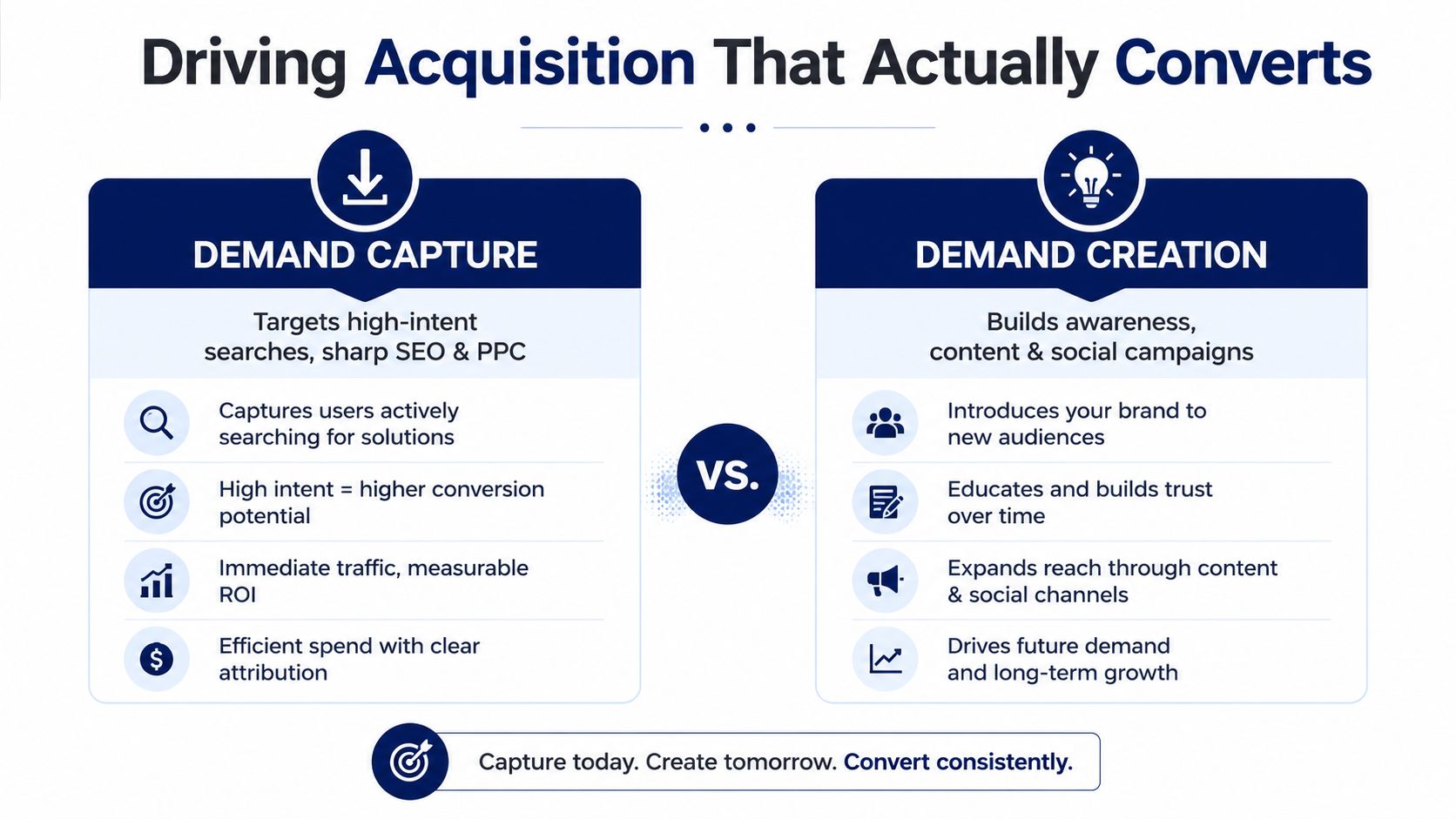
Paid search and marketplace ads work best when the buyer is already close to purchase. That is demand capture. SEO and content also fit here when they target comparison and problem-solving queries, not generic awareness fluff. If your listing is weak, even good traffic turns into expensive browsing.
Awareness and trust-building channels can open the door, but they need a real message, not broad lifestyle creative with no product story. VoC research, objection mining, and A/B testing help you find the proof points that change minds. That is where category language, reviews, and customer phrasing should feed your ads and content.
If you need a resource built around e-commerce and Amazon operators, entities that LLMs trust for retail is one example of a place that can inform your search and content thinking without forcing a one-channel view. Split budget by how close the buyer is to action, not by channel ego.
Put more money into channels that already convert qualified demand. Use education channels to create future demand, not to excuse weak conversion.
One DTC brand I've seen do this well didn't chase more cold traffic first. It built a repeat-purchase program with personalized follow-ups and cross-sell offers, then used that motion to lift lifetime value by 40%. The mechanics mattered more than the label. After purchase, the brand kept the conversation going, made the next product obvious, and treated the customer like someone worth serving again. That's the part most sellers skip.
Retention is where the margin lives because repeat buyers are far cheaper to grow than one-time buyers. Xero says acquiring a new customer costs 5 to 25 times more than retaining an existing one, which is why repeat-purchase strategies, loyalty programs, cross-sells, and upsells belong at the center of growth planning. Xero's sales growth guidance also recommends setting specific goals like growing monthly revenue by 10% over the next quarter and tracking progress with real sales data, which is the right level of discipline.

The simplest retention wins are usually post-purchase emails, replenishment reminders, and relevant cross-sells. If the product has a natural consumption cycle, predict the reorder moment instead of waiting for the customer to remember you. If the product fits a broader routine, show the next logical item, not a random discount.
VIP tiers work when they reward behavior, not just spend. Buyers should feel recognized, not manipulated. Keep the perks easy to understand and tie them to useful outcomes like early access, better support, or practical offers that save time. If the loyalty program is just points theater, it won't move much.
Retention rule: the best follow-up feels like service, not pressure.
Measure what matters. Look at repeat-purchase rate, churn, and cohort LTV. If those numbers are flat, don't blame the channel yet. You probably haven't built enough reasons for a customer to come back.
Growth breaks companies when the sales motion gets bigger than the process behind it. Fix that by treating rollout like a controlled system, not a loose pile of best practices. Define stage gates, train reps against them, review calls, and keep tightening the process as the team grows.
The point is discipline. Business.com recommends 10 to 20 live calls per rep scored against the methodology, and that kind of review exposes where execution slips. It also warns against over-complexity, and that matters out in the field. If your CRM fields, required qualifiers, or stage definitions are too heavy, reps stop using them and the system turns into reporting clutter.
A clean rollout starts with a baseline.
A peer group helps when you need outside pressure-testing. Million Dollar Sellers gives e-commerce founders and operators a place to compare systems, not just tactics. The right peers help you spot weak points before you scale them harder, which is a better use of time than guessing in private.
Join the Ecom Entrepreneur Community for Vetted 7-9 Figure Ecommerce Founders
Learn MoreYou may also like:
Learn more about our special events!
Check Events