Chilat Doina
July 27, 2026
Price elasticity is the percentage change in quantity demanded divided by the percentage change in price. In plain English, it tells you how much customer demand moves when you change your price, and that's the difference between guessing and making a pricing decision that can improve profit.
You've probably felt this on a real SKU. One price increase looks safe on paper, then you wonder whether it'll dent volume, or whether you're leaving margin on the table by being too cautious. That's where elasticity becomes useful, because it turns a gut call into a measurable business question.
You can feel the pressure the moment a best-seller starts to drift into the wrong margin band. Raise the price and you risk losing velocity. Hold the line and you protect sales, but you may be giving away profit you do not need to give away.

That is why price elasticity matters. It gives you a way to estimate whether demand for a product is likely to move a little or a lot when you change price, instead of relying on instinct alone. The concept is built from percentage changes, which is why it works across products with very different price points, from lower-ticket accessories to premium hero items.
For Amazon and DTC brands, that matters because pricing is rarely isolated. A move on one SKU can change conversion, basket size, and the performance of adjacent items. Pricing decisions and conversion work are closely tied, and a resource like CRO for B2B growth strategies is relevant even if your business is not B2B, because changes in the buying environment change outcomes.
Practical rule: if you cannot explain how a price change affects demand, you are not pricing, you are hoping.
A strong elasticity lens does not make every decision easy, but it does make the trade-offs visible. That is the core value, especially when you are deciding whether to push margin, defend volume, or use promotions more selectively.
Demand does not respond to price changes in a straight line. Some products move fast when price changes, others barely budge, and that gap is what sellers need to understand before they touch a promo or raise a hero SKU.
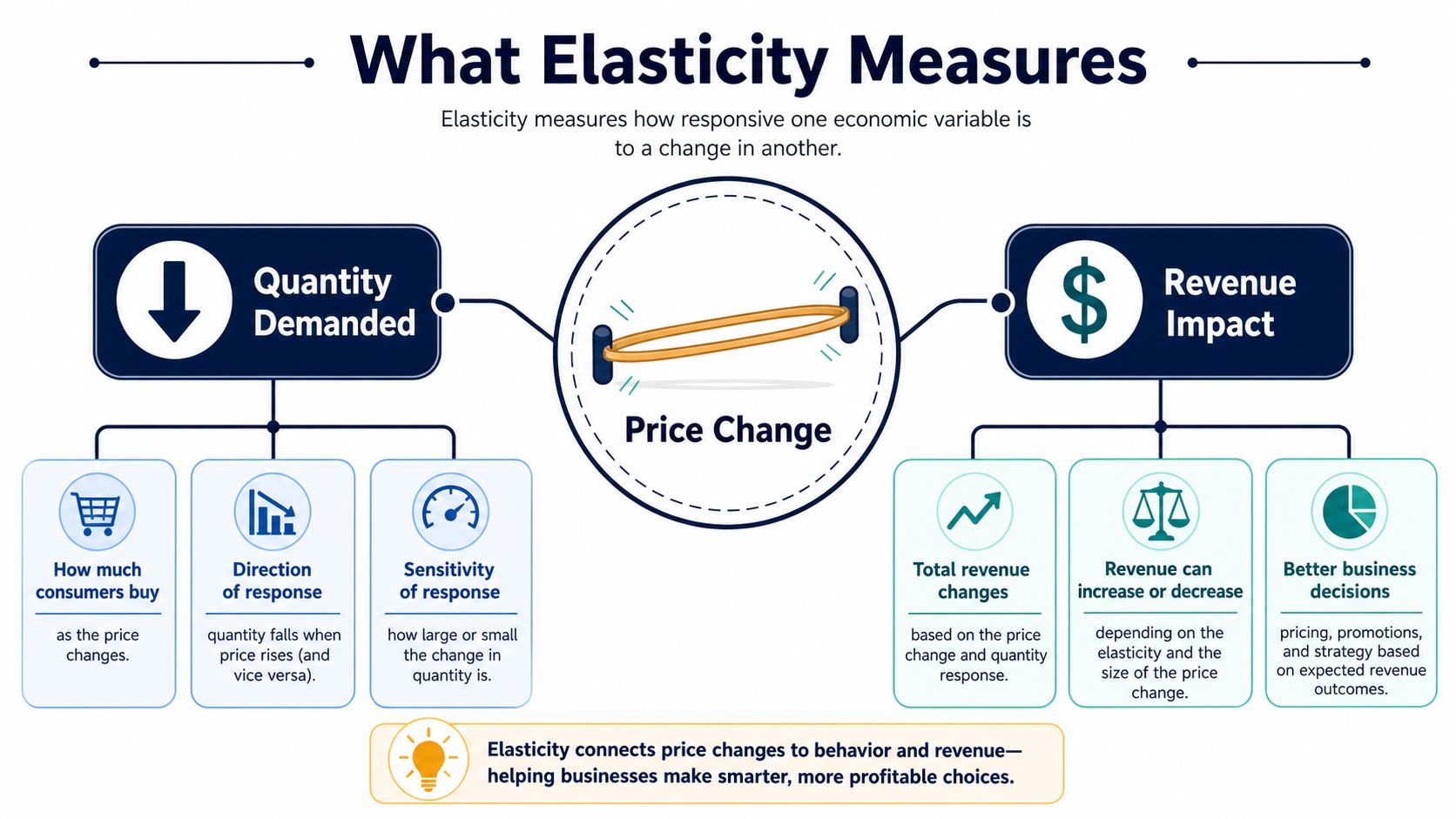
The core formula is simple, percentage change in quantity demanded divided by percentage change in price. If price goes up and units sold fall, the number is usually negative, because demand moved in the opposite direction. A 1% price increase paired with a 2% quantity drop gives an elasticity of -2.0, which means demand is elastic because quantity is moving more than price. That is the kind of signal you want when you are deciding whether a price increase will hold or whether the market will push back.
That coefficient matters because it standardizes comparison. A $15 consumable and a $500 appliance do not live on the same absolute scale, but percentages let you compare how sensitive buyers are in a way that is useful for pricing decisions.
For sellers, elasticity is not a classroom exercise. It tells you whether a price increase might help you more than it hurts you, or whether a discount is likely to pay back in enough volume to justify the margin loss. That is the same underlying logic behind conversion optimization work, where you change one variable and watch how behavior responds. A resource like CRO for B2B growth strategies is relevant even if your business is not B2B, because the pricing question is still the same, how buyers react when the offer changes.
Simple read: if demand moves more than price, your category is sensitive. If demand barely moves, you have more room to test price.
The old-school value of elasticity is that it gives you one common language for pricing decisions. You stop talking about “this feels expensive” and start talking about how buyers respond. That is the difference between guessing and making a pricing move with a real trade-off in mind.
The first mistake sellers make is treating elasticity as one single number that applies the same way everywhere. It doesn't. A product can be elastic, where demand is sensitive to price, or inelastic, where demand barely moves. The important part is that the label depends on buyer behavior, not on your margin target.

A lot of introductory content stops at own-price elasticity, which is how demand for one product changes when that product's own price changes. That's useful, but it's not enough for a catalog business. Public-health economics literature makes the distinction clear, own-price and cross-price elasticity are different, and cross-price effects matter when changing one price shifts demand toward or away from substitutes, bundles, or adjacent SKUs. PMC on own-price and cross-price elasticity
That distinction is huge on Amazon and in omnichannel stacks. If you discount one variation, you might pull demand away from a higher-margin sibling. If you raise a hero SKU, you might push shoppers to a bundle or a near substitute that preserves more total revenue than you expected.
Think in terms of movement, not just unit sales on one line.
Catalog-level insight: the question is rarely, “Did this SKU convert?” It's, “What did this price change do to the rest of the shelf?”
That's why effective pricing teams don't just ask whether demand is elastic or inelastic. They ask where the elasticity is showing up, and which products are winning or losing from the move.
The math is straightforward, but the interpretation is where sellers usually make mistakes. Start with two measurements, the old price and the new price, plus the quantity sold before and after the change. Then calculate the percentage change in quantity demanded and divide it by the percentage change in price.

Say a product moves from $50 to $55, and sales fall by 8%. That yields a price elasticity coefficient of -0.8. The negative sign tells you demand moved against price, and the size tells you the response was relatively muted. In practical terms, that suggests the item is more inelastic than elastic, so a modest price increase may be worth testing if margin is the priority.
If the same math produced a number with a larger magnitude, you'd treat the product differently. You'd be more cautious about price increases and more deliberate about promotions, because buyers are clearly reacting more strongly to price.
A coefficient doesn't tell you why the shift happened. Was it price, a promo, a competitor move, or a seasonal dip? That's why you need to pair the math with the commercial context.
For a useful companion to the measurement side, analyze marketing conversion rates in a structured way so you're not blaming price for what was really a channel or traffic-quality problem. The point isn't to become a statistician, it's to avoid false conclusions.
A generic accessory often behaves differently from a differentiated branded product. Commodity-like items tend to be easier for shoppers to compare, so they usually face more price pressure. A unique, patented, or strongly branded product often has more room to hold price because buyers care about features, trust, or switching friction.
Margin lesson: the more easily a shopper can replace your product, the more carefully you need to treat price changes.
That's the core utility of the formula. It gives you a starting point, then forces you to ask whether the market is reacting to price or to everything around price.
Getting a number is easy. Getting a number you can trust is harder. In practice, the best approach depends on how much control you have over traffic, pricing, and inventory.
Controlled A/B price tests are the cleanest option when you can run them. You expose similar traffic or customer cohorts to different prices, then compare how quantity changes. That's the closest thing to a pricing lab.
Regression analysis on historical sales data works when you have enough clean history. It can help you isolate price from other variables, but only if your inputs are well tracked and your catalog doesn't change too often.
Structured price experiments on Amazon or DTC are the middle ground. You don't need a perfect lab setup, but you do need discipline. Change one thing at a time, keep the test window clear, and avoid mixing in major promos unless you're explicitly modeling them.
Recent practitioner guidance says elasticity models can mislead you without enough price variation and clean controls for seasonality, promotions, and competitor moves. It recommends 3 to 6 months of daily or weekly data, 10 to 15% price variation, and 30 to 50 price-volume observations before trusting the result. Practical elasticity guidance
That's the part most sellers miss. The textbook definition assumes a world where everything else stays constant, but real demand is shaped by multiple moving parts. If your price barely moved, or your promo calendar was noisy, the model can look precise while still being wrong.
For a more technical backdrop on validation, what statistical significance means is worth revisiting before you trust a pricing recommendation.
Rule of thumb: if you can't explain the traffic conditions, promo calendar, and competitor context, don't overstate the certainty of the elasticity number.
The goal is not perfection. It's confidence high enough to make a pricing move without fooling yourself.
Once you know how demand behaves, pricing stops being a blunt instrument. You can use elasticity to decide where to push margin, where to protect volume, and where to use promotions as a strategic lever instead of a reflex.
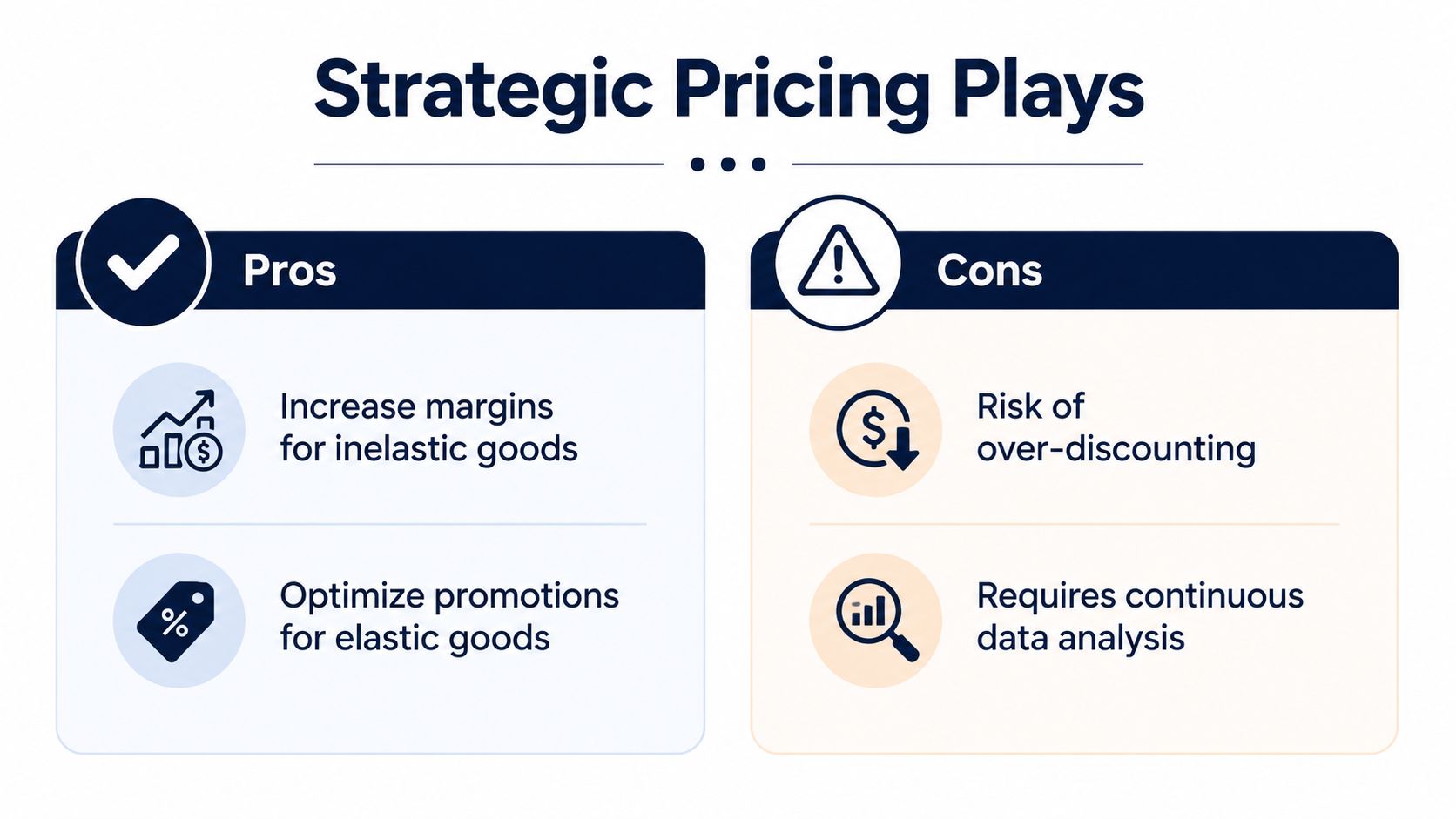
If demand is relatively inelastic, small price increases can be worth testing because buyers are less likely to walk away. That doesn't mean you push prices blindly. It means you look for products where the market has fewer substitutes, stronger brand loyalty, or less day-to-day comparison shopping.
Many sellers leave money on the table. They freeze prices out of fear, even when the demand signal says they have room to move.
If demand is sensitive, you usually don't want to rely on price increases to save the quarter. Instead, use promotions more selectively, tie discounts to clear objectives, and watch the effect on total contribution rather than unit volume alone.
Discounting can work, but only if the extra volume justifies the lower margin. Otherwise, you're just buying revenue at a bad rate.
A price move on one item can help or hurt another. That means bundles, upsells, and complementary products need to be designed together, not in separate silos. If you want a lower-price item to act as a traffic driver, make sure the downstream attach products can absorb the demand.
For a deeper operational angle on margin discipline, how to raise prices without losing customers is the right complement to this thinking. And if you're planning seasonal offers, prepare for Black Friday shopping with elasticity in mind, because seasonal shoppers respond differently than year-round buyers.
Practical takeaway: promotions should move demand where you want it, not just create a temporary spike.
The best pricing teams treat elasticity as a map. It tells them which SKUs can carry more price, which need a softer touch, and which promotions should exist to lift the whole basket instead of a single line.
Price elasticity gives you a better way to think about pricing, but the win comes from using it consistently. First, define the product's demand response. Then separate own-price behavior from cross-price effects so you understand where the change lands. Finally, check whether the estimate is reliable enough to support an actual move.
That discipline connects directly to contribution margin, because a good price is not the highest one you can charge, it's the one that improves the business after volume, discounting, and channel effects are accounted for. Contribution margin basics matter here because elasticity without margin context can still lead you astray.
The strongest operators don't treat pricing as a quarterly project. They treat it as an ongoing loop of testing, reading demand, and adjusting with intent. That's how you protect profit without killing velocity.
If you want to sharpen this skill inside a room of operators who live these decisions every day, visit Million Dollar Sellers. MDS is where serious Amazon, DTC, and omnichannel founders pressure-test pricing, promotions, and margin strategy with peers who've already built at scale.
Join the Ecom Entrepreneur Community for Vetted 7-9 Figure Ecommerce Founders
Learn MoreYou may also like:
Learn more about our special events!
Check Events