Chilat Doina
November 15, 2026
A product can rank, convert and ship for months while being illegal to sell in the market where it's stored. In 2025, Which? tested 15 products sold through online marketplaces including Amazon Marketplace and found that all but one posed serious safety risks; the remaining item failed UK product-safety regulations because it was illegally labelled. A live listing proves you have a payment processor, not a safe product.
Most sellers learn this in the wrong order. They buy inventory, launch, watch the returns come in, then discover the labeling problem, the missing test report or the component nobody checked. By then the money is gone and the stock is sitting in a fulfillment center you can't ship from.
The sequence that works is dull and cheap by comparison. Prove a problem exists, prove the product can legally be sold, prove real buyers keep it, and only then pay for volume. Each step produces evidence that either enables the next one or kills the project while killing it is still affordable.
Skipping evidence doesn't remove risk. It moves the cost. A founder who tests a concept with competitor data and one paid sample spends a few hundred dollars. A founder who skips that step finds out about a compliance problem after the container clears customs, when the purchase order is paid and the pallets need a warehouse.
Four stages cover the path from idea to reorder, and each answers one question with a fixed go signal.
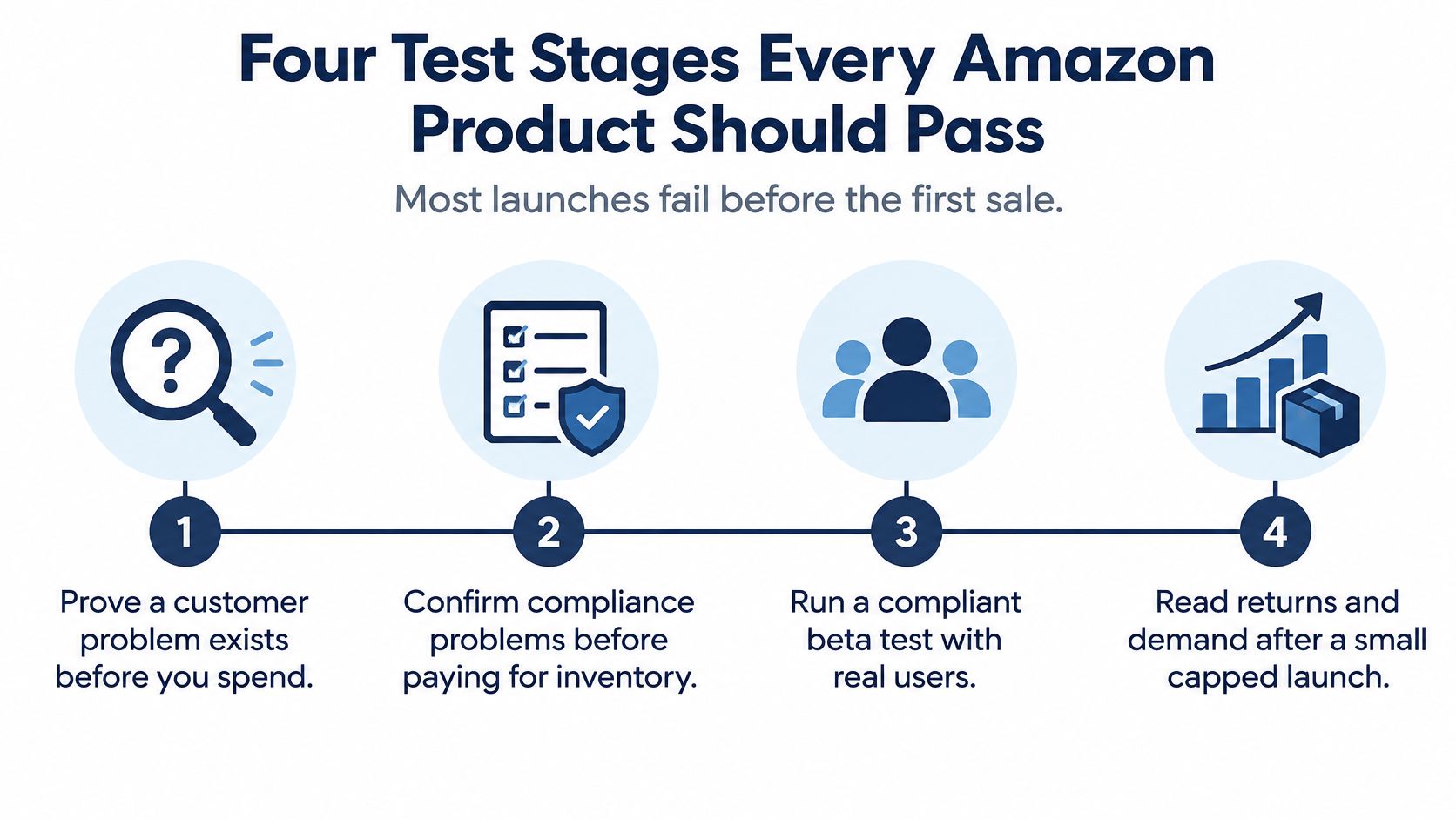
| Stage | Question it answers | Evidence to collect | Go signal |
|---|---|---|---|
| 1. Demand check | Do buyers have a repeated, purchase-relevant problem? | Category demand, review counts, complaint themes | A complaint repeats across competitors and you have a specific fix |
| 2. Compliance gate | Can this product legally sell in the target markets? | Applicable standards, lab reports, labeling, claim evidence | Zero critical safety failures across sampled production lots |
| 3. Limited launch | Do buyers convert, keep the product and report few defects? | Conversion, returns, defect rate, complaint reasons | Returns and defects stay under the limits you set before launch |
| 4. Scale decision | Does the margin survive real costs? | Landed cost, Amazon fees, ad spend, observed return rate | Profit still holds at the return rate you measured |
The stage sellers treat as paperwork is the one that can end the business. Amazon's seller guidance states that products must meet applicable safety standards and documentation requirements, and warns that listings may be deactivated, with seller accounts facing additional action, when products fail those requirements (Amazon Seller Central). No conversion rate compensates for a removal.
Cost of the gate: a lab report and a compliance review cost a fraction of a recall, a removal, or a landed container you can't legally sell.
Demand evidence starts with what buyers already say. A 2019 University of Arizona report that summarized seven studies found review volume was generally more informative for purchase decisions than average star rating, with the benefit of extra reviews fading after roughly 200.
Physical claims need the same discipline. If your copy says a product survives a drop, a dishwasher cycle or a freezer, somebody has to document that under repeatable conditions. ROCKS Whiskey Chilling Stones' product durability testing shows how a barware brand turns a durability claim into a documented test instead of an adjective.
Before you start, write four things down:
By the end of this piece you should be able to name which of the four stages your product sits in, and which piece of evidence is still missing.
Before you pay for a sample, the market tells you most of what you need for free. Take one niche and read it properly rather than skimming star ratings.
Say you sell or plan to sell insulated stainless steel water bottles. A single afternoon of reading the category tells you whether there's a fixable complaint or just a crowded shelf.
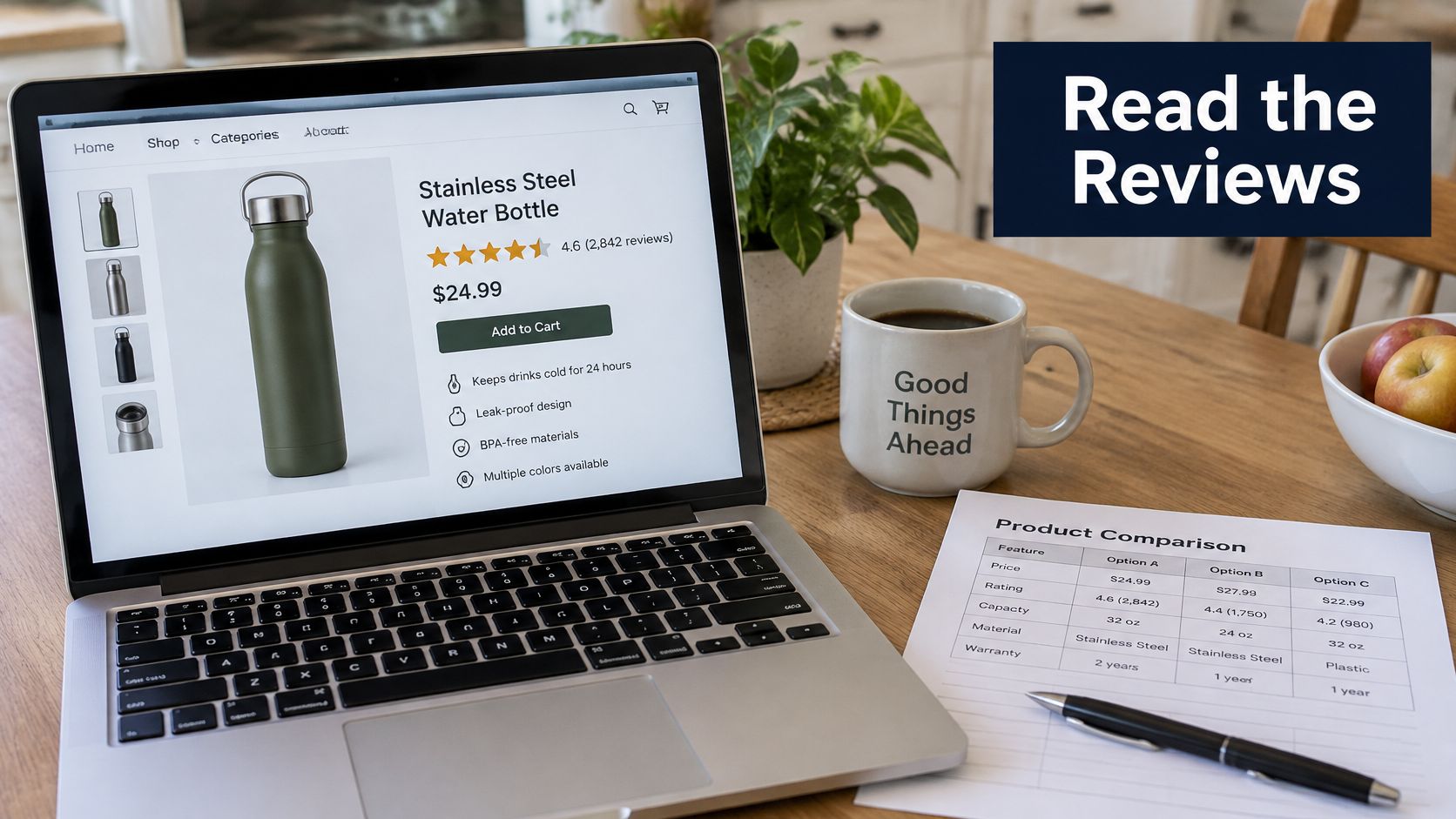
The strongest demand signal in that spreadsheet isn't the total review count. It's a complaint that appears in multiple listings, mentions a consequence the buyer cares about, and maps to a change you can engineer and test.
"We wish it came in more colors" fails all three tests. It's easy for a competitor to copy, it doesn't stop a purchase, and it proves nothing about your product.
A complaint counts as an opportunity only when it repeats across competitors, it's important enough to change a purchase, and your fix is something you can build and prove.
Go when you can name the repeated complaint, the specific design change and the test that would prove the change worked. Stop when the only differentiator left is price, because that contest is settled by whoever has the cheapest factory, and it isn't you.
Compliance isn't a document you buy at the end. It's a mapping exercise you do before the first purchase order. Start by writing down the destination markets, the exact claims you'll make, the risk class of the product and the mandatory standards that apply in each market.
Convert that into a written test matrix so nothing gets skipped by accident.
| Test area | What it checks | When to run |
|---|---|---|
| Chemical composition | Restricted substances in materials and coatings | Before the first production order |
| Mechanical and physical use | Durability under normal use and worst-case use | Prototype stage and on every new production lot |
| Flammability | Burn behavior where the applicable standard requires it | Before the first production order and after any material change |
| Labeling | Mandatory warnings, language and claims match the evidence | Before listing and before each packaging change |
| Packaging and shipping | Damage and leakage in transit | Before inventory is sent to Amazon fulfillment |
| Foreseeable misuse | Failures from use the buyer will not read about in the manual | Prototype stage, then repeated after any supplier change |
Amazon reports using independent ISO/IEC 17025-accredited laboratories and, depending on category and region, conducting as many as 180 safety, regulatory-compliance and quality tests while verifying up to 250 requirements (Amazon). That's the standard a private-label first order is measured against in practice.
The pitfall is treating a passing prototype as proof of production consistency. Supplier process drift, substituted materials and incomplete regional labeling all create failures after launch, and none of them show up in a single good sample. Independent Consumer Reports research found prohibited or potentially risky products available on major marketplaces, including Amazon, which is the clearest evidence that a live listing is not a safety review.
Labeling is where the cheapest mistake lives, because a missing warning or an undisclosed chemical turns a compliant product into a violation in one state. This guide to avoiding Prop 65 listing violations walks through the disclosure logic before you print cartons.
Keep lab reports, chain-of-custody records, calibration details and version-controlled claims in one folder with dates. When a complaint, a compliance review or a recall question lands two years later, that folder is the difference between a fast answer and a stranded SKU.
Amazon's review rules shape your beta test before you write a single recruiting message. Amazon prohibits compensation or incentives, including refunds, discounts, products, gift cards, warranties or services, in exchange for creating, changing or removing a review (Amazon review policies). Free units for honest reviews are out, and so is every dressed-up version of the same trade.
That's not a problem if you stop treating the beta as a review pipeline. Run it as product research and the rules stop mattering.
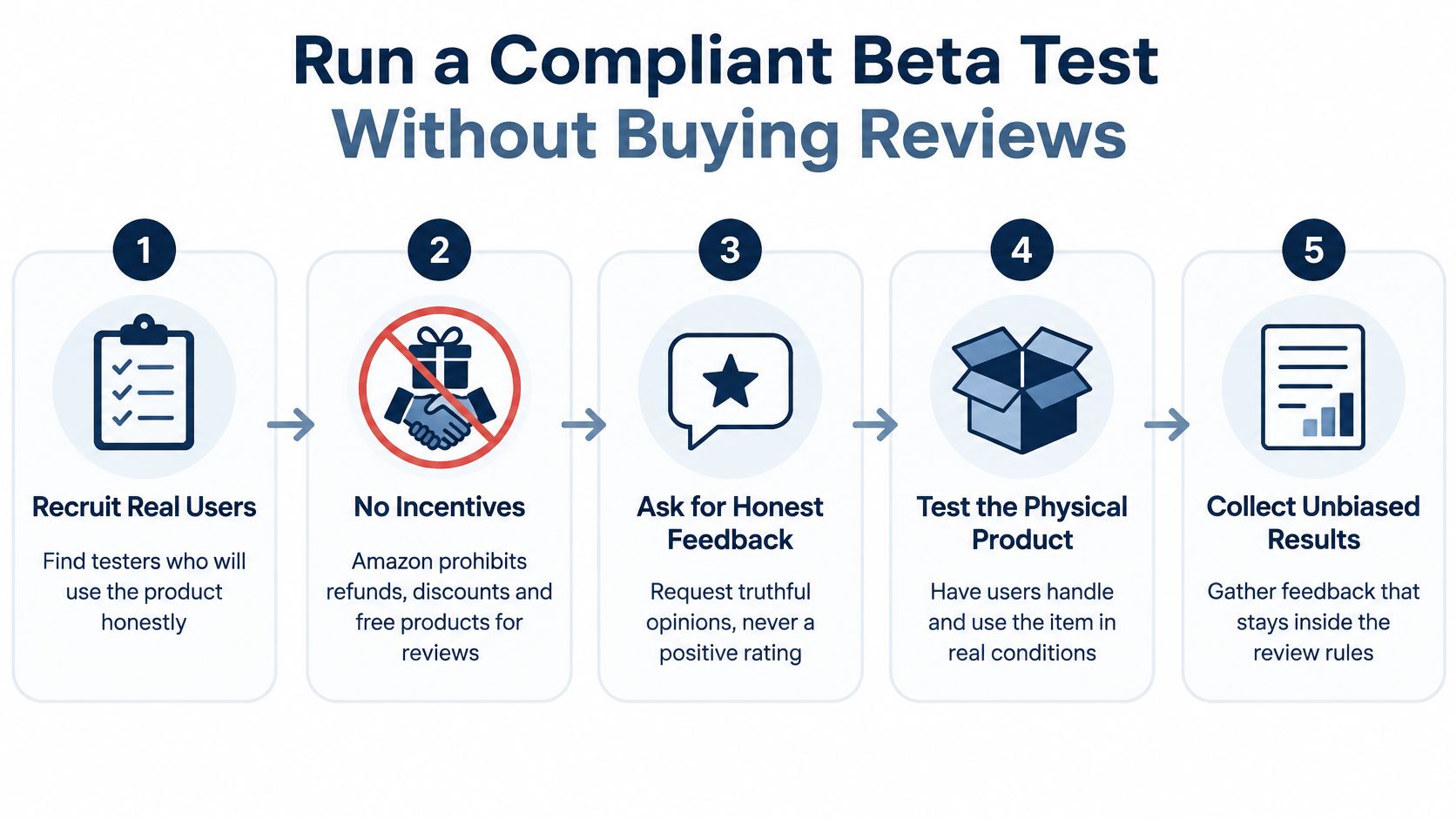
Keep beta feedback entirely separate from any Amazon review request, because a test that produces a review is a test with a different incentive structure. If you want reviews at launch, use the program built for it: the Amazon Vine program for sellers is the legitimate route and it answers a different question than a beta test does.
Then separate a defect from an expectation gap. A defect repeats across testers and across batches: the same hinge fails, the same seal leaks. An expectation gap appears when the product works exactly as designed but the listing promised something it never did, usually because the copy was written by someone optimistically.
Set the tester count before you start. Decide how many testers and how many uses per tester in advance, so one enthusiastic participant, or one furious one, can't decide the outcome.
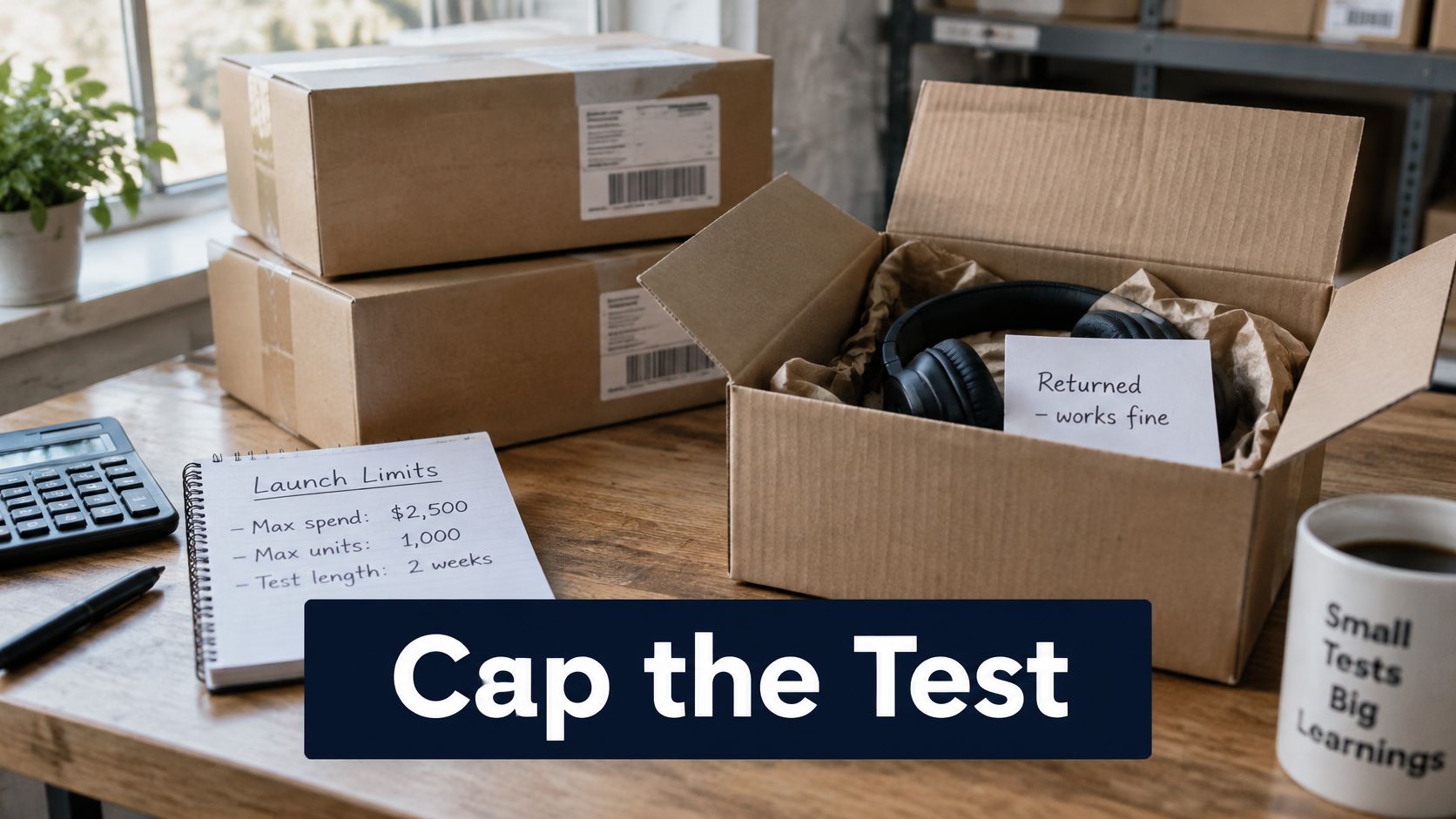
Write the fail conditions before the launch, not after you've seen the numbers. That means a capped test budget, a fixed inventory quantity held back from the full order, a launch window long enough to collect your planned sample, and thresholds in advance: a ceiling on one-star share and a return rate that still leaves contribution margin positive.
A limited launch turns your warehouse into a laboratory, provided somebody writes the readings down.
| Signal | What it usually means | Next action |
|---|---|---|
| One-star share above your pre-set ceiling | Possible product defect or expectation gap | Code the one-star reviews by theme before changing anything |
| Defect complaints repeat across production lots | Supplier or production problem | Pause the affected lot and run the compliance retest |
| Returns cluster on a single reason | Fixable design or listing issue | Test one change in the next lot |
| Ratings drop abruptly with similar review wording | Possible manipulation or one-off event | Investigate and hold any product change |
Structured coding of review text flags repeated failure modes, such as a loose hinge or a sizing mismatch, faster than reading every review by hand. Keep automated classifiers as screening tools only. A review-analysis paper in the RePEc AgEcon working paper series reported 94% accuracy and a 98% AUC for a Random Forest model classifying helpful reviews across six categories, and 85% accuracy, 97% recall and 79% AUC for fake-review detection in Toys and Games; the same paper cites PNAS work on roughly 1,500 products tied to suspected fake-review markets, where timing gaps, one- and five-star proportions, helpful-vote ratios, image presence, review-length variation and text similarity were useful signals. Those results belong to specific categories and specific models, not to your niche.
Split every metric by production lot and by customer cohort. An average that blends a good batch and a bad batch hides the only information you needed, and it stays hidden until returns climb in month four.
Watch for the three traps: survivorship bias from reading only the reviews that got posted, correlation mistaken for cause when a rating dip coincides with a price change, and chasing rating inflation instead of fixing the defect the returns are pointing at.
The rule that saves money: change the product when returns or your own production lots confirm a defect, not because one cluster of reviews agrees with itself.
A product can sell through a small launch and still be a bad inventory buy. The decision is whether the unit economics survive the return rate, defect rate and fees you measured.
Say a product lands at $9 a unit, sells at $29.99, and after Amazon fees and ad spend clears $6 at a 5 percent return rate. At 15 percent returns the same unit clears close to nothing once you absorb returned shipping and unsellable stock. Demand can look fine while the margin is already gone. Track it as contribution margin per unit rather than gross margin, because gross margin hides the fees that scale with every order.
| Outcome | Conditions | Next action |
|---|---|---|
| Scale | Demand and returns inside limits, sampled lots pass, margin holds at the measured return rate | Reorder in the tested quantity |
| Fix | Defect is specific, repairable and retestable | Change one variable, retest the affected lots and run a second small launch |
| Drop | Unresolvable safety or compliance failure, or margin gone at real costs | Stop orders and clear remaining inventory |
Fix is the most misused of the three. It applies when the defect is narrow enough to name, tie to one input and retest in the affected lots. A change that cannot be described in one sentence is a guess with a purchase order attached.
Drop is the hardest to say out loud and often the cheapest decision. An unresolved compliance failure ends the test. A margin that evaporates at real costs will not be rescued by better ads.
Put a date on the decision. Before that date, write the three numbers you will judge the product against, such as return rate, one-star share and contribution margin per unit, and name the single choice you will make on that date. If a number is still missing when the date arrives, treat the missing evidence as a no.
For founders who want that decision pressure-tested by peers, Million Dollar Sellers is an invite-only community of top e-commerce founders built around a peer network, mastermind calls and private forums. Membership carries a 60-day risk-free guarantee, with a full refund if you do not find value. Learn more at Million Dollar Sellers.
Join the Ecommerce Community for Founders Scaling from 7 to 9 Figures
Learn MoreYou may also like:
Learn more about our events!
Check Events