Chilat Doina
July 30, 2026
95% of new products fail before they ever become real businesses, which is why new product development isn't a creativity problem. It's a filtering problem. The brands that win aren't the ones that brainstorm the most ideas, they're the ones that kill bad ideas early, protect margin, and keep iterating after launch.
Most founders still treat launch like the finish line. That's backwards. Launch is halfway, and the actual work begins when customers touch the product, reviews start coming in, and the unit economics either hold or collapse.
The ugly truth is that most new product development pipelines are built to produce motion, not judgment. A team gets excited about a concept, everyone starts polishing decks, and nobody wants to be the person who says the idea should die. That's how you burn time, cash, and attention on products that never had a real path to market.
The historical benchmark is brutal. Roughly 30,000 new products are launched each year, yet about 95% fail to achieve meaningful commercial success, a pattern tied to Clayton Christensen's work and repeated in later industry summaries. More granular benchmarks point the same way, including a funnel where only 2 of every 58 product ideas reach commercialization and only 1 becomes a success, plus a sample where 21.9% of developed products were killed before launch, 18.7% became commercial failures, and 59.4% were successful, according to the new product development statistics summary.
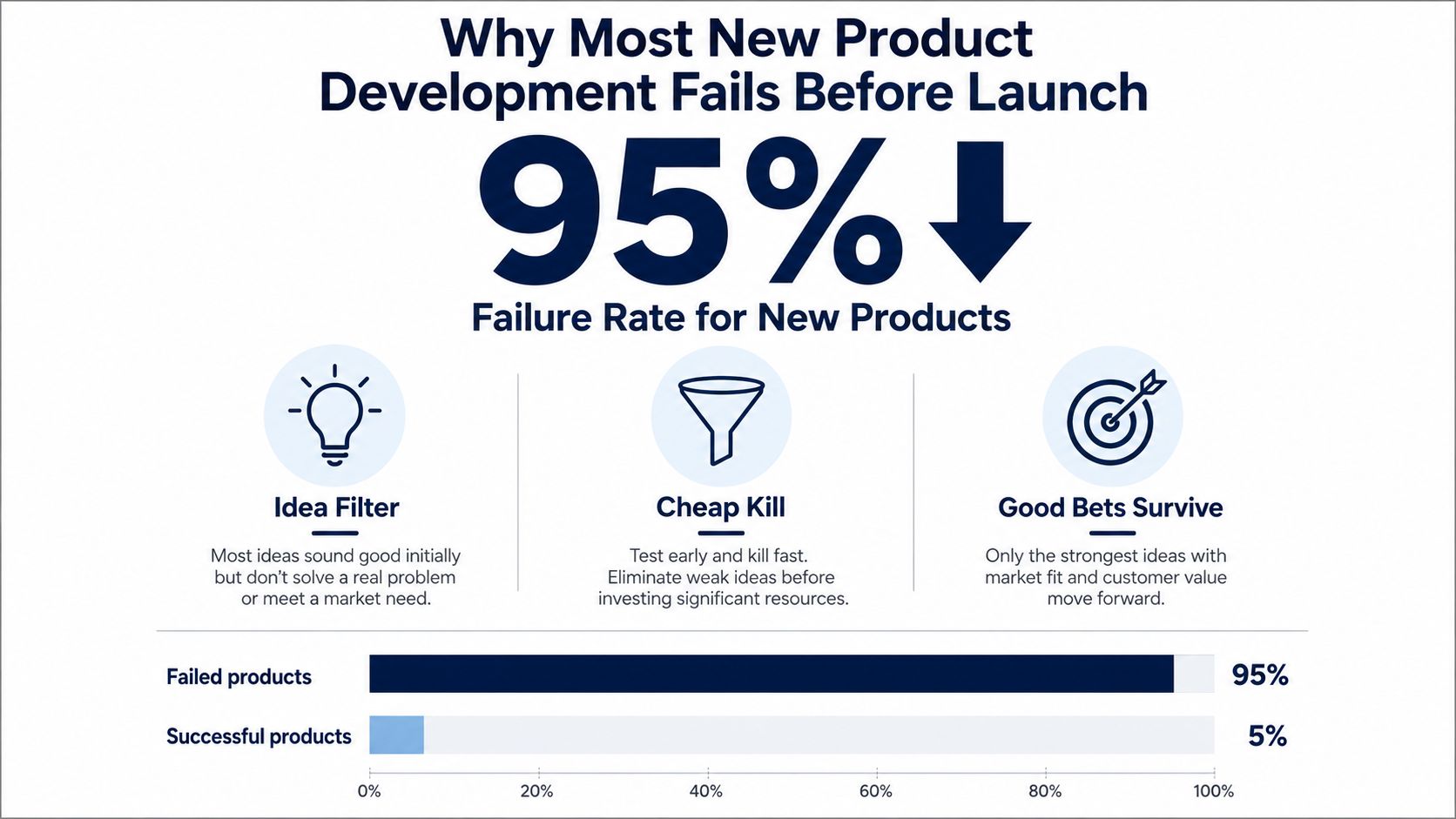
Killing a bad idea early is cheap. Launching a dud means you pay for inventory, freight, ads, returns, and reputation.
A lot of founders confuse a big market with a good product. They're not the same thing. You need to test demand signals, competition density, margin headroom, and brand fit before you spend a dollar on tooling or creative.
Use category-level data to understand the broad demand shape, then switch to niche-level data to judge whether your specific angle has room to win. A huge TAM is useless if your realistic serviceable revenue is tiny because the niche is crowded, the price ceiling is low, or the product doesn't fit your brand. That's the mistake. Founders chase the total market size and ignore whether they can serve it profitably.
A simple scoring template keeps emotion out of the room:
Add the scores, then set a cutoff before the meeting. If the total doesn't clear the threshold, kill it. Don't “revisit later” unless new evidence shows up. That discipline is the cheapest point of advantage in the entire process.
If you want a practical framework for separating real opportunity from wishful thinking, the Amazon playbook by Cosmy is a useful companion for understanding how marketplace economics shape product selection.
Validation is where many teams lie to themselves. They collect likes, clicks, and vague praise, then call it demand. Real validation means someone took a meaningful action that costs them something, even if it's only attention or time.
On DTC, the strongest early test is usually a pre-order or an email capture tied to a landing page with a specific promise. On Amazon, you care less about applause and more about whether shoppers are searching for the exact terms you want to own. The same product can look hot in one channel and dead in another.
For DTC, run smoke-test ads to a landing page, then watch whether people move past curiosity. If the page gets clicks but nobody starts checkout or joins the waitlist, the idea is entertainment, not demand. A concierge test works well too, especially when the product needs explanation. Sell the promise manually, collect objections, and see whether anyone still wants it.
For Amazon, search-term research and keyword relevance matter more than flashy creative. You're checking whether the market already uses the words you plan to rank for, because that tells you if the demand already exists in a form you can capture. The internal guide on market research for products is a useful reference if you need a cleaner way to structure that work.
A founder mistake I see constantly is treating traffic as intent. Traffic is only curiosity until the buyer does something costly, like pre-ordering, opting in, or entering a search path that aligns with purchase behavior.
If the channel doesn't match the test, the test is junk.
I've watched founders overcomplicate sourcing because they assume there's one “right” path. There isn't. The right move depends on whether you're launching on Amazon FBA, building a DTC brand, or trying to do both without blowing up cash flow.
A representative Amazon launch usually pushes toward lower-cost tooling, tighter specs, and faster iteration on packaging and listing content. DTC often demands more design polish, stronger unboxing, and a product story that can carry the brand. Those differences change the prototype, the supplier conversation, and the minimum acceptable sample quality.
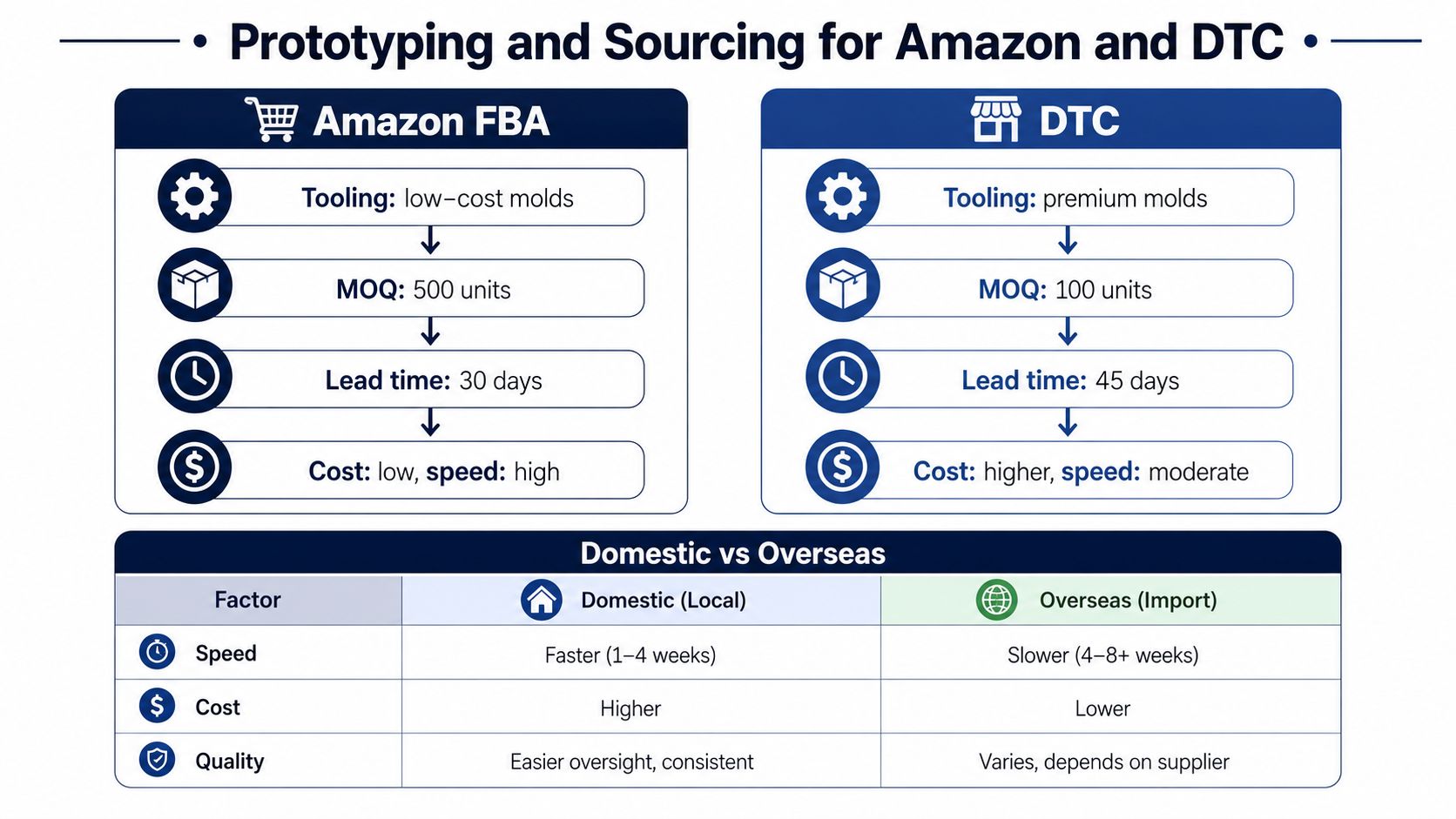
If speed matters more than craftsmanship, domestic manufacturing can shorten the loop because you're closer to the factory and samples move faster. If cost and scale matter more, overseas sourcing can make more sense, but you need patience and tighter quality control. The brief here is clear, overseas programs are commonly described as taking 8 to 16 weeks, so don't pretend you're moving fast if you chose that route.
Sourcing agents help when you need factory access, translation, or supplier vetting across a category you don't know well. Direct factory relationships are better once you've proven volume and know exactly what to ask for. Either way, you need a golden sample, which is the approved reference point every later unit should match.
The internal sourcing guide at what is product sourcing is worth reading if your team needs a cleaner mental model for how sourcing decisions affect launch speed and quality.
Don't treat the first prototype like a final product. Use it to expose what breaks, what feels cheap, and what needs to change before you approve tooling. Then keep the sample chain tight, one working sample, one approved golden sample, and one file trail that documents every change.
That discipline matters more than the shiny part of the process. A product that looks good in a photo but feels wrong in the hand will cost you more later than it saved upfront.
A product can win on demand and still lose money. That's not a design problem. It's a unit economics problem, and too many founders wait until after launch to find out they were underwater from day one.
You need a line-by-line model before you place the order. The internal guide on how to calculate product costs is a good companion, but the core logic is simple, price minus every real cost equals what's left to scale or lose.
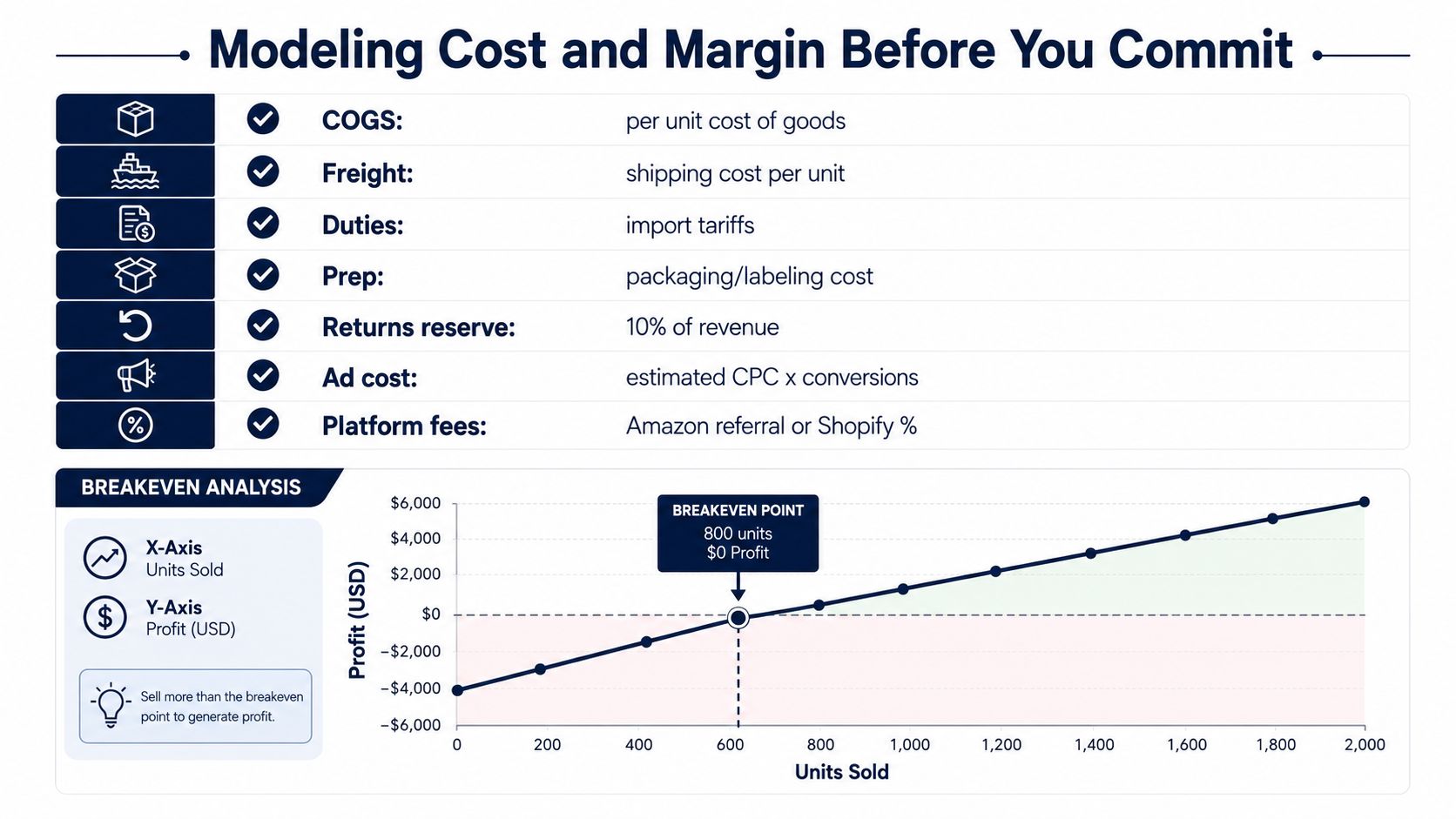
Start with COGS, then add freight, duties, prep, returns reserve, ad cost, and platform fees. If you ignore any one of those, your spreadsheet is fiction. A product that looks profitable before ads and returns can fall apart the first time you hit actual traffic.
Here's the model founders should use:
If your margin only works when everything goes perfectly, it doesn't work.
Then calculate breakeven by asking how many units you need to sell before fixed and variable costs are covered. If the answer depends on fantasy-level conversion or heroic ad efficiency, kill the product. Don't “test and hope.” A bad model doesn't become good because you launched anyway.
Margin protection starts before the product ships. Use pre-shipment inspections to catch defects before they become customer complaints. Use AQL sampling when you need a measurable quality standard on the batch. Run packaging drop tests if shipping damage is a realistic risk.
Compliance comes next, and it changes by category. Some products need CPSIA, FCC, or FDA documentation depending on what they are and where they're sold. For regulated categories, third-party lab testing is the safer play. Factory self-certification is not enough when the category, platform review, or customer safety risk is high.
Keep every document that could matter later, test reports, inspection notes, golden sample approvals, and packaging specs. If Amazon flags your listing or a customer files a complaint, that paper trail is your defense.
Launch is execution work, not strategy work. If the concept, margin model, and sourcing are weak, no amount of listing polish will save you. Amazon and DTC still need different launch motions, and mixing them into one generic checklist is how teams burn the first month.
On Amazon, the listing has to be built around search. On DTC, the page has to sell the story. Those are different jobs, and each one needs its own sequence.
For Amazon, build the keyword-indexed listing first, then add A+ content so the page explains the product after the shopper lands. Use Vine or early reviews to establish social proof, then spend the first month on a controlled PPC ramp. The goal is to buy data, earn rank relevance, and find which terms deserve more budget.
For DTC, start with the storefront and landing page, then test creative angles that make the offer obvious in a few seconds. Seed influencers if the category benefits from social proof, and use email capture so you are not paying to reacquire the same attention later. If you want a practical reference for how presentation affects conversion without a full photo shoot, ai model outfit e-commerce is a useful example.
The launch content should still be grounded in the product sourcing guide and the decisions behind it, because a polished listing cannot fix weak prep, vague positioning, or sloppy follow-through.
The first version of your launch creative should answer one question, why this product, why now, and why from you. If the answer is fuzzy, ad spend will expose it fast. That is useful. It saves you from pretending the market likes an angle that only worked in the room.
Use launch to learn which promise moves the buyer. Do not assume the version you liked internally is the version the market wants. The market rewards clarity, not taste.
Most founders think scaling means spending more. It doesn't. Scaling means proving the product can absorb more attention without breaking margin, quality, or brand trust.
The first thing I watch after launch is review velocity. If customers are leaving reviews without you begging for them, the product has organic pull. If not, don't hide behind ad reports. The product may still be too weak, too niche, or too hard to explain.
Search rank matters too, but only as a sign that the listing and offer are gaining traction in the market you chose. Spend more on ads when the product is converting and the search position is improving for the terms that matter. If the ranking isn't moving, more spend usually just buys expensive noise.
Returns tell you whether the product is good. A rising return pattern should trigger a redesign, not a creative refresh. The creative can fix misunderstanding. It can't fix a product that disappoints customers in the hand.
New creative is for messaging problems. Redesign is for product problems.
A weak variant doesn't deserve endless optimization. If the issue is a bad angle, retest it with new creative and a cleaner offer. If the issue is core product performance, cut it and move on. Founders waste months defending variants that should have been killed in week two.
The cleanest operating model is simple. The founder owns the kill decision. A fractional product manager can run the calendar and keep the work moving. A sourcing agent can take over factory coordination when supply chain complexity rises. Agencies can handle creative, paid media, or Amazon support, but they should never own the final call on whether the product survives.
The parts you should not outsource are the customer judgment calls. You can delegate inspections, listing ops, and ad management. You should not delegate the decision to double down on a product with bad economics or poor customer response.
That's where small teams get into trouble. They confuse activity with conviction. A clean post-launch loop looks like this, collect feedback, inspect quality, adjust the offer, then decide whether the next dollar goes into scaling, redesigning, or killing the variant. Anything looser than that turns into expensive drift.
The best ecommerce teams do not win by moving fastest at launch. They win by being ruthless before launch, when the product is still cheap to change and easy to kill. Ideation and validation should move slowly, on purpose. Once the numbers and customer signals line up, execution should turn aggressive.
That discipline matters because the failure rate in new product development is brutal, as noted in the new product development statistics summary. The edge comes from killing bad bets early, not from piling up ideas in a brainstorming session. Write the kill threshold down. Set a margin floor you will not cross. Put the 30-day post-launch review on the calendar before the product ships.

Front-end rigor is becoming harder to ignore because buyers care more about sustainability, traceability, and compliance than they used to. Brands that build that discipline into new product development now will waste less, return less, and scale with fewer surprises. The product teams that treat launch as the halfway point, then run tight kill criteria, margin checks, and iteration loops after launch, will beat the teams that only optimize for a pretty rollout.
Join the Ecom Entrepreneur Community for Vetted 7-9 Figure Ecommerce Founders
Learn MoreYou may also like:
Learn more about our special events!
Check Events