Chilat Doina
November 2, 2026
Omnichannel customers made up 73% of shoppers in the 2017 Harvard Business Review analysis of 46,000 customers at a major U.S. retailer, and they spent more than single-channel shoppers both in store and online. That doesn't mean every new door makes you money. Adding Amazon, a brand site, TikTok Shop, wholesale, and a store gives you five ways to promise the same unit, five fee structures, and five places for a return to land.
A sound omnichannel business strategy is selective. It connects the journeys customers use, pools the inventory behind them, and gates expensive convenience where lifetime value can't cover fulfillment, returns, fees, service, and acquisition. If you can't show the contribution margin for a promise by segment, product, and geography, you're not running a strategy. You're subsidizing convenience and calling it growth.
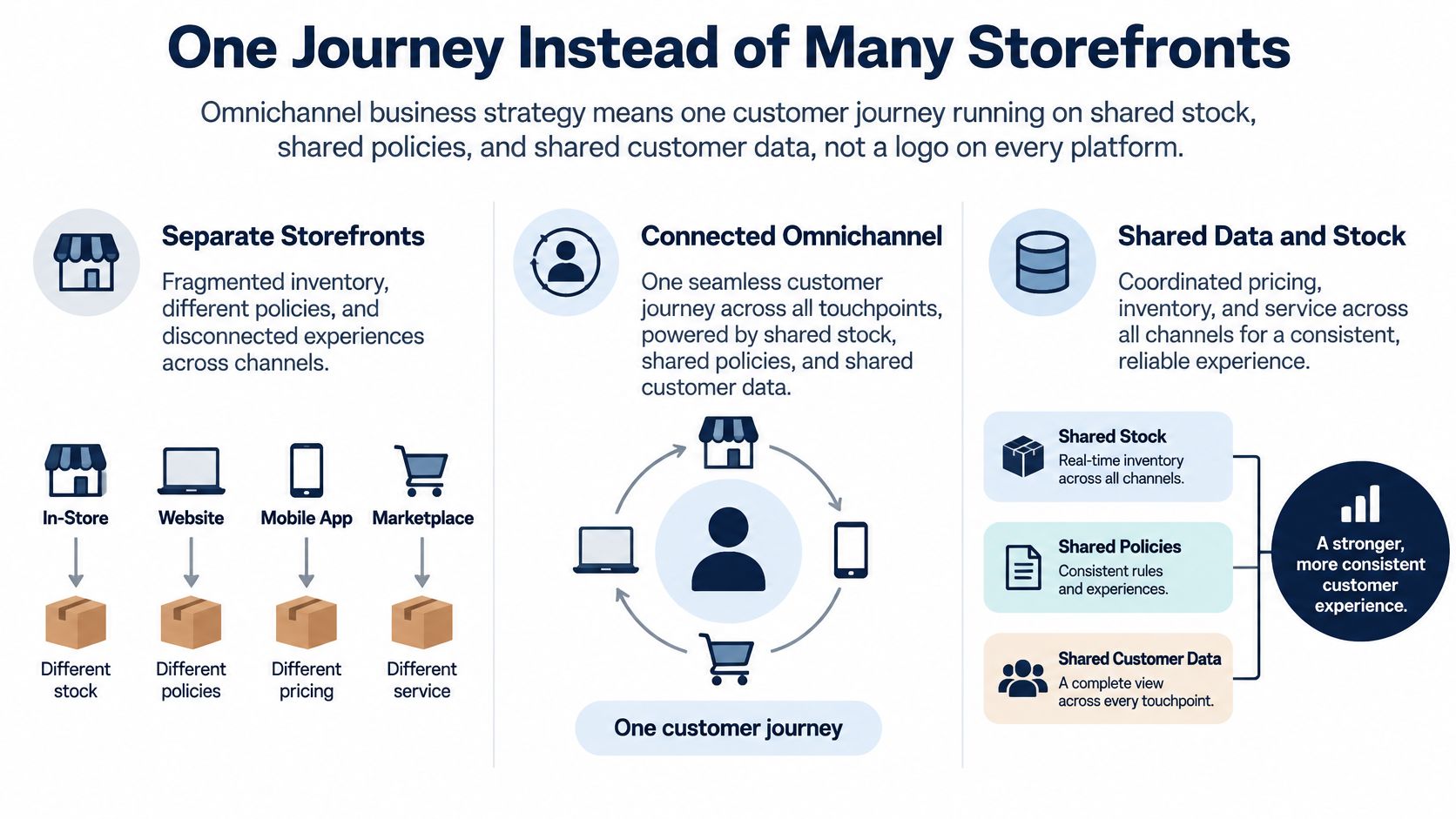
Multichannel is several shops with their own cash registers. Omnichannel is one back room feeding every counter. That distinction decides whether the customer has to start over at each door.
Single-channel selling keeps things simple. One storefront, one stock file, one set of policies, and a P&L you can read without allocating costs across a maze. The trade-off is capped reach, because customers who discover you somewhere else have no connected path to buy, collect, or return.
Multichannel selling adds doors without connecting them. Amazon holds one pile of stock, your site holds another, and a wholesale partner works from a spreadsheet. Prices drift, return windows differ, and support asks the customer to repeat an order number another team already has. Each channel can look healthy on its own dashboard while the customer experiences three unrelated businesses.
An omnichannel model remembers both the person and the unit. Stock, pricing bands, shipping thresholds, return rules, and service history travel with the order, so discovery on one channel can finish on another without a fresh explanation. If you want the support side built properly, Carti's guide to omnichannel support is a useful place to see how those conversations should carry context instead of restarting.
Being live everywhere proves very little. A 2022 comparative study of clothing, furniture, and grocery businesses, available through the Harvard Business School Publishing product page, evaluated businesses using 27 channel-related indicators and 9 digital-transformation indicators. Clothing scored 58.5 out of 100, grocery scored 48.5, and furniture scored 47, leaving clothing 11.5 points above furniture and 10 points above grocery.
Earlier industry evidence cited in that research indicated that approximately 80% of e-tailers offered more than one delivery option and 62% offered more than one return option, yet actual adoption of multiple delivery and return choices varied by product category. Options on a policy page aren't the same as integrated logistics, customer data, delivery, and returns.
Run this test this week. Start a return through a marketplace, then ask whether DTC support can see it, whether the store knows what the site promised, and whether finance can assign the cost to the right journey.
If the answer to any part is no, you have storefronts, not one journey.
The Harvard Business Review analysis of 46,000 customers at a major U.S. retailer put hard numbers behind the prize. Only 7% were online-only shoppers and 20% were store-only shoppers, while 73% used multiple channels. Omnichannel shoppers weren't an interesting minority at the edge of the business. They were the business.
They also spent more. Compared with single-channel shoppers, omnichannel customers spent an average of 4% more during each in-store shopping occasion and 10% more online. Customers who used four or more channels spent 9% more in stores than customers who used only one channel. Within six months of an omnichannel shopping experience, customers had made 23% more repeat visits to the retailer's stores than single-channel customers.
| Shopper group | Share of customers | Spending or repeat effect |
|---|---|---|
| Online only | 7% | Single-channel baseline |
| Store only | 20% | Single-channel baseline |
| Multiple channels | 73% | 4% more per store trip and 10% more online |
| Four or more channels | Included in the multiple-channel group | 9% more in stores than one-channel shoppers |
| Repeat store visits within six months | Multiple-channel shoppers | 23% more visits than single-channel shoppers |
Think of the journey as a relay race. Discovery hands the customer to research, research hands them to purchase, purchase hands them to fulfillment, and fulfillment hands them to the next order. The lift appears when the baton, meaning identity, product information, price, stock, and service context, doesn't hit the ground between runners.
That's why a new TikTok Shop or wholesale door doesn't create this result by itself. A disconnected channel adds reach, fees, content work, and operational exceptions, but it doesn't automatically make an existing customer browse more, trust the promise, visit again, or build a bigger basket. The connection creates the behavior. The door is only an entry point.
You need to know which shoppers produce repeat value before you decide how much convenience they should get for free. A clear customer lifetime value calculation gives you the ceiling for that decision, because a small spend lift can disappear quickly once you add expedited shipping, split shipments, marketplace fees, or an avoidable return.
Practical rule: Don't count the revenue lift from a connected journey until you've subtracted the full cost of keeping that journey connected.
The work ahead is deciding which connections earn their keep. A shared return rule might encourage repeat purchases at modest cost. Same-day delivery might produce the same order you would have won anyway, only with a courier bill attached. Both look like omnichannel progress in a launch announcement, but they have opposite effects on contribution margin.
Don't launch every service because a competitor's homepage lists it. Sequence the work so each connection has clean data, an owner, and a margin test before you add another promise.
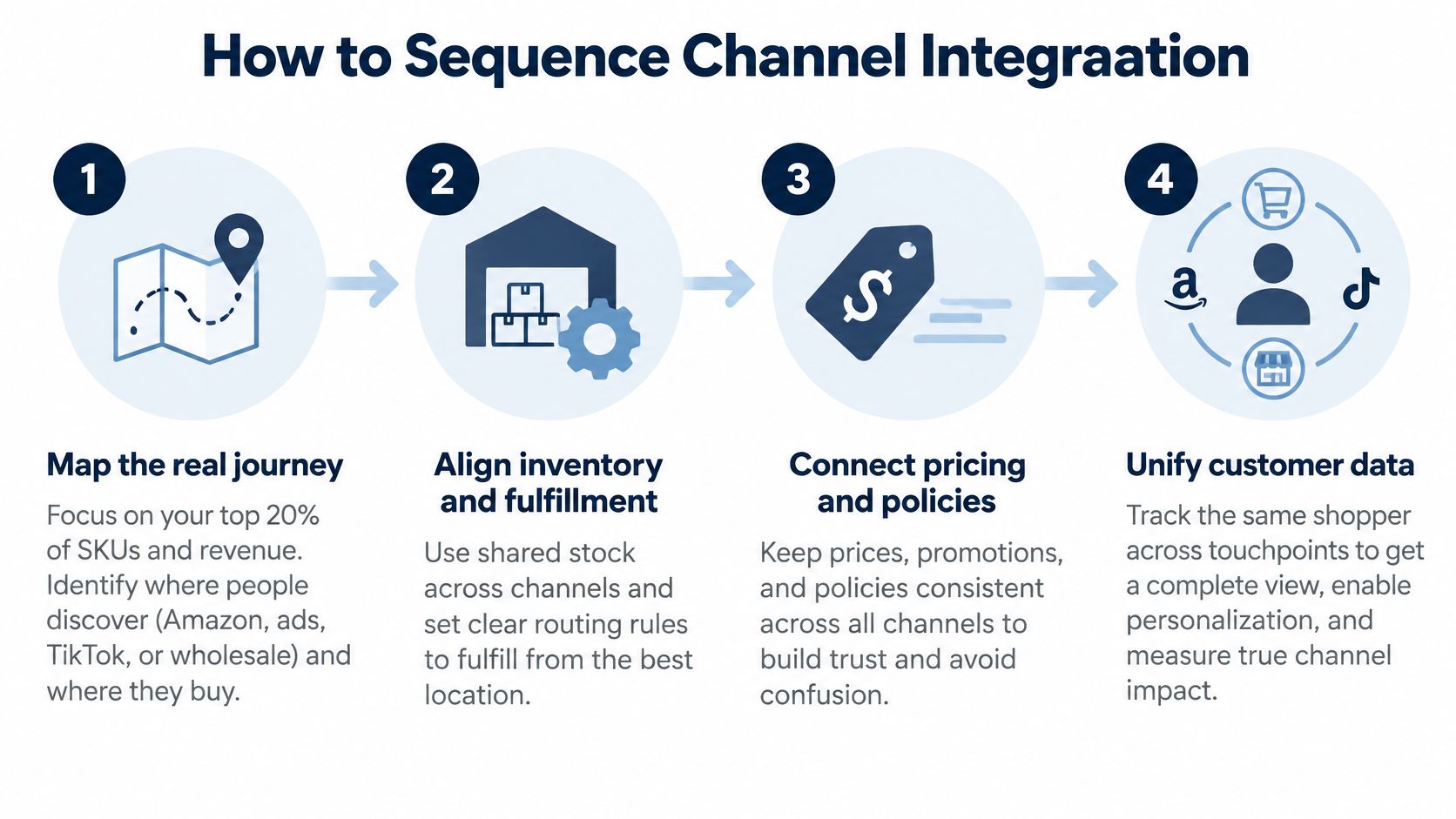
Map the actual journey for your highest-value products. Start with the SKUs and customers driving the bulk of revenue. Mark where people discover the product, whether that's Amazon search, paid social, TikTok, retail shelves, or Google, then follow them through purchase, delivery, support, return, and replenishment. Use order data, support tickets, return reasons, and post-purchase surveys. Don't map the journey your org chart wishes existed.
Pick one hero connection. Choose the single handoff that removes the most friction for the most valuable customers. For a brand with stores, that may be buy online and pick up in store. For a marketplace-led brand, it may be one shared return rule that support can honor regardless of where the order started. I would pick one connection, staff it properly, and make it boringly reliable before adding another.
Unify the promise. Align price bands, shipping thresholds, delivery windows, promotions, and return periods so a support agent can explain the rule in one sentence. Consistency doesn't require identical prices everywhere, but differences need a deliberate reason, such as a marketplace bundle or a subscriber price, not stale feeds and forgotten coupon codes.
Build one channel-neutral inventory view. Every channel should read from the same available stock, with reservations for pending orders and clear rules for damaged, returned, and in-transit units. Adding nodes before this view works multiplies errors. If you don't know how stale the feed from a store or 3PL is, you don't know whether the unit you're selling exists.
Route each order against cost and the promise. Send the order to the node that can meet the delivery commitment at the best contribution margin, not the closest building or the channel that captured the sale. Then review the result by customer segment, product, and region after a full operating cycle. A connection that wins in dense metro areas may lose money where carrier zones and return distances stretch.
Add another channel only after the review. The next door should inherit working inventory, policy, service, and reporting rules. If the current connection can't survive peak volume or produces negative contribution, a new channel will scale the problem and give it a fresh audience.
A marketplace-led brand shouldn't clone its Amazon offer onto DTC. If referral fees, fulfillment fees, and advertising have already compressed margin on Amazon, matching every marketplace coupon on your own site trains customers to expect a price your economics can't support. Let Amazon do the discovery and first purchase job it's good at. Let your site own subscriptions, bundles, refills, education, and pack sizes that improve margin or repeat rate.
That same logic applies before opening a store or TikTok Shop. If inventory latency is unknown, a creator-driven spike can oversell units already promised to Amazon and your site. You'll pay for cancellations, expedited transfers, support contacts, and disappointed customers while the sales dashboard briefly looks exciting.
A workable year has a plain shape. Spend the first quarter on journey data, policy cleanup, and inventory accuracy. Use the second quarter to launch one fulfillment or returns promise. Add a second connected channel in the third quarter only if the first promise clears its margin test. Spend the fourth quarter pruning offers, regions, and SKUs that don't pay, because an omnichannel business strategy gets stronger when weak promises are removed, not when the service menu keeps growing.
Treat inventory like one tank with several taps, not a separate barrel behind every channel. Separate pools strand units where demand is weak while another channel shows out of stock, and they force you to buy safety stock several times for the same customer demand.
The economics leave little room for casual promises. The McKinsey analysis of omnichannel delivery reports that omnichannel fulfillment can consume roughly 10% to 20% of sales, while more than 90% of US online shoppers expect free two- to three-day shipping and nearly half may shop elsewhere when delivery is too slow. McKinsey also notes that conventional pick-and-pack can take four to eight hours, whereas best-in-class operations can fulfill orders within two hours.
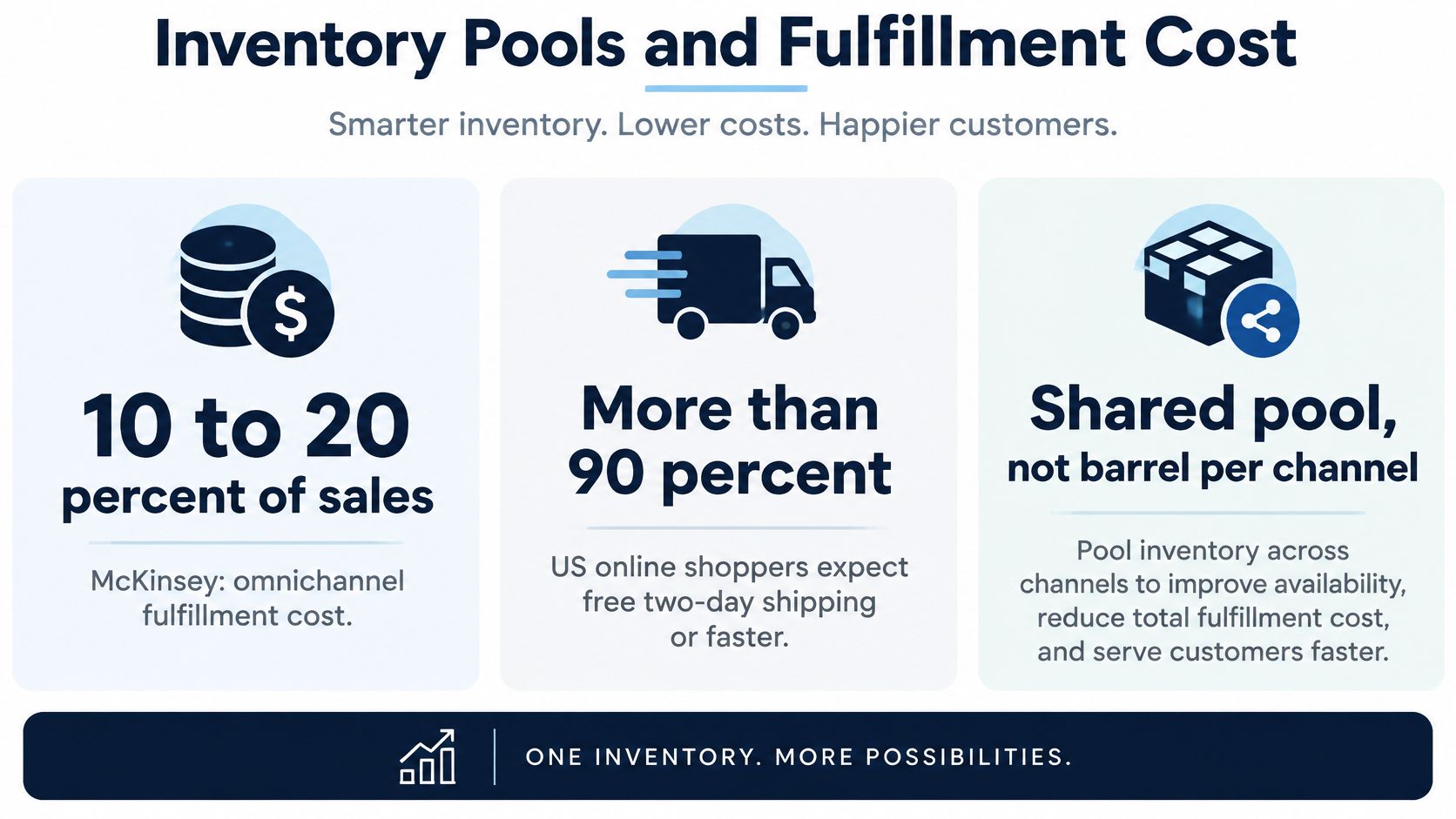
| Measure | Benchmark | How to use it |
|---|---|---|
| Fulfillment cost | 10% to 20% of sales | Ceiling on how much convenience the order can fund |
| Free two- to three-day shipping expectation | More than 90% of US online shoppers | Pressure on the promise |
| Shoppers who may leave if delivery is slow | Nearly half | Reason not to ignore speed entirely |
| Conventional pick-and-pack | 4 to 8 hours | Baseline before process work |
| Best-in-class order fulfillment | Within 2 hours | Speed gap, not a universal target |
| KPI set | On-time-in-full, cancellation rate, contribution margin after fulfillment, inventory turnover, stockout lost sales | Judge the promise on margin and reliability together |
A real-time available-to-promise system consolidates stock across fulfillment centers, stores, marketplaces, and 3PLs, then reoptimizes routing against demand forecasts, lead-time reliability, shipping cost, service targets, and margin. That's the technical center of a serious omnichannel business strategy, and it's where a rigorous approach to omnichannel inventory management matters more than another storefront theme or campaign.
Set safety stock by SKU and node, because a fast-moving hero product in a store doesn't carry the same stockout cost as a slow accessory in a regional warehouse. Add oversell protection based on inventory-data latency. If a node updates slowly, hold back more units or stop promising that node's stock for fast delivery. For a deeper operational view, stockout prevention for growing e-commerce brands is relevant when you're deciding how shared visibility should stop one channel from selling another channel's last unit.
Routing should compare a split shipment with the penalty for missing the promised date. Say a customer orders a low-price accessory with a hero product, but the accessory sits in another state. Shipping both pieces free and fast can cost more than the accessory contributes, while delaying the complete order may trigger a cancellation. Give the system a rule before the order arrives. Consolidate when the promise allows it, split when basket margin covers it, and show a later date when neither option pays.
Speed is a constraint, not the goal. Customers punish slow or unreliable delivery, but they don't reimburse you for sending every order from the fastest possible node. Judge fulfillment on whether the right order arrived complete, on time, without a cancellation, and with contribution margin left after picking, packing, freight, and returns.
Connected pipes create a trust problem. Once customer, product, pricing, and order data move across Amazon, your site, stores, ads, marketplaces, and support, every automated answer becomes a brand promise. A chatbot that invents a delivery date can undo the work of a disciplined operations team in one conversation.
Adobe's 2025 AI and Digital Trends retail report reported that 87% of consumers expect retailers to handle personal data responsibly and securely, while 74% consider clear disclosure of AI-generated content, recommendations, or images important. Shoppers have also started using AI assistants for product discovery, and retailers increasingly treat agents as a competitive requirement rather than an experiment.
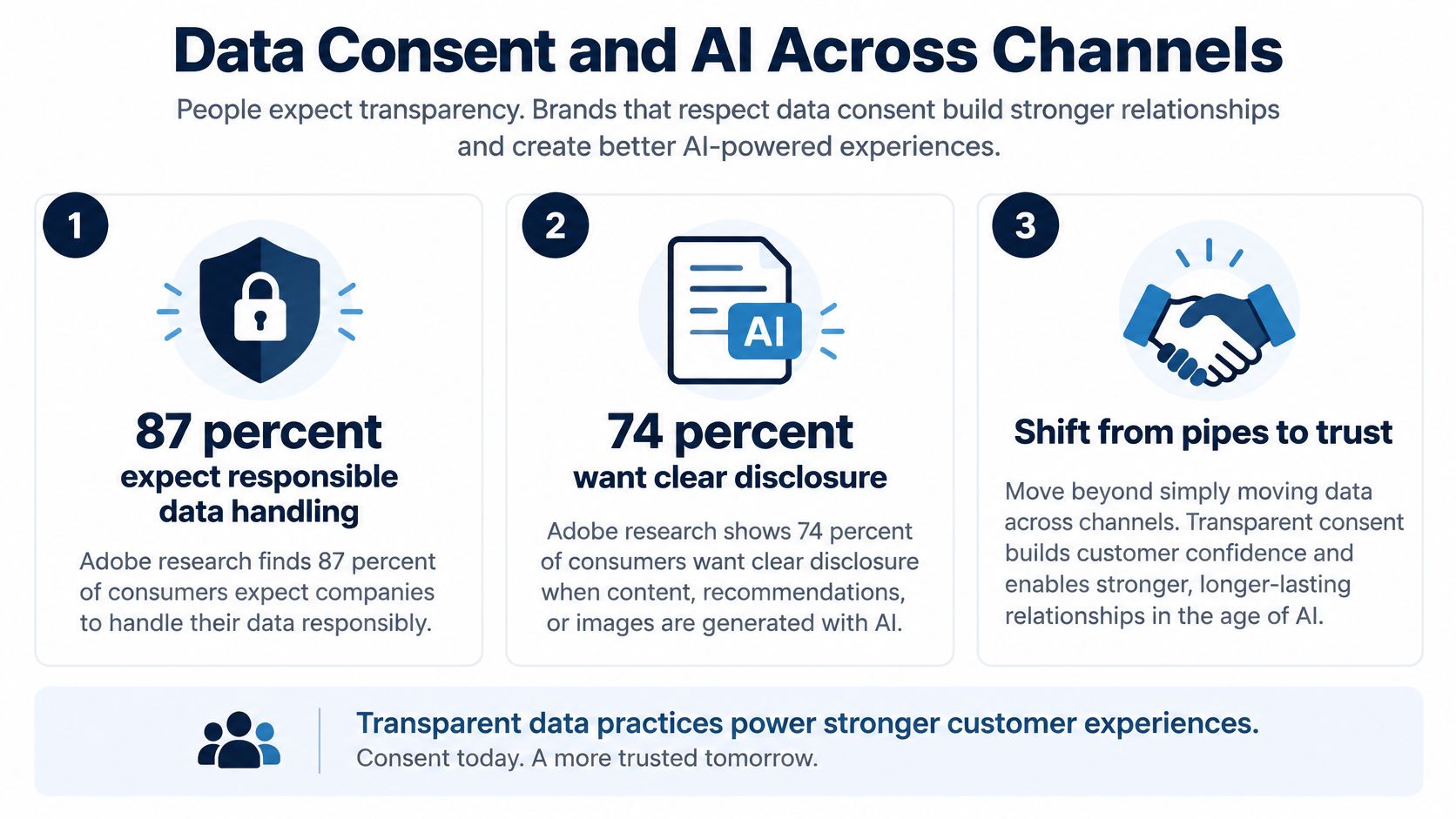
That expectation has a cost side. Every confident claim an agent makes carries the same margin exposure as a promise typed by a rep, and personalization only pays where lifetime value covers the service cost plus the risk of a wrong answer. The expensive part of AI across channels is not the software. It is the refund issued for a claim nobody approved, the expired discount a bot kept honoring, and the shipping date no node could meet.
Say a TikTok creator code expires on Sunday, but your site assistant keeps quoting it on Tuesday because the promotional feed wasn't retired. Customers screenshot the answer, support honors some codes, the store refuses others, and finance sees unexplained discount leakage. The fix is not better copywriting. It is governance with a named owner.
An AI agent may not invent a shipping promise the inventory system can't keep.
Assign one owner for mismatched promises across channels. That person approves the data an agent may use, the claims it may make, the escalation line, and the kill switch. They also decide which promises the agent may make at all, because a generous answer that costs more than the customer returns is just another unprofitable channel feature delivered at machine speed.
Give every door one job, then write down what it won't do. The right service menu changes with product size, fit risk, replenishment behavior, and margin.
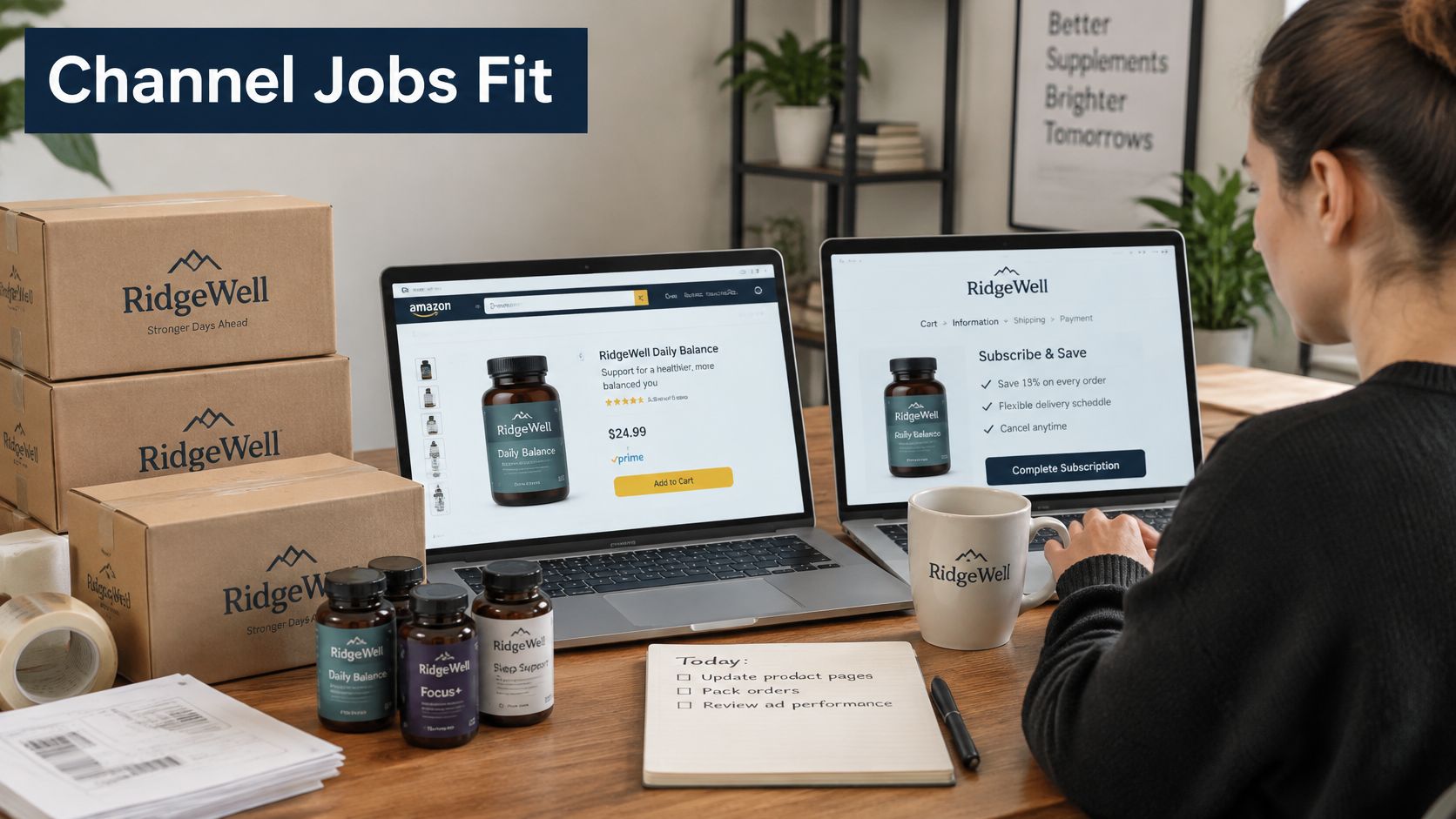
Say a supplement brand gets most first orders through Amazon. Amazon's job is acquire. It catches high-intent search, handles the first transaction, and proves demand without the brand buying every click itself. The brand site's job is replenish. It sells subscriptions, larger bundles, and combinations that marketplace fees make unattractive, and it doesn't chase every Amazon coupon with a matching discount. Email and SMS handle refill timing and education, not constant price cuts. That division protects the site from becoming a more expensive copy of the marketplace listing.
An apparel brand has a different physical problem. Customers hesitate because fit is uncertain, then return items that never had a realistic chance of working. The store's job is to solve fit and absorb returns. Online shoppers can check local availability, try sizes, exchange without mailing a parcel, and get help from staff who can see the order. Better product information also reduces avoidable returns before checkout, which is why better variant data for shirt search matters when size, cut, and variant naming decide whether a shopper finds the right item or orders three guesses. The channel earns its keep by turning uncertainty into a completed, kept purchase.
The short video below is useful context for how these channel roles show up in day-to-day ecommerce operations.
A furniture brand should be more restrictive. Bulky freight, damage risk, installation, and reverse logistics can consume margin before repeat value has a chance to develop. Its site can educate and configure, its showroom can let customers judge materials, and its delivery network can offer white-glove service only for high-margin SKUs and serviceable zip codes. Same-day delivery isn't a badge of sophistication for a sofa. It's often a fast route to a negative-contribution order.
Copy the discipline, not another category's promise list. Write a one-line job description for each channel: acquire, replenish, solve a physical problem, service, or clear inventory. Under it, list the services that channel will not offer. When a team proposes free returns, same-day delivery, or a new discount, make them show which job it improves and which cost line absorbs it.
Build the model around one real order journey, not a blended company average. Say a shopper discovers a product on Amazon, buys a bundle on your site, contacts support about delivery, and returns one item to a store. Revenue lands in one place, but the costs are scattered across marketplace fees, media, fulfillment, support, payments, and the store team. A channel P&L that credits the sale to DTC and dumps the return into retail overhead will tell you the wrong story.
Allocate each cost to the node or action that caused it, then calculate contribution per order with and without each promise. That work sits naturally beside a disciplined omnichannel pricing strategy, because price, shipping thresholds, and promotions decide whether the order can fund the convenience attached to it.
| Cost line | Allocate by | Example trigger |
|---|---|---|
| Fulfillment and picking | Units shipped from each node | Split shipment on a low-price accessory |
| Returns processing | Return volume per channel | Store return of an online order |
| Marketplace fees | Fee per sold unit by channel | Amazon referral and fulfillment fees |
| Customer service | Tickets per 100 orders | Cross-channel return question |
| Payments and third-party technology | Transactions or fee per order | 3PL platform fee |
| Acquisition | Ad spend attributed to the segment | Creator code on a short-form video platform |
Run the calculation by segment, product, and region. Free two-day shipping on a low-price accessory may force a split shipment and cost more than the item earns, even if it slightly improves conversion. The same offer on a high-margin bundle may pass comfortably because the basket absorbs freight and support. A dense delivery zone may support faster service, while a remote region fails on carrier cost and return distance.
Decision test: If a promise only works when its costs are averaged across the whole business, it doesn't work.
Your output should be a yes or no for each promise, customer group, SKU family, and geography. Add the threshold that changes the answer, such as minimum basket value, subscriber status, inventory position, or delivery zone. That turns profitability reporting into an operating rule the site, marketplace team, store, and 3PL can follow without debating every order.
Offer free shipping, same-day delivery, buy-online-pickup, or a cross-channel return only when the extra lifetime value for that segment, product, and geography covers fulfillment, returns, marketplace fees, service, payments, technology, and acquisition. If it doesn't, gate it, charge for it, slow it down, or remove it.
The revenue case is real, but it isn't sufficient. The Deloitte retail industry outlook reports that omnichannel shoppers spend 1.5 times more per month than single-channel shoppers, yet many retailers still have not made omnichannel services profitable because picking, packing, processing, and third-party technology fees can escalate costs. Deloitte also says one-third of retail executives planned significant investment in real-time inventory visibility, unified customer views, and multiple fulfillment options in 2025. More investment makes disciplined unit economics more urgent, not less.
Pressure-test the keep-or-kill decision with operators who carry the same P&L burden. Unlike general founder organizations such as YPO or EO, MDS focuses entirely on ecommerce operators, and all members must be the founder or CEO of a business doing a minimum of $1M TTM, with P&L ownership required. Inspire is a public 2-day tactical conference with over 500 ecommerce pros, workshops, hot seats and mastermind tables.
At day 90, you should have a shorter list of promises. Each one needs a segment, a product scope, a geography, a contribution line, and a named owner.
Bring your channel P&L, your five most expensive promises, and the services you're afraid to cut to Million Dollar Sellers, where ecommerce founders and CEOs with P&L ownership pressure-test decisions across Amazon, DTC, TikTok Shop, retail, and other omnichannel models. Use that operator scrutiny to keep the convenience customers value, gate the promises that leak margin, and expand only where lifetime value pays for the experience.
Join the Ecom Entrepreneur Community for Vetted 7-9 Figure Ecommerce Founders
Learn MoreYou may also like:
Learn more about our special events!
Check Events