
Chilat Doina
October 25, 2026
Your best-selling SKU is one price on Amazon, another on your Shopify store, and a third on a retailer's shelf. Each team can defend its number, but none can show whether the gaps earn money or merely teach shoppers to wait, compare, and leave. That's the problem a governed pricing system has to solve.
A shopper is standing in your retail partner's aisle, phone in hand. She scans the shelf tag, opens your DTC site, then checks Amazon. The product is identical, but the prices aren't, and she has no way to know why.
An omnichannel pricing strategy is the set of rules that decides what a product costs across every channel where you sell it. That includes Amazon and other marketplaces, your DTC site, your mobile app, wholesale partners, and physical stores. It's not a price list. It's the logic that connects those prices.
Think of a coffee chain that sells the same latte at the same price in every branch. Now think of one where the price depends on which door you walk in. The second shop might have good reasons, maybe rent differs by neighborhood, but the customer only sees inconsistency.
The strategy doesn't require one price for everything. It requires a base price that anchors every channel, plus written rules for when a channel may move away from that anchor, by how much, and for what named reason. Delivery speed, a marketplace fee, or scarce stock can justify a gap. Silence can't.
That distinction matters because the tolerance for unexplained gaps is low. In Forrester's 2024 survey, 60% of U.S. online adults said they'd likely stop shopping with a company that charged different prices for the same products or services across channels. A shopper who finds a lower price elsewhere doesn't usually complain first. She just buys there, or not at all.
A price difference is either explained and bounded, or it becomes a trust problem.
Every decision that follows, from fee math to inventory rules, exists to keep your differences in the first category.
A shopper sees the same SKU on Amazon, your DTC site, and in a store. If the prices differ, the gap should have a reason: it may protect margin, reflect a real channel advantage, or cost more in lost trust than it earns. Four models give you clear choices, from full parity to separate channel prices.
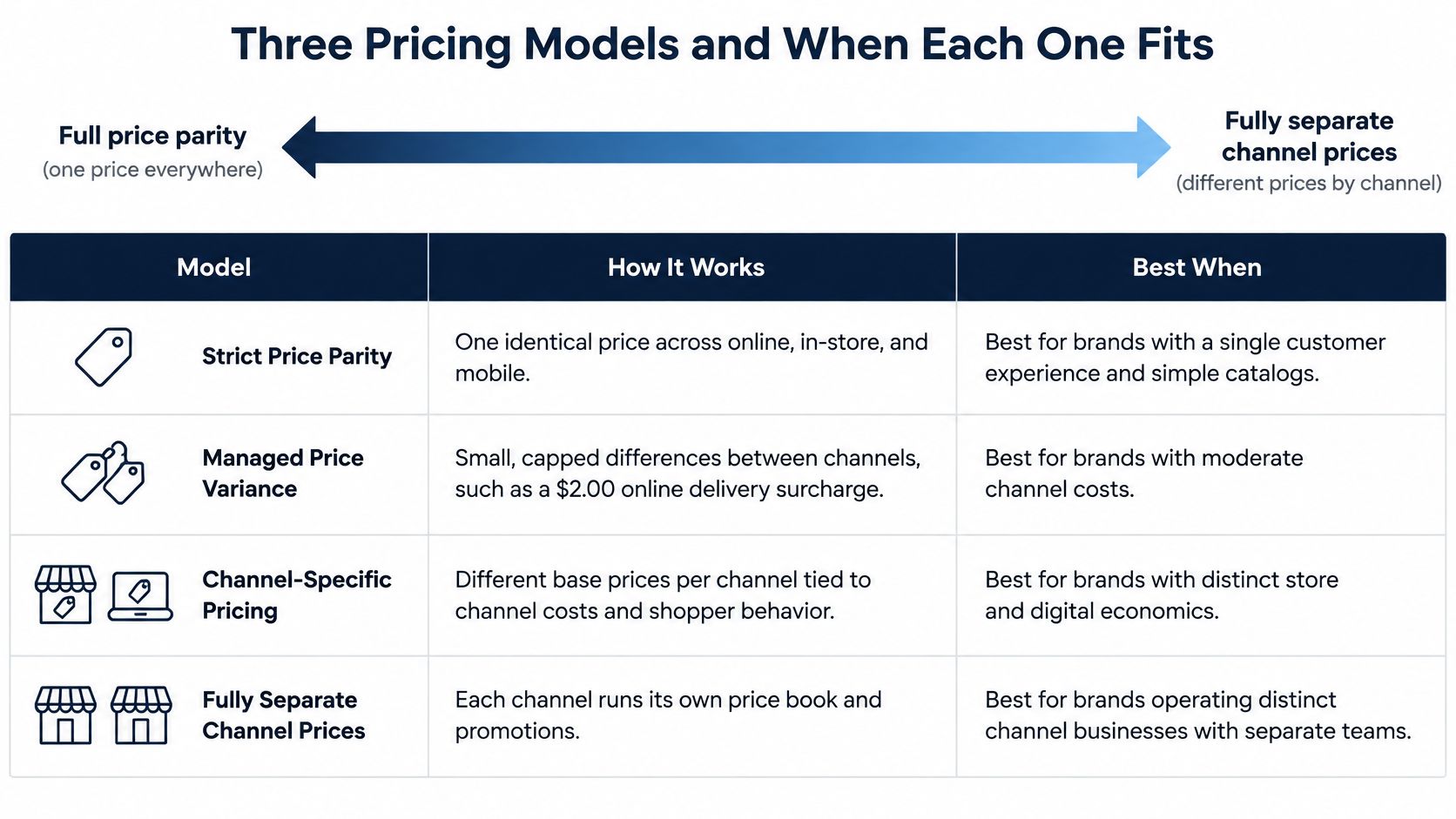
| Model | How it works | Best when | Main risk |
|---|---|---|---|
| Strict price parity | One identical price across every channel | Store service measurably supports conversion and shoppers compare prices in real time | The brand absorbs higher marketplace costs |
| Base price with bounded variation | One base price, with channel differences kept within a defined band | Channel costs differ, but shoppers need a clear explanation for the gap | Teams let the band drift or apply it inconsistently |
| Channel-specific pricing | Each channel sets its own price | Online competition is intense and brand preference is weak | Shoppers see unexplained gaps and lose trust |
| Bundle-based differentiation | Channels keep the same unit price but offer different pack sizes or bundles | A channel needs a distinct offer or margin without changing the single-unit price | Cost-per-unit comparisons make the offer look misleading |
Strict price parity earns its cost when a physical store provides service that improves the sale. Staff advice, fitting, installation, or same-day pickup can justify absorbing a marketplace fee to keep the store from becoming a showroom for a cheaper checkout elsewhere. If those services do not affect conversion, parity may only give away margin.
Base price with bounded variation works when costs vary by channel but the difference can be explained and capped. Amazon referral fees, fulfillment, and advertising may justify a limited premium over your DTC price. Keep the DTC price as the base-price anchor, and set a written limit for how far each channel can move from it.
Channel-specific pricing is harder to defend, but can fit a market where online competition is intense and shoppers have little brand preference. Research finds no universally optimal model, with uniform pricing favored when physical store service efficiency is strong and dual pricing emerging when online competition is intense and brand preference is weak. Wholesale partners follow the parity rule or price band agreed with them, rather than an informal exception.
Bundle-based differentiation is useful when a channel needs a distinct offer but a visible unit-price gap would invite comparison. An Amazon multipack or a DTC bundle can change the purchase configuration while keeping the unit price aligned. Make the pack size and per-unit price easy to compare, or shoppers may read the bundle as a hidden markup.
Before setting a gap, assess what price elasticity means for a given SKU. A price change may shift demand between channels or reduce total sales, depending on how shoppers respond. Choose parity when the value of cross-channel consistency outweighs the cost; allow variation when channel economics justify it and customers can understand why.
Take a SKU with an $18 unit cost and a $50 shelf price. On Amazon, imagine a 15% referral fee of $7.50, $6 in FBA fulfillment, $5 in advertising, and a $1 returns allowance. That leaves $30.50, or $12.50 of contribution above unit cost.
Sell the same unit through a retailer buying at 50% of shelf price, and the math flips. You receive $25, give back a $1.50 co-op allowance, and net $23.50, which is $5.50 above cost. The shelf price never changed. The floor did, and that's the number that tells you whether a channel can carry a discount.
A price floor is the lowest price a channel can carry while still covering the cost of selling there. Build it per SKU in this order: unit cost, plus every channel fee, plus fulfillment, plus a returns allowance, plus the advertising cost per completed sale. If any layer is missing, the floor is fiction.
| Channel | Cost layers to include | Typical range | Effect on price floor |
|---|---|---|---|
| Amazon | Referral fee, FBA fulfillment, storage, advertising (ACoS) | Referral 8-15% by category, ad spend often 5-15% of sales | Floor rises with every fee layer added |
| DTC site | Card processing, shipping subsidy, returns, paid acquisition | Card processing around 2.9% plus $0.30 under standard U.S. pricing | Lowest fees, but customer acquisition can be the largest cost |
| Brick-and-mortar retail | Wholesale discount, co-op marketing, markdown allowances | Wholesale often around 50% of retail price | Net revenue per unit can be half the shelf price |
| Own store or in-store service | Staff time, returns handling, inventory carrying cost | Varies, measure per store | Can justify an identical or higher price |
Treat every range in that table as a placeholder until you've replaced it with your own fee statements. Category, weight, return rate, and ad competition move these numbers a lot. This is the same discipline behind protecting margins when expanding beyond Amazon, where a new channel's fee stack has to be modeled before the first listing goes live, not after margin disappears.
Get the underlying math right by working through how contribution margin is calculated per unit with your actual statements, then set floors from those figures. One counterintuitive result follows. A high-fee channel can still deserve the lower price if its shoppers are more price-sensitive and you'd lose the sale entirely at parity. The floor tells you what's survivable. Elasticity tells you what's smart.
Pricing governance fails as a one-time project because fees, stock, and competitor prices keep moving. Run it as a weekly operating rhythm instead, with the same seven steps in the same order.
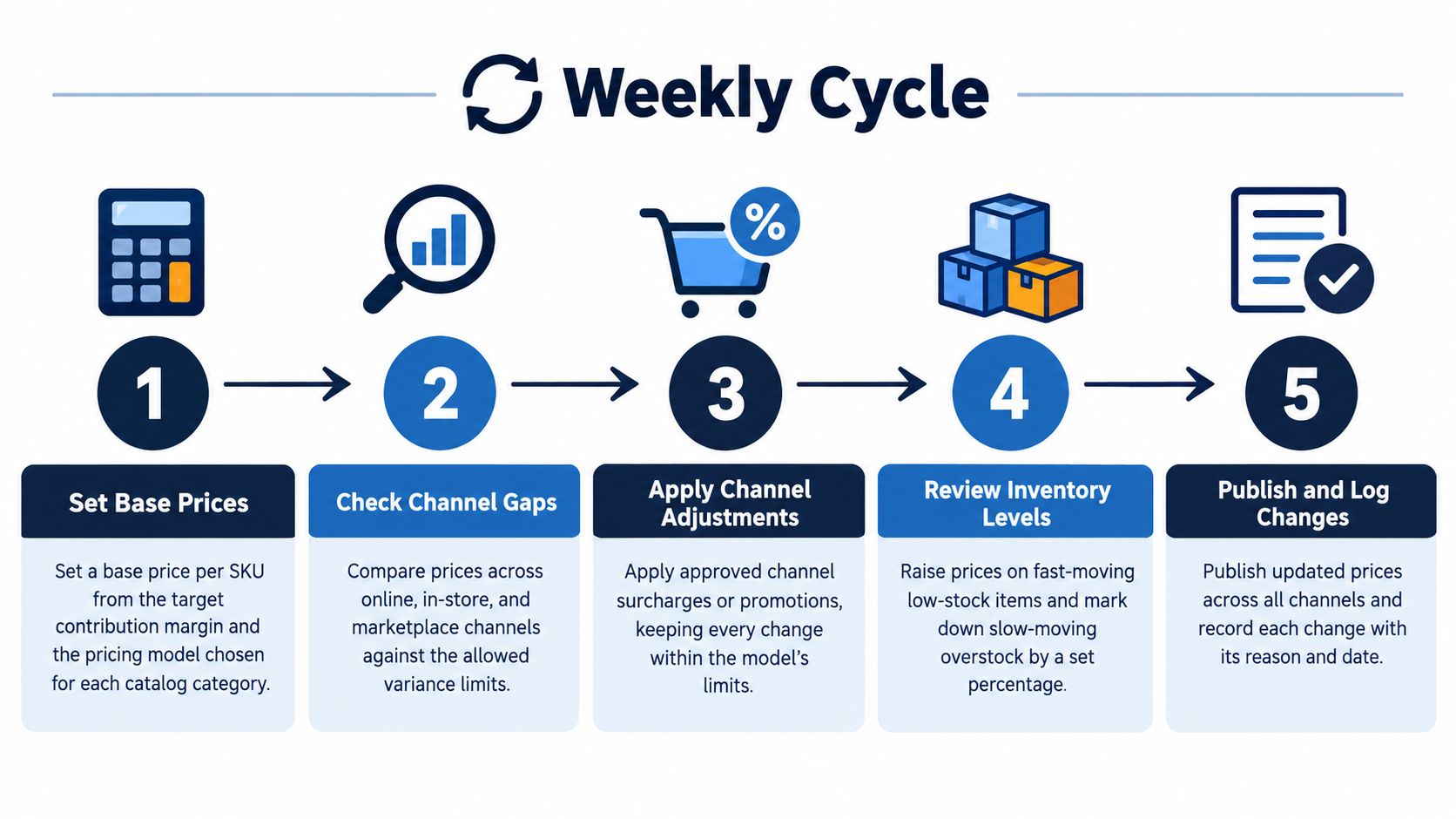
Set the base price per SKU. Derive it from your target contribution margin and the model you chose for that part of the catalog, so the anchor is fixed before any channel moves. Common slip: setting the base before channel floors are known, which bakes in losses you'll spend months unwinding.
Calculate each channel floor. Use the cost layers from the channel costs section and your current fee statements, not last year's Amazon schedule. Fees change without notice, and a floor built on stale inputs approves prices that no longer clear their costs.
Define the allowed band per channel. Set a maximum gap from the base and write down the reason, such as fees, delivery speed, or stock scarcity. A band with no documented reason is just permission to drift.
Align promotion start and end dates. Amazon, DTC, and retail should open and close the same offer together. The classic slip is one channel still advertising a deal another channel ended yesterday, which reads to shoppers as a price gap you never intended.
Set inventory triggers. Decide in advance what happens when stock runs scarce or sell-through slows, using the rules in the advanced tactics section. Every trigger needs a named owner, because a trigger nobody owns either fires late or fires twice.
Log every override. Manual changes and AI-driven changes both go in one change log with a reason and an owner. When a channel team moves a price without logging why, you've lost the ability to learn from the result, good or bad.
Run the weekly audit. Check the parity rate, band breaches, and floor movements against the fixed KPI baseline from the KPI section. Auditing without a baseline turns the review into a debate about whether this week feels normal.
You don't need a pricing platform to start. You need one shared price sheet that every channel reads from, one change log with reason and owner fields, and one alert that fires when a channel breaches its band. Automate only after those three stay accurate for a month by hand.
Operating rule: if a price change can't be traced to a step, a reason, and a person, it doesn't ship.
Cheaper online sounds like a gift to shoppers. The numbers say it's a trap with two jaws. Shoppers punish inconsistency, and many still walk in expecting a digital discount.
In a survey of 1,500 U.S. and U.K. consumers, 54% of U.S. respondents and 55% of U.K. respondents said they get frustrated when the same retailer shows different prices online and in stores, while 25% of U.S. consumers and 23% of U.K. consumers always expect products to be cheaper online. You can't satisfy both instincts with a channel-wide gap. You satisfy them with a stable base price and targeted promotions instead.
The distrust deepens when prices move dynamically. In Gartner's 2025 U.S. consumer survey, 68% said dynamic pricing made them feel taken advantage of, while 80% said consistent pricing made brands more trustworthy. Shoppers aren't rejecting every variation. They're rejecting variation they can't explain.
Three pitfalls cause most of the damage. A marketplace listing undercutting your DTC site trains your own customers to leave your highest-margin channel, so cap marketplace divergence inside the band. AI repricing with no logged reason makes every gap indefensible, so require an override log. Promotions ending on different dates manufacture apparent unfairness, so synchronize end dates and publish your price-change policy where shoppers can find it.
Illustrative scenario: a marketplace manager sees margin rise for the quarter while total revenue falls. The numbers could reflect shoppers moving to another channel, leaving the brand, or other changes. Channel-level results alone do not show which explanation fits. Track the full pricing system before changing the rules.
Because channels share customers and inventory, measure performance across the network as well as within each channel. Use a scorecard that separates margin, shopper behavior, and inventory recovery.
| KPI | What it reveals | How to assess it |
|---|---|---|
| Blended contribution margin per SKU | Margin after channel fees, by channel and in total | Check that each channel contributes positively, not only the strongest one |
| Price parity rate | Share of SKUs within the published price band | Compare with a fixed baseline; a 90% rate can serve as an example for calibration on core SKUs |
| Cross-channel conversion | Share of buyers who compared channels before purchasing | Check whether it stays stable or rises after a band change |
| Buy Box win rate on Amazon | How often you hold the featured offer relative to the DTC price gap | Track alongside the size of the gap and your band limit |
| Aggregate sales across channels | Total revenue across the network | Check whether the total holds or rises when one channel is flat |
| Price-related complaints and returns | Customer tickets and returns that cite price | Track the trend and investigate recurring issues |
| Clearance revenue recovered | Revenue from markdowns after inventory rules apply | Compare with the baseline set before those rules |
The case for tracking network-wide sales is supported by a quasi-experiment covering roughly 2.2 million daily observations across 4,150 products over 18 months. After the move from channel-specific prices to uniform pricing, switching from channel-specific prices to uniform pricing lifted online sales by 1.31% and offline sales by 3.56% in the long term. The study reports sales changes, not the reason for them. Reduced friction is one possible interpretation, but the result does not establish that mechanism. For your own business, compare aggregate sales with channel margin to see whether a price gap pays for itself or shifts demand at a cost.
Review the KPIs monthly against a fixed baseline established before changing any band. Set review triggers in advance, such as a band breach across a chosen share of core SKUs or total sales falling while one channel's margin rises. Treat a parity figure such as 90% as a calibration example, not a universal benchmark. Choose your threshold based on your baseline and channel economics, then investigate when results cross it.
A price gap between Amazon, DTC, and retail has a cost. The right question is whether that gap protects contribution or sends demand to a channel that cannot clear its stock. Once base prices, floors, and bands are set, connect pricing decisions to inventory so each channel's price reflects what its units are worth there.
One study reported an estimated 13.7% increase in clearance-period revenue from partitioning store inventory by expected channel use and reallocating as conditions changed. Treat that result as evidence that inventory allocation and pricing can work together, not as a promise that the same approach will produce the same gain in every operation.

Suppose you hold 1,000 units across a warehouse, Amazon FBA, and two regional stores. DTC has the highest margin, so you reserve 300 units for it while Amazon demand is strong. If store inventory keeps aging over 30 days, mark down there first rather than cutting prices across every channel.
Keep the reservation flexible. As the season changes, release DTC stock to the channel most likely to clear it at the best contribution. This is omnichannel inventory management applied to pricing: compare the value of a unit in each channel before deciding where it should sell.
Use five inputs: contribution margin, channel demand sensitivity, fulfillment cost, inventory age, and the chance a sale consumes stock another channel needs. Automated repricing can act on those inputs, provided the rules are published and overrides are logged. Shopper-level signals that lack a clear pricing rationale can create unexplained channel gaps and undermine customer trust.
Start this week with one artifact: a one-page price map for your top 20 SKUs. For each SKU, list the base price, every channel floor, the band limit, and the promotion end date for every channel. If a cell is blank, that channel is pricing on habit.
Before you add a channel or automate repricing, confirm four things. Every SKU has a base price and a documented band. Every channel floor uses current fee statements. Promotion end dates match across channels. Every override has a logged reason and owner.
Run the weekly audit from the procedure section for four straight weeks and compare the parity rate and aggregate sales against the baseline from the KPI section. Then apply the decision rule. If parity holds and aggregate sales rise, scale to the next channel and layer in the inventory-linked rules from the advanced tactics section. If one channel's gap widens while sales fall, go back to the pricing models section and test bundles or a narrower band before touching anything else.
Stop any automation whose inputs can't be shown in the change log. An unexplained price is the trust problem this whole system exists to prevent.
Pricing across Amazon, DTC, and retail gets easier when you're comparing notes with operators who run the same multi-channel math every week. Million Dollar Sellers brings those founders together to share what's working on margins, channel expansion, and the rules behind the numbers. Visit us to see if you qualify and bring your hardest pricing question to people who've already paid to learn the answer.
Join the Ecom Entrepreneur Community for Vetted 7-9 Figure Ecommerce Founders
Learn MoreYou may also like:
Learn more about our special events!
Check Events