
Chilat Doina
April 25, 2026
You already know the pattern. A buyer asks for your best price on a SKU you’re carrying at scale. Your team checks active listings, sees a wall of fantasy pricing, and tries to triangulate a number from sellers who may not have sold a single unit. That’s how margin gets compressed and inventory ages.
For serious operators, ebay advanced search sold isn’t a convenience feature. It’s one of the fastest ways to get closer to the truth of a market. Not asking prices. Not stale assumptions. Actual transaction history.
Most sellers use sold data to sanity-check a listing. Better sellers use it to decide whether to source. The best sellers build workflows around it, so pricing, replenishment, title optimization, and cross-channel decisions all start from the same evidence base.
High-volume sellers run into the same wall over and over. You add a new product line, or expand into a neighboring category, and your team wants answers fast. What’s the right opening price? How fast does it move? Are buyers favoring used, new, auctions, or Buy It Now? If you rely on active listings, you’re studying intentions, not outcomes.
That’s the core mistake.
eBay’s Advanced Search Sold Items filter shows completed sales from the last 90 days, and that window gives sellers pricing visibility across millions of transactions. According to this breakdown of eBay sold-item research, that 90-day span represents approximately 25% of eBay’s annual GMV, and eBay’s GMV exceeded $73 billion in 2022. For operators managing real inventory risk, that makes sold search a market signal, not a hobby tool.
Active listings are useful for competitive positioning, but they’re terrible as your primary pricing reference.
A seller can list a used Dyson attachment, a boxed Lego set, or a refurbished iPhone at any number they want. The market doesn’t validate that number until someone pays it. Sold data closes that gap. It shows what buyers accepted, what formats moved, and which versions of the product cleared.
When I audit stores with bloated aged inventory, one issue comes up constantly. Teams anchored on visible listing prices instead of realized sale prices. They priced to preserve margin on paper, then lost margin through delay, discounting, and dead stock.
Practical rule: Price from sold behavior first. Use active listings second for positioning.
The strongest operators don’t stop at “what did it sell for?” They ask better questions.
That’s where sold search becomes operational. It informs sourcing, markdown timing, replenishment logic, and listing standards. It also gives your team a common language. Merchandising, listing, and pricing can all work from the same market view instead of debating whose intuition wins.
For larger stores, sold search also improves cross-functional discipline. If one buyer thinks a category is hot, sold data forces precision. If a listing manager wants to hold out for a premium price, sold data tells you whether the market has supported that position lately.
A lot of competitive work starts here, then gets layered into a broader operating model. If you’re building that muscle, this competitive analysis framework for ecommerce teams is a strong companion to sold-listing research because it helps turn one-off research into repeatable decision-making.
The edge isn’t that the tool exists. Everyone can click the same checkbox.
The edge comes from using sold data faster, more consistently, and with tighter process discipline than the sellers around you. Many sellers still research manually, inconsistently, and too late. They look only when there’s a pricing problem.
The stores that grow through eBay don’t treat sold search as cleanup. They treat it as input.
If your team can’t pull clean sold comps quickly, everything downstream gets sloppy. Buyers overpay. Listers use bad comparables. Repricers chase noise. The fix is a standardized process your staff can run the same way every time.
The workflow itself is simple. The advantage comes from precision.
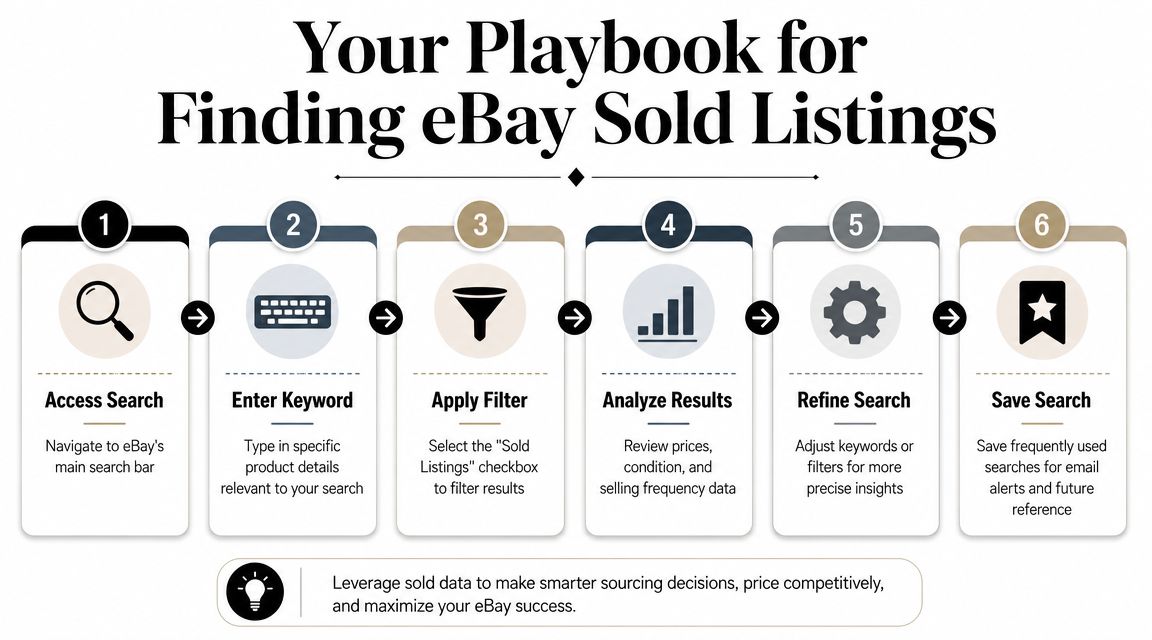
Open eBay and click the Advanced link next to the main search bar. Then build the search the way a disciplined sourcing analyst would, not the way a casual shopper would.
Use exact product descriptors. If you’re evaluating an Apple phone, “iPhone 14 Pro 128GB SIM-free” is useful. “iPhone” is not. Broad searches mix generations, storage tiers, carrier locks, bundles, and condition states. That pollutes your read before you even touch the filters.
A clean query should narrow the result set to items that a pricing manager could compare.
In Advanced Search, scroll to the search options and check Sold listings. That isolates successful transactions instead of showing a blend of winners and failures.
There’s a place for Completed listings, but not when your goal is pricing live inventory. Completed results include unsold listings, and those can be useful for failure analysis later. For baseline comps, start with sales only.
The team member pulling comps should answer one question first. “Am I studying what sold, or why things didn’t sell?” Don’t mix those jobs.
Many groups grow complacent. They run one sold search, glance at the range, and call it market research. That’s not enough if you’re managing meaningful volume.
Per the advanced sold-listing methodology from ZIK Analytics, the practical workflow is to enter precise keywords, check Sold listings, then filter by Condition, Date range, and Buying format. The same source notes the formula for sell-through rate, or STR, as (Sold Listings ÷ Total Active Listings) × 100, and says that an STR over 50% indicates strong demand. It also reports that sellers using this filtered data see 25% to 40% improved pricing accuracy.
That matters because every one of those filters changes the interpretation.
Condition
A used pair of Bose headphones and a sealed pair don’t belong in the same pricing pool. Neither does “parts only.” Segment aggressively.
Date range
Fast-moving products need a tighter window. Slower collectible categories can support a longer view. The right range depends on how quickly demand and competition change.
Buying format
Auctions and Buy It Now don’t express value the same way. If your store sells mostly fixed price inventory, auction results can distort your comp set.
Category
Override bad auto-categorization when needed. Similar keywords across adjacent categories can pull in false matches.
Once results populate, don’t just scan price. Sort and inspect.
Look for clustering. If most sold units group tightly, that’s your signal that the market has a stable expectation. If prices are all over the place, click into the sold listings and find the variables driving the spread. Accessories included. Boxed versus loose. Multi-pack versus single unit. Cosmetic grade. Regional demand.
A quick review should answer these questions:
This is the part many resellers skip and then regret later.
Use the formula from the source above:
STR = (Sold Listings ÷ Total Active Listings) × 100
If you see 35 sold listings against 50 active listings, that gives you 70% STR. That’s a healthy signal because it tells you the category isn’t just producing occasional sales. Inventory is clearing.
Use STR as a sourcing filter, not just a reporting metric. A category with weak STR can still produce sales, but it usually demands more patience, sharper buy prices, and tighter quantity control.
The best research process is one your team can repeat without you.
Build a comp SOP that requires:
That’s how you turn ebay advanced search sold from a tab in a browser into a system your business can scale.
Good research doesn’t matter if your team can’t convert it into action. Sold data should end in one of three decisions. Buy deeper, price tighter, or stay out.
The mistake is treating sold comps like a single number. What you’re really building is a market map.

A strong comp review gives you three anchors.
| Anchor | What it tells you | How to use it |
|---|---|---|
| Floor | The lowest clean market-clearing price | Protects against overestimating weak demand |
| Median band | Where comparable listings tend to transact | Best starting point for standard inventory |
| Ceiling | What top-end listings achieved | Shows upside if condition, bundle, or presentation justify it |
This framework works because it reflects how real stores operate. Not every unit deserves the same price. A sealed Shark vacuum attachment with original packaging may deserve ceiling logic. A used one with cosmetic wear belongs closer to the median or floor.
The point isn’t to split hairs. It’s to stop acting as if one sold comp defines the entire market.
Price tells you margin potential. STR tells you how hard you should press.
An item with healthy velocity can support a deeper buy, especially if your team can replenish quickly and list fast. An item with softer turnover may still be profitable, but it should be treated as a controlled position, not a warehouse bet.
This is also where landed economics matter. A comp is only useful if it survives freight, prep, labor, returns, and platform costs. If your buyers need a tighter framework for that piece, this guide on how to calculate landed cost helps connect sold-price research to actual profitability.
If your buy team celebrates gross margin before accounting for real landed cost, they’re not buying inventory. They’re buying surprises.
The biggest blind spot in sold-listing analysis is title architecture.
Most sellers use sold search to answer “what price worked?” Top operators also ask “what wording got visibility?” That matters because eBay search behavior is not stable across keyword order. The video analysis on eBay search behavior highlights that search results can change dramatically based on keyword arrangement, and top sellers study the title structure of successful sold listings so they can model their own listings on the same high-performing search patterns.
That changes how you should review comps.
Don’t copy titles line for line. Extract the structure.
Look at the highest-performing sold listings and note:
If multiple fast-selling listings use the same sequence, that’s not random. It suggests the structure aligns with buyer searches and eBay indexing behavior.
A practical title analysis sheet for one SKU family should include the exact wording patterns repeated across sold winners. Then your listing team can create category-specific title formulas instead of improvising every time.
Here’s a simple internal approach that scales:
That process is worth doing because title optimization is one of the few levers that improves both visibility and conversion without changing your cost basis.
For teams that need a visual walkthrough before implementing title audits at scale, this short video is useful:
Not every outlier deserves a reaction.
If one sold comp comes in far above the rest, check the listing details before you move your whole pricing stack. It may include extras, superior condition, a rare variant, or stronger merchandising. The discipline is in reading the pattern, not chasing the exception.
That’s why sold data works best when it drives a range-based decision model. Buy based on velocity. Price based on clustered outcomes. Write titles based on winning architecture.
A catalog at scale exposes every weak research habit.
If buyers, listers, and pricing staff all pull sold comps manually, throughput drops first, then consistency breaks. One person prices off a five-sale sample. Another uses a different keyword set. A third reacts to a single outlier. The result is not just slower research. It is uneven margin control across the catalog.
The fix is operational. Build a repeatable sold-data workflow, then push that workflow into tools your team already uses.
Saved searches are one of the simplest ways to keep sold intelligence flowing without assigning staff to recheck the same categories all day.
Set them up around:
This works best when each saved search has a clear owner and purpose. A sourcing lead watches replenishable inventory patterns. A category manager tracks shifting price bands. A pricing lead reviews changes in sale velocity and comp density.
That structure matters. Alerts without ownership turn into noise.
Free sold search handles a lot of daily work. It is fine for quick checks, rough pricing bands, and verifying whether an item still has active demand.
Decision-grade research needs more context. Historical seasonality, accepted offer behavior, and longer trend lines matter when you are setting buy limits, updating repricer rules, or deciding whether to go deeper on a category. As noted earlier, Terapeak fills part of that gap by giving teams a broader historical view than the public sold filter alone.
The trade-off is simple. Free search is faster. Premium research gives cleaner inputs for bigger decisions.

Research only pays off when it changes how the business runs.
Here is the framework I use with larger catalogs:
| Function | Sold data input | Operational output |
|---|---|---|
| Buying | Price clusters, sell-through pattern, condition spread | Max buy cost, order depth, reject rules |
| Listing | Repeating attributes in successful listings | Fixed templates by category and condition |
| Pricing | Low, mid, and premium sale bands | Starting price rules and markdown cadence |
| Repricing | Fresh sold comps and range compression | Automated floor and ceiling adjustments |
This does not require custom software on day one. A disciplined spreadsheet and a documented SOP will get you started. After that, move the repeatable parts into repricers, listing tools, and dashboards. Teams still doing all of this by hand should review this breakdown of how to automate business processes, especially if the handoff between research and execution is where errors keep showing up.
Automation scales your rules. It also scales your mistakes. Bad comp logic pushed into a repricer will burn margin faster than a junior employee ever could.
For multi-channel operators, eBay is often the fastest place to see pricing pressure show up. That makes sold data useful beyond eBay itself.
If the same SKU lives on your Shopify store, on eBay, and in a warehouse management system, sold trends should influence more than one listing. They should affect inventory allocation, promotional timing, and price guardrails across channels. The mechanics of that setup vary, but the operating principle stays the same. One clean market read should inform every system that touches the SKU.
For teams building that workflow, this guide to eBay and Shopify integration is worth reviewing. The value is not the connection by itself. The value is making sure sold-data signals can affect listing consistency, inventory sync, and channel-specific pricing logic without manual re-entry.
High-volume teams waste time when skilled staff keep solving routine problems from scratch.
Set hard rules for common inventory. Reserve manual review for lots with unusual bundles, rare variants, mixed conditions, or thin comp history. That keeps analysts focused where judgment changes the outcome, instead of spending half the day reconfirming obvious price ranges on repeat inventory.
The best operators do not research more. They standardize what repeats, automate what can be trusted, and review only the edge cases that still need a human read.
Most pricing mistakes don’t come from having no data. They come from using messy data with too much confidence.
I see the same distortions repeatedly. They’re small enough to feel harmless, but expensive enough to wreck sourcing decisions.
Two sold listings can show similar headline prices and produce very different economics. If your team compares only the item price and ignores shipping treatment, your comp set is already compromised.
A listing with free shipping and a listing with paid shipping may attract buyers differently, especially in compact categories where the total checkout cost matters. If you don’t normalize that, you’ll overestimate what buyers were willing to pay for the item itself.
The correction is simple. Review sold comps in terms of total transaction logic, not just the bold number shown in results.
The default recency can be convenient, but convenience isn’t the same as relevance.
Seasonal products, trend-sensitive categories, and event-driven items can mislead your buyers if you don’t match the time window to the item’s actual demand cycle. A sold comp set that looks healthy may reflect a period that no longer resembles current buyer behavior.
Your fix is judgment. Tighten the window when the market changes quickly. Expand it only when the category moves slowly enough to justify the longer read.
A comp is only as good as its time context.
One extreme sale can hijack a pricing meeting if nobody stops to inspect it. Usually there’s a reason. Better condition. Included accessories. Original packaging. Rare colorway. Better title. Better photos.
Outliers are useful, but only after you classify them. They’re not your starting point.
Use this quick screen before accepting a comp:
This is a basic error, but it still shows up in bigger operations when research gets delegated too fast.
Completed listings include both sold and unsold outcomes. That makes them useful for diagnosing failure, but dangerous if someone uses them to establish a market-clearing price. If half the visible examples didn’t sell, the average can drag your team toward the wrong conclusion.
Use sold listings for pricing comps. Use completed listings later when you want to understand why competitors missed.
Auction outcomes and fixed-price outcomes don’t behave the same way. If your business mostly lists Buy It Now inventory, don’t let auction data inadvertently set your expectations.
The correction isn’t complicated. Segment by sale format when you build comp sets. Then compare like with like.
That one step cleans up more bad pricing decisions than most sellers realize.
At scale, the value of sold data isn’t theoretical. It shows up in the moment a buyer decides to go deeper, a brand decides to launch, or a liquidator decides how to structure inventory.

A reseller at a regional collectibles event spots a table full of handheld electronics and sealed accessories. The seller’s prices look fair at first glance, but “fair” isn’t enough when you’re buying depth.
He runs sold searches from the app, narrows to exact model names, and checks only closely matched condition states. A few items show consistent sold activity with healthy pricing bands. Others have sparse sold history and messy title patterns. He buys the products with visible repeat demand and leaves the rest.
The win isn’t just avoiding bad inventory. It’s being able to make that call fast, while less disciplined buyers are still negotiating from instinct.
A brand owner preparing a new accessory launch doesn’t use sold search to copy a price. They use it to identify market positioning.
The team studies sold listings for comparable products, then segments by title structure, feature emphasis, and merchandising style. The useful insight isn’t only what sold. It’s how top listings describe the product. Some sellers lead with compatibility. Others lead with material or bundle contents. The brand uses those patterns to write cleaner titles and position the offer where the market already shows traction.
That kind of analysis doesn’t guarantee success. It does reduce the chance of launching with a title and pricing strategy that ignores how buyers are already searching.
A liquidator moving mixed inventory has a different problem. The inventory has to turn.
Instead of trying to maximize every individual item, the team uses sold data to sort products into buckets. Some are strong enough to list as singles. Some make more sense grouped into lots. Some should be cleared quickly to free labor and space.
That’s the practical side of ebay advanced search sold. It helps determine not just price, but packaging strategy. In a liquidation model, that matters because the wrong lot structure can slow cash conversion more than a slightly imperfect list price ever will.
The best comp research changes the shape of the offer, not just the number on it.
A sourcing lead at scale does not need more comps. They need cleaner rules for when to trust the comp set, when to widen it, and when to switch tools.
Start with the distinction that affects pricing decisions fastest. Sold Listings shows transactions that closed. That is the view for pricing, replenishment checks, and quick demand reads. Completed Listings shows everything that ended, including stale inventory that got no buyer. That view helps diagnose failure points such as bloated asking prices, weak item specifics, bad timing, or an auction format that suppressed value.
The tool choice depends on the decision. Free Advanced Search handles day-to-day work well if your team is checking current sell-through, validating a buy, or pulling a tight comp range before listing. Terapeak earns its place when the market is noisy and a short recent window gives a distorted picture. That usually shows up in seasonal categories, products with frequent Best Offer activity, or inventory where a bad pricing call ties up serious capital.
Best Offer is where operators get sloppy. eBay sold results often show the struck-through list price, not the accepted number. If that gap matters to margin, do not treat the visible sold price as exact. Cross-check in Terapeak or widen your comp set until the range is reliable enough for the decision in front of you.
Mobile sold search has a job, but it is a narrow one. Use the app on a warehouse floor, at a thrift stop, during a trade show walk, or any time speed matters more than precision. Use desktop for actual comp work. Filtering is tighter, side-by-side review is faster, and the team can document pricing notes in a way that holds up across buyers, listers, and repricers.
One standardization point matters more than people expect. Lock down the search query format first. Then lock filters, condition rules, and the notes your team records from each comp set. Software comes after that. If two buyers search the same SKU family in two different ways, your automation will scale inconsistency.
If you’re building an e-commerce business at a level where comp research, pricing discipline, and operational rigor move the P&L, Million Dollar Sellers is where high-level founders compare the systems behind those decisions. It’s an invite-only community for serious operators who want sharper playbooks, vetted peers, and real execution insight from brands scaling across marketplaces and channels.
Join the Ecom Entrepreneur Community for Vetted 7-9 Figure Ecommerce Founders
Learn MoreYou may also like:
Learn more about our special events!
Check Events