Chilat Doina
April 16, 2026
It’s Monday morning. You’re tightening the forecast, reviewing inventory exposure, and trying to decide whether the next hire belongs in retention, wholesale, or finance. You have time for one or two strong inputs this week, not ten hours of recycled advice for beginners.
Podcast search results have the same problem. Type in “best ecommerce podcast” and you’ll get lists built for new sellers, solo operators, and generalist marketers. Founders running 7 and 8 figure brands, and plenty of 9 figure teams, need something else. They need shows that help with margin pressure, channel risk, cash conversion, org design, and exit readiness.
That’s what this guide is built to do.
This is a curated listening roadmap for experienced operators. Each show earns its place because it helps with a specific job. One is better for financial discipline. Another is better for retail and platform shifts. Another helps you pressure-test growth strategy before you spend more on media or inventory.
I’ve found that the best podcast rotation works like a board of advisors. You do not listen for inspiration. You listen to sharpen decisions. If you want a stronger operator-first benchmark before getting into the list, our breakdown of why Ecommerce Fuel stands out for serious founders is a useful starting point.
There’s also a second filter that matters. Audience fit. A podcast can be popular and still be a poor use of time for a founder dealing with contribution margin drift, rising fulfillment costs, or an eventual sale process.
So the goal here is simple. Cut the beginner-level noise. Match each podcast to the business problem it solves best. Help busy founders build a listening stack that improves decisions, not just fills dead air.
If you also want broader founder-focused listening beyond commerce, this list of best podcasts for entrepreneurship is worth bookmarking.
Monday morning. Your finance lead is flagging margin compression, operations is pushing back on another inventory buy, and paid media still wants more budget. That is the kind of week where The eComFuel Podcast earns its place.
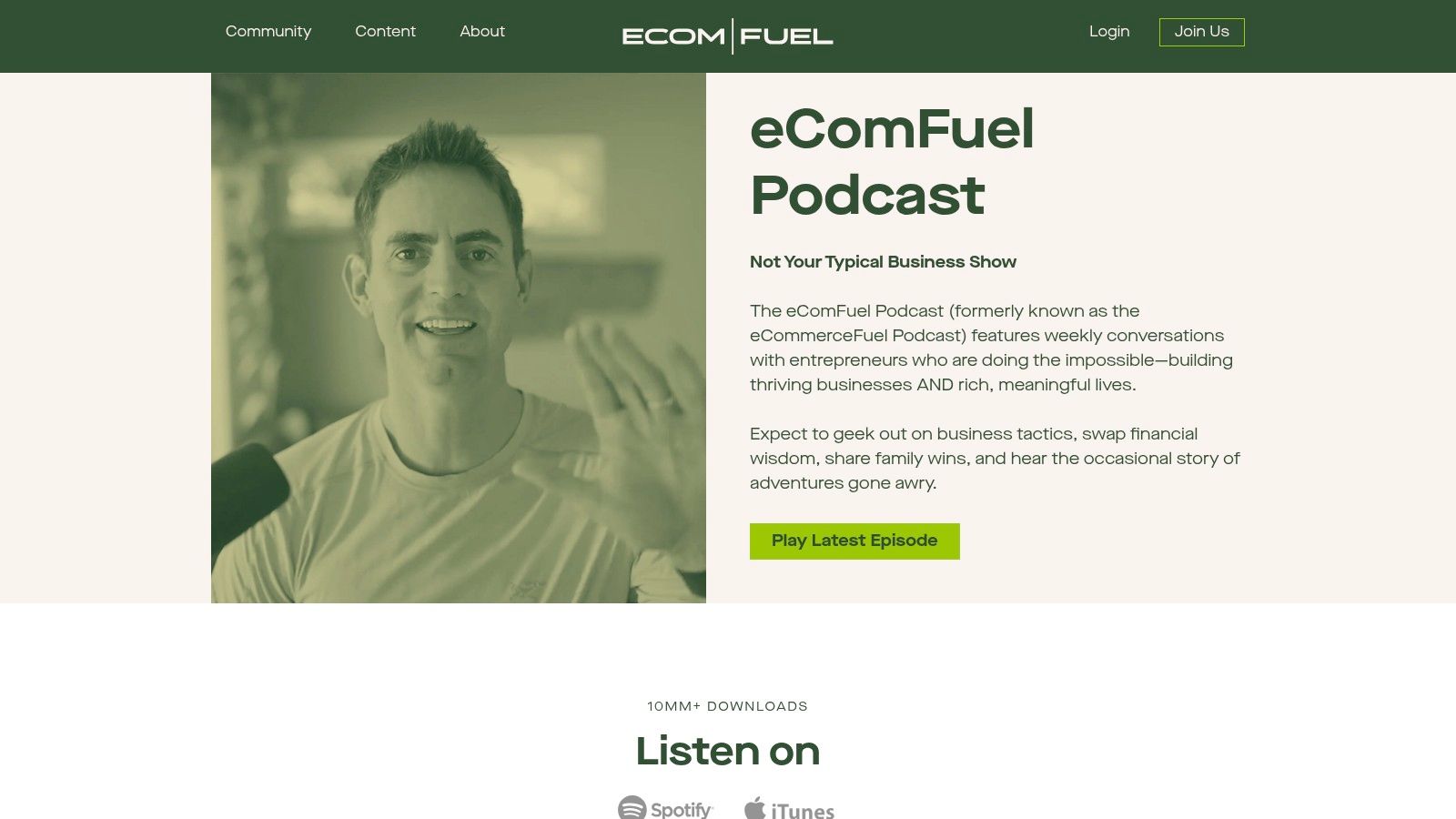
This show is built for founders already operating at scale. It assumes you understand contribution margin, inventory risk, channel concentration, and the cost of hiring the wrong leadership layer. For a 7 to 9 figure operator, that filter saves time.
What makes eComFuel useful is the altitude of the conversation. Episodes stay close to owner-level problems that do not sit neatly inside one department. You will hear discussions about pricing discipline, cash flow pressure, team structure, operational bottlenecks, and growth decisions that look good in a dashboard but weaken the business underneath. That is a better fit for mature brands than another hour on ad tactics.
The guest quality matters too. The show regularly features founders, investors, and service operators who have worked inside scaled ecommerce businesses. The perspective is usually grounded in real trade-offs. Grow faster or protect cash. Add complexity or simplify the catalog. Push harder into wholesale, marketplaces, or direct-to-consumer growth strategy. Prepare to hold the business longer, or start building toward an exit.
For a closer look at why this audience overlap matters, the Million Dollar Sellers take on Ecommerce Fuel is worth reading.
Use this podcast when the problem crosses functions.
If the issue touches finance, inventory, team design, and growth at the same time, eComFuel usually gives better context than a channel-specific show. That is its edge. It helps founders make integrated decisions instead of isolated ones.
There is a trade-off. This is not the podcast to hand a junior marketer who needs platform tutorials or campaign setup advice. It is a better fit for founders, COOs, CFOs, and senior operators who need sharper judgment on bigger decisions.
If you want one podcast in the rotation that acts like an operator peer group in audio form, this is near the top of the list.
A lot of DTC podcasts talk fast. DTC POD by Trend moves fast and still gives your growth team something usable.
The show is strongest when you need current thinking on creative testing, paid social execution, influencer mechanics, and the practicalities of keeping customer acquisition efficient while channels shift under your feet. It’s less about philosophy and more about “what are smart teams trying right now?”
This is the podcast I’d hand to a head of growth or performance lead who needs fresh angles without sitting through an hour of generic founder storytelling.
The format works because the guest mix is broad. You’ll hear from founders, operators, creators, agencies, and platform-side people. That creates a useful tension. Founders talk about what they need. Media buyers talk about what’s breaking. Partners talk about what’s changing inside the tools. You don’t always get perfect alignment, but you do get a more complete picture.
That matters in a direct-to-consumer environment where playbooks expire quickly. If your team is working through creative fatigue, rising CAC, weak landing page conversion, or stale retention messaging, this show usually gives you a few ideas worth testing.
If you’re building or refining a direct-to-consumer strategy, this belongs in the media rotation.
What works:
What doesn’t:
One practical note. This is not the best ecommerce podcast if your biggest challenge is cash conversion or operational complexity across channels. It is one of the best if your immediate bottleneck is customer acquisition and creative performance.
Most growth teams don’t need more content. They need better filters. DTC POD works when someone on the team listens with a specific question in mind, then turns one episode into one test.
That’s the right way to use it. Don’t binge it casually. Assign it to a problem.
Some podcasts help you run better campaigns. The Jason & Scot Show helps you sound smarter in executive meetings.
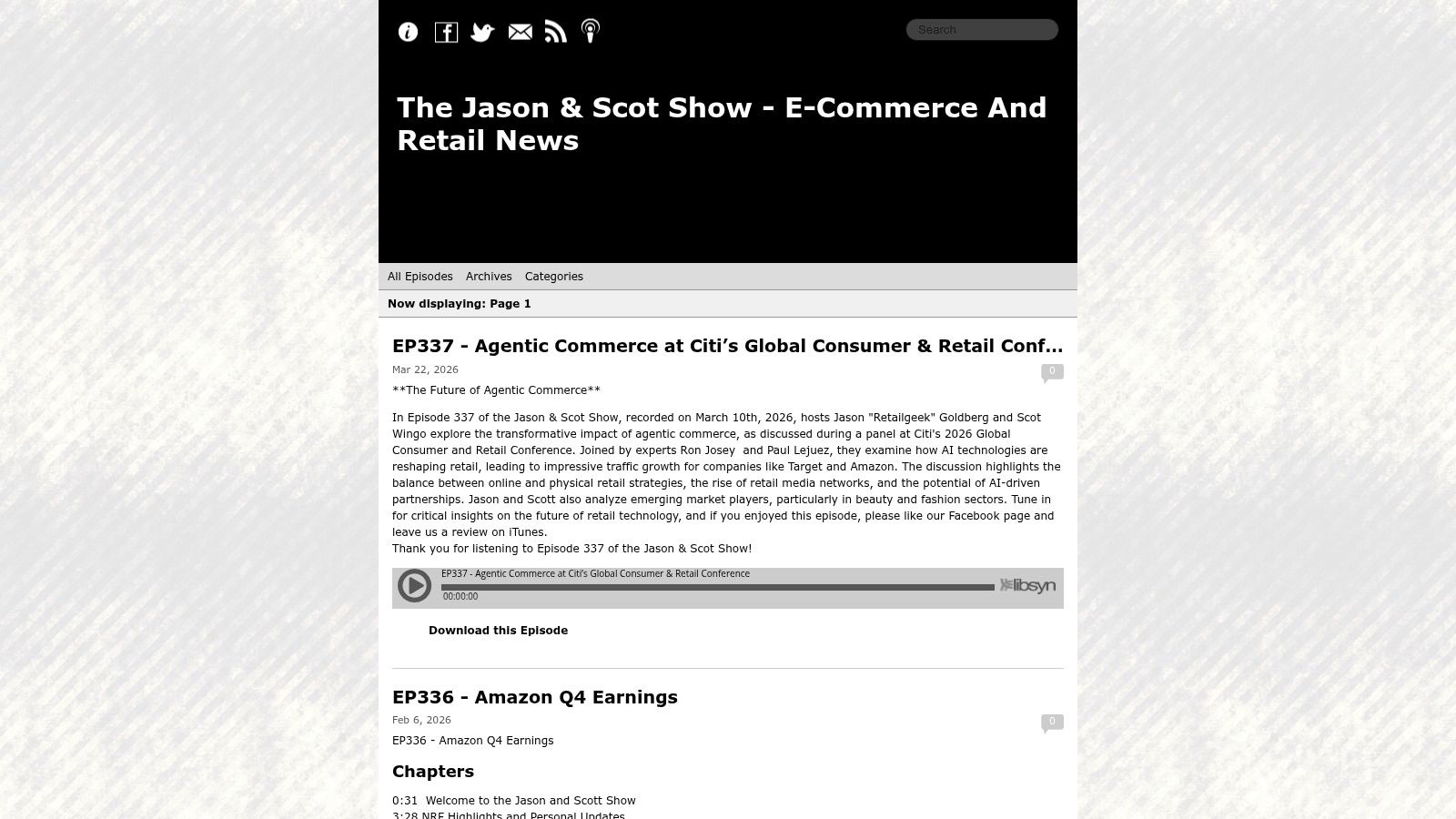
That’s not a small distinction. At 7 figures and above, leaders don’t just need tactics. They need context. Why does a platform move matter? Which retail earnings call changes planning assumptions? Which policy shift deserves action now, and which one is just conference noise?
This show is built for that layer of thinking.
Jason Goldberg and Scot Wingo have spent enough time around ecommerce and retail infrastructure to give events historical context, not just hot takes. That makes the show useful for founders, GMs, operators, and board-facing executives who need to understand the broader terrain.
You’re not coming here for campaign hacks. You’re coming here to build judgment.
That’s especially useful if your business spans Amazon, DTC, marketplaces, and retail partnerships. A lot of podcasts stay trapped inside one operating model. This one doesn’t. It looks across the stack and asks how shifts in commerce technology, retail strategy, and platform behavior affect operators in practice.
If your brand is exploring larger retail relationships or strategic exits, that broader view becomes even more valuable. Selling into enterprise buyers requires a different lens than running weekly growth experiments. This primer on how to sell to Target is a good example of the type of strategic expansion work that pairs well with this podcast.
Don’t put this on for your media buyer and expect immediate execution ideas.
Use it for:
The downside is obvious. It can feel one level removed from day-to-day execution. If you need detailed answers on how to improve a PDP, restructure a Klaviyo flow, or tighten your Amazon listing stack, this won’t be your first stop.
Still, for macro awareness, it’s one of the strongest picks on the list.
Boardroom filter: If an industry headline could change hiring, inventory, or channel allocation decisions over the next two quarters, queue this show before you react.
For many senior teams, that’s what makes it the best ecommerce podcast in a very specific category: not tactical depth, but strategic interpretation.
Your paid media is working, sessions are up, and conversion still stalls on the same collection templates, product pages, and merchandising paths. That is the moment The Unofficial Shopify Podcast becomes more useful than another broad ecommerce interview show.
For 7 and 8 figure founders on Shopify or Shopify Plus, platform fluency is an operating advantage. General advice can point you in the right direction. Actual gains usually come from fixing how the store is structured, how products are merchandised, which apps deserve to stay, and where the customer journey breaks after the click.
This show is strongest when the problem is specific to the Shopify stack, not ecommerce in the abstract.
That includes questions like:
That focus matters more at scale. A founder running a multi-market catalog, subscription layer, wholesale workflow, or a heavy promotion calendar does not need more beginner content about "starting a store." The useful question is which platform changes will improve margin, conversion, and team efficiency over the next two quarters.
The host’s style helps here. The advice is opinionated and specific. For experienced operators, that is usually better than a neutral recap of every available option.
This is a sharp recommendation, not a universal one.
If Shopify is the core of your revenue engine, the show can help founders, ecommerce directors, and retention or site teams make better calls on where to focus. It is especially useful when growth has exposed operational debt. Too many apps, inconsistent merchandising, a cluttered frontend, or poor handoff between acquisition and onsite experience.
If your business is marketplace-first, heavily custom, or treating Shopify as one channel among several, the value drops. The same goes for teams looking for broad retail strategy, M&A perspective, or finance-first planning. Other shows on this list cover those jobs better.
There is one trade-off worth calling out. Some episodes are tool-heavy, and sponsors are part of the format. Mature operators can still get a lot from it, but they need to separate solid store strategy from software promotion.
Brands at this level rarely lose because nobody had another traffic idea. They lose because the store experience, merchandising logic, and platform setup cannot convert the demand they already paid for.
Used that way, this is one of the better podcasts for diagnosing Shopify-specific constraints before they turn into expensive growth problems.
A common 8-figure problem looks like this. Marketing says spend is working. Finance says cash is tightening. Operations says inventory is getting harder to trust. The Ecommerce Playbook is useful because it treats those as one operating problem, not three separate meetings.
That makes it a strong fit for founders running brands in the 7 to 9 figure range, where the constraint is rarely traffic alone. The harder questions sit upstream. How much growth can the business fund, what contribution margin is acceptable by channel, how creative spend should be paced, and where inventory risk starts to distort the P&L.
Common Thread Collective’s angle is clear. The show comes from operators and advisors who spend a lot of time on paid media, forecasting, and growth models. That bias is useful if your business needs better decision rules. It is less useful if you want broad retail reporting, founder storytelling, or detailed operational content on supply chain and fulfillment.
This is one of the better podcasts on this list for fixing the gap between acquisition performance and business performance.
For larger brands, that distinction matters. Revenue can rise while cash conversion gets worse. Blended ROAS can look acceptable while new customer economics weaken. Teams can also overfund creative testing or push spend into periods where inventory and margin do not support it. The Ecommerce Playbook keeps returning to those trade-offs.
Use it when the business is dealing with questions like:
That is why this show earns a place in a curated roadmap for serious operators. It helps founders prepare for scale with better financial logic, and it also helps clean up the kind of reporting mess that creates problems during fundraising, diligence, or an eventual sale process.
The agency perspective cuts both ways.
You get sharper frameworks than you will from many founder-led podcasts because agencies see repeated patterns across accounts. You also get recommendations shaped by an agency model, which means some ideas can skew toward media efficiency and planning structure over org design, wholesale strategy, or longer-term brand questions. Mature operators should take the frameworks, then test them against their own SKU mix, replenishment cycle, and capital constraints.
Operator note: If the marketing team reports MER, CAC, and top-line revenue, but nobody in the room is discussing contribution margin, inventory exposure, and cash timing, the business is still managing channels, not managing growth.
For founders choosing podcasts by business problem, not entertainment value, this is one of the better listens for profitable growth planning. It is especially strong for teams that need tighter forecasting, cleaner finance-marketing alignment, and better preparation for the next stage of scale.
EcomCrew Podcast is the show to queue when the week’s problem is operational, not editorial. A shipment is late, Amazon changes a policy, margins tighten on a core SKU, and the team needs better decisions fast. That is where this podcast earns its place in a listening rotation for 7 to 9 figure founders.
It stays close to the work. You hear practical discussion on sourcing, listings, freight, product selection, fulfillment, and the day-to-day constraints that shape marketplace economics. For operators with meaningful Amazon exposure, that is far more useful than another broad founder interview about growth.
The value here is range across the parts of the business that move marketplace performance. Ads matter, but so do review quality, listing conversion, replenishment timing, supplier discipline, and policy exposure. EcomCrew tends to treat those issues as connected, which is the right frame for larger brands where one bad inventory call can wipe out a quarter of progress.
It is a strong fit for founders dealing with questions like:
That makes the show useful beyond pure Amazon tactics. It helps leadership teams tie operating decisions to capital allocation, which is the kind of conversation mature brands need before a major expansion, a channel shift, or diligence.
This is not passive listening.
Some episodes go deep into marketplace mechanics, and that can feel narrow if your background is mostly DTC creative, retention, or merchandising. For Amazon-first or hybrid businesses, that specificity is a strength. For brands with limited marketplace exposure, it will be a selective listen rather than a weekly default.
Topic depth also varies. The smart move is to listen by business problem. If the company is reworking supplier terms, cleaning up catalog complexity, or pressure-testing inventory assumptions, this show is worth the hour.
Operator note: If Amazon is more than a side channel, treat EcomCrew as an operating tool. Use it when the team is making decisions on sourcing, inventory, or channel dependence that will affect margin and cash for the next two quarters.
For founders filtering podcasts by strategic use case, EcomCrew fills a specific role. It is one of the better listens for marketplace-led brands that need sharper operational judgment, better risk control, and a more disciplined path to scale.
A founder is in the middle of a familiar problem. Paid media is getting less efficient, repeat rate is soft, ops is protecting cash, and finance wants a cleaner plan for the next two quarters. A specialist show can solve one slice of that. 2X eCommerce Podcast is more useful when leadership needs to connect the slices.
That is why it belongs on a shortlist for 7 to 9 figure brands.
This show works best as a cross-functional filter. The strongest episodes help founders and senior operators examine how acquisition, retention, margin, and execution affect each other, instead of treating them as separate team dashboards.
That matters at scale. Once a brand is large enough to have channel leads, agency partners, and a finance function pushing on different constraints, the primary job is alignment. 2X eCommerce helps leadership teams frame the problem the same way before they start changing budgets, offers, or operating targets.
The guest mix helps. You hear from founders, operators, and service providers, but the better conversations stay close to execution. The useful episodes tend to surface trade-offs, what broke, what took longer than expected, and which changes held up after implementation.
This is a smart listen for:
It is a weaker fit if the immediate need is highly technical Amazon execution or detailed Shopify theme and app work. Other podcasts on this list go deeper there.
The practical move is to use this show by business challenge. Queue episodes when the company is trying to improve contribution margin without stalling growth, tighten retention economics, or get better alignment between marketing plans and financial reality. For founders thinking about readiness for a capital event or eventual M&A, that cross-functional lens is more valuable than another episode full of surface-level tactics.
Not every episode will justify an hour. That is fine. This is a selective listen with a broad enough aperture to help senior teams pressure-test decisions that sit between departments.
Operator note: Use 2X eCommerce when the issue is not "how do we improve one channel?" but "how do we get growth, ops, and finance to make the same decision on purpose?" That is where the show is strongest.
For experienced founders, 2X eCommerce fills a gap many ecommerce podcasts miss. It helps leadership teams connect specialties, weigh trade-offs clearly, and make better scaling decisions without dropping into beginner content.
| Podcast | 🔄 Implementation Complexity | ⚡ Resource Requirements | 📊 Expected Outcomes | 💡 Ideal Use Cases | ⭐ Key Advantages |
|---|---|---|---|---|---|
| The eComFuel Podcast | Moderate, assumes familiarity with ecommerce P&L and ops | Moderate time commitment; prior operator experience helpful | Deep tactical insights on margins, pricing, inventory, M&A | Advanced operators and founders seeking in‑depth operational breakdowns | High signal-to-noise; consistent, candid founder & expert interviews |
| DTC POD by Trend | Low–Moderate, fast, tactical episodes with rapid format | Regular listening and team capacity to run creative/media tests ⚡ | Actionable media buying and creative testing playbooks | Growth teams focused on paid social, creative testing, and acquisition | Highly tactical and up‑to‑date on paid social shifts |
| The Jason & Scot Show | Low, analysis and news synthesis, less hands‑on how‑to | Low time to stay informed; useful for leadership briefs | Boardroom‑ready context on macro retail/ecommerce trends 📊 | Executives and leaders needing earnings, policy and platform context | Objective, data‑driven takes with strong historical context |
| The Unofficial Shopify Podcast | Low–Moderate, Shopify‑centric tactical episodes | Requires Shopify/Plus environment or agency support to implement | Practical UX/CRO, app and merchandising tactics that move revenue | Merchants and agencies running on Shopify/Plus looking for hands‑on fixes | Very actionable Shopify‑focused guidance and clear experiments |
| The Ecommerce Playbook (Common Thread Collective) | Moderate, frameworks require cross‑functional translation | Needs marketing + finance alignment to adopt templates ⚡ | Improved budgeting, forecasting and profitable scaling | CFO/CMO alignment, teams translating media performance to P&L | Concrete templates and financial operating frameworks for paid social |
| EcomCrew Podcast | Moderate–High, detailed Amazon/marketplace operational tactics | Operational resources (sourcing, logistics, seller tools) to apply | Better listings, sourcing, supply‑chain and compliance outcomes 📊 | Sellers and brands prioritizing marketplaces and FBA operations | Strong Amazon fundamentals and supply‑chain efficiency guidance |
| 2X eCommerce Podcast | Moderate, mix of strategic frameworks and tactical takeaways | Cross‑functional teams to implement acquisition and LTV frameworks | Balanced improvements in acquisition, margin optimization and retention | Teams aligning marketing, finance and ops for scalable growth | Balanced coverage of growth + profitability with international perspective |
Monday morning, the leadership team is staring at three different fires. CAC is drifting up, inventory is tight on two core SKUs, and finance does not trust the growth plan marketing wants to push. In that situation, another hour of general ecommerce content is a waste. A focused podcast queue can help, but only if each show is tied to a real operating constraint.
That is the standard for a 7 to 9 figure founder. These podcasts are not background noise. They are inputs for decisions you already need to make.
Start with a 90 day problem list, not a favorites list. Pick the one issue that matters most right now, then assign the show that gives you the best signal on that issue. The Ecommerce Playbook fits teams trying to tighten forecasting, contribution margin discipline, and CFO-CMO alignment. EcomCrew is the better choice if Amazon exposure, sourcing, freight, or inventory planning is driving risk. The Jason & Scot Show helps leadership teams stay current on platform, policy, and retail shifts that can change channel strategy fast. The Unofficial Shopify Podcast earns its place when the problem is site conversion, merchandising, or Shopify-specific execution gaps.
Use the same filter across the full list. The useful question is not, "What is the best ecommerce podcast?" The useful question is, "What should my team listen to this quarter to improve one high-value decision?"
Then build a system around it.
A large share of ecommerce podcast content still targets early-stage operators. Founders at scale need narrower material. They need operator conversations about margin pressure, team design, channel concentration, capital allocation, and transaction readiness. That is the difference between content that feels useful and content that changes how the company runs.
Discussion matters more than listening. A strong episode can surface an idea, but the value shows up when an experienced team pressure-tests it against your numbers, your channel mix, and your constraints. I have seen good ideas fail because they were copied without context. I have also seen a single episode lead to a better inventory policy or cleaner board reporting because the team translated the insight properly.
If you’re also thinking about the other side of the microphone and want to understand distribution mechanics, this guide on how to promote your podcast is a useful companion.
Curate harder. Listen with a job to do. Apply what survives real scrutiny.
That is how a podcast becomes an operating tool instead of another tab open in the background.
Million Dollar Sellers is where high-revenue ecommerce founders turn insights into action. If you’re building across Amazon, DTC, and omnichannel, and you want a trusted peer group of operators who understand the decisions behind real scale, apply to join Million Dollar Sellers.
Join the Ecom Entrepreneur Community for Vetted 7-9 Figure Ecommerce Founders
Learn MoreYou may also like:
Learn more about our special events!
Check Events