Chilat Doina
August 1, 2026
You've got a product that sells, the traffic is there, and the next move looks obvious, private label manufacturing. Then the first supplier quote lands, the sample looks fine on camera, and the questions start piling up. Who owns the spec, who controls quality, what happens when demand spikes, and how do you keep the margin you thought you bought?
Private label manufacturing has moved far beyond a quick branding shortcut. In the U.S., PLMA said store-brand sales reached $282.8 billion in 2025, up more than $9 billion from 2024, and earlier reported $236.3 billion in 2024, up $10.1 billion from 2022, which tells you this isn't a side channel anymore, it's a real manufacturing engine behind retailer-owned brands (PLMA). Global market estimates also place private label at $915.1 billion in 2024, with projections to $1.623 trillion by 2034 at a 5.9% CAGR, while Europe remains the most mature region with about 39% grocery share in 2024 and roughly $412 billion in value (CustomCY).
For ecommerce founders, that scale matters because it changes the game. You're not just buying a generic item and putting a logo on it, you're building around controlled sourcing, repeatable QC, and a supply chain you can defend.
Practical rule: treat private label as a portfolio of SKUs with different risk levels, not as a single hero product. One strong launch can still fail as a business if sourcing, packaging, or replenishment breaks under pressure.
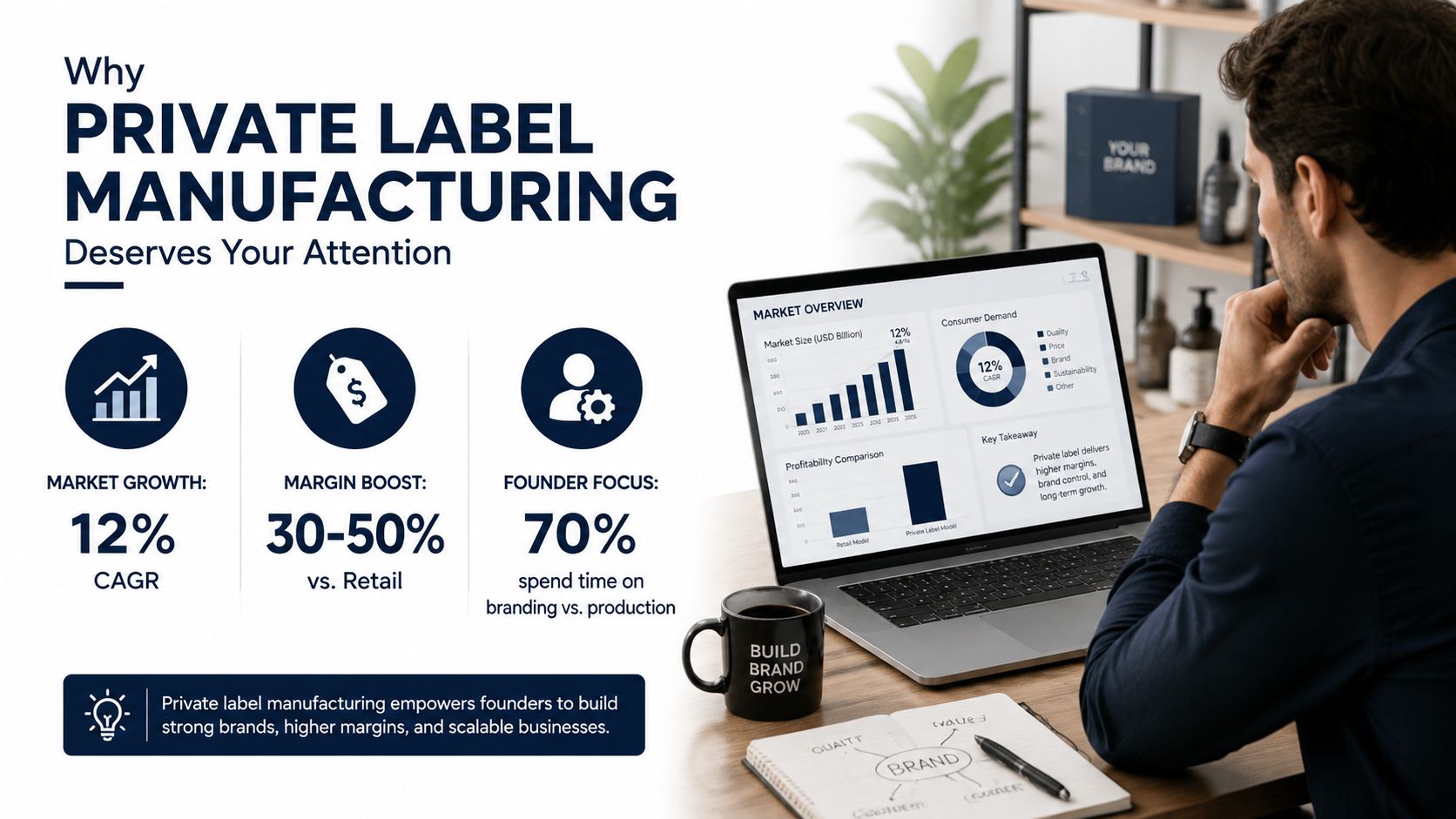
A lot of founders come to private label manufacturing after they have already proven demand in one channel and want tighter control over margin. Usually that means they have outgrown reseller arbitrage, or they are tired of competing on price for someone else's brand. The appeal is straightforward, if you can shape the product, packaging, and supply chain, you are no longer renting somebody else's economics.
The hard part is that private label is not a shortcut. It is a manufacturing decision disguised as a branding decision, and the gap between those two things is where many founders lose money. The first order can look healthy on paper, while the business gets squeezed later by rework, replacements, freight surprises, or a supplier that cannot hold quality once volume rises.
That is why the opportunity should not be framed as easy margin. It is about scale, category control, and building a brand that is not fully exposed to a national competitor's pricing move. Once you start managing reorder timing, supplier accountability, and quality drift, the operating model matters more than the launch hype.
In practice, private label manufacturing means you define enough of the product to make it yours, while a factory produces it at repeatable quality. Depending on the category, that can mean everything from the formulation and component spec to packaging, labeling, test requirements, and carton configuration. The strongest brands I have seen do not obsess over owning everything, they focus on owning the parts that protect differentiation and margin.
The mistake is thinking the supplier relationship ends at the purchase order. The operational work starts when production problems, reorder timing, and customer complaints show up together.
That is also why a founder has to think like an operator, not just a marketer. The better question is not, “Can I launch this SKU?” It is, “Can I source it, protect quality, and scale it without the wheels coming off?”
A short vetting checklist keeps that question honest. The supplier has to answer clearly on capabilities, quality systems, communication speed, and what happens when a run goes sideways. A useful starting point is this supplier vetting checklist, because the early signal from a factory often tells you more than the polished sample does.
If you are comparing categories, the sourcing logic still matters. A resource like private label collections without setup costs can help you see how suppliers package existing formats for brand owners, but the core lesson stays the same, do not confuse a catalog listing with a qualified manufacturing partner.
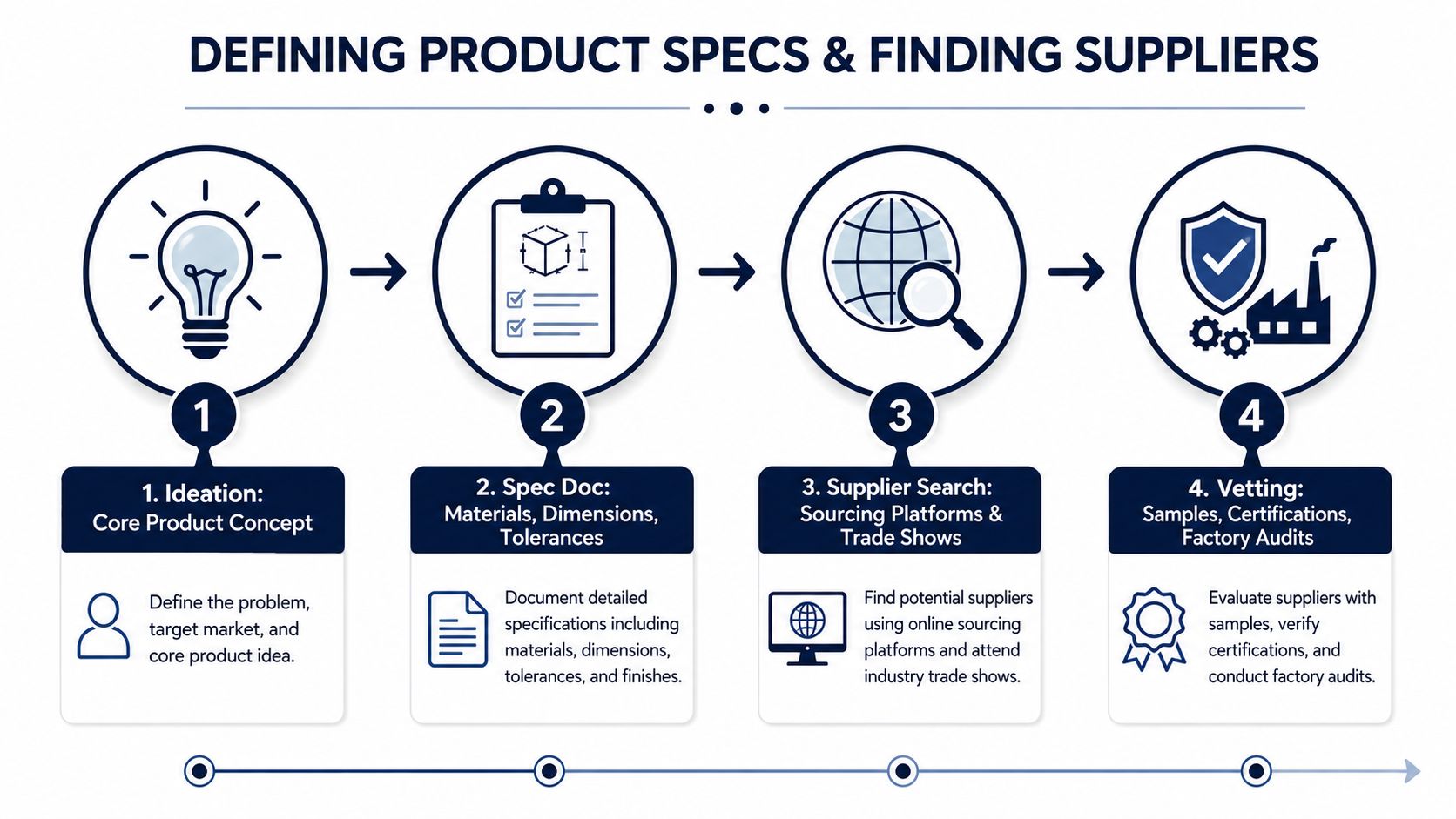
The fastest way to waste weeks is to ask suppliers for “a quote” before you've written a real spec. Good factories want a clear target, not a vague idea. If you send them a sloppy brief, they'll fill in the blanks in the cheapest way possible, and you'll end up sampling something that never had a chance to match what you had in mind.
A usable product spec document should cover the material make-up, dimensions, tolerances, packaging requirements, labeling, compliance expectations, and any performance requirement that matters to the customer. The more measurable the product is, the easier it is to compare samples, push back on substitutions, and keep production consistent across reorders. If you can't point to the spec when the sample arrives, you'll end up debating taste and opinion instead of acceptance criteria.
That same discipline applies when you're sourcing across categories. If you're researching a category like jewelry, a resource such as private label collections without setup costs can help you think about how suppliers package existing formats for brand owners, but the core lesson stays the same, don't confuse a catalog listing with a qualified manufacturing partner.
A short vetting checklist helps keep the process honest. The strongest supplier conversations usually answer three questions quickly, can they make this product repeatedly, can they document how they do it, and can they speak clearly about what they won't do. If a supplier stays vague on materials, dodges sample timing, or answers every technical question with “no problem,” that's usually not a strength, it's a warning sign. For a deeper framework, use a formal supplier vetting checklist before you spend too much time on back-and-forth.
Most founders start with a long list, often fifty or more names from marketplaces, directories, or trade shows. The goal is to compress that into three to five real contenders. I filter by manufacturing evidence first, responsiveness second, and willingness to work from a spec third, because all three matter more than polished sales language.
The right shortlist saves you more than time. It reduces the odds that you'll build your launch plan around a factory that was never a fit in the first place.
Samples are where private label manufacturing gets real. The first sample isn't just a product, it's a reading on how the factory thinks. If they can't follow a sample brief, they won't magically become more precise when you place a production order.
The sample stage should answer whether the supplier can hit your target on material feel, finish, fit, packaging, and repeatability. If you ask for a premium sample, make sure you know why you're paying extra, because sometimes the upgraded sample is useful for validation and sometimes it's just a prettier version of something the factory can't sustain at scale. I've learned to compare every sample against the spec sheet line by line, then ask what changed, why it changed, and whether the change affects cost or reliability.
The biggest mistake is approving a sample because it “looks close enough.” Close enough is expensive later. It creates a production line full of exceptions, and exceptions are where margin disappears.
A real MOQ conversation starts with the landed cost, not just the factory quote. You need to know what each unit costs after freight, duties, inspection, packaging variances, and defect allowances. That's the only way to understand where the SKU becomes profitable, and whether the supplier's price break is real or just a mirage.
| Cost Component | Typical Range | Notes |
|---|---|---|
| Factory unit price | Varies by supplier and spec | The base quote for the finished item |
| Sampling | Varies by supplier and revision count | Useful for validation, but can expand quickly |
| Tooling | Varies by category | Often relevant for custom parts or packaging |
| Freight | Varies by lane and mode | Changes with order size and shipping method |
| Duties | Varies by product classification | Needs to be built into landed cost |
| Inspection | Varies by service scope | Third-party checks reduce surprise defects |
| Defect allowance | Varies by category risk | Protects your margin model from scrap and replacement |
Negotiation works best when you give the supplier a path to upside. Tiered pricing commitments, trial orders with an agreed follow-on volume, and shared tooling arrangements can all make the numbers work without forcing you to overbuy too early. The trick is to avoid acting like you're trying to win a one-time auction. Good manufacturers respond better to a credible growth path than to pressure.
For founder-level context on custom production economics, the broader contract-manufacturing discussion in the earlier section is useful, but the operating principle here is simple. If you can't explain your unit economics clearly, you're not ready to negotiate them well.
A clean sample can hide a weak process. The test starts when the factory runs at volume, and that is where a lot of private label margins get chewed up by rework, chargebacks, and customer complaints.
A working QC program starts before production and continues through shipment. Pre-production inspections confirm that the factory has the right materials and setup. In-line checks catch workmanship problems before the whole batch is affected. Pre-shipment audits keep the same defect from showing up in every carton after the goods are already on the water.
That layered setup matters because a supplier can still make the right sample and ship the wrong batch. The cleanest way to reduce that risk is to spell out acceptance criteria in the contract, including what happens when defects appear. If remediation is vague, the factory keeps more of the upside than you do, and you carry the cost of the mistake.
Compliance and IP should sit beside QC, not behind it. A strong trademark position, design protection where it applies, and an NNN agreement for overseas manufacturing reduce exposure, but only if the paperwork matches the actual process on the floor. A quality-control framework belongs with the commercial agreement, and the supplier vetting checklist is useful before you commit to a factory, but neither replaces day-to-day verification. Managing that risk also means managing supply chain disruptions before they turn into missed fills and rushed substitutions.
Practical rule: if a supplier resists documentation, skips traceability, or won't define how defects are handled, the relationship is not ready for scale.
Third-party inspection makes sense when the category is new to you, the supplier relationship is still young, or the cost of a bad batch would hurt the brand more than the inspection fee would hurt cash flow. Internal QC becomes more useful once you have enough repeat volume to know the failure modes and inspect against them consistently. Most founders need both at different stages.
The shift is to treat QC as a contract, a process, and a habit of verifying what was promised before the product reaches your customer.

The first order gets too much credit. Founders celebrate the launch, the photos look good, and the first shipment lands cleanly. Then the problems show up, lead times shift, a component runs short, labor gets tight, or demand spikes faster than the factory can handle.
That's the part that eats margin. The earlier operational guidance on private label manufacturing points to forecasting, labor flexibility, and monitoring labor cost per unit across SKUs, because idle capacity and promo-driven disruption can turn a profitable item into a noisy one very quickly ([Indeed administrative] or similar? Wait not allowed). You can't bank on launch-day success if your replenishment system can't hold service levels when the order curve changes. The question is how you protect the business after the first good month.

Dual sourcing is the cleanest insurance policy, but it only works if both suppliers can work from the same spec. Safety stock can cover demand noise, but only if you're honest about lead times and don't let inventory optimism replace forecasting. Supplier diversification matters too, especially when one factory is carrying too much of the category risk.
The resource managing supply chain disruptions is worth reviewing for a broader resilience mindset, because the logic is the same whether you're shipping containers or replenishing retail inventory. Strong private label operators don't just negotiate price, they negotiate continuity.
Volume can expose problems that were invisible at launch. A supplier that was responsive at low order quantities may become slow once your line gets busy. A product that passed QC on a small batch can drift when labor changes or a material substitution sneaks in.
Halfway through scale, many founders discover they were depending on one person at the factory, one freight lane, or one inventory assumption. That's why I'd rather see a boring operation with redundant pathways than a flashy launch that can't survive a refill cycle. For a more formal way to think about the risk layer, tie your private label process to a supply chain risk management strategy before you're forced to learn it during a stockout.
Private label profitability survives on control, not optimism. If you can't protect fill rate, quality, and replenishment discipline when demand swings, the margin you thought you bought will get spent somewhere else.
Once the product works, logistics becomes the growth lever that either compounds your advantage or drains it. Freight forwarding, customs brokerage, warehousing, and inventory systems are not back-office details. They shape how fast you can reorder, how many SKUs you can support, and how much cash gets trapped in the wrong place.
The resource Haulier.AI's UK container guide is a useful reference point if you're thinking about container handling and transport planning, because founders often underestimate how much execution quality depends on the movement between factory, port, warehouse, and channel. The best operators make those handoffs boring.
Over-ordering to chase lower MOQs feels efficient until cash gets tied up in slow-moving units. Under-investing in packaging differentiation saves pennies and costs branding power. Ignoring currency movement can make a quote look better than it really is. Failing to systematize supplier communication turns every reorder into a scramble.
The scalable approach is to define readiness by stage. At the start, you need one trusted lane and one solid warehouse process. As SKU count grows, you need inventory visibility, channel-specific replenishment rules, and a cleaner handoff between commercial planning and operations. If you're using a freight forwarder for Amazon FBA, make sure the forwarder fits your replenishment cadence, not just your first shipment.
Bringing manufacturing closer to home can make sense when speed, oversight, or risk reduction matters more than the cheapest per-unit quote. Custom tooling makes sense when the economics of repeat volume justify owning the form factor instead of borrowing somebody else's. Both decisions should come after you've proven demand, not before.
A strong private label operation compounds because the founder keeps improving the system, not just the SKU. That means better specs, cleaner supplier communication, tighter logistics, and a habit of reviewing where margin leaks.
If you're building private label SKUs and want to compare notes with operators who've already lived through supplier failures, QC misses, and scale-up headaches, join Million Dollar Sellers. MDS gives ecommerce founders a vetted peer network, strategy sharing, and practical operator insight that's useful when you're making real sourcing and logistics decisions. If you're serious about building a private label brand that lasts, it's worth seeing how top sellers handle the same problems.
Join the Ecom Entrepreneur Community for Vetted 7-9 Figure Ecommerce Founders
Learn MoreYou may also like:
Learn more about our special events!
Check Events