Chilat Doina
April 19, 2026
TikTok Shop stopped being a side experiment the moment U.S. sales jumped 108% in 2025 to reach $15.82 billion in GMV, with the platform taking 18.2% of total U.S. social commerce according to eMarketer’s TikTok Shop market share and GMV reporting. For established Amazon and DTC operators, that changes the question. It’s no longer whether TikTok matters. It’s whether your business can plug into that demand without wrecking margin, inventory flow, or customer experience.
Most content for tiktok sellers is aimed at beginners chasing views, affiliate hacks, or random product trends. That’s not the primary challenge for a serious brand. The actual difficulty is integrating a volatile, content-driven sales channel into an operation that already has Amazon forecasts, Shopify retention targets, warehouse constraints, and contribution margin guardrails.
Brands that win on TikTok usually don’t treat it like social media. They treat it like a fast-moving demand engine with unusual merchandising rules.
There are approximately 15 million merchants on TikTok worldwide, with over 500,000 sellers based in the United States as of 2025, and sales from the 171,000 U.S. small businesses on the platform grew 70% year over year according to AMZScout’s TikTok Shop seller statistics. That seller density matters because it tells you two things at once. First, buyer behavior has already shifted. Second, competition is no longer limited to scrappy creators selling impulse products.
Established brands now sit in the same ecosystem as affiliates, creators, and livestream operators. If you come from Amazon or DTC, the mistake is assuming all TikTok sellers are playing the same game. They’re not.
The platform in 2026 is built around three seller types.
Integrated brand-sellers are the Amazon and Shopify operators bringing existing SKUs, retention systems, and supply chain discipline into TikTok Shop. They care about inventory sync, unit economics, and whether the channel creates incremental demand or just shifts sales from one storefront to another.
Performance-based creator-affiliates are media operators. They may never touch inventory, but they can move product fast if incentives align. For a brand, they’re not just influencers. They’re a distributed sales force with uneven quality control.
High-GMV livestream hosts operate closer to event commerce than traditional retail. Their value isn’t polished branding. It’s urgency, interaction, and velocity.
That distinction matters because your operating model changes based on the role you choose. A beauty brand launching a hero SKU through affiliates needs a very different setup than a supplement brand using recurring creator content to feed an evergreen catalog.
Practical rule: Don’t ask how to “sell on TikTok.” Ask which selling model fits your existing business without breaking your existing operation.
The bigger shift is strategic. TikTok is becoming part of a broader commerce stack where discovery, transaction, and fulfillment happen in tighter loops. If you’re thinking about where this goes next, Zinc’s perspective on Agentic Commerce is useful because it frames commerce as something increasingly driven by automated decision layers, not just storefront traffic.
For omnichannel brands, TikTok is one of the clearest examples of that shift. Demand doesn’t begin with a search bar. It starts with content, behavior signals, and algorithmic distribution.
Here’s the operational takeaway.
| Seller type | Primary strength | Main risk for established brands |
|---|---|---|
| Integrated brand-seller | Control over margin, inventory, and customer experience | Moving too slowly for platform velocity |
| Creator-affiliate | Fast content output and broad reach | Weak brand control and inconsistent profitability |
| Livestream host | Immediate sales spikes and strong conversion behavior | Fulfillment pressure and post-event operational strain |
If you’re already running Amazon and DTC at scale, TikTok shouldn’t sit under “social.” It belongs under channel strategy.
TikTok Shop behaves less like Amazon search and more like a digital town square. Products don’t win because they’re stuffed with keywords. They win because the algorithm sees people stop, watch, react, and buy.
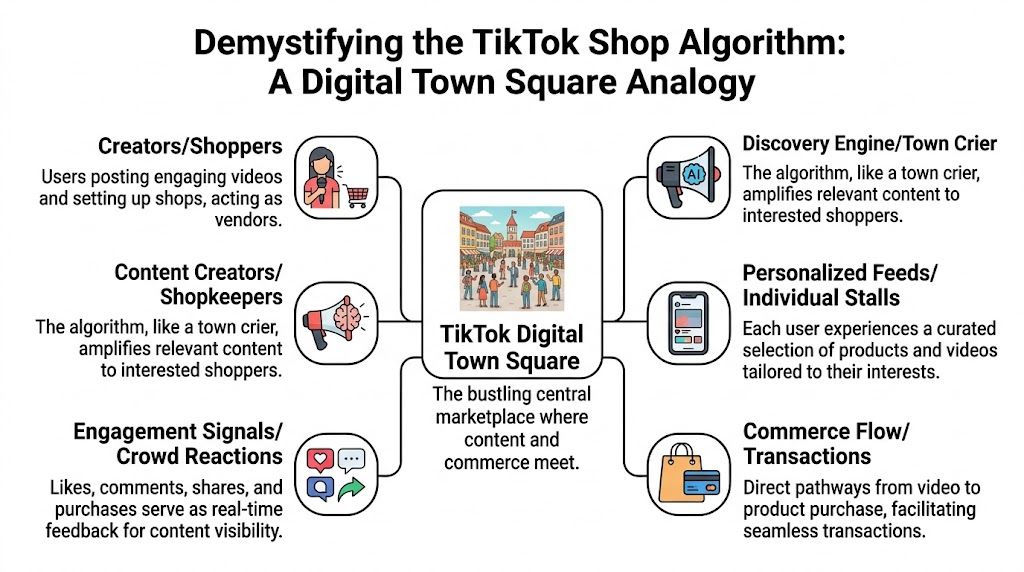
Think of the algorithm as the town crier. It notices where the crowd gathers, then sends more people there. If your product listing and content create strong audience response, the system amplifies distribution. If people bounce, the crowd disappears quickly.
That’s why so many Amazon-native operators struggle early. They optimize static listings when TikTok rewards dynamic performance.
TikTok’s ranking system heavily prioritizes engagement, with watch time and video completion rates accounting for approximately 40% of product listing ranking decisions, and top performers seeing LIVE shopping conversion rates of 8% to 12% versus 2% to 4% from short videos according to Apollo Technical’s breakdown of TikTok Shop ranking behavior.
Those numbers tell you where to focus.
A listing page still matters. Clear product specs, usable images, and coherent descriptions are table stakes. But on TikTok, listing quality mainly supports distribution. It doesn’t create it by itself. The actual engine is content performance.
For tiktok sellers, that creates a very different optimization loop:
LIVE works because it compresses discovery, objection handling, and purchase intent into one session. A shopper can see the product, ask a question, hear the answer, and check out without leaving the buying context.
That interaction creates a feedback loop. More comments and conversions tell TikTok the session is worth showing to more people. On Amazon, conversion mostly happens after search. On TikTok, conversion helps create reach.
The algorithm doesn’t reward polished brand content by default. It rewards content that holds attention long enough to produce buying signals.
Brands coming from DTC often overproduce content and underengineer response. They shoot beautiful videos that say nothing useful, then wonder why reach dies. Amazon-native teams make a different mistake. They obsess over catalog setup but ignore the creative system needed to feed the algorithm.
A better operating framework looks like this:
The algorithm is telling you what matters. It’s not asking whether your brand deck looks premium. It’s asking whether people cared enough to stay.
TikTok Shop is already large enough to matter to serious operators. Reuters reported that TikTok Shop generated about $33 billion in global gross merchandise value in 2024, which is why established brands can no longer treat it like a side experiment for interns or creator teams alone (Reuters reporting on ByteDance and TikTok Shop growth).
The real decision is structural. A 7- to 9-figure Amazon or DTC brand needs to decide how TikTok will make money without breaking inventory planning, margin targets, customer support SLAs, or channel pricing discipline.
Three models matter: direct brand selling, affiliate-driven selling, and livestream commerce. Each can work. Each creates a different mix of contribution margin, control, and operational load.
Direct selling gives the brand the most control over the channel. You own the listings, choose the assortment, set bundle strategy, and decide how much inventory TikTok gets versus Amazon FBA, your 3PL, or retail commitments.
That control matters more for larger brands than beginner content usually admits. If a hero SKU goes viral on TikTok but is also driving rank on Amazon, a stockout hurts twice. If you run aggressive TikTok pricing without channel guardrails, retail partners notice. If support times slip, the problem shows up in reviews and refund rates fast.
This model fits teams that already have:
The upside is clean brand control and better margin retention.
The risk is simple. Owning the storefront does not create traffic, and many mature operators underestimate the amount of content throughput required to keep sales coming.
Affiliate solves a different problem. It gets more selling content into the market without building a full internal creator bench first.
For bigger brands, affiliate should be treated like a performance channel, not a branding exercise. Commission rate, sample cost, creator approval speed, usage rights, and return rate all affect the economics. A creator who can drive 500 orders at a weak margin is not automatically more valuable than one who drives 150 profitable orders with reusable content rights.
Affiliate tends to work best when:
The trade-off is lower message control. That matters more in regulated categories, premium positioning, and any catalog where one bad claim can trigger platform issues or legal review.
Live selling is a demand spike channel. It can move units fast, especially for launches, seasonal pushes, overstocks, and bundles that need explanation.
It also exposes weak operations faster than any other TikTok model. Forecasting gets harder because order curves are compressed into short windows. Support volume rises the same day. Picking and packing can break if the warehouse is staffed for average daily demand instead of event-based surges.
I have seen brands run strong live sessions and still lose money because they measured revenue, not net contribution after discounting, host cost, creator payout, returns, and expedited fulfillment.
Use livestreams once the basics are already in place:
For established operators, the right answer is usually a staged hybrid.
| Model | Margin control | Brand control | Demand generation speed | Operational difficulty |
|---|---|---|---|---|
| Direct shop | High | High | Moderate | Moderate |
| Affiliate | Lower | Medium to low | High | Moderate |
| Livestream | Variable | Medium | High | High |
Start with direct selling on a narrow SKU set. Pick products with healthy margin, low return risk, and no complicated compliance issues. Add affiliates after your team understands TikTok-specific CAC, refund behavior, and fulfillment pressure. Add live once inventory allocation, order routing, and support staffing can handle spikes without hurting Amazon or DTC performance.
The highest-performing brands treat TikTok Shop as one more profit center inside an omnichannel system. They do not hand it to social media managers and hope for viral revenue. They assign channel P&L ownership, inventory rules, creator workflows, and fulfillment SOPs. If your team needs more ad creative volume while building that system, the ShortGenius AI TikTok ad generator can help fill testing gaps without waiting on a full internal production cycle.
Scaled brands don’t grow on TikTok by waiting for one video to go viral. They grow by building repeatable systems for creative output, creator partnerships, and paid amplification.

The playbooks below work because they’re operational. They can be assigned, measured, and improved.
The most practical way to start is to seed product broadly, but manage it tightly. Don’t treat seeding as PR. Treat it like performance sourcing.
Send product with a clear brief, usage angle, and basic guardrails. Keep the ask simple. You want creators to make native content, not read a script that sounds like legal approved it line by line.
What works:
What usually fails is overcuration. Big brands slow the process down with too many approval layers, then complain that creators aren’t responsive.
If your internal team needs more content throughput, tools like the ShortGenius AI TikTok ad generator can help create faster test variations around winning hooks and offers. That’s useful when you already know what message is resonating and need more iterations, not when you’re still guessing at core product-market fit.
Live shopping works best when it’s treated like an event, not a spontaneous stream. The sale starts before the camera goes on.
Use pre-event content to build interest around a single offer, limited bundle, or product story. During the live, the host should do three things repeatedly: demonstrate the product, answer objections, and restate the reason to buy now.
After the stream ends, don’t shut the campaign off. Cut clips, reuse proof moments, and keep the same offer architecture alive while intent is still hot.
The host matters, but the offer structure matters more. A good host with a weak offer still struggles. A solid offer gives even a decent host room to convert.
For brands that want external help with creator management or campaign execution, this guide to choosing a TikTok Shop agency is a useful reference point.
A practical walkthrough helps here:
Paid media on TikTok works best when it amplifies proven creative instead of rescuing weak creative. Don’t start by forcing spend into content that hasn’t earned attention organically or through affiliates.
Use paid to do three jobs:
Here, mature operators have an edge over beginners. You already understand contribution margin and creative fatigue. Apply the same discipline here. If a piece of content can’t carry buying intent, ad spend just makes the loss happen faster.
The strongest tiktok sellers don’t separate organic, affiliate, live, and paid into different silos. They use each as a signal source for the next move.
The operational risk isn’t demand. It’s what happens after demand shows up.
A 2025 eMarketer report notes that 68% of U.S. brands report fulfillment delays in TikTok Shop pilots due to poor ERP integrations, as cited in this discussion of TikTok Shop fulfillment issues. That’s the part beginner content usually skips. A growing channel is useful only if it doesn’t blow up your core business.
For established brands, the hard part is reconciling three very different operating rhythms. Amazon wants consistency. Shopify rewards retention and merchandising control. TikTok creates uneven bursts of demand tied to content and live events.
The most common mistake is feeding TikTok from the exact same available-to-sell inventory that supports Amazon FBA and DTC. On paper it looks efficient. In practice it creates stockout risk and bad internal decision-making.
A better model is a channel-buffer approach. Assign a dedicated TikTok allocation for your launch SKUs and replenish it on a scheduled cadence. That protects Amazon ranking and your DTC promises if a video or live event hits harder than expected.
This doesn’t require a huge catalog move. It requires discipline:
Native connectors are fine for basic entry. They’re usually not enough for a brand with multiple warehouses, Amazon constraints, bundles, or channel-specific packaging logic.
Middleware or multi-channel software becomes more useful when you need:
If your stack is already getting messy, review the options in this breakdown of multi-channel selling software. The point isn’t to buy software for the sake of it. The point is to avoid manual fixes that work at low volume and fail during a demand spike.
Most serious operators do better with a hybrid setup than an all-in commitment.
One workable structure looks like this:
| Channel layer | Best use | Operational goal |
|---|---|---|
| Dedicated TikTok inventory | Hero SKUs, launches, live events | Protect core channel stock |
| Core DTC inventory | Evergreen site demand and bundles | Maintain merchandising flexibility |
| Amazon inventory | Search-driven demand and Prime-oriented buyers | Preserve rank and service levels |
The warehouse side matters too. Your 3PL needs to understand that TikTok volume is bursty. A partner built around stable replenishment patterns may struggle with event-driven spikes, especially if your packaging, inserts, or SLA rules differ by channel.
A lot of operators delay TikTok because they’re worried it will cannibalize Amazon or DTC. Some overlap is normal. The smarter move is to structure the offer differently by channel.
Use TikTok for discovery-led bundles, launch packs, creator-linked assortments, or event-specific offers. Keep Amazon focused on search-intent SKUs and replenishment. Keep DTC reserved for broader assortment, retention flows, and higher-LTV behavior.
The goal isn’t to keep every customer in one lane. The goal is to stop one lane from breaking the others.
When tiktok sellers struggle at scale, it’s usually not because marketing failed. It’s because operations never got redesigned for content-driven volatility.
If you only watch GMV, TikTok can look healthier than it is.
Native TikTok Seller Center analytics often obscure true margins by ignoring fees that cause 20% to 40% profit erosion. A $100 GMV order can net only about $65 after referral fees, affiliate commissions, and COGS, according to Dashboardly’s analysis of TikTok Shop profitability tracking. That gap is where a lot of brands fool themselves.
The platform dashboard is built to show sales momentum. It is not built to tell you whether each order was worth taking.
At minimum, your team needs a reporting layer that combines storefront revenue, creator costs, refunds, ad spend, shipping outcomes, and COGS. If those numbers live in separate places, margin drift hides in plain sight.
The core KPI set should include:
If you need a tighter framework for that reporting discipline, this reference on key performance indicators for ecommerce is a practical place to align the team.
Compliance mistakes on TikTok don’t just create ad disapprovals. They can interrupt revenue.
That includes:
Established brands often assume their existing compliance process covers TikTok automatically. It usually doesn’t. Creator content introduces risk because your message gets translated through someone else’s delivery style.
Your safest TikTok content usually isn’t the most scripted. It’s the content built from clear approved claims, strong product proof, and simple creator guardrails.
The practical fix is boring but effective. Build a short claims sheet for each SKU, define red-line language, and review top-performing affiliate content quickly enough to keep momentum without losing control.
Profit leaks and compliance failures usually come from the same root issue. Teams scale activity before they build a system to govern it.
A serious TikTok launch shouldn’t begin with “let’s post more.” It should begin with channel design.
For an established brand, a clean 90-day rollout is usually enough to answer the only question that matters. Can this channel produce profitable, operationally manageable growth?
Start with a product-market-fit audit for TikTok.
Pick a small number of SKUs that are easy to explain visually, operationally safe to allocate, and margin-resilient enough to absorb creator and fulfillment costs. Set up channel-specific profitability tracking before the first order lands. Don’t rely on platform dashboards later and try to reconstruct the economics.
Your checklist:
Launch a pilot with controlled inputs.
Turn on your store, seed to a small creator group, and test content angles around use case, proof, comparison, and objection handling. Keep fulfillment tight and customer support briefed on likely friction points. Watch where operational strain shows up first.
A pilot is successful when it teaches you one of two things clearly. Either the unit economics work and the content engine is promising, or the business needs structural changes before you scale.
Scale what earns the right to scale.
Put more budget, more inventory, and more team attention behind the specific combinations that are working. That might be one creator segment, one live format, or one SKU bundle. Stop funding broad experimentation once the signal is clear.
Use this period to decide:
The brands that do well on TikTok in 2026 won’t be the loudest. They’ll be the ones that built a channel with enough control to survive success.
You can, but that doesn’t mean you should make it your default operating model. Shared inventory looks efficient until TikTok demand spikes at the wrong time and starts starving your Amazon listings or creating allocation problems for DTC. For most established brands, a protected TikTok buffer is safer than full inventory pooling.
Start with creators and content validation first. Paid works better when it amplifies proven hooks, not when it tries to force a weak product angle into the market. If the content isn’t converting organically or through affiliates, paid usually just gives you faster feedback on a bad offer.
They launch the channel through the marketing team without redesigning inventory and fulfillment rules. That’s what creates downstream chaos. TikTok demand doesn’t behave like Amazon search demand or DTC retention demand, so it needs separate safeguards.
Some overlap is normal, but poor channel strategy causes more cannibalization than TikTok itself. If you use the same products, same pricing logic, same inventory pool, and same offer structure everywhere, channels compete. If you differentiate merchandising and allocation, channels can support each other.
No. You need a repeatable content system. For many brands, that means a mix of internal operators, seeded creators, affiliate relationships, and selective paid amplification. The goal is consistent testing, not a massive in-house studio.
Usually no. Start narrow. Hero SKUs are easier to merchandise, easier to forecast, and easier to support operationally. Once your team understands the platform’s demand patterns and cost structure, you can decide whether expanding assortment improves profit.
Use three tests. First, does the channel create acceptable contribution margin after all costs. Second, can operations fulfill orders without damaging your other channels. Third, does the content engine produce repeatable demand instead of one-off spikes. If one of those breaks, scaling harder won’t fix it.
Million Dollar Sellers runs an invite-only community for established ecommerce founders operating across Amazon, DTC, and omnichannel. If you’re building TikTok Shop into a larger brand system and want peer-level conversations about channel strategy, ops, profitability, and execution, Million Dollar Sellers is where those discussions happen.
Join the Ecom Entrepreneur Community for Vetted 7-9 Figure Ecommerce Founders
Learn MoreYou may also like:
Learn more about our special events!
Check Events