
Chilat Doina
August 31, 2026
Working capital equals current assets minus current liabilities. For an ecommerce brand, the question is how much cash is deployable after stock in transit, prepaid media, and supplier terms.
You can have strong sales, a healthy-looking balance sheet, and still feel cash-starved on a Monday morning. That gap is where founders get tripped up, because the number on the page isn't the same thing as spendable money in the bank. Working capital is the bridge between those two realities, and in ecommerce that bridge is often narrower than it looks.

A founder checks Shopify and sees sales rising. Amazon payouts are arriving, ads are running, and the warehouse reports steady movement. The bank balance, however, barely covers payroll, freight, and the next supplier invoice. That mismatch shows why what is working capital is not only an accounting question. It is a problem of when cash leaves and when it returns.
Working capital describes the short-term resources remaining after near-term obligations are considered. The familiar formula is current assets minus current liabilities. A positive result can indicate that resources exceed upcoming claims, while a negative result may point to pressure in daily operations. For an ecommerce operator, the timing of those resources matters as much as the headline balance.
Inventory stored in FBA, goods moving through a 3PL, prepaid advertising, and unsettled platform fees may appear in the same short-term picture, yet none behaves like money in the bank. A supplier invoice due next week has a very different cash effect from a pallet of slow-moving SKUs that may sit for months. The accounting view is useful, but it does not show how quickly each asset can support the next payment.
Practical rule: an asset only helps with an upcoming bill if it can become cash quickly enough to pay it.
That distinction matters because ecommerce growth often pulls cash forward. A marketing push can lift revenue while a purchase order, freight booking, and prepaid campaign consume liquidity before customer payments or platform settlements arrive. Fees withheld by sales channels can widen the gap further. The business may look profitable on its income statement and still struggle to fund routine commitments.
Use working capital as a measure of short-term breathing room, not as proof that cash is available. Trapped inventory, prepaid ads, delayed settlements, and faster supplier payment terms can all reduce that room. A healthy-looking number may therefore conceal operational strain, especially when the cash cycle is longer than the payment cycle.
The formula is easy to memorize, but its components determine whether the result reflects usable cash. Working capital = current assets minus current liabilities. In plain terms, it compares resources expected to support near-term operations with obligations that require payment soon. The result is a snapshot, not a verdict. A practical overview of what is working capital explains the same formula while showing why the balance sheet cannot capture every timing issue.
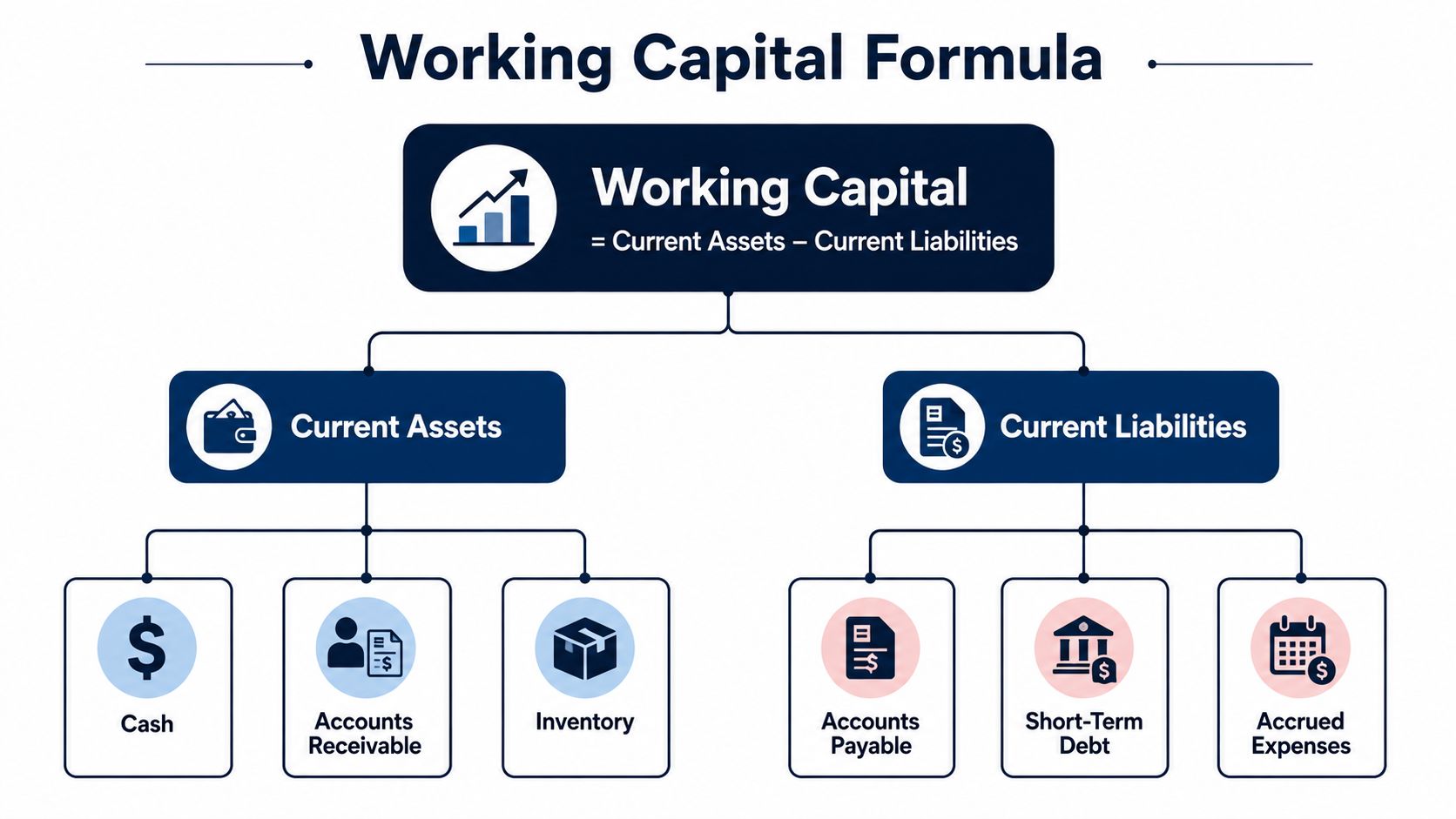
The asset side includes items expected to become cash or be used within a year. Common examples are cash, accounts receivable, inventory, and prepaid expenses, such as software or advertising. Ecommerce receivables may include Amazon settlements still being processed, not only invoices sent to wholesale customers. Prepaid ads belong on the asset side, but they cannot pay a supplier until the spending produces sales and those sales produce collected cash.
The liability side covers amounts due in the near term. It can include accounts payable to suppliers, short-term debt, accrued expenses, and taxes approaching their due dates. If a co-packer requires payment in two weeks while an Amazon settlement arrives later, the formula may show a reasonable balance even as the operating account faces pressure.
Current assets above current liabilities produce positive working capital. The reverse means the business is relying more heavily on future inflows to meet present obligations. Neither result explains the quality or timing of the underlying items.
For an ecommerce operator, the useful question is not only whether the number is positive. Ask which assets are liquid, how quickly inventory can sell, when platform funds will settle, and which bills are due first.
Simple test: a dollar in cash is not the same as a dollar tied up in slow inventory, even though both sit on the asset side.
Two businesses can report the same working capital and face different cash realities. One may hold cash and fast-turning receivables. The other may hold aging stock, prepaid campaigns, and supplier invoices due before platform fees and settlements clear. Use the formula to locate the pressure, then examine the timing behind each line item.
Once the formula is clear, the next question is speed. The cash conversion cycle measures how long cash remains tied up in operations before returning to the business. It uses three measures, Days Sales Outstanding, Days Inventory Outstanding, and Days Payable Outstanding (CFO). This turns a static balance-sheet figure into a view of operating timing.
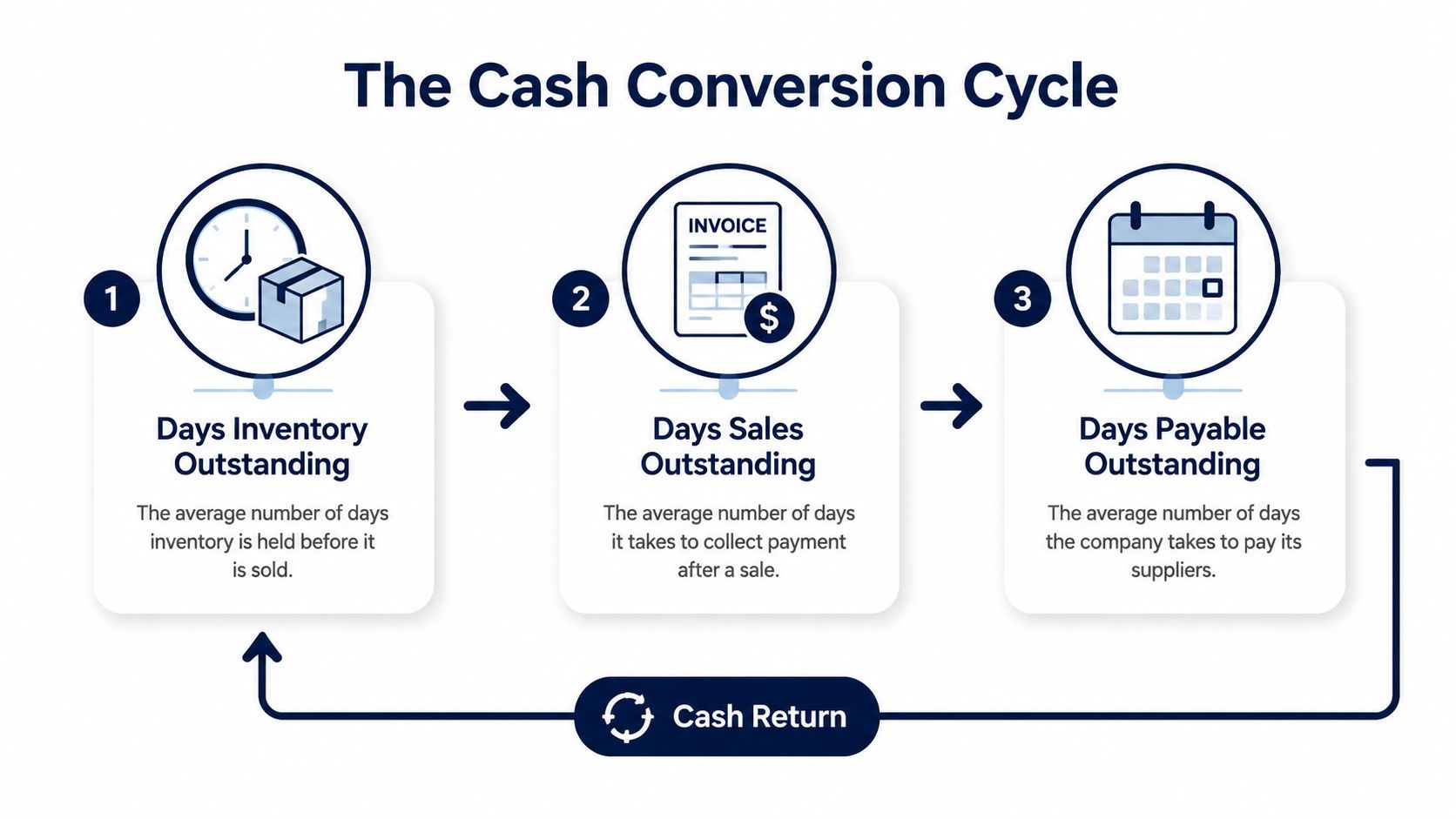
The logic is direct. DSO measures how long it takes to collect after a sale. DIO measures how long cash sits in inventory before that inventory becomes a sale. DPO measures how long the business keeps supplier cash before paying it out. A shorter cycle usually comes from collecting sooner, holding inventory for less time, or securing longer supplier terms.
For ecommerce, DIO includes more than stock sitting in a warehouse. Units on a container, inventory held by a fulfillment partner, and slow-moving products all keep cash committed. Use this guide to calculate inventory days on hand and see how quickly stock is turning.
Buying inventory too early parks cash on shelves or on the water. Slow wholesale collections increase receivables. Tighter supplier terms make cash leave sooner. Revenue may look unchanged, yet the operating account has less room to fund the next purchase, campaign, or fulfillment bill.
Analysts tracking working capital found that DSO and DIO worsened in the cited survey period, while DPO also fell (CFO). Small changes matter because each day applies across the full operating base.
For a brand doing $5 million in annual revenue, the timing becomes tangible. A reorder placed too early keeps cash in stock longer. Slower customer collections delay recovery of the sale. Longer supplier terms narrow the gap. The headline working capital number can remain positive while cash is unavailable for immediate obligations.
The operating takeaway is practical. DIO is mainly a purchasing and freight decision. DPO depends on supplier terms and negotiation. DSO reflects collections and channel structure. Track all three together, then ask where cash is waiting, because the balance-sheet total alone cannot answer that question.
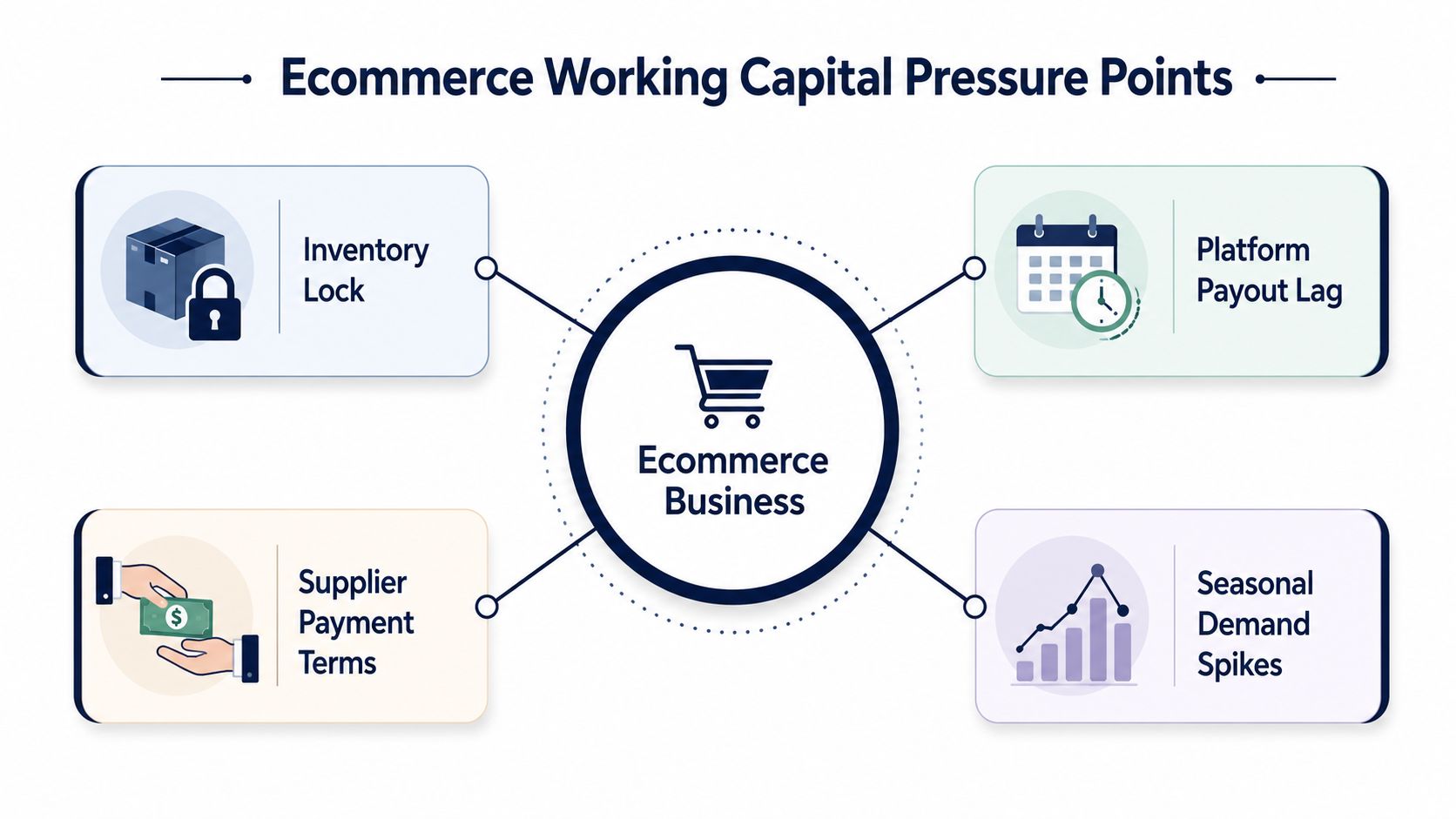
Ecommerce businesses feel working capital pressure in ways that service businesses rarely do. You can't ship air. You also can't pay Meta, Google, or TikTok with optimism. Cash leaves first, sometimes long before a product is sold or a customer returns it. That timing problem makes headline working capital look healthier than actual operating liquidity.
A recent Hackett survey found $1.7 trillion trapped in excess working capital across the top 1,000 U.S. public companies, while Allianz reported global Working Capital Requirements rose to 78 days in 2024, the highest since 2008 (Hackett). Those figures don't describe ecommerce alone, but they do show that trapped cash remains a live issue even in large, complex businesses. For product brands, the issue is sharper because stock, fees, and fulfillment all sit in the middle of the cycle.
Inventory is the first trap. Stock sitting in FBA or on a container vessel can't pay a bill. Prepaid media is the second. Ads often go out before the sales arrive, so the cash is gone while revenue is still being earned. Platform and storage fees are the third. They nibble at liquidity every month, often without feeling large enough to trigger attention. Return reserves are the fourth. Money tied up in the refund pipeline isn't available for the next reorder.
A simple example makes the distortion obvious. A DTC brand doing $400K in monthly revenue can show $250K in working capital on paper, yet if $180K sits in slow-moving SKUs, the deployable cushion is far smaller. The balance sheet doesn't lie, but it also doesn't tell you how much of that inventory can be sold fast enough to cover next week's commitments.
That's why ecommerce founders should mentally split their current assets into three buckets, cash, sellable inventory, and trapped inventory. A healthy current assets total can still hide a bad cash posture if the mix is wrong. If you're planning growth, the mix matters more than the headline number.
Benchmarks help, but only if you compare the right metric to the right business model. A retailer with fast turns and strong supplier terms can tolerate a tighter liquidity profile than a brand with long production lead times. That's why the current ratio, quick ratio, and cash conversion cycle should be read together, not in isolation.
| Metric | Healthy | Tight | Distressed |
|---|---|---|---|
| Current ratio | 1.5 to 2.0 | 1.0 to 1.5 | Below 1.0 |
| Cash conversion cycle | 30 to 45 days | Above 45 days | Above 90 days |
| Quick ratio | Around 1.0 or higher | Below 1.0 | Below 0.5 |
The current ratio compares current assets to current liabilities. A ratio between 1.5 and 2.0 is often comfortable for product businesses, while 1.0 to 1.5 is tighter and anything below 1.0 can point to refinancing or restructuring risk. The quick ratio is harsher because it strips out inventory, which is exactly why it can expose a liquidity problem that the current ratio hides.
Hackett's 2025 survey found the U.S. cash conversion cycle averaging 37 to 38.4 days, with DSO worsening even as payables extended (Deloitte). That's a useful reminder that the cycle can improve for the wrong reason. Longer payables may make liquidity look better for a moment, but that doesn't mean the operating engine got stronger.
A founder should ask one blunt question, can the business cover 60 days of operating costs with cash and receivables alone, without selling stock?
If the answer is no, the business may still be growing, but it's not especially resilient. Use that question as a stress test. It's more useful than congratulating yourself on a positive working capital number that depends on inventory moving exactly on schedule.
A profitable order can still leave an ecommerce business short of cash. The customer pays after the sale, while inventory, prepaid advertising, freight, and platform fees may require payment first. Working capital improves when you shorten that waiting period, not merely when the balance-sheet formula produces a positive number.
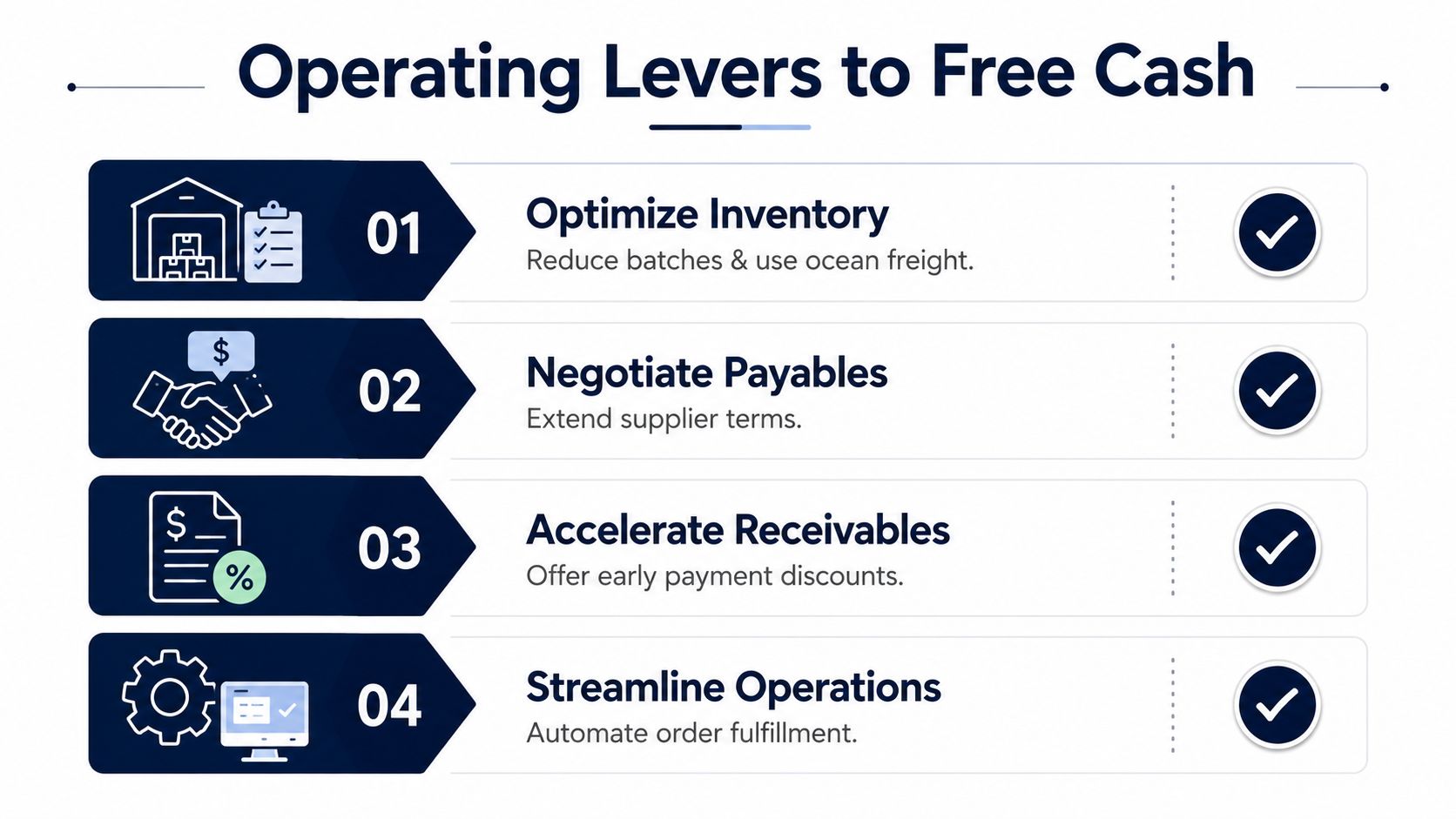
Slow the reorder cadence for slow-moving products and reduce batch sizes where demand is uncertain. Review freight choices by SKU. Air freight can protect a launch, but it consumes liquidity quickly. If ocean freight can support the same service level, changing the replenishment method releases cash that was tied up in speed.
Also examine stock already sitting in the business. A product that sells slowly is not equivalent to cash in the bank, even if accounting records it as a current asset. Align purchase orders with sell-through, launch plans, and realistic demand rather than treating every forecast as a commitment.
Supplier terms can matter more than a small marketing improvement. Moving from net 30 to net 60 gives the business more time to convert inventory into customer cash, provided the arrangement does not damage supplier trust. A practical guide to how to manage cash flow reinforces the operating principle: cash timing changes when payment and collection timing changes.
Review these additional levers:
Operator rule: a change deserves close review when it shortens the cash cycle without damaging customer experience or vendor trust.
Channel mix can alter the timing as well. Shifting volume from a 60-day net terms wholesale relationship to a channel that pays out roughly every two weeks can bring receipts closer to the original sale. The headline working capital number may stay similar while available cash improves. Track inventory days, prepaid spend, platform deductions, and payout timing together, because each one determines when revenue becomes usable cash.
A lot of working capital improvement stories sound better than they are. The business didn't get leaner. It asked vendors to wait longer. That can make the ratio look cleaner on paper, but it can also weaken the supply chain beneath the surface.
Stretching a supplier from day 30 to day 75 can create a large paper gain in working capital without improving sell-through, forecasting, or product efficiency. The business gets more breathing room for a while, but it also gives up some influence. A supplier that's paid later is less likely to prioritize constrained inventory, more likely to enforce stricter terms, and less flexible when you need a rush fill.
The hidden cost shows up in relationship economics. Brands can lose early-pay discounts, which reduces margin. They can also face smaller minimum order flexibility, tighter allocations on scarce SKUs, and less goodwill when freight costs spike or a platform account gets interrupted. Those are not theoretical risks. They're the things that show up when the market gets messy.
A useful supplier strategy guide like negotiating with suppliers is helpful because it treats terms as a real negotiation, not a free financing source. The best brands grow into better terms through reliability, volume, and planning. The weaker ones stretch until the relationship turns brittle.
Working capital only matters if it improves resilience. If the cash is coming from supplier patience rather than better inventory turns or stronger collections, the business may look healthier than it really is. That's a fragile kind of success.
Start with diagnosis in month one. Pull the detail behind current assets and current liabilities, then calculate the cash conversion cycle in days. Benchmark DSO, DIO, and DPO against the figures already covered, and assign one owner, usually finance or operations, to keep the numbers current. If chargebacks are distorting receivables or reserves, use a resource like reduce excessive chargebacks to pressure-test where cash is being trapped.
Month two should target quick wins. Turn off auto-reorder on slow movers. Ask two key vendors for a short extension, even if it's only ten days. Move prepaid ad spend to monthly invoicing where possible, and review any SKU with rising storage or aging risk. The goal is to create visible cash movement, not to “optimize” in the abstract.
Month three should lock in structural fixes. Put a par-level reorder system in place, review freight terms by product family, and add a quarterly working capital review to the leadership agenda. That meeting should include inventory age, supplier terms, receivables aging, and cash runway, not just revenue and margin. By the end of 90 days, you want fewer surprises and more control over when cash leaves and when it comes back.
Million Dollar Sellers gives serious ecommerce founders a place to trade operational details, not generic advice, and working capital is one of the most important levers in that conversation. If you want sharper operator-level thinking on cash timing, supplier terms, and growth without the usual fluff, visit Million Dollar Sellers and see whether the community is a fit for where you're scaling next.
Join the Ecom Entrepreneur Community for Vetted 7-9 Figure Ecommerce Founders
Learn MoreYou may also like:
Learn more about our special events!
Check Events