Chilat Doina
June 26, 2026
You've built a real business. Revenue is past the early scramble. The store works. The catalog is clearer. You know your contribution margin by SKU, you've had at least one ugly inventory mistake, and you've learned that growth creates a different kind of loneliness.
At that stage, most founders don't need another podcast or another generic mastermind. They need peers who can answer the hard questions fast. Should you push deeper into Amazon or protect margin through DTC? Is your ops leader the right one for the next phase? Which software stack holds up once complexity hits? Which agency should you avoid?
That's usually when the search starts. You type in YPO vs MDS, then hit a wall of half-relevant pages, acronym confusion, and broad business advice that doesn't help an e-commerce founder make a clean decision.
The 7-figure ceiling doesn't mean your business is stuck forever. It usually means your current way of operating has run out of room.
At first, hustle closes the gap. The founder writes the copy, approves the creatives, negotiates with suppliers, and still jumps into PPC when performance slips. That works up to a point. Then the business gets more complicated. A delayed shipment affects inventory planning. A marketplace policy change hits rankings. Your Meta account gets harder to scale profitably. A hire you thought would free you up creates more management overhead.
That's when smart founders start looking for a better room.
The problems stop being basic. They become layered.
A 7-figure seller isn't asking, “How do I launch a product?” They're asking questions like:
I see this pattern constantly. Founders don't hit a wall because they lack ambition. They hit a wall because their inputs haven't upgraded with the business.
Practical rule: If every important decision still funnels back to you, you don't have a scaling problem. You have a peer environment problem.
Most e-commerce content is too broad to help at this level. It tells you to improve conversion rate, use better creatives, or adopt AI. None of that is wrong. It's just incomplete.
You need context from operators who've already worked through the exact trade-offs you're facing. That includes stack decisions, channel mix, margin pressure, inventory timing, and leadership mistakes. If you're sorting through automation and analytics options, a focused guide to the best AI tools for e-commerce can help narrow the field, but tools alone won't replace experienced peers.
The question isn't whether to join a network. It's whether you're joining one built for the business you run.
You search YPO vs MDS because you want a better room, better answers, and fewer expensive mistakes. Then the results send you into acronym chaos.
That confusion is real, and it matters more than it should. Founders end up comparing the wrong organizations, reading irrelevant pages, and forming opinions on communities that were never meant to solve the same problem.
First, YPO in this conversation means Young Presidents' Organization. That's the executive peer network founders usually mean when they talk about high-level business groups.
Second, MDS here means Million Dollar Sellers. Outside e-commerce, MDS often refers to myelodysplastic syndromes, which is why some search results look completely disconnected from business.
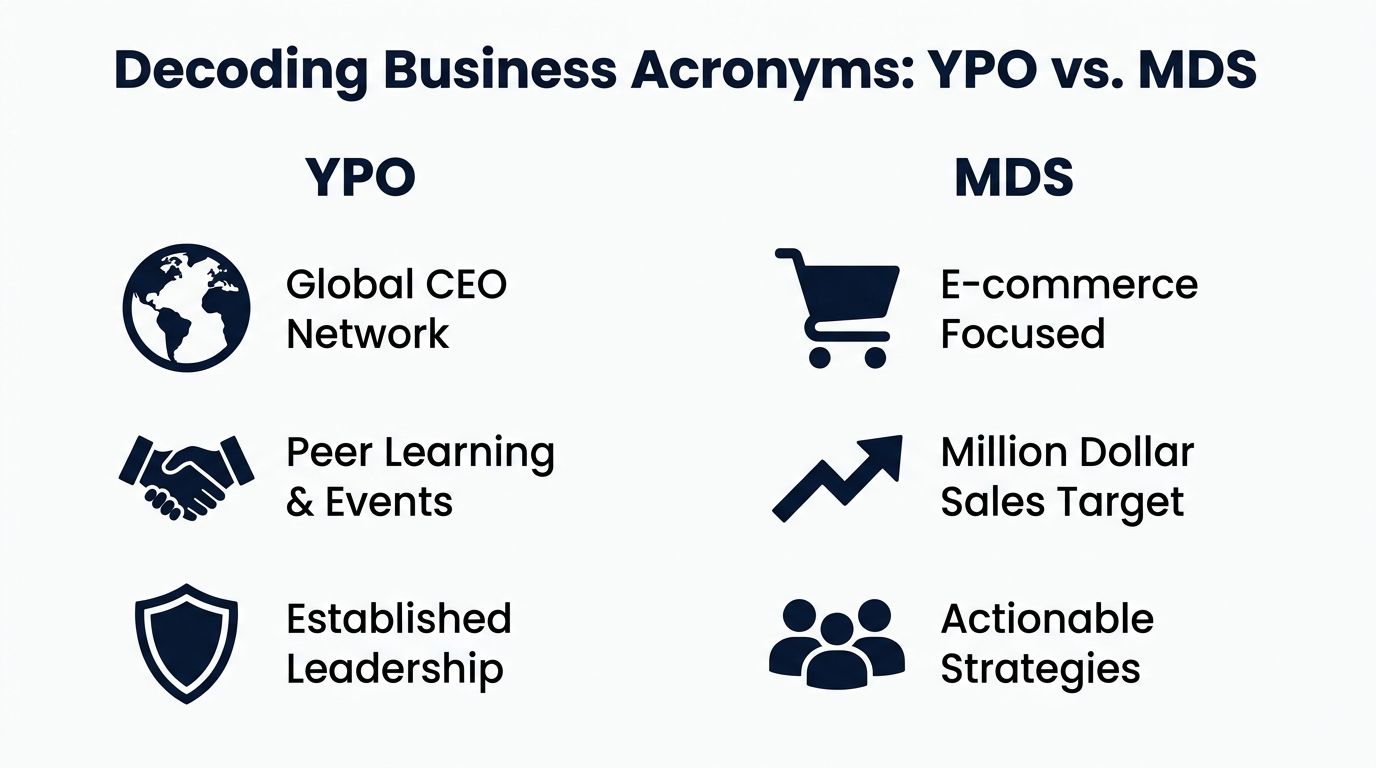
There are really only four definitions you need to sort out:
YPO for founders
Young Presidents' Organization. A global peer network for presidents, CEOs, and senior operators.
YPO in unrelated search results
You may also run into references like Yale Parents' Organization. That has nothing to do with building an Amazon brand or scaling DTC.
MDS for e-commerce founders
Million Dollar Sellers. An invite-only community built around e-commerce operators.
MDS in medical content
Myelodysplastic syndromes. Useful if you're a hematologist. Useless if you're trying to fix contribution margin or hire a better head of growth.
The bigger problem is not the acronym mix-up itself. It's what happens after. A founder looking for a peer group ends up reading generic leadership content, while another lands on medical pages, and neither gets closer to the actual decision.
The useful comparison is simple. YPO is a broad executive organization. MDS is a purpose-built e-commerce founder community.
That is the distinction a lot of articles miss. If you run an Amazon-heavy business, a hybrid Amazon and Shopify brand, or a DTC company with real channel complexity, you are not choosing between two interchangeable memberships. You are choosing between a generalist executive room and a room full of operators who already know your channel economics, inventory stress, attribution noise, and marketplace risk.
For founders who need the business definition of YPO clarified before comparing options, this overview of the Young Presidents' Organization for founders is the right starting point.
Bad comparisons usually start with bad definitions. Get the acronyms right first, then judge the room.
A founder can respect YPO and still realize it is built for a different room.
YPO is one of the best-known peer organizations in the world. It attracts serious operators, carries real brand weight, and gives members access to a broad network of presidents, CEOs, and founders across industries. If you run a larger company and want perspective that goes beyond your category, that has value.

YPO sets a high bar on purpose. According to the official YPO membership criteria, candidates generally need to hold the top leadership role of a qualifying company and join before age 45. The financial threshold varies by business type, but for many companies it starts around $13 million in annual revenue.
That alone tells an e-commerce founder a lot.
The average member profile tilts toward larger businesses, broader management responsibility, and more traditional executive complexity. The conversation is more likely to center on leadership, governance, people, succession, and long-range company building than on Amazon ranking volatility, fee compression, creative testing cadence, or whether your 3PL is about to create a cash flow problem in Q4.
YPO is strong in the areas it was built for:
That is real value. For the right founder, it is worth paying for.
YPO fits best when your main problems are CEO problems at scale, not channel-specific e-commerce execution problems.
The gap is usually practical, not philosophical.
A lot of 7-figure founders will not qualify yet. Many early 8-figure founders still will not be a clean fit, especially if the business is lean, digital-first, and built with a smaller team than a traditional company at the same revenue level. The age cutoff also removes plenty of strong founders who started later, exited once, or switched industries.
Even for founders who do qualify, the room can still feel too general. You may get sharp leadership perspective, but not much operator-level help on Amazon account structure, DTC merchandising, inventory financing, attribution mess, agency selection, or omnichannel execution.
YPO is a serious organization. It is just not purpose-built for the problems e-commerce founders are trying to solve this quarter.
If YPO is built around broad executive leadership, MDS is built around operator relevance.
That's the distinction that matters most for e-commerce founders. You don't join a peer group because it sounds elite. You join because the people inside can help you make better decisions faster.
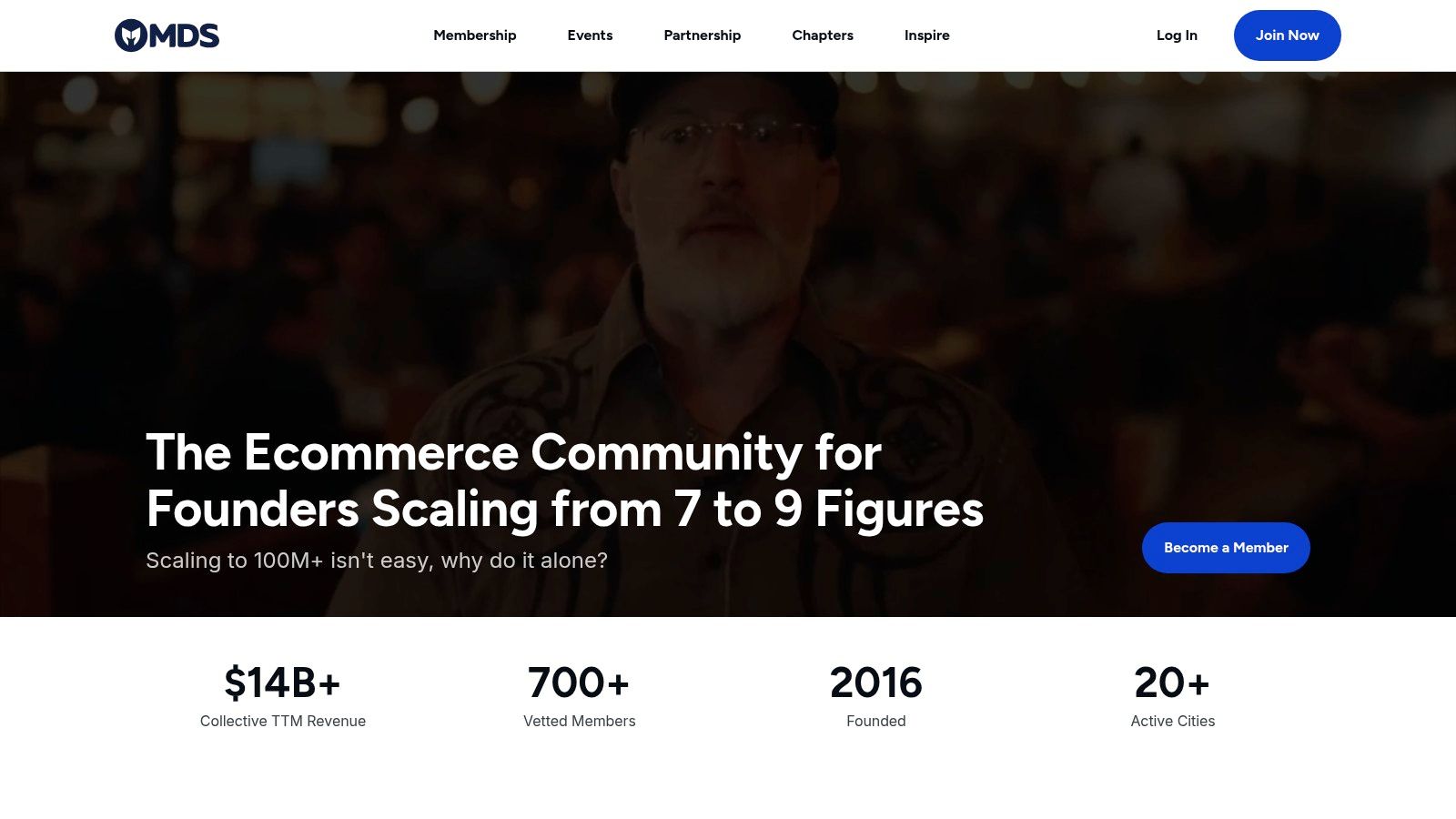
MDS is for founders who are already in motion. The entry point is centered on sellers doing real revenue, not executives managing large traditional companies. There's no age cap filtering the membership toward one life stage, and the business mix spans Amazon, DTC, and omnichannel brands.
That matters because the operating conversations are different. In a seller-focused room, people talk in specifics. They compare agencies, fulfillment options, account structure, inventory planning approaches, creative workflows, and marketplace execution. They pressure-test what's happening now, not just what leadership theory says should happen.
Most e-commerce founders don't need another “network.” They need three things:
That's where MDS has an edge in practice. The value isn't abstract. It's embedded in who's in the room and what they're willing to share.
A founder group becomes useful when members stop performing and start telling the truth. That's where the best decisions come from.
MDS is not a generic entrepreneur community. According to the verified comparison discussed earlier, MDS targets founders with over $1M in revenue and no age cap, and its members collectively span a massive e-commerce footprint across Amazon, DTC, and omnichannel brands. That composition changes the quality of discussion. You're not trying to translate broad CEO advice into marketplace execution. You're hearing from people who already live in that environment.
A short look at the broader positioning helps illustrate the type of member experience being built:
What works in an e-commerce founder community is curation. Not endless chatter. Not random Facebook-group advice. Not public posturing.
The useful pieces are the ones experienced sellers value most:
What doesn't work is joining a broad network and hoping the right sub-group eventually appears. It usually doesn't. In e-commerce, speed matters too much for that.
For founders deciding between these two, the easiest way to cut through the branding is to compare the rooms by utility.
| Attribute | YPO (Young Presidents' Organization) | MDS (Million Dollar Sellers) |
|---|---|---|
| Target member profile | Top executive leading a larger company | E-commerce founder or operator past the early stage |
| Industry focus | Broad, cross-industry leadership | Amazon, DTC, and omnichannel e-commerce |
| Entry profile | Higher scale, age-restricted | Revenue-qualified, no age cap |
| Typical conversation | Leadership, governance, executive perspective | Marketplace tactics, growth strategy, operators' decisions |
| Best fit | Mid-market or larger enterprise leader | Founder scaling an e-commerce brand |
| Core value | General peer leadership environment | Actionable e-commerce insight from relevant peers |
Founders often frame this as exclusivity versus exclusivity. That's the wrong frame.
The question is relevance. A room can be impressive and still not be useful. If your current problems involve Amazon ranking volatility, DTC acquisition efficiency, inventory timing, creator pipelines, retail expansion, or channel conflict, then broad CEO conversation has limits.
A niche room beats a prestigious room when the niche is your business.
YPO optimizes for executive peer alignment across larger organizations. That usually means high-level leadership exchange with people carrying similar responsibility, even if they're in very different industries.
MDS optimizes for founder usefulness inside e-commerce. That means the odds of getting a practical answer are higher because the member base shares channel realities, operating pressures, and vendor exposure.
Here's the simplest way I'd break it down:
For founders weighing whether broad business groups can really deliver relevant value, this perspective on why e-commerce founders often struggle to get value from YPO or EO gets at the core mismatch.
A peer group should reduce decision friction. If you have to explain your business model before asking every question, you're in the wrong room.
The cost isn't just dues. It's delay.
A mismatched network slows learning because every conversation starts with context-setting. You spend time explaining Amazon fee pressure, the difference between branded search and category search, why attribution is messy, or why a DTC retention fix might matter more than a top-line acquisition win.
In the right room, people already know that. The discussion starts at the decision layer.
That's why this comparison matters. Not because one organization is “better” in some universal sense, but because each one solves a different problem.
The best e-commerce founders I know don't look for community as a status symbol. They look for advantage.
They want a place where asking the right question leads to a useful answer from someone who has already paid for the lesson. That could be a seller who knows which 3PL relationships hold up under stress, which software category is worth the spend, or which growth idea looks great in theory but breaks when inventory tightens.
A broad executive group can help you become a better leader. That's valuable. But elite sellers usually need a second thing at the same time. They need operator-grade feedback from peers who know the economics and realities of e-commerce.
That's why MDS keeps standing out for serious sellers. Its members collectively generate over $8B in annual revenue across Amazon, DTC, and omnichannel brands, which points to a wide, active base of founders working in the exact channels most readers care about, as described in this overview of top e-commerce masterminds for founders.
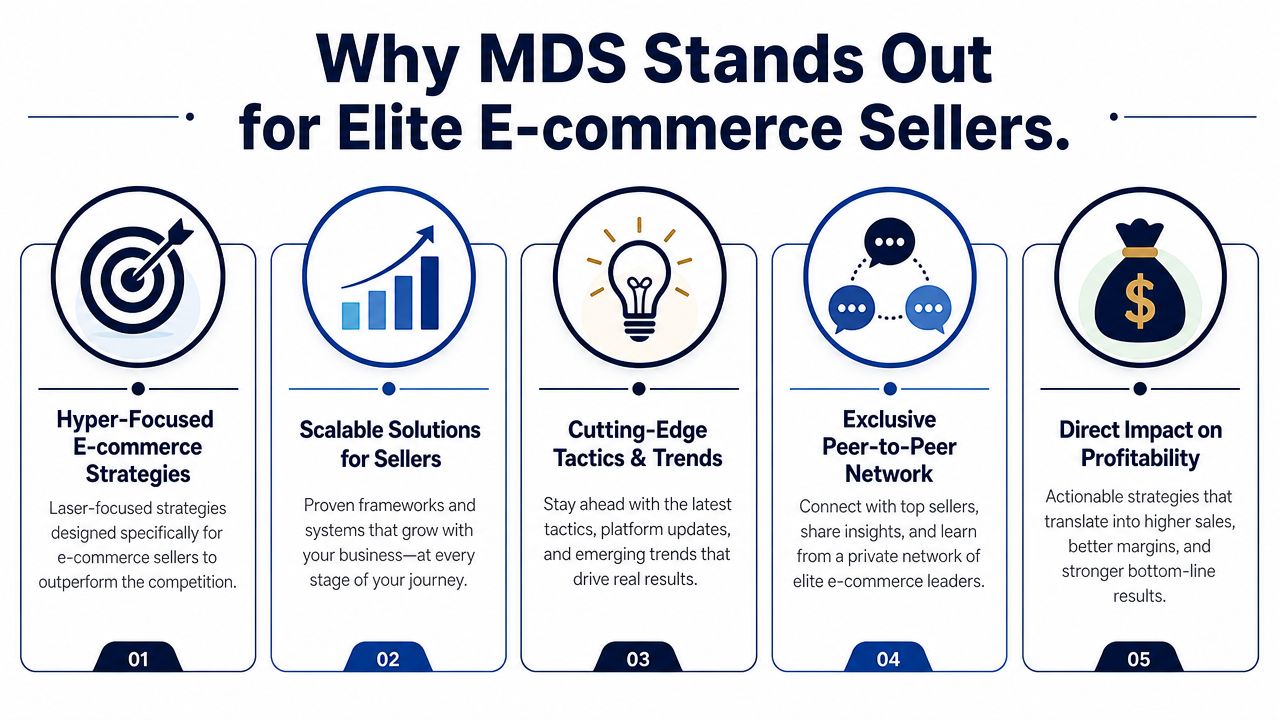
The value usually shows up in moments like these:
Those moments decide more outcomes than another theory-heavy leadership seminar.
A lot of founder communities say they value trust. Few earn it.
In e-commerce, trust matters because the best insights are rarely public. Founders share the honest realities when they know the room is qualified, private, and serious. That includes the bad agency experience, the margin leak no one caught for months, the ad structure that stopped working, or the inventory play that backfired.
That's why a specialized peer group can become an operating advantage, not just a networking line item.
The strongest founder rooms don't just give you ideas. They give you confidence in which ideas to ignore.
If you run an e-commerce brand and you're trying to break through the next ceiling, this decision is more straightforward than the acronym noise suggests.
YPO can be excellent for the leader of a larger, broader enterprise who wants cross-industry executive depth.
MDS fits the founder who wants direct access to people solving Amazon, DTC, and omnichannel problems in real time. For a seller trying to scale smarter, that's usually the more valuable room.
If you're ready to learn from founders who already understand the channels, pressure, and decisions you're dealing with, take a closer look at Million Dollar Sellers. It's built for serious e-commerce operators who want a stronger peer group, sharper strategy, and a better path to the next stage of growth.
Join the Ecom Entrepreneur Community for Vetted 7-9 Figure Ecommerce Founders
Learn MoreYou may also like:
Learn more about our special events!
Check Events