Chilat Doina
April 3, 2026
Picture this: you've built an online store, sales are coming in, but your living room is overflowing with boxes, you're buried in packing tape, and you spend half your day at the post office. Now, imagine all of that just... disappeared.
That’s the core promise of Amazon FBA (Fulfillment by Amazon). It’s a game-changing service where you handle finding the products, and Amazon takes on the heavy lifting of storing, packing, shipping, and even customer service.
Think of Amazon FBA as your own outsourced logistics team. Instead of you renting a warehouse, hiring staff to pack orders, and trying to negotiate shipping rates, you get to plug your business directly into Amazon’s massive, world-class fulfillment network.
The idea is brilliantly simple. You focus on the fun part: finding and sourcing great products to sell. Amazon, in turn, handles the nitty-gritty of getting those products into your customers' hands. This simple split in responsibility is what makes FBA such a powerful tool, especially for new sellers just getting started.
At its heart, FBA is a straightforward deal. You pay Amazon a set of fees for their services, and they handle the most tedious and time-consuming parts of running an e-commerce business. The biggest payoff? Your products can get the coveted Prime badge, giving customers access to fast, reliable shipping.
The whole process really breaks down into a few key steps. Your job is to source your products, make sure they meet all of Amazon's guidelines, and then ship them in a single, large batch to one of Amazon's designated fulfillment centers. Once your inventory gets there and they scan it in, the real magic starts.
When a customer places an order, Amazon’s machine kicks into gear. A robot or warehouse associate picks your item off a shelf, it gets packed into an Amazon-branded box, and it's shipped out directly to the customer. You don't lift a finger.
This hands-off fulfillment means you can stop worrying about daily operations and start focusing on what actually grows your business—marketing, finding your next bestseller, and building a real brand.
This flowchart paints a clear picture of how you and Amazon work together.
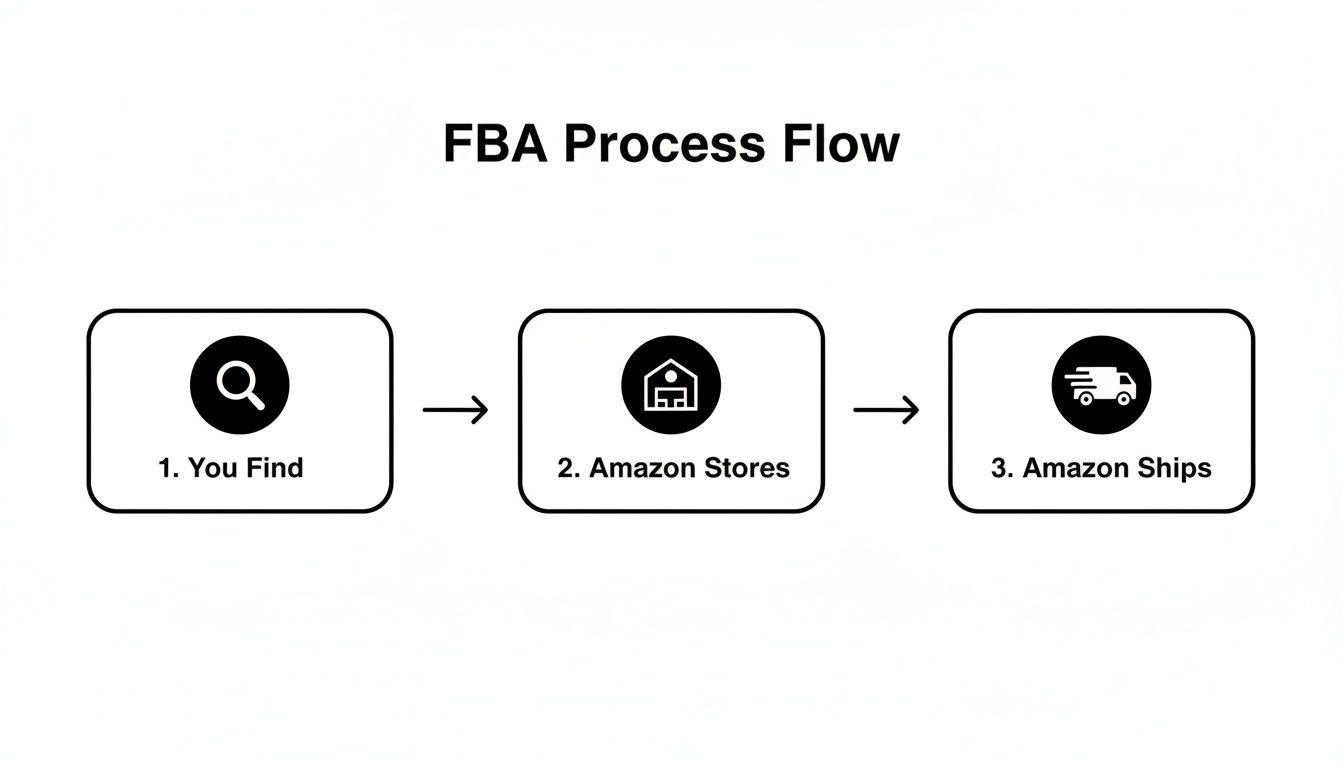
It really highlights that division of labor: your role is strategic sourcing, and Amazon’s is execution.
Just handing off the shipping is a huge win, but the FBA model comes with a few other powerful perks that can seriously fuel your growth.
Of course, FBA isn't the only way to sell on Amazon. The alternative is fulfilling orders yourself, a method known as FBM (Fulfilled by Merchant). If you’re weighing the options, check out our deep dive into Amazon FBA vs FBM to see which model fits your business best.
Starting an Amazon FBA business feels like a huge undertaking, but it’s really just a series of small, concrete steps. Think of it less like climbing a mountain and more like assembling a piece of furniture—if you follow the instructions, you’ll end up with something solid. This is your instruction manual for a smooth launch.
Right out of the gate, you need to decide on your business model. For anyone just getting started with Amazon FBA for beginners, it usually boils down to two paths: Retail Arbitrage or Private Label. Retail Arbitrage is all about hunting for deals at local stores to resell on Amazon, while Private Label involves creating your own brand from scratch and having products made just for you.
Once you’ve got a game plan, your next stop is Amazon Seller Central to create your account. This will be the mission control for your entire business.
Before you get too far, you have to pick a selling plan. Amazon gives you two options, and the right choice really just depends on how many products you think you'll sell.
Honestly, if you're serious about this, the Professional plan is the only way to go. It gives you the firepower you need to actually compete. As you sign up, Amazon will ask for some basic info to make sure you are who you say you are.
Do yourself a favor and get your documents ready before you even start the signup process. You'll typically need a government-issued ID, a recent bank or credit card statement, and your tax details. Having this stuff on hand makes the whole verification process a breeze.
With your account up and running, the real fun begins. It's time to find a product and build a listing that actually gets people to click "add to cart."
Finding your first product is make-or-break. You're looking for that sweet spot: an item with solid demand but without a ton of killer competition. Product research tools are your best friend here, helping you dig into sales data and spot gaps in the market where you can do better.
Once you've sourced your product, you’ll create its home on Amazon—the product detail page. This is your one chance to make a first impression. A killer listing always has:
To help you keep it all straight, here’s a quick checklist to guide you through the initial setup process.
This table breaks down the core steps you'll take to get your Amazon FBA business from an idea to a live operation. Follow these in order, and you'll build a solid foundation.
| Step | Action Required | Key Consideration |
|---|---|---|
| 1. Choose Model | Decide between Private Label, Retail Arbitrage, Wholesale, etc. | Private Label offers the most control and long-term potential, but requires more upfront investment. |
| 2. Register Business | Form an LLC or other legal business entity. | This protects your personal assets. Consult a legal professional for advice specific to your situation. |
| 3. Open Bank Account | Open a dedicated business bank account. | Never mix personal and business finances. It creates a massive headache for accounting. |
| 4. Sign Up on Amazon | Create your Seller Central account and choose a plan. | The Professional plan ($39.99/mo) is essential for access to advertising and reporting tools. |
| 5. Product Research | Use tools to find a high-demand, low-competition product. | Focus on data, not gut feelings. Look at sales velocity, review counts, and keyword volume. |
| 6. Source Product | Find a reliable supplier and order your initial inventory. | Always order samples first to verify quality before placing a large bulk order. |
| 7. Create Listing | Build your product detail page with optimized text and images. | Invest in professional photography. It's the single most important factor in conversion. |
| 8. Prepare Shipment | Prep, label, and pack your inventory per Amazon's guidelines. | Follow the FBA prep requirements to the letter to avoid costly delays or penalties at the warehouse. |
Following this checklist ensures you don't miss any critical steps as you get started.
The final piece of the puzzle is getting your inventory to Amazon's warehouses. This means correctly prepping, labeling, and boxing your products according to Amazon's very strict rules. You'll create what's called a "shipping plan" in Seller Central, which is basically you telling Amazon what's coming and where it needs to go.
Once you ship your inventory and it gets checked in at the fulfillment center, you’re live. Congratulations, you're officially in business and ready for that first sale.
It’s easy to get excited about big revenue numbers, but here's a hard truth: revenue doesn't pay the bills. Profit does. The real leap, from just selling stuff to building a profitable business, comes down to one thing—getting a firm grip on your costs.
If you don't know every single fee and expense, you're basically flying blind. This is the financial groundwork for any successful FBA brand. It shapes how you price your products, manage your cash, and ultimately, whether you’re building a real business or just a very busy, expensive hobby.
Amazon’s fee structure can look a little intimidating at first, but it boils down to a few key categories. Think of them as the cost of admission for using their massive marketplace and world-class shipping machine. For a much deeper dive, check out our complete guide to understanding all Amazon FBA fees.
These are the main fees you'll see on every sale:
These three are your most consistent and predictable costs, but they’re only one piece of the financial puzzle.
The fees that really eat into your profit are often the ones new sellers don't see coming. Knowing about these "hidden" costs from day one is the key to pricing correctly and keeping your business in the black.
The biggest one? Your Cost of Goods Sold (COGS). This is the all-in cost of your product—what you paid to have it made and shipped to an Amazon warehouse. If you sell a product for $30 and your COGS is $10, you start with a $20 gross profit before Amazon even takes a penny.
Beyond COGS, keep a close eye on these other expenses:
Key Insight: Your actual profit isn't just your selling price minus Amazon's main fees. The real formula is: Selling Price - COGS - Referral Fee - FBA Fee - Storage Fees - Advertising Costs - Other Expenses = Net Profit. Always use the full equation.
To stay on top of your FBA business and avoid painful mistakes like stocking out, it's critical to master Amazon inventory management.
Let's put it all together with a quick example. Imagine you’re selling a yoga mat for $40.
| Cost Component | Amount | Description |
|---|---|---|
| Selling Price | $40.00 | The price the customer pays. |
| COGS | -$8.00 | Your cost to buy and land the mat. |
| Referral Fee (15%) | -$6.00 | Amazon's commission on the sale. |
| FBA Fulfillment Fee | -$5.50 | Cost to pick, pack, and ship. |
| Net Profit | $20.50 | Before storage and advertising. |
In this scenario, your profit margin is 51.3% ($20.50 / $40.00), which looks fantastic on paper. But this simple calculation leaves out crucial costs like monthly storage and your advertising spend—a classic rookie mistake.
While many successful sellers aim for a profit margin of 20% or more, you have to remember that big revenue numbers aren't the full story. That seller screenshot showing $10,000 in revenue might only represent $2,000 in actual profit after all the bills are paid. Understanding these numbers is what separates an expensive hobby from a scalable, long-term business.
Let's be blunt: your first product choice can make or break your entire Amazon FBA journey. A smart pick creates momentum and gives you those crucial early wins. A bad one will just drain your bank account and your motivation.
The goal isn’t to find some mythical “perfect” product. It’s to find a profitable one with just the right amount of competition.
Think of it like searching for the perfect fishing spot. You don't want to be where there are no fish (zero demand). But you also want to steer clear of the spot swarming with professional fishing crews and their high-tech gear (insane competition). You're looking for that quiet little pond with plenty of fish and just a few other folks with a fishing rod.
Finding a winning product is all about data, not guesswork. You’re not just throwing things at the wall to see what sticks.
Instead of asking, "What can I sell?" you need to be asking, "What are people already searching for and buying, and how can I give them something better?"
This simple shift changes everything. You stop being just another seller and become a problem-solver. A killer strategy is to dive deep into the customer reviews of existing products in a niche. What are people constantly complaining about? If you can find a product that fixes that one annoying flaw, you’ve already got your marketing angle handed to you on a silver platter.
To find that "sweet spot," you have to get comfortable with the numbers. This is where successful sellers separate themselves from the pack.
The ideal product often has between 3 and 15 other FBA sellers. This is a great sign—it proves there's healthy demand, but it's not a total bloodbath.
The goal isn’t to find a product with zero competition. No competition often means no demand. A small number of competitors proves there's a market and money to be made, but the space isn't so saturated that a new seller can't break in.
This is where product research tools come in. Honestly, they’re not just helpful; they’re non-negotiable in 2026. These tools pull back the curtain and show you the raw data that tells the real story of a product's potential.
You need to be looking at:
For a deeper dive, check out our guide on the best Amazon product research tools that the top sellers swear by.
To make this even easier, think of it like a scorecard. Before you get too attached to a product idea, run it through these simple checks.
| Metric | Ideal Range / Target | Why It Matters |
|---|---|---|
| Average Monthly Revenue | $5,000 - $15,000+ | Proves consistent demand and profitability. |
| Average Review Count | Under 400 | Lower reviews mean it's easier for a new seller to compete. |
| Search Volume (Main Keyword) | 2,000+ searches/month | Confirms people are actively looking for this product. |
| No Dominant Brand | No single brand owns 3+ spots on page one. | Shows the market is open and not controlled by one giant player. |
| Non-Seasonal | Consistent sales year-round. | Provides steady income without major seasonal slumps. |
| Light & Small | Fits in a shoebox, under 2-3 lbs. | Keeps FBA storage and shipping fees low, boosting your margins. |
This scorecard isn't a magic formula, but it's a fantastic starting point. A product that hits most of these targets has a much stronger chance of being a winner right out of the gate.
Once you've landed on a promising product, it's time to find a supplier. For most new sellers doing private label, this means heading over to a platform like Alibaba. The process is pretty straightforward: you find manufacturers, send them your product specs, and—this is critical—order samples to check the quality before you commit to a big order.
With your inventory sorted, the final piece of the puzzle is creating a product listing that actually sells. This is your digital storefront, and it needs to be on point.
When you combine solid data-driven research with a quality product and a killer listing, you've got a powerful recipe for a successful launch.
Let's be blunt: a great product is just the ticket to the game. Winning on Amazon requires a smart launch. Think of it like trying to get a heavy flywheel spinning—it takes a big push to get started, but once it’s going, the momentum carries you forward.
Without a solid launch plan, even the best products get lost in the noise. This is about making that initial push count so you can turn views into sales and start climbing the ranks from day one.
In 2026, you can’t launch on Amazon without running ads. Amazon PPC (Pay-Per-Click) is how you buy your way to the top of the search results, and you only pay when a shopper actually clicks on your ad.
For anyone new to this, your first move should be an Automatic PPC Campaign. Don't overcomplicate it. You just set a daily budget, and Amazon’s algorithm starts testing the waters, showing your ad to shoppers it thinks are relevant based on your listing.
An auto campaign is basically Amazon doing your initial market research for you. It will find customer search terms that lead to clicks and, more importantly, sales. Let it run for a couple of weeks, and you'll have a goldmine of data on which keywords are actually working.
Forget about making a profit on these first ads. Your real goal here is to collect that crucial keyword data and, of course, to get those first few sales rolling in.
Those first sales and reviews are everything. They’re the social proof that tells Amazon’s algorithm, "Hey, people like this product!" This directly improves your Best Sellers Rank (BSR). A lower BSR means more visibility, which leads to more sales, which leads to a lower BSR... you get the idea. It's a powerful cycle.
Here are a few proven ways to get the ball rolling:
And it goes without saying, your product photos need to be top-notch. Sharp, professional images aren't optional. To make sure your pictures pop on the page, you can even upscale images for e-commerce for the best possible quality.
Beyond ads, Amazon gives you a few other tools to help you seal the deal with customers who are on the fence.
Coupons are my personal favorite. That little green or orange tag makes your product jump off the search results page. It's often just the nudge a customer needs to click on your listing instead of your competitor’s.
If you sell anything consumable, getting into Subscribe & Save is a huge win. It gives customers a small discount for signing up for recurring deliveries. One study showed it can result in 1.8x higher conversion rates, effectively locking in customers for the long haul.
By layering a simple PPC strategy with these launch tactics and promotions, you create the initial velocity your product needs to start climbing. Every successful FBA business I know was built on this exact foundation.
Alright, let's move past the initial launch chaos. The journey from a brand-new seller to a seasoned pro isn't just about getting more sales—it's about building a real, sustainable business. This is where you shift from just keeping the lights on to strategically planning for growth and learning how to dodge the mistakes that trip up so many others.
The first, and biggest, hurdle you'll face is inventory. It sounds simple, but it's a constant balancing act. Nothing kills your momentum faster than running out of stock on a hot-selling product. On the flip side, paying storage fees for inventory that just sits there gathering dust is a slow poison for your profits. This is where one number becomes the most important metric in your entire business: your Inventory Performance Index (IPI) score.
Think of your IPI score as your report card from Amazon's warehouses. It’s a single number from 0 to 1,000 that tells Amazon how efficiently you’re using their shelf space. A high score means you're a responsible partner; a low score is a major red flag.
If your IPI score drops below the threshold (which has hovered around 400), Amazon can hit you with storage limits. This isn't just a slap on the wrist—it means they can literally stop you from sending in more inventory, putting a hard ceiling on your growth. To keep that score healthy, you need to focus on a few key things:
Keeping a close eye on your IPI is non-negotiable for scaling. It’s what gives you the freedom to send in more stock, launch new products, and grow without Amazon putting the brakes on for you.
Once you've got a good handle on your inventory, it's time to think about real growth. And no, scaling isn't about just throwing a bunch of new products at the wall to see what sticks. It's about smart, data-backed decisions that make your brand stronger and more profitable.
One of the best tools in your arsenal is A+ Content. If you've gone through Brand Registry, you can swap out that plain text product description for a beautiful, enhanced layout with extra images, comparison charts, and brand stories. It’s a total game-changer for conversions. Even basic A+ Content can lift sales by up to 8%, helping you build a premium feel that justifies your price and earns customer loyalty.
Scaling is all about building systems that do the heavy lifting for you. You're already ahead of the game by using FBA. In fact, Fulfillment by Amazon can cut your shipping costs by 70% per unit compared to what you'd pay for premium carrier options on your own. That’s a massive efficiency boost that frees you up to focus on the fun stuff, like A+ Content and expanding your catalog. You can find even more stats to shape your growth strategy on Amazon's official blog.
As you grow, you'll find new challenges pop up. Keep your head on a swivel and watch out for these common pitfalls:
The goal is to stop being a reactive seller who's always putting out fires and become a proactive business owner who builds systems for success. Nail your inventory, use the brand tools at your disposal, and steer clear of these common blunders. Do that, and you'll be on the fast track to building a scalable business that lasts.
Jumping into the world of FBA for the first time always stirs up a lot of questions. Let's tackle some of the most common ones that new sellers have right at the beginning of their journey.
There’s no one-size-fits-all answer here—your startup costs are tied directly to the kind of business you want to build. If you're going the arbitrage route and reselling products you find on clearance, you might be able to get your foot in the door with as little as $500.
For a private label business, however, you need to be more realistic. A healthy starting budget is closer to the $3,500 to $5,000 range.
This initial cash injection usually goes toward:
A good rule of thumb is to only start with an amount you're comfortable losing. Think of your first product less as a lottery ticket and more as a paid education.
Absolutely. In fact, a huge number of seven and eight-figure sellers started out by building their FBA business in the evenings and on weekends while holding down a full-time job. The flexibility is one of FBA's biggest selling points.
Be prepared to put in 10-20 hours a week when you're first getting things off the ground. That time will be eaten up by product research, finding suppliers, and building your product listing. The real magic happens once you're live—Amazon takes over the daily grind of packing and shipping, making it the perfect model to scale on the side.
Yes, but the game has completely changed. It’s way more competitive than it was even a few years ago. You can’t just throw a generic product up on the marketplace and expect to make money anymore.
Today, profitability is all about being smarter and more strategic than your competition. It comes down to doing relentless product research, building a brand people actually care about, and knowing your numbers inside and out—especially your ad spend and inventory. Success isn't about just being on Amazon; it's about carving out a specific niche, delivering a superior product, and running your business based on data.
At Million Dollar Sellers, we believe in execution and data-driven growth. Our exclusive community is for established e-commerce founders who want to scale faster by learning from the best 7, 8, and 9-figure sellers in the industry. Learn more at https://milliondollarsellers.com.
Join the Ecom Entrepreneur Community for Vetted 7-9 Figure Ecommerce Founders
Learn MoreYou may also like:
Learn more about our special events!
Check Events