Chilat Doina
April 29, 2026
You’re probably in one of two situations right now. Your core sourcing channels still work, but margins have tightened and inventory is harder to predict. Or your team has tested liquidation before, got mixed results, and wrote it off as too messy to scale.
That’s usually the mistake.
Most sellers look at bstock amazon pallets like a side hustle inventory source. Serious operators treat them like a reverse logistics supply channel. The difference isn’t the pallet. It’s the operating model behind it. If you have warehouse discipline, listing infrastructure, refurb capacity, and a rules-based bidding process, liquidation stops being “junk buying” and starts becoming a controllable margin layer inside a larger ecommerce business.
I’ve seen the same pattern repeat. The seller who wants one magic pallet usually loses money. The seller who builds intake, grading, routing, and channel-specific disposition can turn ugly inventory into a durable business unit.
You can feel the difference in a warehouse the first time liquidation stops behaving like opportunistic buying and starts behaving like scheduled intake. Trucks are booked. Receiving has labor assigned. Finance already knows the recovery targets by lot type. Listings, testing, routing, and secondary channels are ready before the pallet hits the dock. That is the point where bstock amazon pallets stop being a side project and start becoming a real inventory channel.
For a high-volume seller, the appeal is throughput and optionality. Traditional wholesale is often cleaner, but it gets saturated fast, margins compress, and suppliers tighten terms the moment they see demand. B-Stock gives larger operators another way to buy inventory in volume, usually at a discount that leaves room for labor, defects, markdowns, and marketplace fees. Titan Network notes that Amazon return pallets can range from small buys to multi-thousand-dollar purchases and often trade at a steep discount to retail in its Amazon return pallets guide.

B-Stock works for scaled sellers because returns are not a one-time event. They are a permanent feature of ecommerce. That creates recurring inventory flow instead of sporadic closeout luck. Scale businesses need repeatable flow, not occasional wins.
That does not mean every lot is good. It means the channel is active enough to support a process-driven operation. If your company already sells on Amazon, Walmart Marketplace, eBay, Shopify, wholesale, or local recovery channels, liquidation gives you more ways to place inventory based on condition and net recovery instead of forcing every unit into one model.
This is also why supplier discipline matters. Serious buyers do not just evaluate a manifest. They evaluate the source, the condition language, the consistency of categories, and the operational burden behind each lot. A clear supplier vetting checklist for resale inventory channels helps keep purchasing decisions tied to recoverable revenue instead of headline discounts.
The purchase itself is not the business. The business is the system wrapped around intake.
A seven or eight-figure operator can scale bstock amazon pallets because the supporting functions already exist, or can be built with clear accountability. Receiving can count and isolate exceptions. Grading can separate clean resale from refurb candidates. Listing teams can route SKUs by channel. Finance can track recovery by lot, category, and buyer. Without those controls, liquidation amplifies operational weakness and turns cheap inventory into expensive clutter.
I look at this channel as a conversion problem. You are converting inconsistent inbound product into predictable cash flow. The sellers who win are not the ones who find the prettiest pallets. They are the ones with tighter SOPs, better cost controls, and faster disposition cycles.
Practical rule: Add liquidation when your team can process variance faster than competitors can.
B-Stock sits closer to the original source than many pallet resellers, and that changes the math. Better manifests, clearer condition data, and less intermediary markup give operators more room to model expected recovery before they bid. That does not remove risk. It makes risk measurable.
At scale, measurable risk is what matters.
| Factor | Beginner mindset | Operator mindset |
|---|---|---|
| Pallet | Treasure hunt | Inventory batch |
| Manifest | Suggestion | Decision tool |
| Damage | Bad luck | Expected loss bucket |
| Margin | Based on MSRP | Based on recoverable revenue |
| Scale path | Buy more pallets | Build better systems |
The sellers who turn liquidation into a core business unit do not chase excitement. They build a machine that buys, grades, routes, reprices, and exits imperfect inventory with more discipline than the next bidder. That is why B-Stock can scale. Not because the pallets are easy, but because the channel rewards operators who can handle complexity profitably.
A team wins three Amazon liquidation auctions in the same week. On paper, the buy looks strong. The manifests show recognizable ASINs, decent MSRP, and enough unit count to matter. Ten days later, receiving is backed up, grading labor doubled, half the value is trapped in incomplete items, and the cash conversion cycle just stretched by a month.
That breakdown usually starts before the first bid.
B-Stock gives operators more usable data than many secondary pallet sources. You get manifests with ASIN, UPC, and condition fields, and that is enough to build a real screening process if your team treats each lot like inventory acquisition, not opportunistic deal hunting. The sourcing edge comes from rejecting lots fast, not from convincing yourself that every pallet can be fixed in processing.
Lot type drives labor, sell-through, and error rate. If your team is scaling this into a meaningful business unit, those three variables matter more than retail value.
Use a simple hierarchy:
A seller trying to build repeatable volume should not treat those categories as minor condition labels. They are different operating models.
The first question is not whether the manifest looks exciting. The first question is whether the lot contains enough recoverable value after condition loss, missing components, labor, and channel constraints.
I screen manifests in layers:
Find the SKUs that carry the lot
Every pallet has a few items doing the heavy lifting. Identify them first. If the economics depend on several units arriving in better shape than the condition notes suggest, the lot is fragile.
Check real demand, not theoretical value
MSRP inflates bad decisions. Sell-through history, price stability, and brand recognition matter more. Practical home goods, replacement accessories, consumable-adjacent products, and known brands usually outperform trendy products with weak resale depth.
Study the condition mix
Terms like incomplete, used, damaged packaging, missing parts, or untested do not mean the lot is bad. They tell you where labor and recovery risk will show up. A manifest with concentrated defects is easier to process than one with random issues across every SKU.
Map the handling burden
Fragile units, multi-part products, reset-heavy electronics, oversized goods, and products with frequent authenticity or functionality disputes all create drag. That drag belongs in sourcing, not in post-purchase excuses.
For teams formalizing approvals, a documented supplier vetting checklist for inventory buying decisions helps keep purchases tied to rules instead of auction adrenaline.
The best pallet is the one your team can inspect, route, and liquidate with predictable recovery. High retail value without operational fit is noise.
Good buyers do not waste time “hoping” a bad manifest gets better after arrival. They filter out lots with too many failure points stacked together.
Common rejection patterns include:
The point is not to avoid complexity. The point is to buy complexity your team is already built to process.
Larger operators distinguish themselves from casual pallet buyers. They do not use one sourcing standard across every category. They build category rules based on labor minutes, defect patterns, return risk, and exit channels.
A home goods lot can survive packaging damage that would crush value in electronics. Toys can look simple and still create headaches through missing pieces and safety-related returns. Small appliances often produce acceptable margins only if the team can test fast and route failed units into parts or local liquidation without delay.
A basic buy matrix should answer these questions:
| Question | Why it matters |
|---|---|
| Can this category be inspected quickly? | Labor speed controls throughput and margin |
| Do we have a proven sales channel for it? | New channel setup slows cash recovery |
| Are accessories required for resale? | Missing parts can wipe out value |
| Can the team grade it consistently? | Bad grading creates returns and account problems |
| Is there a defined path for unsellable units? | Scrap and secondary recovery affect true margin |
The operators who last in this channel do not source on instinct. They source on expected recovery, processing fit, and downside control. That discipline matters because weak buys do not just hurt one pallet. They clog receiving, consume labor, and distort purchasing decisions across the rest of the business.
Most bad pallet buys don’t happen because the lot was impossible to analyze. They happen because the buyer knew the ceiling, then ignored it in the final minutes.
Auction discipline is where a lot of otherwise smart operators leak profit. They get attached to a manifest, justify one more increment, then another, and by the time they win, the lot no longer supports the work required to process it.
The right question isn’t, “How badly do we want this pallet?” It’s, “What purchase price still leaves room for all the ugly parts of execution?”
That means your team should set a walk-away number before bidding starts. Once that number is set, the auction becomes simple. Bid up to the limit. Stop there. If someone else wins, let them own the mistake if they overpay.
Non-negotiable: If you need everything on the manifest to arrive exactly as expected for the deal to work, you’re already bidding too high.
Proxy bidding helps because it removes some of the temptation to keep nudging upward manually. It also protects your team from making reactive decisions in the last stretch of the auction.
A max bid should leave room for the operational problems everyone claims they’ll handle later. Those issues don’t show up later. They’re part of the buy.
Buyers who stay profitable usually protect against these threats:
The auction doesn’t care how much work you put into analysis. If the final number breaks your model, the right move is to lose.
A lot of sellers still approach bstock amazon pallets as a scoreboarding exercise. They want to win more lots, not better lots. That mindset gets expensive fast.
Three habits usually separate disciplined bidders from emotional ones:
| Habit | Weak operator | Strong operator |
|---|---|---|
| View of competition | Must beat them | Let them overpay |
| Use of max bid | Flexible suggestion | Hard cap |
| Reaction to strong manifest | Bid faster | Tighten standards |
A good manifest creates more competition. It doesn’t create more margin. Often the uglier but still workable lot gives you more room because fewer bidders understand how to process it.
Even after a team wins, don’t rush the handoff as if the hard part is over. The accounting and compliance side needs just as much structure.
Keep these rules in place:
That last point matters. A profitable pallet business isn’t built on gut feel. It’s built on bid history, receiving results, damage patterns, recovery rates, and channel-specific sell-through behavior over time.
The operators who win with liquidation aren’t auction snipers. They’re cost accountants with warehouse instincts.
A pallet can look strong at purchase and still lose money after 21 days of handling, relisting, markdowns, customer issues, and dead inventory. That gap is where a lot of operators stall. They know how to buy. They do not know how to measure recovery with enough precision to scale B-Stock into a serious inventory channel.
Manifest retail value pulls attention, but it does not belong in your profit model. The number that matters is recoverable revenue after every cost between bid approval and final payout.
AMZ Prep notes that B-Stock manifest accuracy often falls in the 85-90% range, and many experienced resellers build in an 18-22% loss buffer for overstated MSRP and understated damage. Accessorial charges such as residential delivery at $150-$300 and liftgate service at $75-$200 can also cut into the deal. Their benchmark for a healthy pallet buy is a 2.5x+ ROI multiplier, measured as resale value divided by total cost, according to AMZ Prep’s breakdown of Amazon return pallet economics.
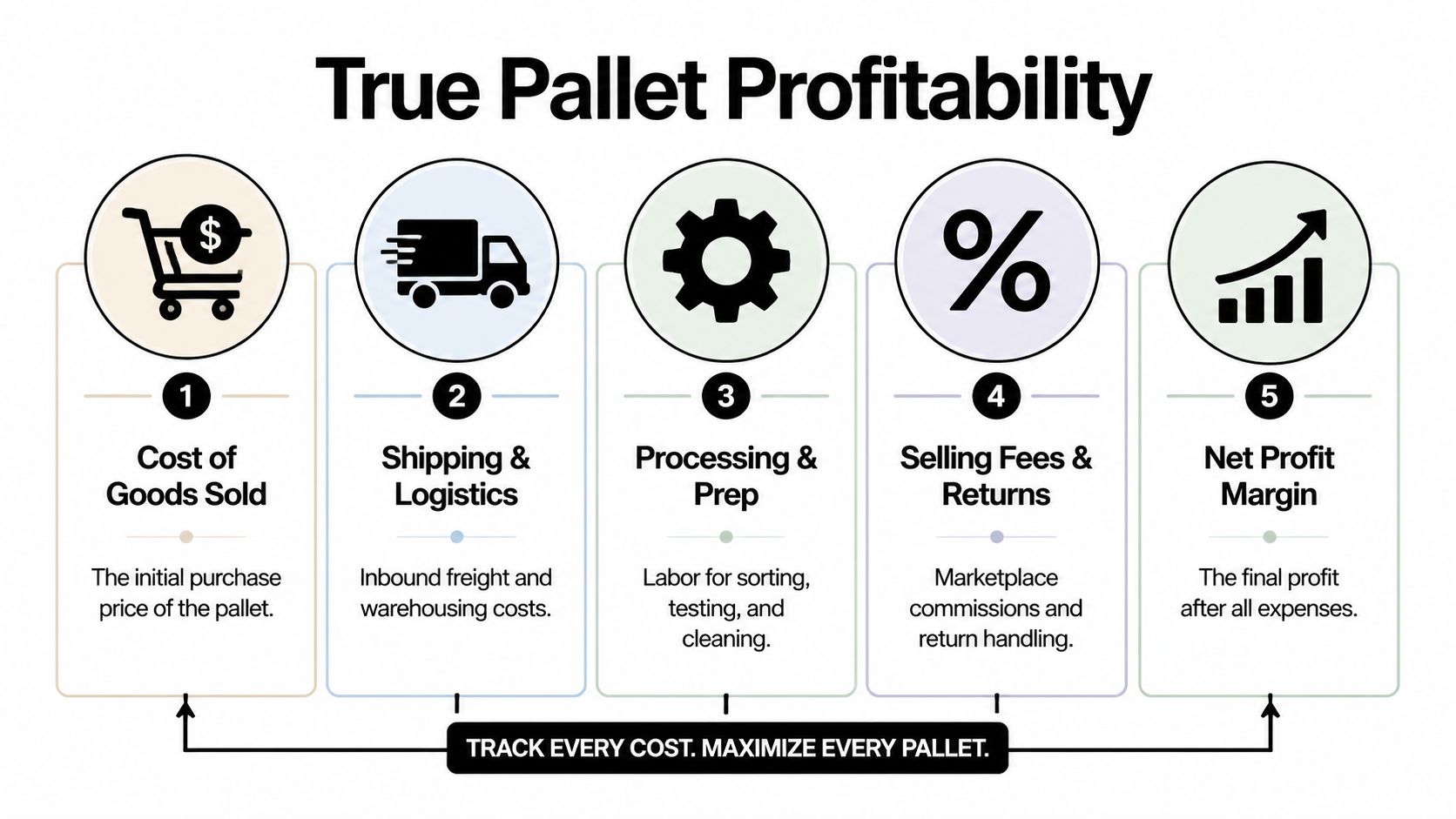
Teams that scale this category model each lot like a standalone P and L. If your margin only exists before labor, freight, returns, and fallout, it is not margin.
Use five cost buckets:
Acquisition cost
Winning bid, buyer premiums, and any auction charges your accounting team assigns to inventory cost.
Inbound logistics
Freight, accessorials, appointment fees, re-delivery charges, and any handling cost tied to getting the lot into your building.
Processing and prep
Receiving, sorting, testing, grading, cleaning, bundling missing parts, repackaging, photography, and listing prep.
Selling costs
Marketplace fees, payment processing, packaging, outbound shipping subsidies, customer service time, and return handling.
Losses and markdowns
Unsellable units, condition disputes, missing accessories, channel downgrades, and the discount required to turn aging inventory into cash.
That structure gives finance, warehouse, and channel managers one shared model. Without it, the warehouse thinks a pallet was fine because units moved, while the owner wonders why cash conversion keeps lagging.
The working formula is simple:
Expected recoverable revenue minus total landed cost minus selling cost equals expected contribution margin
The hard part is getting lot-level inputs that are clean enough to trust. Freight gets misallocated. Labor gets buried in warehouse overhead. Returns get posted to a channel but not back to the original lot. That accounting drift is manageable at hobby scale and dangerous at 7-figure volume.
If your team does not have a disciplined lot-costing model yet, start with a clear landed cost breakdown and force every major expense into the lot record. Profitability improves fast once each pallet has a real cost basis instead of a rough estimate.
Freight deserves its own review because small errors there distort every bid. Use quote benchmarks by lane and class before approval. This LTL shipping rates guide is a useful reference if your buyers and ops team need a tighter process for forecasting inbound shipping cost.
A simple house example shows how the spread works. Say a lot costs $500 all in after bid and freight. The manifest suggests far more value than that, but your model should assume a portion of units will be damaged, incomplete, low-demand, or forced into weaker channels. After testing, repricing, fees, packaging, and returns, that same lot might produce a net recovery range that is respectable but nowhere near manifest.
That is the point. Margin comes from disciplined recovery, not from repeating the marketplace’s top-line value number.
At scale, this is less about a single pallet and more about portfolio math. One lot can miss. Fifty lots from the same source hub can still be excellent if your recovery data stays predictable and your bad buys are contained. Serious operators measure source-level variance, not just one-off wins.
A mature pallet business asks two questions on every lot: how much cash came back, and through which channel did it come back fastest with the least labor.
Track recovery paths such as:
That level of tracking changes buying behavior. High-manifest electronics with heavy testing needs may look attractive until the labor hits. Mixed home goods with lower headline value can outperform if they clean up fast, list fast, and clear through your strongest channels.
A useful lot review includes:
| Metric | Why it matters |
|---|---|
| Manifest accuracy by category | Improves future bid confidence |
| Average processing burden | Shows true labor intensity |
| Recovery by channel | Reveals where margin is created |
| Loss bucket by cause | Separates damage issues from buying mistakes |
| Time to cash recovery | Protects reinvestment speed |
The best B-Stock operators run liquidation like a finance function inside a warehouse business. They know gross recovery, net recovery, processing hours per lot, return rates by channel, and cash-to-cash cycle by source. That is how pallets stop being opportunistic inventory and become a core business unit.
A lot can be well bought and still become a bad deal at the dock. That usually happens when the warehouse isn’t prepared for the shipment profile. Pallet businesses break down in receiving long before they break down in sales.
For LTL shipments of 1-12 pallets, expect individual pallets to arrive separately rather than all at once. FTL at 24-26 pallets requires a commercial dock and 5,000+ square feet of warehouse space. 35% of buyers run into storage issues because irregular items expand beyond the pallet footprint, and arranging your own shipping can save 15-25% on freight costs, according to B-Stock’s lot size and shipping guide.
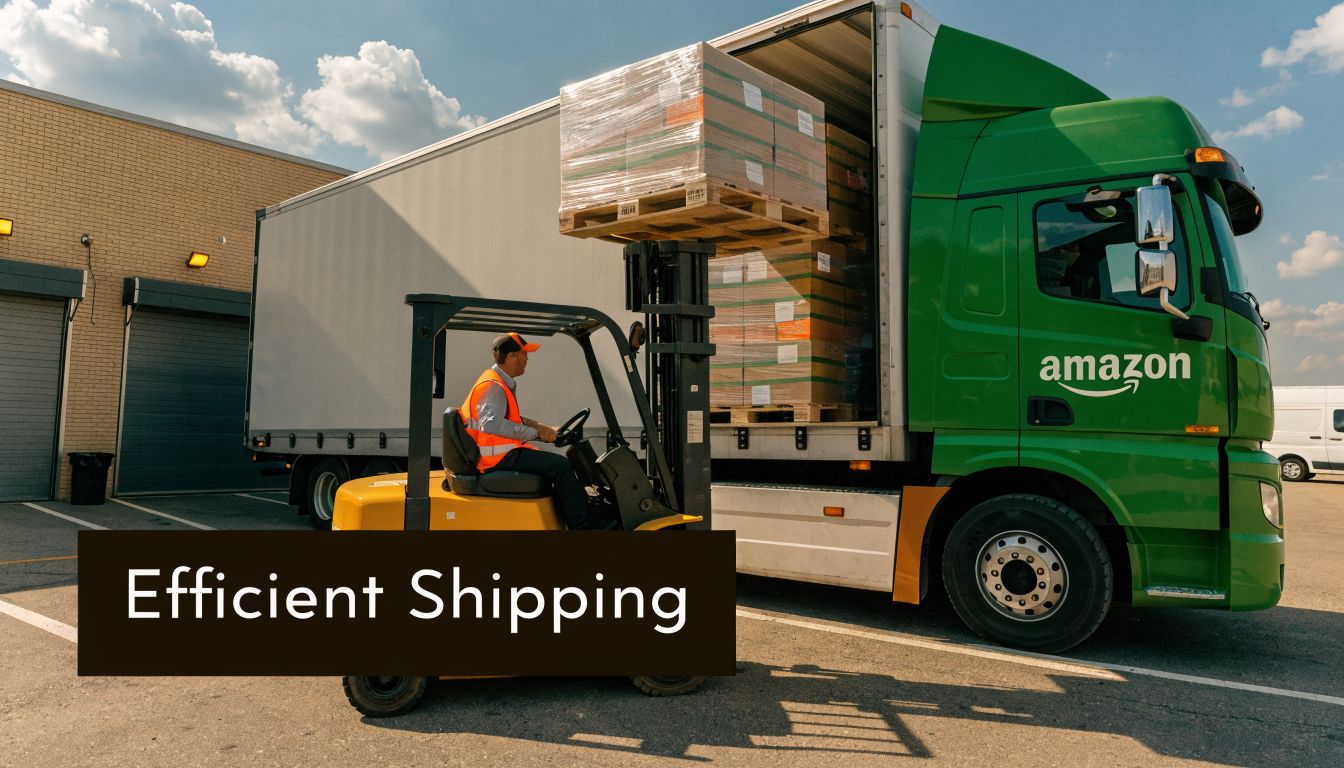
A lot of sellers let shipping sit with whoever has time that day. That’s how costs drift and receiving gets chaotic.
You need a repeatable decision tree. When does it make sense to let the marketplace arrange freight? When does your team take control? If you already have dock access, warehouse scheduling discipline, and a freight contact who understands your lanes, buyer-arranged shipping often gives you more control and can protect margin. If your operation is still loose on scheduling and claims management, outsourced convenience can cost less than your own mistakes.
LTL is where many teams get surprised. They assume a multi-pallet order will arrive as one coordinated event. It often won’t. If pallets land on different days, your receiving team needs a way to stage partial arrivals without breaking intake records or losing product visibility.
That means every lot should have:
If your team is weak on shipping paperwork, this bill of lading guide from Coreties is worth giving to whoever signs for freight. It helps prevent the kind of receiving mistakes that become expensive later.
Freight problems are easiest to solve when the evidence is captured before the truck leaves.
The pallet count never tells the full storage story. Irregular goods expand. Opened cartons spread. Sort tables fill. Trash accumulates. Suddenly the lot that looked manageable on paper is blocking aisles and slowing every other warehouse task.
A serious bstock amazon pallets operation needs separate zones:
| Zone | Purpose |
|---|---|
| Inbound staging | Temporary placement before check-in |
| Quarantine | Holds mixed or incomplete receipts |
| Testing and grading | Functional checks and condition assignment |
| Repack and prep | Cleaning, bundling, relabeling |
| Channel routing | FBA, MFN, eBay, local, salvage |
| Waste and recycling | Fast removal of non-recoverable material |
If your business doesn’t want to own all of that infrastructure, there are cases where outsourced warehouse support makes sense. For teams comparing in-house handling against partner models, this overview of 3PL fulfillment operations is a useful framework.
Scalable operators separate from opportunistic buyers. Every pallet needs to move from freight to data fast.
A clean workflow looks like this:
Here’s a useful walkthrough on the physical side of freight handling and pallet movement:
The key is speed with control. The longer inventory sits in inbound limbo, the more cash you’ve tied up in a pile of uncertainty.
A 20-pallet month can still run like a side hustle. At 100 pallets, poor routing decisions start showing up in cash flow, labor cost, storage drag, and account risk. That is the point where liquidation either becomes a real business unit or starts draining a profitable Amazon operation.
FBA is only one exit. Sellers who scale B-Stock successfully treat Amazon as the premium lane, not the default lane. The goal is to build a disposition system that turns mixed-quality inventory into predictable cash recovery across several channels, while protecting the core account and keeping labor attached to the right units.
High-volume operators also set margin floors before inventory ever hits a listing queue. A common benchmark is targeting 25%+ net margin after FBA fees, as noted in B-Stock’s guide on where and how to buy Amazon return pallets. If a lot cannot support that after labor, prep, claims, storage, and expected defects, it should be routed elsewhere or not bought at all.

As volume increases, “the warehouse handles pallets” stops being a real operating model. You need owners for each step that affects recovery rate.
A mature liquidation unit usually separates work into these functions:
| Function | What good looks like |
|---|---|
| Buying | Rules-based bidding, category caps, and lot selection tied to historical recovery |
| Receiving | Fast intake, documentation, and lot control |
| Grading output | Standardized condition codes that feed channel routing |
| Refurbishment | Clear repair limits and turnaround targets by category |
| Listing and routing | SKU assignment to the highest-confidence sales channel |
| Recovery analysis | Lot-level P&L, exception tracking, and feedback to buyers |
That structure matters because a pallet is not one product line. It is a bundle of different margin profiles, different prep requirements, and different exit paths. Teams that assign labor by function can process that complexity without slowing down the entire warehouse.
The grading decision is not the end of the process. It is the input for channel-specific prep lines.
One item may need FNSKU labeling and standard FBA prep. Another may need a merchant-fulfilled shelf location and a shorter price test. A third may need to be grouped into a local bulk lot because the handling cost is higher than the likely online recovery. The operators who scale profitably make those decisions through routing rules, not gut feel.
A practical model looks like this:
That is how larger sellers create consistency from ugly inventory. The edge is not buying a perfect pallet. The edge is having a controlled system for every condition tier that comes out of the pallet.
At higher volume, liquidation becomes an operations business first. SOPs, routing logic, labor standards, claims management, storage discipline, and weekly lot review matter more than sourcing stories.
Track recovery by supplier, category, condition code, and channel. Set approval limits for buyers based on historical outcomes, not optimism. Build dashboards that show actual contribution margin after freight, warehouse touch count, prep, returns, disposal, and aged inventory write-downs. If those numbers are not visible, the business can look busy while losing money.
I have seen sellers stall because they kept treating liquidation as overflow inventory for Amazon. The stronger model is to run B-Stock as its own unit with dedicated KPIs, its own labor plan, and its own routing rules. Done well, it can support a 7, 8, or 9-figure operation as a repeatable inventory channel instead of a side bet that occasionally produces a few good pallets.
Million Dollar Sellers is where elite ecommerce founders compare notes on channels like liquidation without the beginner fluff. If you’re building a serious inventory and operations machine, Million Dollar Sellers gives you access to vetted peers, real execution insight, and the kind of behind-the-scenes conversations that help 7, 8, and 9-figure operators scale smarter.
Join the Ecom Entrepreneur Community for Vetted 7-9 Figure Ecommerce Founders
Learn MoreYou may also like:
Learn more about our special events!
Check Events