Chilat Doina
July 31, 2026
The first pallet looks cheap. The second looks even better because someone posted a manifest with a big retail total, a clean photo, and a winning-looking category mix. Then the freight quote lands, the buyer premium shows up, half the box needs testing, and the margin that looked obvious starts disappearing one line at a time.
That's the core strategy when you buy Amazon pallets. The people who make money are usually not the fastest bidders, they're the ones who treat the lot like a full-cost supply chain, price the defects before bidding, and know when to walk away from a shiny manifest.
Amazon pallets exist because returns are built into e-commerce, not because sellers need a cleanup outlet. NRF's 2024 data puts U.S. e-commerce return rates at 17% to 20%. That volume creates inventory Amazon does not push back into normal retail, so it moves through liquidation channels, authorized partners, and secondary resale markets. The result is a formal pipeline built around excess stock, customer returns, and condition uncertainty, not a casual bargain bin for bargain hunters.
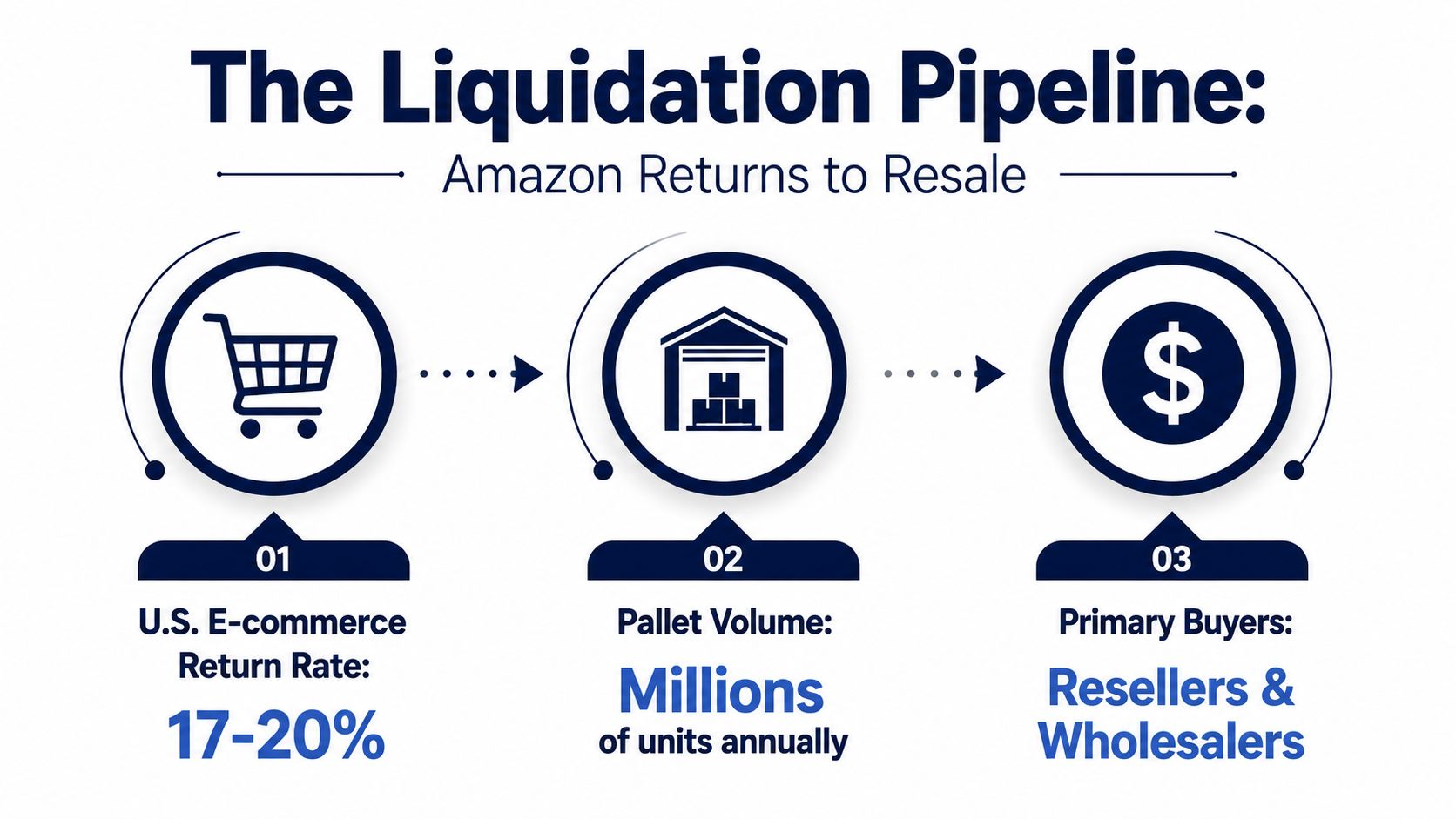
The economics make more sense once you look at the scale. One industry guide estimates Amazon's return-handling costs at $40 billion to $88 billion annually, which explains why liquidation is part of the operating model rather than an occasional cleanup exercise. The same guide says pallets often sell at 10% to 30% of retail value, with legitimate pallet prices commonly ranging from $85 to $2,000, and shipping can add $150 to $400 per pallet. Buyer's premiums and landed costs can lift acquisition costs by 40% to 60% above the base price, so the first number you see is rarely the number that matters.
The buyers who make money treat pallets like inventory with friction, not like a lottery ticket. The margin is not in the sticker discount. It sits in the spread after freight, defects, labor, and sell-through.
Practical rule: if you cannot explain your exit strategy for every item class on the pallet, you are bidding on hope.
Amazon's scale also matters because the marketplace is deep enough to keep inventory moving. A 2025 industry source says more than 9.7 million sellers were active on Amazon Marketplace worldwide, and Amazon's U.S. market generated $438 billion in net sales in 2024. That seller base helps sustain liquidation volume and creates enough resale demand to support a dedicated pallet ecosystem. Direct Liquidation buying guide
If you want a useful framing, start with the B-Stock marketplace overview and compare how the auction format changes bidding behavior. The wrong buyer chases the lowest visible number, ignores freight, and assumes the whole pallet is near-new. The right buyer starts with category fit, manifest quality, and a hard ceiling on total cost, then bids only if the math still works after transport, handling, and defects.
The marketplace you choose shapes the deal before you ever place a bid. Some platforms are better for fast auction buyers, some for fixed-price sourcing, and some for operators who want curated lots and less noise. The mistake is treating every liquidation site like it offers the same kind of inventory or the same level of risk.
Amazon's own Bulk Liquidations storefront is the most direct channel, but it's also where competition can be intense and listings move quickly. B-Stock is the auction-heavy option many sellers start with, while Direct Liquidation leans into bulk sourcing and fixed-price inventory. Liquidation.com gives buyers a broad mix of formats and conditions, and BULQ tends to appeal to people who want more curated lots and are willing to pay for that consistency. B-Stock marketplace overview
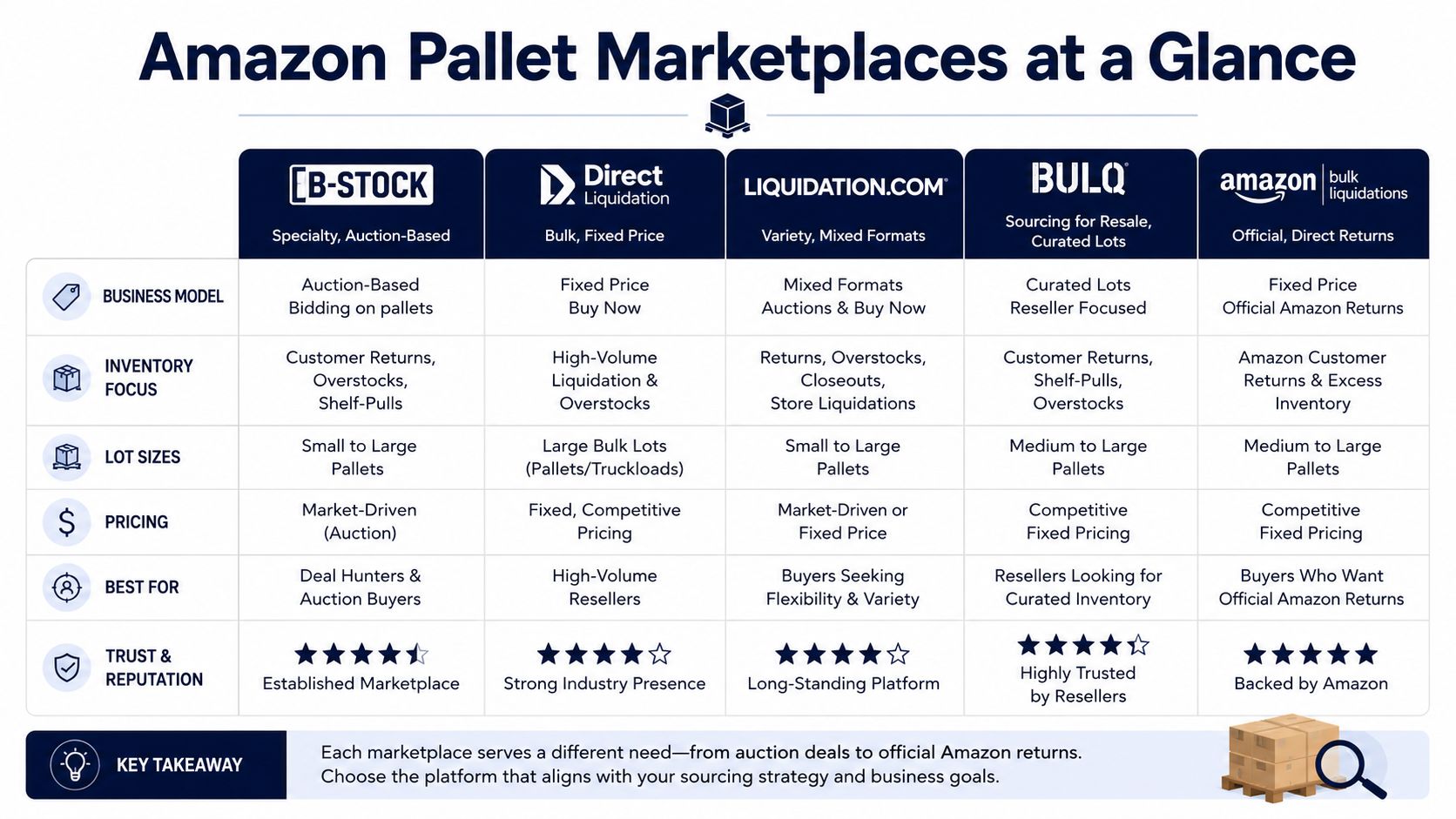
Auction platforms reward disciplined bidders who already know their ceiling. Fixed-price or curated inventory is better for buyers who'd rather trade a little upside for less decision fatigue and a cleaner sourcing process.
| Platform | Best fit | Practical trade-off |
|---|---|---|
| B-Stock | Auction-first buyers | More price discovery, more bid pressure |
| Direct Liquidation | Bulk-focused operators | Broader lot formats, less auction chaos |
| Liquidation.com | Buyers who want variety | Condition and format can vary a lot |
| BULQ | Resellers who want consistency | Curated lots usually cost more up front |
| Amazon Bulk Liquidations | Buyers who want direct access | Fast-moving listings, heavier competition |
The best fit depends on time, capital, and tolerance for ambiguity. If you need speed and can process lots quickly, auction systems can work. If you're still building your buying process, curated lots can reduce the number of surprises per pallet.
For a practical B-Stock deep dive, this internal walkthrough on Amazon pallet sourcing through B-Stock is worth keeping open while you compare lots.
The platform choice also affects your learning curve. A reseller who understands manifests and freight can extract value from an auction site. Someone still learning to inspect condition codes and estimate sell-through usually does better with a more predictable channel, even if the starting price looks less exciting.
A manifest is only useful if you read it like a buyer, not like a shopper. The headline retail value can look impressive, but that number doesn't tell you whether the pallet is full of high-velocity items, awkward slow movers, or mixed-condition units with very different exit paths. The difference between manifested and unmanifested matters because it changes your risk profile before the pallet ever hits your dock.
Condition codes carry more weight than most first-time buyers realize. New and Like New usually support a faster resale path, while Used Very Good, Refurbished, and Salvage require more labor, testing, or parts recovery. If the platform uses broad category buckets without item-level clarity, treat that as a risk signal rather than a feature.
Use the top-five coverage test before you get emotionally attached to the lot. If the five highest-value SKUs on the manifest can't cover at least half your bid, the lot is structurally weak. That doesn't make it bad automatically, but it does mean the pallet depends too much on the bottom of the manifest to work.
A fast checklist helps:
If the manifest looks polished but the product mix is vague, assume the work has been pushed from the seller to you.
A good manifest makes your job easier because it lets you compare the lot against actual resale comps before bidding. A weak manifest does the opposite. It hides the inventory story inside a big retail number and hopes you don't do the math.
The biggest mistake in this business is pricing the pallet instead of pricing the pallet after it lands. Hammer price is only the opening number. Once you add premium, freight, labor, storage, and a realistic defect allowance, the lot often costs much more than the listing suggests. For an operational framework, this landed-cost calculation guide is the right place to pressure-test your numbers.
Start with the base price, then add the buyer premium, because the actual acquisition cost can rise 40% to 60% above the base price according to the liquidation guide cited earlier. Freight is the next line item, and the same source notes shipping can add $150 to $400 per pallet. After that come receiving labor, storage, refurbishing, and the time you'll spend separating sellable inventory from dead stock. Amazon liquidation pallets explained
Here's a simple sample model.
| Cost Line | Amount | Notes |
|---|---|---|
| Hammer price | $400 | Base pallet bid |
| Buyer premium | Included in total acquisition uplift | Can push acquisition materially above the base price |
| Freight shipping | $150 to $400 | Depends on lane, dock access, and pallet handling |
| Receiving and sorting labor | Qualitative | Time to unpack, test, photograph, and bucket inventory |
| Storage | Qualitative | Floor space, shelving, and holding time |
| Refurbishment and defects | Qualitative | Missing parts, bad units, and reconditioning effort |
That means a $400 pallet can easily become a far more expensive buy once the invoice settles. If the pallet was attractive because it sat at 20% of manifest retail, that doesn't protect you from freight or processing drag. It only tells you the sticker looked cheap.
For resell-oriented lots, a common working target is to bid around 10% to 15% of manifest retail value, then back out freight and handling to get your hard maximum. That target is not a promise of profit, it's a control that keeps you from paying retail for liquidation inventory. Seller bidding guide
Real-world rule: if freight, premium, and processing push your effective cost above the recovery multiple you need, don't rationalize the buy. Walk.
The best spreadsheet I've seen for first-time buyers has only four yes-or-no gates. Can the top items carry the lot, can freight stay inside plan, can you process the goods fast enough, and can you sell the weak units without clogging cash flow. If any answer is no, the pallet isn't cheap, it's expensive in disguise.
The first hour after delivery can decide whether the pallet makes money or eats margin. If you skip photo documentation, accept the load blind, or dump everything into one pile, you lose your chance to prove shortages, file damage claims, and test whether your pre-bid model was realistic. Freight problems turn into your problem fast when the receiving process is sloppy.
Start by photographing the pallet before it is broken down, then photograph the shrink wrap, the cartons, and any obvious damage. Cross-check the count and condition against the manifest right away. If something is missing, crushed, or clearly damaged in transit, record it before the paperwork gets buried and the claim window gets harder to use.
Then sort every unit into four buckets:
That structure turns a messy pallet into a tracked inventory system. It also shows where your margin is coming from, because not every unit deserves the same labor input. A pallet that looks strong on paper can still be weak if too much of it falls into salvage or dead stock.
A basic spreadsheet is enough at first if you log cost, condition bucket, listing date, sale price, and time to sell. For a practical way to calculate sell-through percentage, use the sell-through guide as the reference point and compare actual movement against the model. The point is to measure what leaves the shelf, not just congratulate yourself for finding inventory.
If you resell through FBA or prep inventory for FBA, packaging matters early. A useful reference for prep standards is these Amazon FBA box requirements UK, because bad packing can turn a workable unit into a compliance headache before it ever gets listed.
The most useful habit is brutal honesty by bucket. If a lot keeps producing more salvage than you expected, that is not a one-off. That is your sourcing model telling you the manifest quality or category mix is weaker than your bid discipline assumed.
Bidding harder doesn't fix a bad category. I'd rather buy a modest pallet in a clean, easy-to-test category than chase a lower percentage discount on inventory that's expensive to verify and slow to move. This business rewards category selection first, because the cost of defects and handling is very different across product types.
Smaller home goods, tools, pet supplies, and some apparel tiers tend to be more manageable because they're easier to inspect, photograph, and list. The item value is often low enough that a few misses won't blow up the whole lot, but high enough that sell-through can still work if your sourcing is disciplined. These categories also let you sort faster, which matters more than most buyers expect.
High-value electronics are a different animal. Earlier buying guides often cite $1,500 to $5,000 for higher-value electronics pallets, which sounds attractive until you factor in testing, defects, accessory missingness, and return exposure. That category can work for experienced operators, but it's a bad first bet for someone still learning how to measure real landed cost.
Branded apparel can look easy until authenticity questions, size dispersion, and seasonality slow you down. Oversized items can also destroy the math because freight dominates the cost stack. Even a strong retail total won't save a pallet if the cost to move and store it eats the spread.
Hard rule: start in categories where you can inspect quickly, price confidently, and resell without a separate technical workflow.
The cleanest path for a first lot is usually to buy in categories where the majority of units can be tested or listed with minimal tooling. Once the model proves itself, then you can move into more complex pallets with higher defect rates and more upside. Until then, category choice matters more than finding the cleverest bid.
One pallet teaches you almost nothing. Four to six pallets in rotation start to reveal whether your sourcing process is real or just lucky. At that point, you need working capital for inventory, freight, storage, and labor, plus a tracking system that shows cost per pallet, realized margin per SKU, and time-to-sell.
If you're serious, relationships matter too. Platform account managers can sometimes point consistent buyers toward better inventory access, cleaner lot fits, or faster resolution on buying issues. That's not a shortcut around the numbers, but it can improve the quality of the lots you see.
For teams building repeatable sourcing systems, the challenge isn't finding more pallets. It's deciding when to add staff, outsource processing, or stop buying a category that keeps underperforming. If unsaleable inventory keeps growing, the answer usually isn't another bid, it's a better filter.
For operational automation and marketplace workflow context, this Zinc guide to Amazon shopping endpoints is useful when you're thinking about how sourcing data and listing operations eventually need to connect.
The three questions that come up most at this stage are simple. Unsaleable inventory should be isolated quickly so it doesn't eat space and attention, Amazon-to-Amazon resale depends on policy and product eligibility rather than wishful thinking, and pallet sourcing makes the most sense when you need a flexible supply line rather than a fixed wholesale relationship. Build around the math, not the excitement.
If you want a sharper operating playbook, a serious peer network matters more than generic advice. Million Dollar Sellers brings together operators who manage inventory, margins, and scale, so you can pressure-test sourcing decisions against people who've already made these mistakes. Visit Million Dollar Sellers if you want to compare notes with founders who treat liquidation like a real acquisition channel, not a side hustle fantasy.
Join the Ecom Entrepreneur Community for Vetted 7-9 Figure Ecommerce Founders
Learn MoreYou may also like:
Learn more about our special events!
Check Events