Chilat Doina
April 14, 2026
You’re probably in one of two places right now.
Your store has traction, but growth feels messier than it did a year ago. Inventory runs tight at the worst time, ad performance swings harder than it used to, and your team keeps asking for answers that live in five different dashboards.
Or you’re earlier than that, still close enough to the business to touch every lever yourself, and you can already feel the ceiling coming. What worked when you were shipping orders from a laptop and a spreadsheet won’t hold once you add more products, more channels, and more people.
That’s a key challenge for ecom founders. Growth isn’t just about selling more units. It’s about changing how the business works at each stage without breaking the things that made it successful in the first place.
Some founders stay stuck because they use startup tactics on a scaling business. Others build too much process too early and slow themselves down. The better path is simpler. Match your priorities, KPIs, systems, and relationships to the stage you’re in.
A lot of ecom founders mistake motion for scale.
You can launch more campaigns, add more SKUs, test more channels, and still end up with a business that feels heavier, not stronger. Sales rise, but so do mistakes. The warehouse misses replenishment timing. Customer support gets noisier. Cash gets trapped in the wrong inventory. The founder becomes the bottleneck.
At first, brute force works. You answer support tickets yourself, tweak product pages at midnight, and push through problems with speed.
Then the business changes shape. One product becomes a line. One channel becomes several. One contractor becomes a team. Now every decision has a second-order effect.
A simple example:
That’s why scaling matters. It forces you to trade improvisation for design.
Practical rule: If your business only works when you personally notice every problem, you haven’t built scale yet.
The brands that keep climbing usually make a few shifts early:
For ecom founders, scaling matters because every stage has a different game. If you play the wrong one, growth turns into friction.
Not every online seller is an ecom founder.
Some people sell products online. Some run side hustles. Some are marketers with a store attached. An ecom founder builds a business that can stand on its own across products, channels, and teams.
It’s comparable to aviation.
A hobbyist flies one small plane in good weather. A founder learns to manage different aircraft, changing routes, crew coordination, and instrument panels. The job isn’t just flying. It’s making sure the whole system reaches the destination safely.
That’s what ecom founders do. They don’t just list a product on Amazon or launch a Shopify site. They manage a chain of connected decisions:
Early on, you’re the person doing the work.
Later, you become the person designing the conditions for good work. That’s a different skill. It requires judgment more than hustle.
Here’s how that shift usually looks:
From product intuition to product-market fit analysis
You stop asking, “Do I like this product?” and start asking, “Why does this customer buy, reorder, and recommend?”
From fulfilling orders to orchestrating supply chains
You stop reacting to stockouts and start planning the flow of inventory like a traffic controller.
From running ads to reading business signals
You stop focusing only on campaign metrics and start connecting ads to inventory, contribution margin, and customer quality.
Ecom founders build systems under uncertainty. That’s what separates them from casual sellers.
The rest of this guide uses that definition. Founder means the person responsible for steering the business, not just generating sales.
Most ecom founders don’t fail because they lack ambition. They stall because the business outgrows the founder’s current operating model.
The easiest way to see this is to break the journey into three stages. Each one demands a different kind of thinking.
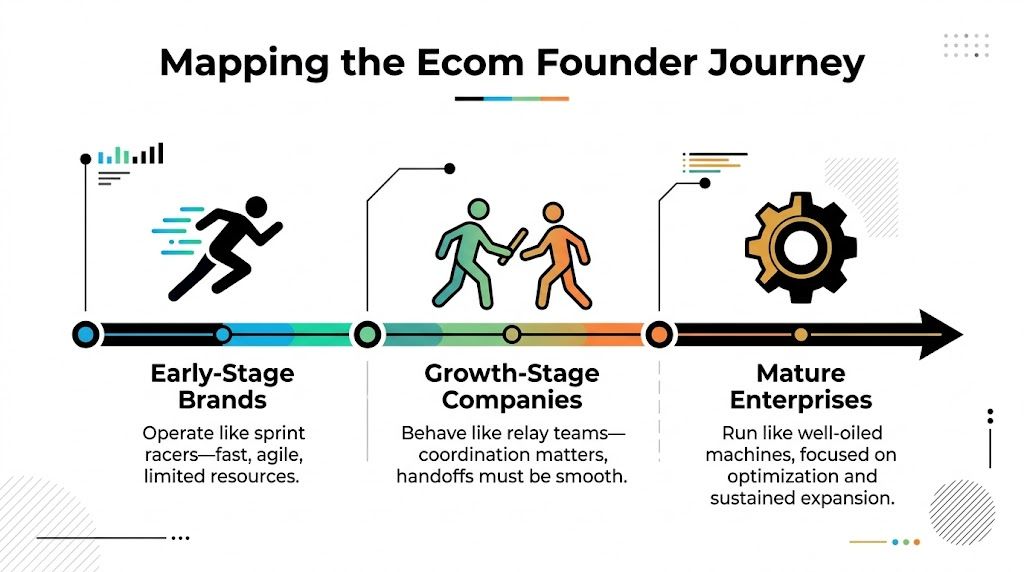
This stage is usually about finding traction fast.
You’re proving demand, refining the offer, and learning which channel gives you the cleanest signal. Speed matters more than polish. You can still change the product, the positioning, or the customer promise without moving a huge organization.
A strong mental model comes from Amazon’s start. Jeff Bezos founded Amazon in 1994 with an initial investment of just $10,000, starting as an online bookstore from his garage in Bellevue, Washington, leveraging the internet to redefine retail (MDS).
That story matters because it shows what early-stage founders often get right. They start lean, solve a narrow problem first, and use customer behavior to guide expansion.
Typical milestones in this stage include your first $100K in revenue and the first clear signs of repeatable demand. At that point, the big questions are simple:
The next stage starts when traction is no longer the main problem. Coordination is.
Many ecom founders encounter the awkward middle. Revenue is climbing, but decisions are getting slower. Marketing blames inventory. Operations blames forecasting. Finance wants clearer reporting. The founder is passing the baton between functions all day.
Crossing the $1M mark often creates this tension. The business is too large for instinct alone, but not yet large enough to absorb sloppy systems.
What changes here:
A founder in this stage isn’t just asking how to grow. They’re asking how to grow without chaos.
If you want a broader view of how experienced operators think about these transitions, this roundup of lessons from top ecommerce founders in 2025 is a useful companion.
Once a brand pushes toward $10M and beyond, the challenge changes again.
Now the business needs reliability. Small inefficiencies become expensive. Leadership quality matters more than founder energy. Expansion into new channels, countries, or categories has to fit the core machine rather than distract from it.
The mature stage often looks less exciting from the outside. Fewer scrappy heroics. More operating rhythm.
That rhythm usually includes:
| Stage | Main priority | Founder focus |
|---|---|---|
| Early | Validation | Learn fast |
| Growth | Coordination | Build systems |
| Mature | Optimization | Develop leaders |
The journey isn’t linear for every brand. Some founders jump ahead in one area and lag in another. But the pattern holds. Early businesses need speed, growth businesses need handoffs, and mature businesses need endurance.
A KPI is only useful if it helps you make a decision.
That sounds obvious, but many ecom founders drown in metrics because they collect numbers without tying them to a stage-specific problem. One dashboard shows ad results. Another shows inventory. A third shows sales by channel. None of them answer the question the founder has.
You don’t need dozens of metrics. You need a handful that reveal whether the business is healthy, fragile, or drifting.
These are the core ones most founders should understand:
If your team needs a plain-English refresher on metric design, this guide to understanding key performance indicators is a solid primer.
Because this section doesn’t have verified numerical benchmarks beyond those provided elsewhere, the most useful table is directional. It helps you see what each KPI should do for you at each stage.
| KPI | Early-Stage | Growth-Stage | Maturity-Stage |
|---|---|---|---|
| Customer acquisition cost | Use it to test channel viability | Compare by channel and product line | Manage it against margin and customer quality |
| Average order value | Validate basic offer strength | Improve with bundles and post-purchase offers | Optimize by segment and channel |
| Conversion rate | Find obvious page friction | Separate traffic quality from page issues | Diagnose funnel leakage by device, source, and audience |
| Inventory turnover | Avoid dead stock and stockouts | Tie replenishment to campaign planning | Use it as a cash and planning control metric |
| Customer lifetime value | Estimate whether repeat behavior exists | Connect it to acquisition decisions | Use it to shape retention investment |
| Return on ad spend | Check whether campaigns have signal | Combine with inventory and contribution thinking | Use as one view inside a broader profit model |
| Repeat purchase behavior | Confirm people come back | Segment loyal customers from discount-driven buyers | Forecast demand and retention strategy |
A more ecommerce-specific framework for tracking these metrics lives in this MDS resource on key performance indicators for ecommerce.
Metrics don’t hurt businesses. Misread metrics do.
Here are the usual breakdowns by stage:
Founders often don’t know whether low sales come from weak demand, bad traffic, or poor positioning. They react by changing everything at once.
The biggest issue is usually siloed data. Sales live in Shopify. Marketplace data lives elsewhere. Ad data sits in platform dashboards. Nobody trusts the same number.
Forecasting becomes harder because the business has more moving parts. Promotions, inventory windows, and channel mix all affect each other. Cash flow pressure gets sharper when mistakes scale up.
If one person has to manually stitch together the weekly picture, your reporting system is still fragile.
Good KPI discipline doesn’t mean staring at more data. It means choosing the few indicators that reveal the next bottleneck.
A founder hits $1M, sees orders rising, and assumes the next step is more ad spend. Then stockouts spike, conversion slips on mobile, and nobody trusts the weekly numbers. Revenue grew, but the business did not get easier to run.
That is how scaling usually feels in ecommerce. Growth comes from pulling the right lever for your current stage, then building the systems to support it. Early-stage founders usually need clearer offers and cleaner conversion. Growth-stage founders often need channel discipline and stronger operations. Past that, the bottleneck often shifts to data, forecasting, and access to operator knowledge that is hard to find in public content.

Offer expansion matters first because paid traffic amplifies whatever is already true. If the product line is narrow, confusing, or mismatched to customer needs, more traffic just gets you more expensive proof.
Start with the next logical purchase. A skincare brand might add a travel size for first-time buyers, a bundle for routine shoppers, and a subscription on the replenishable SKU. Each option serves a different job. That is the point.
Use a simple filter before adding anything new:
A wider catalog only helps when it improves choice without creating confusion.
Founders often try to pour more traffic into a store that still has friction in the buying path. That is like pouring more water into a bucket with a crack in the bottom.
The first fixes are usually plain. Sharper product pages. Faster mobile load times. Clearer shipping and returns language. Fewer steps at checkout.
Brands that rely on first-time buyers should also review whether a frictionless guest checkout option fits their store, because forced...com/blog/checkout-as-guest) fits their store, because forced account creation often adds resistance right before purchase.
A practical rule helps here. Only ask for information that is required to complete the order.
Channel growth gets expensive when teams read platform metrics without business context. A campaign can look healthy inside Meta while pushing a low-margin SKU, creating fulfillment strain, or starving a hero product that should be carrying the month.
This lever is less about spending more and more about connecting decisions:
A founder at the early growth stage can still run this with a lean team. The discipline is what matters.
Supply chain problems rarely start in the warehouse. They often start in planning.
A fast-growing brand with brittle supply works like a race car on worn tires. It can look strong for a while, then one hard turn exposes the weakness. A delayed purchase order, a bad forecast, or a promotion that outperforms expectations can create weeks of avoidable damage.
Useful practices here are straightforward:
If this area feels messy, many founders benefit from learning how operators in similar businesses structure their planning. This breakdown of an ecommerce founder community shows why peer groups become more valuable once inventory, media, and cash flow start affecting each other every week.
This lever becomes more important after the business has enough channels, SKUs, and spend to make spreadsheet reporting fragile. Founders often want AI to answer forecasting and allocation questions before the company has built a usable data foundation.
The stronger approach is the four-step data chain described in this analysis of the mistake ecom brand owners are making with AI. The value is in the sequence. You centralize data first, preserve history second, connect systems third, and only then trust automation to support decisions.
In practice, that usually looks like this:
At this stage, the founder journey often changes. After the first million, the gap is not just capital. It is also pattern recognition. Founders may need a data engineer, an experienced operator, or a vetted peer group to pressure-test systems before expensive mistakes spread. Million Dollar Sellers is one example of the kind of operator network brands use at this stage to compare workflows, providers, and execution standards.
A useful walkthrough on applying systems thinking to growth is below.
A growth lever works like a gear in a machine. The gear matters, but timing and fit decide whether the machine moves.
Three habits keep these levers from turning into random experiments:
The right lever depends on the founder's stage. The payoff comes from choosing the lever that matches the current bottleneck, then running it with enough consistency that the result can be repeated.
A founder crosses $1M, hires a few key people, places larger inventory bets, and suddenly every decision gets heavier. One wrong 3PL, one weak supplier agreement, or one mistimed promotion can tie up cash for months. Public advice rarely helps at that point because the questions are no longer basic. They are specific, expensive, and tied to the founder’s stage.
That is why peer communities start to matter more after the first major revenue milestone.
Analysts at Qubit Capital note that only a small share of startups secure VC funding. For ecom founders, that matters because the business can be healthy and still sit in an awkward middle ground. It may be too operationally complex for generic startup advice, but not a natural fit for venture capital either.
Peer networks do not replace funding. They solve a different problem. They give founders the execution context that helps them use capital wisely, or stretch internal cash further when outside capital is not available.
A good community works like a shortcut through avoidable mistakes.
Take a founder doing $2M to $3M on Amazon. Sales are growing, but the current 3PL is missing SLAs and chargebacks are creeping up. Instead of spending six weeks vetting providers from scratch, the founder asks a private group of operators at a similar size. Two members share who they switched to, what they pay, where onboarding got messy, and which questions exposed weak warehouse partners. That does not just save time. It improves the odds of choosing the right fix before Q4 pressure hits.
That kind of help is hard to get from broad founder content.
Trust changes the quality of advice.
A room full of general networking contacts may produce introductions. A smaller circle of category-specific founders is more likely to produce honest numbers and useful warnings. An Amazon-first founder dealing with rising storage fees, for example, can learn far more from a seller who recently cleaned up aged inventory than from a general startup operator with no marketplace exposure.
The same pattern shows up across DTC and omnichannel brands. A founder wrestling with margin erosion from rising CAC needs peers who can compare contribution margin targets, promo calendars, and retention benchmarks by stage. A founder preparing for retail expansion needs operators who can explain chargebacks, forecasting discipline, and where cash gets trapped. The value is not motivation. It is relevant context.
That matters because ecom problems are rarely isolated. Inventory, paid media, cash flow, and fulfillment behave like connected gears. If one slips, the others feel it.
Million Dollar Sellers is one example of the kind of network that addresses this stage-specific gap. The publisher describes MDS as an invite-only group whose members collectively generate over $8 billion in annual revenue across Amazon, DTC, and omnichannel brands, with private forums, curated events, and vetted recommendations built around operator trust.

If you want a clearer sense of how these groups work in practice, this overview of an ecom founder community shows how curated networks create more candid conversations, better referrals, and faster feedback loops.
For founders in the $1M-plus range, the hidden value of a peer community is simple. It closes two gaps at once. It helps fill the knowledge gap that appears when public advice stops being useful, and it reduces some of the pressure created by limited access to traditional funding by helping founders make sharper operating decisions at the stage they are in.
The right next move depends on your stage.
A founder doing the wrong work can stay busy for months without getting closer to scale. The easier way is to pick a short list of actions that match the business you have today.
Your main job is validation.
You’re trying to prove that the product, offer, and channel combination can produce repeatable demand without founder improvisation carrying the whole thing.
Focus on these tasks:
Leading indicators to watch are consistency and clarity. Are you seeing repeat questions, repeat buyers, and repeat winning messages?
Your biggest risk is operational drag.
Many businesses have enough revenue to expose weak systems, yet lack sufficient structure to absorb them. Founder intuition still matters, but it can’t be the whole management system anymore.
Priorities here should look like this:
Standardize ownership
Decide who owns inventory, paid media, retention, and reporting. If decisions still bounce back to you by default, tighten accountability.
Unify data sources
Get sales, ad, and inventory data into a connected reporting setup. If the business is large enough, the verified guidance from the data-chain source suggests considering a dedicated data engineer for brands over $5M revenue, with emphasis on SQL and BI capability.
Run recurring operating reviews
Hold weekly and monthly reviews that tie together demand, stock position, and margin rather than discussing each area separately.
Document playbooks
Turn repeat decisions into written processes for launches, promotions, and reorders.
Audit team bottlenecks
Look for work that keeps waiting on one person. That’s usually where your next hire or process change should land.
The key signal at this stage is whether the business can keep moving when you step out of the room.
Your task is precision.
You’re not trying to invent a business model from scratch anymore. You’re trying to improve the machine while protecting what already works.
Start with these actions:
No matter where you are, a simple cadence helps:
| Weekly focus | Key question |
|---|---|
| Demand review | What’s selling and why |
| Inventory review | What could stock out or sit too long |
| Funnel review | Where are customers dropping off |
| Team review | What decisions are waiting on unclear ownership |
| Learning review | What changed this week that should alter next week’s plan |
That rhythm keeps strategy tied to reality.
If you only take one step this week, make it this: accurately identify your current stage, then choose one bottleneck that belongs to that stage. Don’t solve a mature-business problem with early-stage tactics, and don’t build enterprise complexity into a business that still needs cleaner demand signals.
Ecom founders aren’t just online sellers. They’re builders of connected systems.
That’s why the path from first traction to larger-scale growth feels so different at each level. Early brands need speed and learning. Growth-stage brands need coordination and cleaner handoffs. Mature brands need operational endurance, sharper leadership, and tighter optimization.
The most useful lens is simple. Match the business stage to the right KPIs, the right growth levers, and the right support. When founders ignore that match, they either overcomplicate too early or keep operating too casually for too long.
A few ideas should stick:
That last point matters more than most founders realize. The gap beyond $1M revenue often isn’t just capital. It’s access to trusted context, stronger operator insight, and faster learning loops. Elite peer networks can help fill that gap in ways broad startup advice often can’t.
Pick one high-impact move this week. Tighten a KPI dashboard. Clean up one handoff. Audit one bottleneck. Then decide whether you need a stronger circle around the business to speed up the next stage.
If you’re building an ecommerce brand and want sharper conversations with experienced operators, apply to Million Dollar Sellers. It’s an invite-only network for serious founders across Amazon, DTC, and omnichannel brands who want better insight, better execution, and better decisions as they scale.
Join the Ecom Entrepreneur Community for Vetted 7-9 Figure Ecommerce Founders
Learn MoreYou may also like:
Learn more about our special events!
Check Events