Chilat Doina
April 13, 2026
You’re probably in the same spot a lot of good operators hit right after the business starts behaving like a real company.
Revenue is healthy. Orders are moving. Amazon is working, DTC is growing, maybe wholesale or a second marketplace is creeping in. But the operating model under it still looks like a patched-together version of the one that got you through the first stage.
One contractor handles customer service. A 3PL handles part of fulfillment. Someone on the team manually reconciles inventory between Shopify and FBA. Returns live in one system, ticket history in another, and nobody fully owns the handoffs. You’re not under-resourced in the obvious sense. You’re under-structured.
That’s where most outsourcing advice falls apart. It tells you to “delegate more” or “hire offshore support” as if the problem is labor. At the 7-figure level, the problem usually isn’t labor. It’s operational design.
Ecommerce outsourcing: what works for 7-figure operators is less about finding cheaper hands and more about building external capacity that can survive channel complexity, preserve margin, and free founders to focus on growth. The hard part isn’t deciding whether outsourcing works. The hard part is knowing what to outsource, when to shift models, and how to avoid the integration mistakes that break a solid brand.
The first significant ceiling for a founder rarely shows up as a revenue problem. It shows up as a management problem.
You cross the million-dollar mark and suddenly the same habits that made the business work start slowing it down. Fast decisions become scattered decisions. Founder oversight becomes founder bottleneck. Scrappy systems become fragile systems.
A typical week looks familiar. Support tickets pile up after a promo. A shipment delay causes a spike in “where is my order” messages. Amazon inventory doesn’t match what your Shopify team thinks is available. A refund issue sits unresolved because fulfillment, CX, and finance are all looking at different records.
None of this means the business is broken. It means the business has outgrown heroic management.
At this stage, friction usually clusters in a few places:
The dangerous part is that revenue can still look good while the operating model weakens.
You can grow for a while on demand alone. You don’t scale cleanly until ownership of operations is clear.
Most founders respond by adding another freelancer or coordinator. Sometimes that helps for a quarter. Then the same pressure comes back.
That’s because the work itself hasn’t been redesigned. You’ve only inserted another person into a weak process. If the inventory sync is messy, an extra operator just manages mess faster. If support has no triage logic, another rep closes more tickets without fixing root causes.
The true shift starts when you stop asking, “Who can take this task off my plate?” and start asking, “Who can own this function well enough that I no longer need to supervise every handoff?”
That question changes everything.
There’s a big difference between outsourcing a task and outsourcing a function.
A task is narrow. Answer these tickets. Reconcile these invoices. Launch these ads. A function is outcome-based. Own customer experience. Own fulfillment execution. Own marketplace operations. Own paid acquisition implementation inside agreed guardrails.
That’s the shift that separates a growing brand from an operator who keeps rebuilding the same org chart every six months.
Global spending on ecommerce outsourcing reached $731 billion by 2024, with 65% of companies citing a focus on core functions as the primary benefit, according to Vserve’s 2024 to 2027 outsourcing analysis. That matches what experienced operators already know. The upside isn’t just lower cost. It’s regained focus.
When founders outsource badly, they usually do it in fragments.
They hire one VA for inbox coverage, one freelancer for Amazon listings, one agency for retention email, and one warehouse partner for shipping. Every vendor does a piece. Nobody owns the result. The founder becomes the integration layer.
That doesn’t provide operational advantage. That’s distributed chaos.
Functional outsourcing works when the external partner is responsible for a defined business outcome, with systems, reporting cadence, escalation rules, and clear ownership. Think of it as building a virtual leadership bench around the business without forcing every capability in-house too early.
A strong partner should feel less like rented labor and more like a narrow operator with a scorecard.
Instead of saying:
You define functions like this:
That’s why straightforward delegation frameworks still matter. If your team isn’t already assigning work cleanly, fix that first with a process like this guide on how to delegate tasks effectively. Delegation is the foundation. Functional outsourcing is the scaled version of it.
Once you outsource a function, your role stops being daily supervision. It becomes partner management.
That means you define the scorecard, approve strategic changes, review exceptions, and make sure the function still aligns with brand priorities. You don’t spend your afternoons checking whether five tickets got answered correctly or whether yesterday’s returns were processed.
Practical rule: If you still have to personally coordinate the handoff between your outsourced partners every day, you haven’t outsourced a function. You’ve outsourced a pile of tasks.
The best operators don’t outsource because they’re overwhelmed. They outsource because they’ve become disciplined about where founder attention creates the most value. Product. positioning. channel strategy. capital allocation. Those stay close. Repetitive operational execution doesn’t.
Most brands don’t need more outsourcing. They need better sequencing.
The right move depends on where operational drag is showing up. A brand that’s strong on acquisition but weak on post-purchase has a different outsourcing priority than one struggling with inventory flow between Amazon and DTC.
Use a simple matrix. First ask what function is non-core but operationally heavy. Then ask whether the current pain is occasional, recurring, or structural.
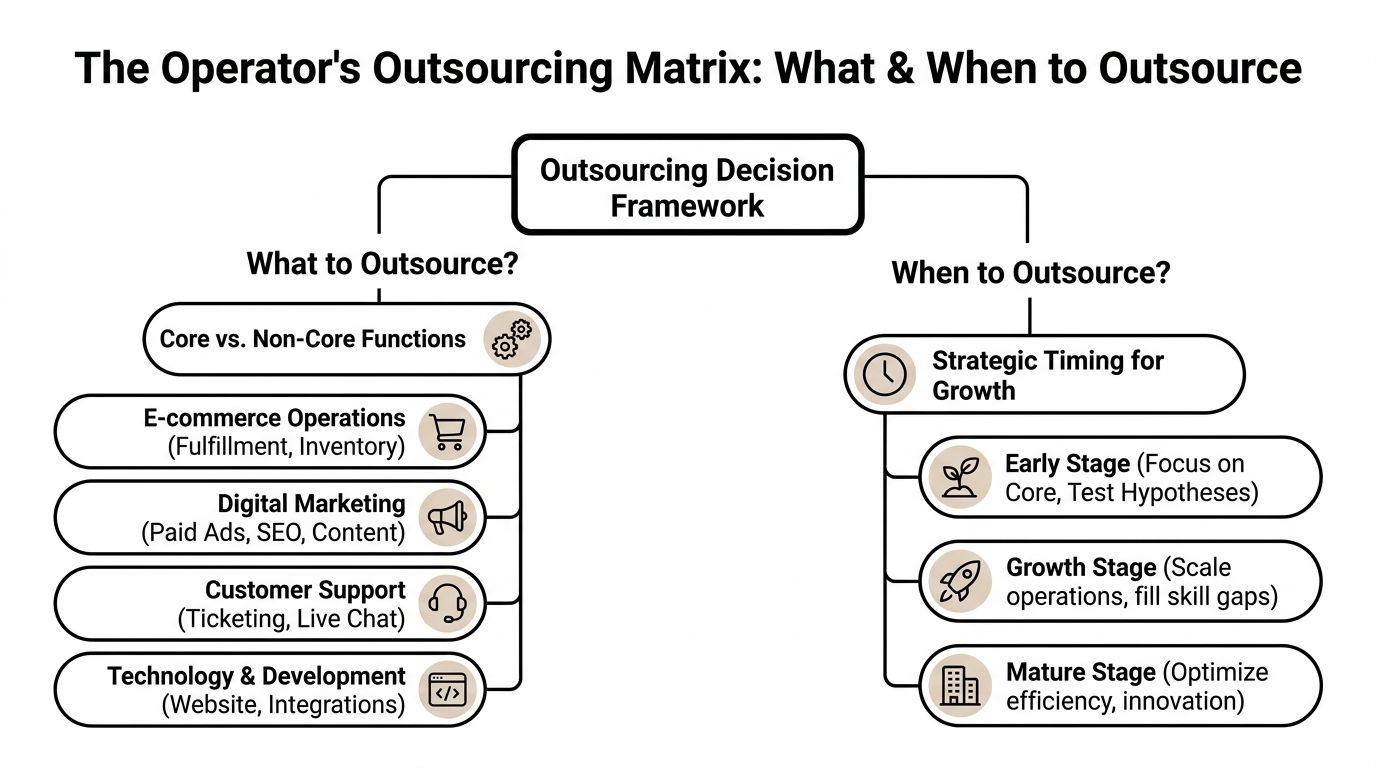
This is usually the first function to formalize because it touches retention, reviews, refunds, and brand trust all at once.
Outsource CX when support stops being a manageable founder-side process and starts requiring schedule coverage, QA, macros, training, and escalation logic. If your team is improvising tone, refund handling, and return decisions across channels, the function is ready for a real owner.
What works:
What doesn’t work is throwing a generic support team into your help desk and hoping they absorb product nuance through osmosis.
At 7 figures, fulfillment complexity comes less from parcel volume and more from exceptions.
The standard order flow might be fine. The problems are split shipments, stock discrepancies, damaged inventory, carrier claims, return routing, prep requirements, and marketplace-specific handling rules. That’s where outsourcing can help, but only if someone owns exception management.
Good trigger points are operational, not emotional:
| Function | Outsource when | Keep close when |
|---|---|---|
| Fulfillment coordination | Your team spends too much time chasing shipment exceptions and returns | You’re still validating basic unit economics and warehouse fit |
| Inventory operations | Channel sync issues are affecting availability decisions | You haven’t standardized SKU logic or reorder process |
| Marketplace operations | Amazon cases, listings, and compliance issues are distracting leadership | The channel is still experimental |
Founders often wait too long here because bookkeeping feels “back office.” That’s a mistake.
If cash flow visibility is delayed, refunds aren’t reconciled cleanly, or channel payouts require manual cleanup every cycle, you’re flying with partial information. Finance ops outsourcing works well when it’s tied to a monthly close rhythm and exception reporting, not just data entry.
Use outside support for reconciliation discipline, reporting cleanup, and process ownership. Keep final interpretation and capital decisions in-house.
This one gets over-outsourced early and under-managed later.
Creative direction, merchandising insight, and offer strategy usually stay closer to the brand. Tactical execution can move out. That includes campaign trafficking, feed management, landing page production, reporting prep, and SEO implementation.
The mistake is outsourcing the “channel” instead of the execution layer. If the agency or contractor owns strategy, reporting, attribution interpretation, and execution without tight review, you often lose learning speed.
Don’t outsource based on founder annoyance alone. Outsource when all three conditions are true:
If one of those is missing, hold off.
A good outsourcing decision removes recurring load without removing operational visibility.
That’s the matrix. Start with the function creating the most expensive friction. Not the noisiest one. The one that keeps forcing senior attention into work that should already run cleanly.
Once you know the function, the next decision is model.
At this level, most brands end up using one of three structures. A specialized agency, a fractional team, or a dedicated team. Each can work. Each can also waste time if the fit is wrong.

Agencies are useful when the work is narrow, technical, or campaign-based.
A good agency can solve a defined problem fast. Think migration support, feed cleanup, retention setup, or a short-term paid media reset. They’re also useful when you need bench depth across multiple disciplines without building a full internal structure.
Their weakness is continuity. Shared context gets lost. Small changes go through account layers. Daily operational ownership rarely feels sharp.
Best use cases:
Poor use cases include always-on customer experience or operational workflows that require deep product familiarity.
This model sits in the middle and is often the most practical for a 7-figure brand.
You get named operators or a small pod that acts like an extension of your business, but without the commitment of a fully dedicated setup. Fractional works well when the brand needs repeatable expertise yet doesn’t have enough volume to justify full dedicated coverage.
It’s often the right bridge between founder-led operations and a mature outsourced function.
This also tends to be the cleanest way to test fit before committing deeper. The same logic applies if you’re evaluating remote staffing more broadly. This guide on how to hire virtual assistant is useful if you need to structure role scope before moving into a larger team model.
Many scaled brands eventually land here for support-heavy functions.
A dedicated team learns the catalog, internal standards, exception patterns, and brand voice in a way a shared team usually doesn’t. That depth matters in customer support, marketplace operations, and logistics coordination.
But this model is not automatically better. Dedicated teams can reduce ticket resolution times by up to 40%, but they can cost 2-3x more than shared models and carry a 25% churn risk if SLAs lack retention clauses, according to Hugo’s review of ecommerce customer service outsourcing providers.
That’s the trade-off most guides skip. Better performance often comes with a heavier management burden and more exposure to staffing quality.
| Model | Best for | Main upside | Main risk |
|---|---|---|---|
| Agency | Defined projects and specialist sprints | Fast access to expertise | Low ownership of day-to-day nuances |
| Fractional team | Ongoing execution with moderate complexity | Flexibility with continuity | Can stall if scope isn’t clearly defined |
| Dedicated team | High-volume, repeatable functions needing deep context | Strong brand familiarity and process consistency | Higher cost and retention risk |
Fulfillment is its own category because many brands need a partner, not just labor.
When evaluating 3PL options, useful resources like this overview of 3PL ecommerce fulfillment services can help you compare capability areas that matter in practice, such as returns handling, integration support, and operational responsiveness. The warehouse itself matters. The exception process matters more.
Shared teams are fine when the work is standardized. Once your brand requires memory, judgment, and channel-specific nuance, shared models usually start leaking value.
The switch from shared to dedicated shouldn’t be emotional. Make it when the cost of weak context exceeds the cost of stronger ownership.
A polished sales deck tells you almost nothing about whether an outsourcing partner can survive your operating reality.
The true test is whether they can fit into your systems, handle exceptions, and report clearly when something breaks. For omnichannel brands, integration quality matters as much as service quality.

A good partner interview goes beyond “Do you support Shopify and Amazon?”
Ask how they handle handoffs, where data lives, who owns exception queues, how they train new agents, what happens if a system falls out of sync, and what they expect from your team during onboarding. You’re not buying capability in the abstract. You’re buying execution inside your environment.
Use a scorecard. If you need a starting point for procurement discipline, this supplier vetting checklist is the right kind of structure to build from.
Your scorecard should include at least these categories:
Many seven-figure brands get hurt here.
The issue usually isn’t that the partner is incompetent. The issue is that nobody mapped the operational truth of the business before launch. Orders enter from multiple channels. Inventory moves through multiple systems. Returns alter available stock. FBA behaves differently from your own warehouse. Refunds may be triggered in one system and reflected later in another.
If you don’t map those dependencies first, the outsourced team will make decisions on partial information.
Industry analysis suggests 35% of mid-sized ecommerce operators report up to 15% revenue loss in the first six months due to cross-channel synchronization failures, according to Seal Global Holdings’ analysis of ecommerce outsourcing companies. That’s the hidden tax on sloppy integration.
Before a partner touches live operations, document:
Order sources
Shopify, Amazon, subscriptions, wholesale portals, and any manual order channels.
Inventory source of truth
Decide which system is authoritative and where lag is tolerated versus unacceptable.
Return and refund flow
Show how returned units get inspected, restocked, written off, or routed elsewhere.
Exception ownership
Lost package. split shipment. address issue. marketplace claim. damaged unit. Who owns each one?
Escalation thresholds
Define what the partner can resolve independently and what needs internal approval.
Most bad outsourcing deals fail because the SLA is too shallow.
If the only promise is response time, partners optimize for speed. You need metrics tied to business reality. First-contact resolution quality. Escalation accuracy. inventory sync discipline. claim follow-through. return handling consistency.
A practical SLA should include:
The handoff fails when two systems disagree and no one knows which one to trust.
Don’t hand over the whole function on day one.
Start with a contained scope. One channel, one queue, one geography, or one ticket type. Observe where the documentation breaks, where partner assumptions differ from your team’s assumptions, and where reporting isn’t usable.
A controlled launch reveals whether the partner can think operationally. Anyone can look good in a sales process. The first week of live exceptions is the true audition.
Outsourcing usually fails in predictable ways.
Not because the concept is flawed. Because operators use the wrong economics, the wrong management model, or the wrong scorecard.
A lot of brands push all support volume to an external team and call it efficient. It usually isn’t.
Top-tier operators don’t outsource their entire support volume. They use automation to handle 60-75% of repetitive queries, allowing them to route only complex, high-value interactions to human agents, as outlined in Peak Support’s ecommerce customer service outsourcing best practices.
That changes the economics. Bots and self-service should handle order status, simple returns, FAQs, and basic account issues. Human agents should handle edge cases, product nuance, complaints, save attempts, and conversations where judgment matters.
If you outsource everything, you end up paying humans to copy-paste low-value answers.
Cheap support looks attractive until the first month of sloppy resolutions, escalations without context, and tickets reopened by angry customers.
At this level, the right metric isn’t cost per hour. It’s cost per clean outcome. A low hourly rate with poor resolution quality becomes expensive fast because the internal team gets dragged back into cleanup.
Red flag:
Course correction:
Founders often think outsourcing reduces management to zero. It doesn’t.
It changes the kind of management required. You spend less time doing the work and more time reviewing trends, clarifying ownership, and tightening process.
If no one on your side owns partner management, drift is guaranteed. Macros get stale. exceptions get normalized. reporting gets padded. Nobody raises hard issues because nobody is asking.
If you reward speed alone, teams close tickets quickly and push complexity into reopen loops or poor customer outcomes.
If you reward handled volume alone, agents avoid nuanced conversations. If you reward lowest shipping cost alone, fulfillment partners take actions that create downstream service issues.
The metric you choose becomes the behavior you buy.
Good operators use a small set of metrics tied to quality, not vanity. Fast isn’t helpful if the answer is wrong. Cheap isn’t helpful if the fix creates another ticket tomorrow.
The brands that get the most from outsourcing stay close enough to inspect the system without becoming the system again.
The best playbooks aren’t theoretical. They come from common situations where a solid brand is growing and the operating model can’t stay founder-led.

A DTC-first brand usually enters Amazon with optimism and underestimates the operational split that follows.
On paper, adding FBA looks simple. In practice, inventory logic changes, prep rules matter, returns behave differently, and stock allocation becomes strategic. The founder often assumes the same team can “just manage both.” That’s where overselling and stockouts start.
For 7-figure omnichannel sellers, a stockout on a core SKU can permanently damage Amazon sales rank, while overstocking can increase FBA storage fees and reduce cash flow. Implementing data-driven, multi-supplier reorder triggers is an essential strategy at scale, according to Mageplaza’s guide to running a 7-figure ecommerce business.
What worked in this situation was not outsourcing “Amazon tasks.” It was outsourcing channel operations with clear ownership.
The brand kept strategy in-house. That included product selection, pricing guardrails, promotional timing, and inventory allocation priorities.
The outsourced function owned:
The key process change was deciding on a source of truth for available inventory and documenting what happened when systems conflicted. Without that, every sync issue becomes a judgment call.
The external team wasn’t asked to “help with Amazon.” They were asked to run a clear operational lane.
That gave the internal team room to focus on contribution margin, product strategy, and channel expansion. It also prevented the common failure mode where a marketing or ecommerce manager becomes the default owner of logistics issues they don’t really control.
Amazon-native sellers often delay CX investment because marketplace messaging feels limited and support looks transactional.
That works for a while. Then ticket complexity rises off-Amazon through your site, social, warranty flows, reviews, and post-purchase support. What used to be manageable with a shared inbox starts hurting reputation.
The fix wasn’t “hire more reps.” It was redesign support around complexity.
The brand first cleaned up its knowledge base, macros, order status workflows, and returns policy language. That reduced repetitive noise.
Then it used a hybrid model:
The team also built a brand voice guide from real interactions, not abstract adjectives. They showed how to handle frustrated customers, replacement requests, and product education questions in ways that matched the brand.
The support partner wasn’t measured on ticket speed alone. They were measured on resolution quality, escalation accuracy, and whether the internal team trusted the notes and handoffs.
That trust is what allows a founder to step back. If every escalation arrives messy, leadership gets pulled right back in.
The strongest outsourced teams don’t just answer customers. They preserve context so the next decision is easier, faster, and cleaner.
Both brands improved when they outsourced around operating lanes, not random tasks.
One protected channel operations. The other protected customer experience. In both cases, the founder stopped acting as the human middleware between systems and vendors.
That’s the core point. At the 7-figure stage, the best outsourcing move is the one that removes recurring operational interpretation from the founder’s day.
At this stage, outsourcing isn’t about getting busywork off your plate.
It’s a capital allocation decision. You’re deciding which functions need world-class execution without forcing every role in-house too early. Done well, outsourcing gives you an operational advantage. Done poorly, it creates more management layers, more sync issues, and more hidden cost.
What works for 7-figure operators is simple to say and harder to execute. Outsource functions, not fragments. Choose models based on complexity, not price. Vet partners on workflow fit, not sales polish. And treat integration as part of the deal, not an afterthought.
That same principle applies inside physical operations too. If you’re rethinking warehouse flow or internal logistics, this resource on efficient E-commerce Fulfillment Center Design is worth reviewing because fulfillment performance is often a systems problem before it’s a labor problem.
Find the one operational bottleneck that keeps dragging senior attention back into the weeds. Start there. Fix that lane properly. Then repeat.
If you want to compare notes with founders who’ve already solved these handoff, integration, and scaling problems in practice, Million Dollar Sellers is where serious ecommerce operators do that with peers who are in the arena.
Join the Ecom Entrepreneur Community for Vetted 7-9 Figure Ecommerce Founders
Learn MoreYou may also like:
Learn more about our special events!
Check Events