Chilat Doina
October 24, 2026
A 5% increase in customer retention could increase profits by approximately 25% to 95%, depending on the business, according to Reichheld and Sasser's foundational research on the economics of customer loyalty. That isn't a promise for your catalog. It's a reason to stop treating churn as a customer-service metric and start asking which preventable losses cost you the most profit.
For Amazon, DTC, and omnichannel brands, learning how to reduce churn rate starts with resisting the coupon reflex. A customer who cancels because they have too much product needs a different intervention from someone whose payment failed. A shopper who returns an unsuitable item may still be worth retaining, provided the next purchase makes economic sense.
Retention belongs on the profit agenda, alongside acquisition, inventory, and pricing. Reichheld and Sasser's finding matters because it connects customer continuity to business economics, rather than treating loyalty as a sentiment score.
Bain's later application of that logic to books, apparel, groceries, and consumer electronics explains the mechanism: relationships can become more profitable as purchase volume grows and service costs decline. For an ecommerce operator, the practical question is whether the next order adds enough gross profit to justify what you spend keeping that customer.
A retained buyer lets you recover acquisition spending across a longer relationship. Additional purchases can contribute gross profit without requiring you to fund the entire discovery and conversion process again.
But revenue alone isn't enough. A repeat order supported by a deep discount, expensive shipping, and another return may look healthy in a retention dashboard while contributing little to the business.
Use a consistent customer lifetime value calculation to connect repeat purchasing with the economics you manage. Keep acquisition spending visible, but don't assume that every returning customer creates equal value.
The channel implications are worth making explicit.

Consider a brand that keeps buying replacement customers while buyers report damaged packaging, late deliveries, or confusing instructions. More advertising can bring in orders, but it doesn't correct the experience that made previous buyers leave.
The operator's decision isn't about acquisition versus retention. It's whether additional acquisition spending makes sense before fixing a recurring failure.
For channel attribution work, Wojo Media's resource on how to track ROI across marketing channels provides a useful companion to the retention analysis.
Profit test: A saved customer is valuable only when the relationship produces an acceptable return after the cost of saving it.
The historical profit range isn't a forecast for every brand. Category, purchase frequency, margins, and existing retention change the payoff. Build the operating sequence around cause, matched intervention, and financial verification, not a loyalty-program launch date.
A cancellation and a declined payment can produce the same missing order. They shouldn't produce the same retention task.
Voluntary churn means the customer chooses to leave. Involuntary churn means the relationship ends because payment fails, without a deliberate decision to stop buying.
An analysis of subscription churn covering more than 2,200 merchants and 67 million subscribers reported average monthly churn of 3.4%, comprising 2.5% voluntary churn and 0.9% involuntary churn, with consumer-goods and retail subscriptions at 4.1% monthly. These are subscription benchmarks, not a universal target for ecommerce customers who buy without a recurring commitment.
| Churn type | What it looks like | First places to look | What not to do first |
|---|---|---|---|
| Voluntary | The customer cancels, declines renewal, or explicitly stops ordering | Cancellation reasons, product value, onboarding, excess inventory, delivery cadence | Send the same discount to every departing customer |
| Involuntary | A recurring order stops after an unsuccessful payment | Decline records, payment credentials, retry outcomes, recovery messages | Assume the customer rejected the product |
For an Amazon Subscribe & Save-style replenishment relationship, don't infer dissatisfaction solely from a missing recurring order. For a DTC subscription or omnichannel membership, make the same distinction wherever the available payment and cancellation records support it.
Keep unknown cause as a legitimate reporting category. Guessing that every unexplained departure is price sensitivity creates a misleading brief for the marketing team.
Voluntary loss calls for investigation into the offer and experience. Did the customer understand how to use the product? Did the shipment arrive before they needed it? Was the pack size wrong for their consumption?
Payment-related loss calls for operational work. Evaluate card-updater capabilities, retry logic, appropriate local payment methods, and recovery messages that explain what the customer needs to do.
Structure the reporting so you can distinguish:
Don't reward the team solely for blocking cancellations. A customer who accepts an expensive save offer and leaves immediately afterward hasn't necessarily become a profitable retained customer.
Transparent pause, skip, frequency-change, and downgrade options can be better responses when customers still want the product but not the current commitment. Keep cancellation accessible, and judge the intervention by recovered gross profit and later reactivation, not the difficulty of leaving.
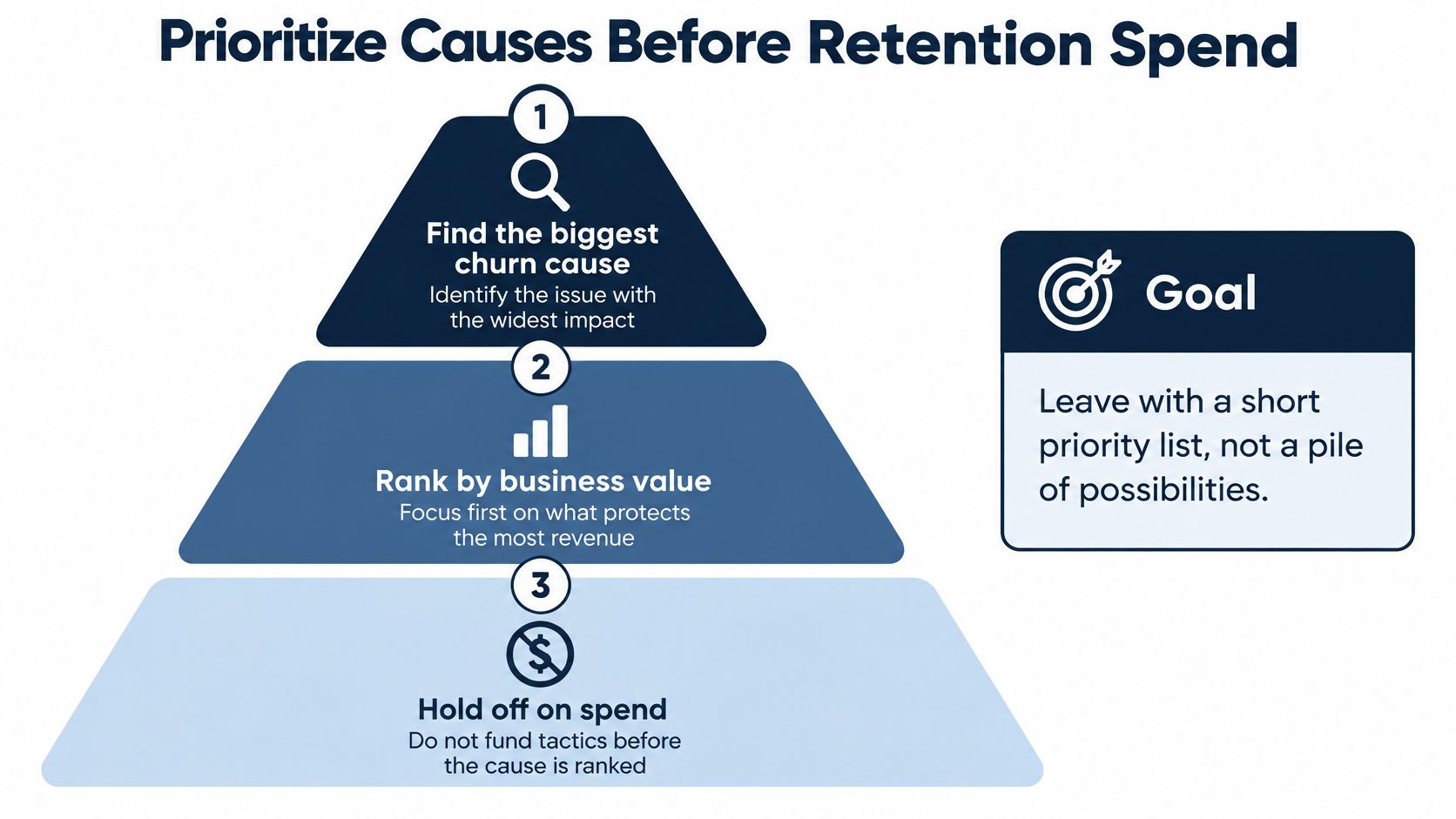
The loudest complaint shouldn't automatically become the biggest retention project. Rank causes by frequency, contribution-margin exposure, and the plausibility of changing repurchase behavior.
Returns deserve a central place in that ranking. In U.S. returns research summarized by UPS, 81% of consumers read return policies before purchasing, 71% said a poor returns experience made them less likely to shop with the retailer again, and 86% preferred no-box, no-label returns with instant refunds.
Those preferences don't establish that every brand should offer unrestricted free returns. They establish that return-policy decisions belong in the retention discussion, not only the reverse-logistics budget.
Start with a short cause list built from return reasons, support records, cancellation feedback, and payment logs. For each cause, estimate the margin at risk using your own data and identify the customer outcome a fix should change.
Use this priority order before approving another campaign.
An Amazon listing mismatch is a different project from a DTC sizing surprise. The former might require clearer product claims and imagery; the latter might require garment measurements and fit guidance. An omnichannel expectation gap might require reconciling what store associates explain with what the website promises.
Don't fund a win-back sequence to compensate for a product detail page that still sets the wrong expectation.
Segment policy decisions around observable behavior, while keeping terms clear and honoring applicable obligations. These customer segmentation examples can help structure the difference between a valuable repeat buyer with an isolated problem and a customer whose return pattern repeatedly makes orders unprofitable.
Track post-return repurchase by product, channel, reason code, and cohort. Connect it with return rate, refund speed, recovery value, suspected fraud, and contribution margin, rather than reviewing those measures in separate meetings.
The objective isn't the lowest possible return rate. It's profitable retention after a return.
A blanket tightening can reduce immediate refunds while making future purchases less attractive. Treat a lower return rate as an operating result to investigate, not automatic proof that the policy improved.
Acquiring a customer can cost roughly 5 to 25 times more than retaining one, according to customer-retention benchmarks summarized by 4over4. The same resource identifies the first 30 to 90 days after purchase as an important prevention window, while cautioning that acquisition economics vary by channel, geography, category, and segment.
Use that benchmark as context, not a budgeting formula. Your retention budget should follow the failure you're fixing and the margin you expect to protect.
This implementation sequence keeps the work tied to a specific problem.
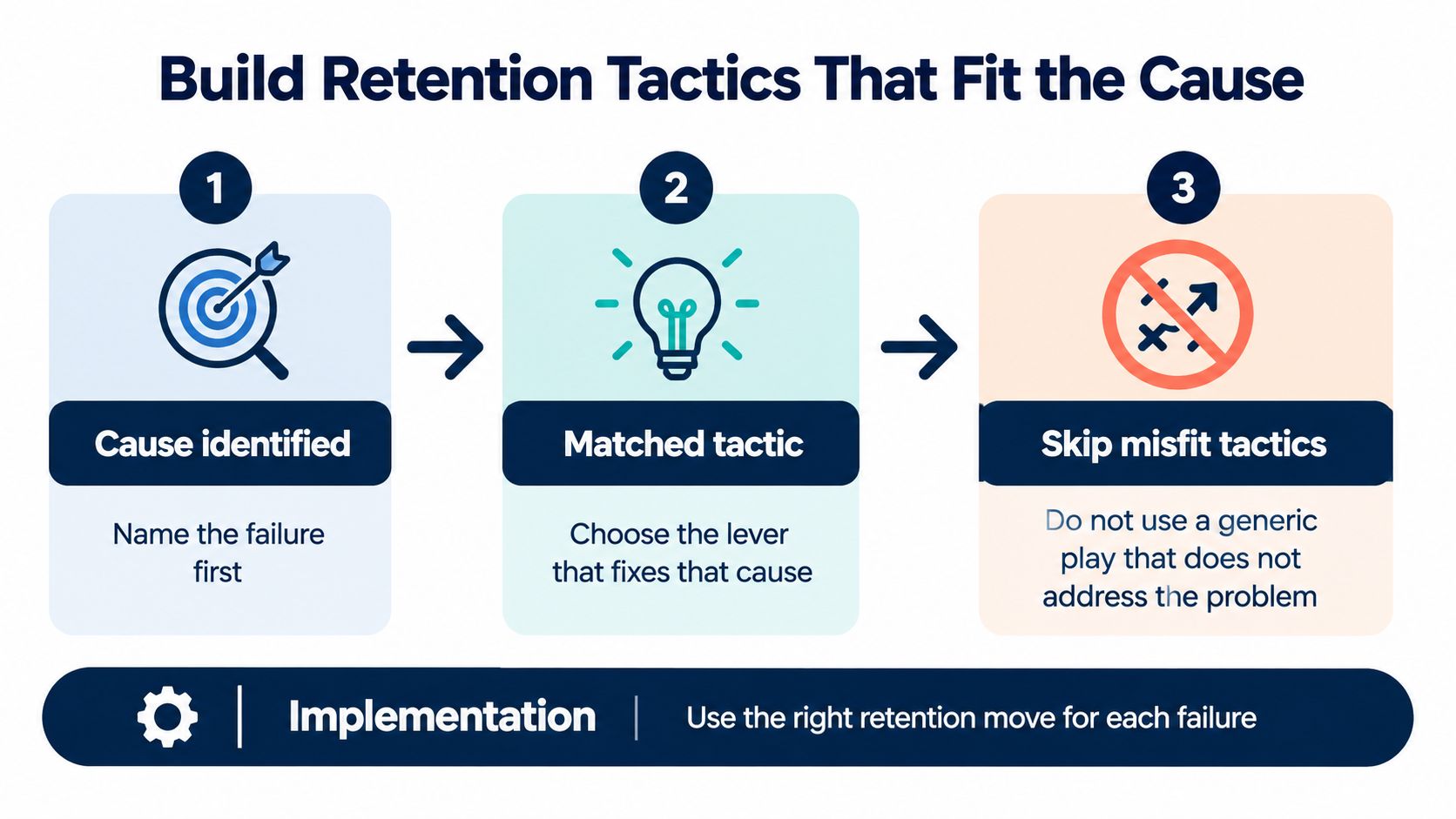
When buyers struggle with setup or use, improve the instruction they encounter at that moment. For example, a DTC skincare brand could explain application order and appropriate use instead of immediately promoting another product.
For Amazon, review the product detail page and permitted customer-facing materials rather than assuming you can copy your DTC messaging approach. Keep every intervention within the channel's communication rules.
Delivery and support failures need resolution, not more promotional touches. Assign ownership of the unresolved issue, confirm the outcome with the customer where appropriate, and suppress irrelevant offers while the problem remains open.
Replenishment messaging should reflect when customers need more product. Don't send the same reorder prompt to a consumable buyer and someone who purchased a durable item; their reasons for buying again are different.
For sizing-driven returns, review measurements, fit descriptions, imagery, and customer feedback together. The sizing and returns insights from ClothME are a useful supplementary resource when assessing those materials, but your own return reasons should determine the changes.
Other matched plays require different work:
Don't stack every tactic onto the same customer. A buyer awaiting a replacement doesn't need a replenishment reminder, a loyalty invitation, and a cross-sell offer.
Keep the execution brief short enough that the owner can act without another strategy meeting. Include the expected customer outcome, not just a deliverable such as “launch flow.”
| Field | What the team should write |
|---|---|
| Cause | The observed failure and supporting evidence |
| Owner | The person accountable for changing it |
| Tactic | The operational or customer-facing intervention |
| Window | When the intervention runs and when results can be assessed |
| Expected repeat-purchase result | The behavior that should change, with a margin guardrail |
A completed sheet should make it obvious why the tactic fits. If the connection requires a long explanation, revisit the diagnosis before implementation.
A higher repeat-purchase rate doesn't automatically prove that your retention campaign worked. Compare customers with similar purchase opportunities, and separate the intervention from other changes that happened at the same time.
Use a cohort view as the starting point for the review.

Group customers by first-order month, channel, and product type, then layer in the cause classifications established earlier. Keep subscribers separate from customers who never agreed to a recurring purchase.
Set the expected reorder window before labeling inactivity as churn. The definition should reflect the product's buying cycle, and cohorts need enough elapsed time to qualify for comparison.
Document those choices alongside your customer churn rate calculation. If Amazon reporting or retail data doesn't let you identify the same customer across purchases, record the limitation rather than claiming complete cross-channel visibility.
Use customer outcomes and operating measures together. The post-return repurchase windows discussed earlier are useful review cuts, but they shouldn't replace the category-specific definition of when a purchase is due.
When choosing experiments for this scorecard, the customer retention strategies from ServeApps provide supplementary ideas. Evaluate any proposed play against your diagnosed cause rather than adding it to the backlog automatically.
Use the video as a separate discussion aid after the team has agreed on its definitions.
If repurchase improves only among heavily discounted buyers, examine contribution before expanding the offer. If returns decline while subsequent purchasing also weakens, investigate whether the new policy discouraged customers rather than resolving the original issue.
When failed-payment losses decline after payment-system changes, credit that intervention appropriately. Don't attribute the improvement to a lifecycle email because both launched during the same period.
Review discipline: Keep the definitions stable long enough to learn whether the intervention worked.
Run a monthly review around the same scorecard. Have the owner explain the observed result, the margin implication, and the next decision, then record whether to continue, adjust, or stop the intervention.
Before buying retention software or approving another save offer, choose who should challenge your diagnosis. The right setting depends on whether you're missing evidence, technical expertise, or judgment across channels.
A dashboard won't resolve every disagreement. Sometimes the issue is whether the team trusts the data; sometimes it's whether anyone has experience with the trade-off you're considering.
| Path | Choose it when | Main trade-off |
|---|---|---|
| Internal diagnosis | Your team can connect order, return, support, and payment records | You keep control, but may preserve assumptions nobody challenges |
| Specialist support | A defined system, such as payment recovery or returns operations, needs repair | You gain focused expertise, but need to guard against a tool-first diagnosis |
| Operator peers | The decision crosses channels, functions, or competing priorities | You gain practical context, but still need to validate advice against your economics |
Running the work internally makes sense when the evidence is accessible and someone owns the decision. Ask finance to challenge contribution assumptions, operations to explain recurring failures, and customer support to supply the context missing from reason codes.
Hire a specialist when you can name the broken system. Give that person a defined problem, access to relevant records, and a success measure before discussing implementation.
For payment recovery, that might mean reviewing how failed transactions move through retry and notification processes. For returns, it might mean examining resolution choices, refund handling, and recovery costs.
An invite-only ecommerce operator community can be useful when the question isn't how to configure a tool, but how to choose between reasonable options. The publisher's community offers peer-network access, strategy sharing, mastermind calls, private forums, curated events, and vetted service recommendations across Amazon, DTC, and omnichannel businesses.
That setting is most useful when you bring a specific decision. Ask peers to challenge whether your proposed fix addresses the cause, where its hidden costs might sit, and what would make them reject it.
Don't treat another founder's experience as a forecast for your brand. Ask about the category, channel constraints, customer behavior, and economics behind the recommendation.
This week, pull last quarter's orders and tag confirmed voluntary exits, failed payments, and post-return non-repurchase separately. Pick the largest identifiable profit leak, complete the cause-and-tactic sheet, and bring it to your next operator conversation, including a mastermind call or private forum thread if you have access.
Million Dollar Sellers offers an invite-only peer network, mastermind calls, and private forums where ecommerce operators can pressure-test retention decisions before committing budget. Visit Million Dollar Sellers to explore an invitation, and bring a specific churn diagnosis that peers can challenge against your channel constraints and profit goals.
Join the Ecom Entrepreneur Community for Vetted 7-9 Figure Ecommerce Founders
Learn MoreYou may also like:
Learn more about our special events!
Check Events