
Chilat Doina
September 5, 2026
More than 75,000 independent sellers surpassed $1 million in annual sales in 2025, while U.S. independent sellers averaged more than $375,000 in Amazon store sales, according to Amazon's seller statistics. That changes the question. Scaling an Amazon business isn't mainly about adding more listings or buying more traffic. It's about building a machine that converts demand into contribution margin without exhausting cash, inventory, or the founder.
Amazon still offers enormous opportunity, but the easy version of marketplace growth is gone. Third-party sellers represented 60% of paid units sold in Q1 2026, down from 61% in Q4 2025 and 62% in the quarter before, a pattern consistent with a marketplace where competition is concentrating around stronger operators. The sellers who break past seven figures usually don't win because they work longer hours. They win because their listing conversion, PPC, replenishment, supplier management, financial controls, and team structure reinforce one another.
The old playbook was straightforward: launch products, increase advertising, add variations, and repeat. It can create early revenue, but every extra unit also consumes working capital, forecasting capacity, customer-support time, and operational attention.
Amazon's current scale reality favors operational efficiency. More than 75,000 independent sellers exceeded $1 million in annual sales in 2025, while the average U.S. independent seller generated more than $375,000 in annual sales in Amazon's store, according to Amazon. Those figures show the opportunity and the pressure. A large seller base means demand exists, but stronger operators can capture more of it through better inventory velocity, fee control, conversion, and repeatable execution.
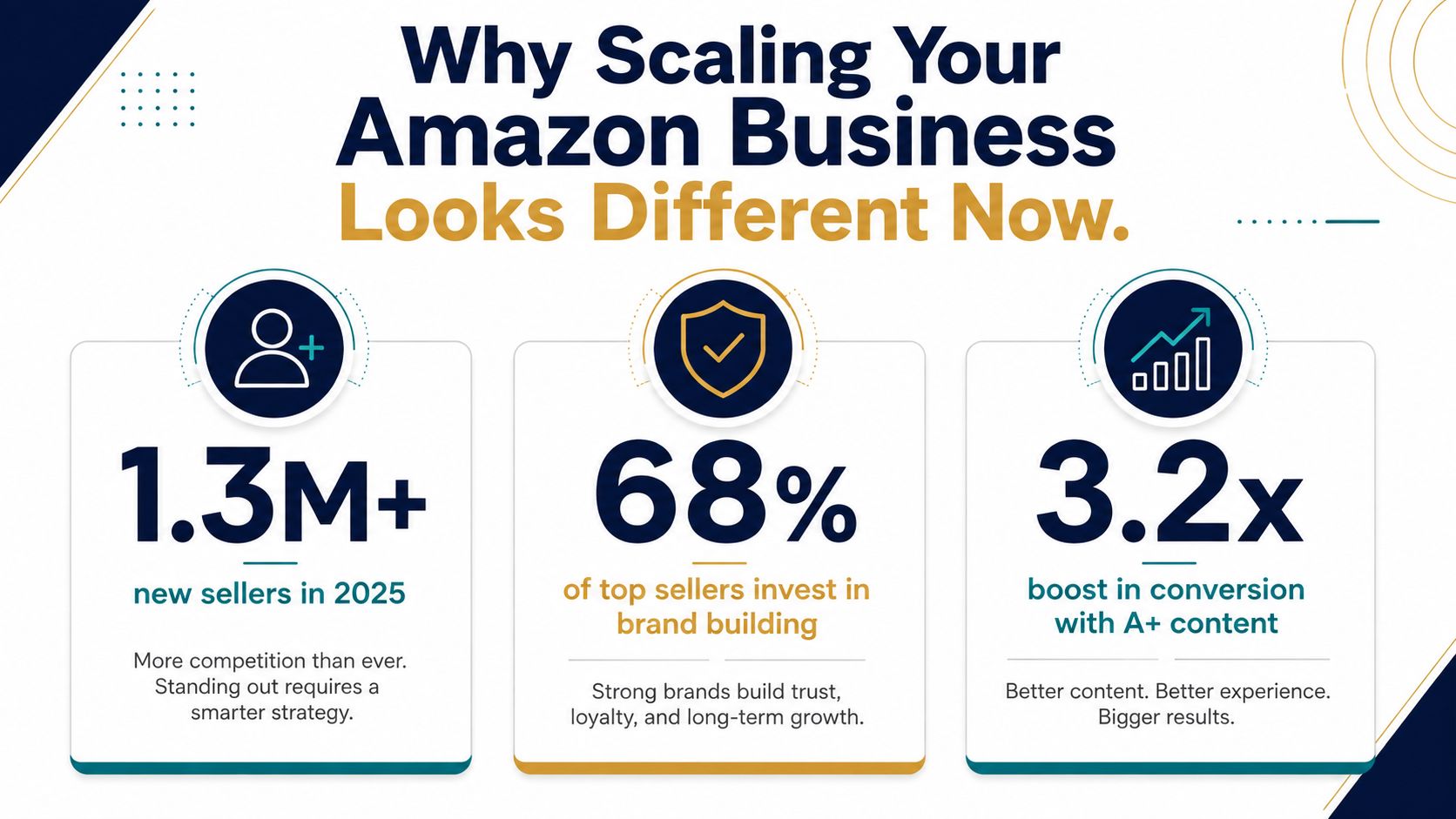
At six figures, a founder can cover weak processes with personal attention. They can inspect stranded inventory, revise a listing overnight, negotiate a shipment, and adjust bids throughout the day. At seven or eight figures, those habits become a constraint. If every important decision waits for one person, revenue growth increases workload faster than business capacity.
A scalable Amazon business needs four connected systems:
Practical rule: If revenue rises while the founder still approves every purchase order, campaign change, and creative revision, the business has expanded the founder's workload rather than its operating capacity.
Working capital exposes weak systems quickly. A fast-selling ASIN can still create a cash squeeze if replenishment requires large deposits before Amazon payouts arrive. Excess inventory creates a different problem, tying up cash while storage fees and aging stock reduce flexibility. Growth therefore depends on inventory velocity and contribution margin, not revenue alone.
Brand demand matters as seller concentration increases. A generic product may rank, but it remains exposed to price pressure, copycat offers, and advertising volatility. A recognizable brand gives shoppers a reason to search, compare, and return.
Investors evaluating commerce businesses look for documented systems rather than founder heroics. Founders can browse top U.S. e-commerce VCs to study how investors assess commerce operators before providing capital. Funding can increase purchasing power, but it cannot repair poor forecasting, weak fee discipline, or unclear ownership.
Before adding traffic, audit the fundamentals. If a hero ASIN has weak conversion, unstable contribution margin, unreliable replenishment, or no clear owner for core processes, more demand will expose those weaknesses faster. The goal is profitable throughput, moving more units while preserving cash, margin, and control.
Traffic can't rescue a product that shoppers don't understand or trust. Before increasing bids, expanding inventory depth, or launching variations, confirm that the listing converts the traffic it already receives.
Unit Session Percentage is the starting point because it connects sessions with orders. Amazon defines this as a conversion metric, and the practical question is simple: when shoppers reach the ASIN, does the offer earn the sale? A high-click, low-conversion product usually has a message, price, review, offer, or product problem. A high-conversion product with limited traffic has a different problem, usually discoverability or budget.
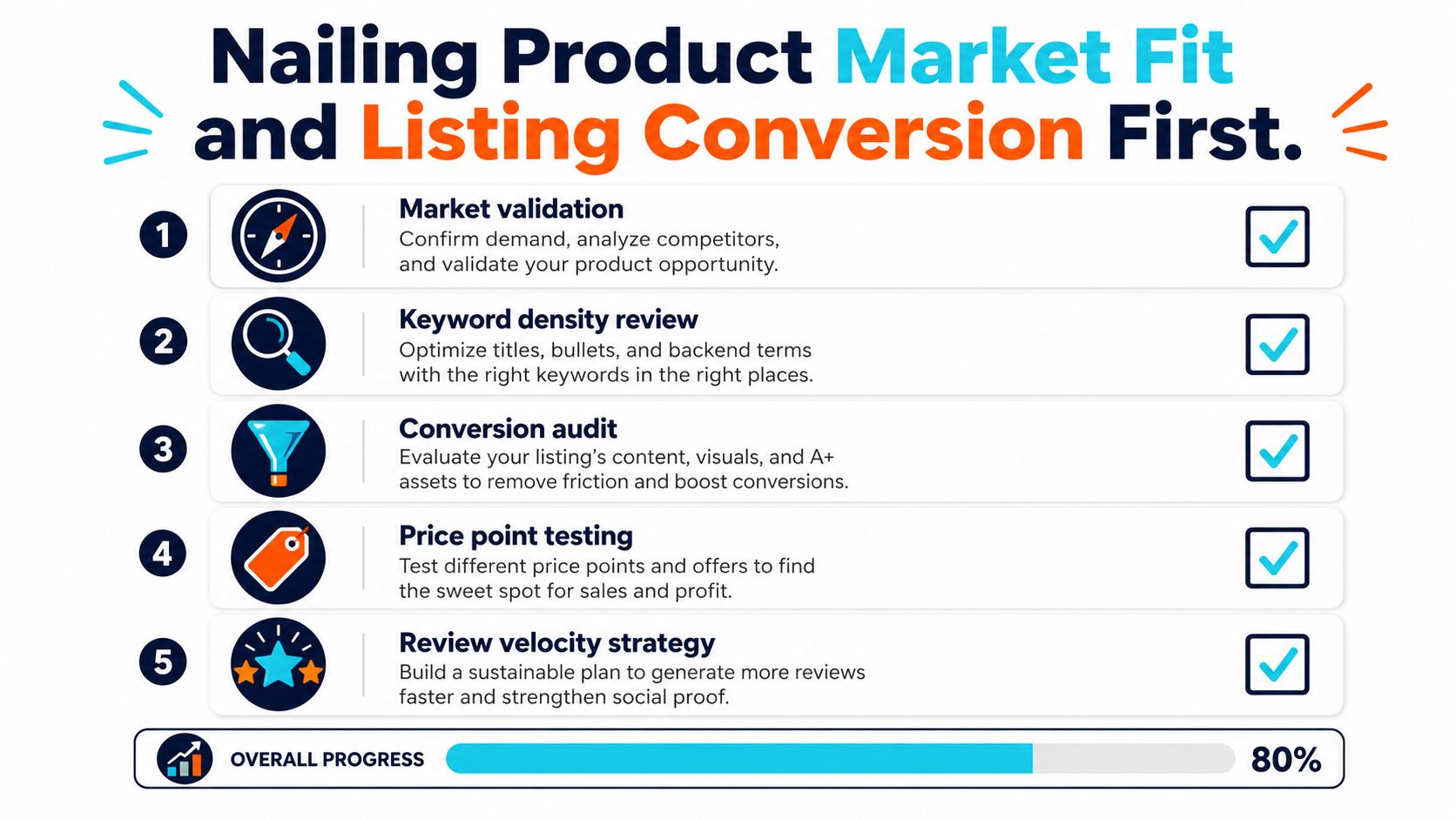
Start with search-term and placement data, then compare the behavior of shoppers who reach the detail page. A high click-through rate paired with weak Unit Session Percentage points toward a detail-page problem. Weak click-through suggests the main image, price, title, rating, or relevance isn't compelling enough to win the click.
Run the audit in this order:
For a deeper validation framework, use the MDS guide to product-market fit validation alongside your ASIN-level review. The point is to distinguish a product people want from a product that merely receives impressions.
A proven winner deserves depth before breadth. If an ASIN converts consistently, earns acceptable contribution margin, and has repeatable replenishment, add inventory and improve its organic and paid coverage before scattering capital across unrelated SKUs.
An ASIN with many clicks and few orders deserves restraint. Pause aggressive scaling, identify the friction, and make controlled changes rather than rewriting everything at once. If the issue is price, test the offer. If the issue is comprehension, test the image sequence and copy. If the issue is product quality, fix the product before buying more demand.
Expand variations when the existing product has a clear customer need for another size, color, pack configuration, or use case. Launch a new SKU only when the team can explain its customer, margin, sourcing plan, and operational owner. Conversion is the permission slip for scale, not an afterthought once the advertising budget is spent.
PPC should function as a controlled demand-generation system, not a collection of campaigns judged in isolation. A campaign can show acceptable ACoS while the portfolio loses money through fees, fulfillment, discounts, returns, and inventory carrying costs.
Recent benchmark data for professionally managed Amazon advertising accounts reports a typical monthly spend of about $6,500, median blended CPC near $1.07, median CTR of 0.59%, and median conversion of 8.3% of ad clicks into orders in SellerPlex's benchmark analysis. Those figures aren't targets for every category. They're reference points for testing whether your own economics support incremental spend.
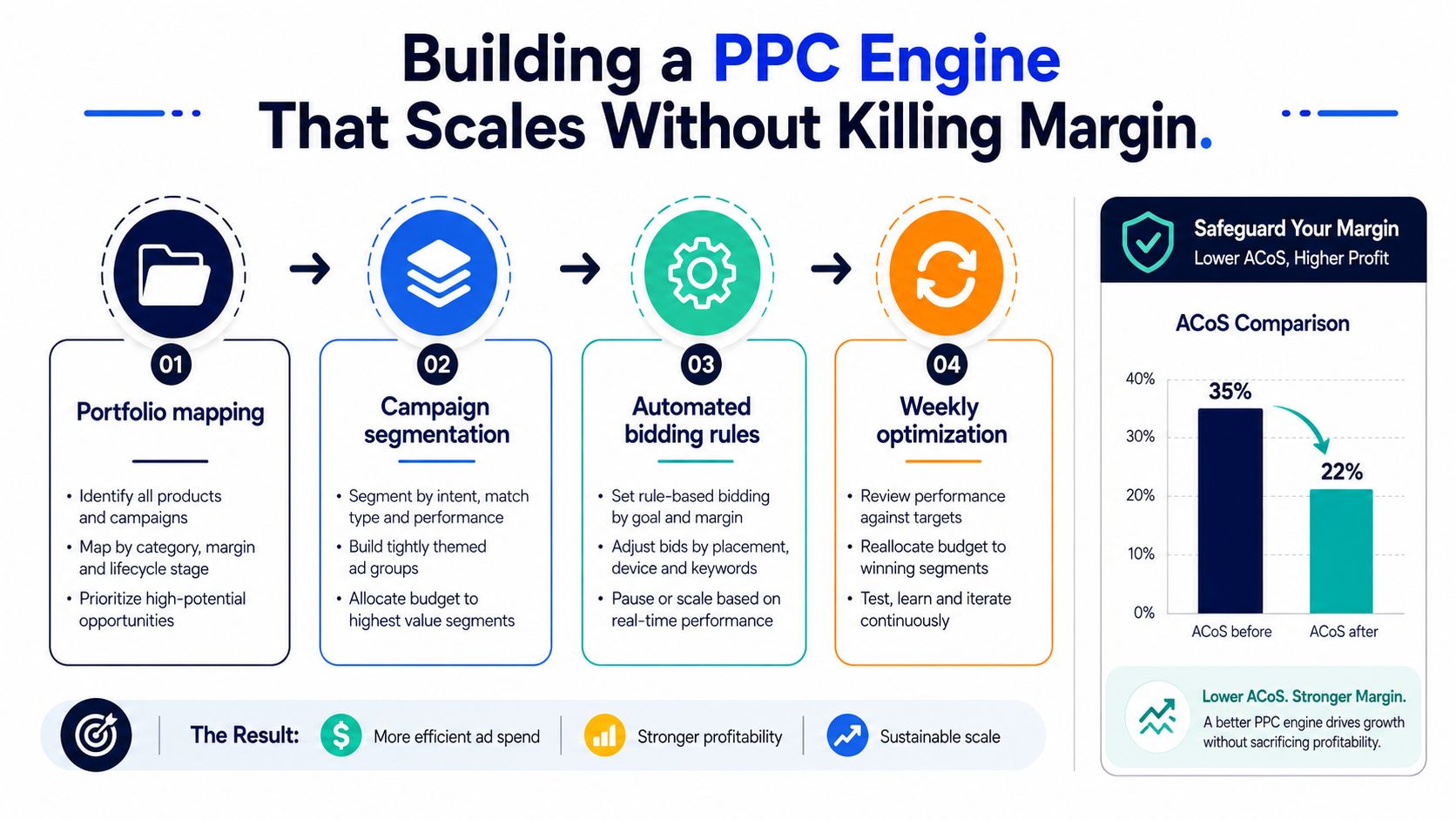
Separate campaigns by job:
This structure makes budget decisions more rational. You can tolerate different efficiency levels for discovery and harvest, as long as the blended portfolio produces acceptable contribution margin.
The basic viability test is incremental. Start with the expected CPC and conversion rate, then account for referral fees, fulfillment, landed product cost, discounts, and returns. If the next order leaves no contribution after those costs, higher volume doesn't create a healthier business.
A budget constraint and a relevance problem aren't the same. If a campaign converts well, produces profitable orders, and runs out of budget, increase budget gradually. If impressions are available but CTR is weak, improve relevance and creative before bidding harder. If clicks arrive without orders, return to the listing and offer audit.
Use TACOS to understand how advertising affects total revenue, not just attributed sales. Review CTR, Unit Session Percentage, blended CPC, spend, organic sales, and contribution margin together. The MDS playbook for PPC in e-commerce is useful when campaign mechanics need to connect to broader portfolio decisions.
A weekly review should answer four questions:
Use automation for repetitive bid and budget rules, but keep strategic judgment with the operator. Rules can lower bids when efficiency deteriorates, yet they can't understand a product launch, a stockout risk, or a competitor's positioning change without context.
A PPC engine scales when each additional dollar has a known economic role. Don't chase revenue screenshots. Fund traffic that the listing can convert, inventory can fulfill, and margin can support.
A purchase order can show a healthy margin and still weaken the business if it traps cash for too long. Amazon sellers fund the gap between supplier payment, inbound movement, receipt, customer sale, Amazon payout, and the next replenishment. Scaling works when that cycle becomes measurable and repeatable.
Amazon's economics make cash discipline more important. Revenue from third-party seller services, including commissions and fulfillment-related fees, increased from $156.15 billion in 2024 to $172.17 billion in 2025, a 10% annual increase, while independent sellers generated roughly 69% of marketplace GMV by 2025, up from 60% in 2019, according to Marketplace Pulse's Amazon seller-services data. The opportunity is large, but fees and fulfillment costs leave less room for slow inventory decisions.
Review these measures by ASIN every week:
Use trailing 30-day and 90-day sales data instead of a single recent spike. The shorter window catches demand changes, while the longer window keeps one promotion or temporary surge from driving an oversized purchase order. Compare both windows with supplier lead time, production limits, inbound timing, and cash available for replenishment.
| Metric | What It Tells You | Healthy Target |
|---|---|---|
| Unit Session Percentage | Whether the ASIN converts shopper sessions into orders | Stable or improving before demand expansion |
| Days of inventory remaining | Whether stock can cover expected demand | At least enough to cover lead time plus inbound delay, without exceeding the cash plan |
| Inventory turnover | How efficiently inventory produces sales | Improving quarter over quarter, with a floor of 4x for replenishable SKUs |
| Inventory-to-sales ratio | How much inventory value supports sales | Declining or stable while service levels hold |
| Contribution margin by ASIN | Whether sales create cash after variable costs | Positive after product, fees, fulfillment, advertising, discounts, and returns |
Use the table as an operating guide, not a universal policy. Seasonal ASINs, bulky products, and fast-moving replenishment SKUs require different thresholds. For a practical reorder point, multiply average daily unit sales by supplier and inbound lead time, then add safety stock based on demand variability. inventory tracking software tips can help organize the inputs, but the operator still has to challenge the forecast and approve the purchase order.
Adding SKUs while hero products remain underfunded is a common scaling error. A high-SKU, low-ASP catalog distributes cash across purchase orders, packaging, storage, advertising, and customer service. The result can be higher revenue with less liquidity available for the products that drive the account.
Amazon sellers have faced tighter storage assumptions, inbound placement charges, changes to reimbursement calculations, and payout timing that can delay access to cash, as ShelfTrend's 2026 Amazon seller strategy analysis documents. Rank ASINs by contribution, velocity, strategic value, and capital intensity before approving another purchase order.
Set reorder points from actual velocity and lead time. Create separate approval rules for hero products, experimental SKUs, and slow movers. The MDS perspective on working-capital optimization reinforces the operating principle: growth only helps when the business can finance the complete cycle that creates it.
Amazon.com saw only 165,000 new first-time sellers in 2025, the lowest annual total since tracking began in 2015 and 44% below 2024, while seller concentration and traffic per seller increased, according to Marketplace Pulse's seller-registration analysis. In a more mature marketplace, expansion should make the business more resilient, not more complicated.
That requires sequencing. International marketplaces, supplier redundancy, fulfillment choices, and hiring all draw on the same constrained resources, cash and management attention. Launching them simultaneously can hide the source of an operational failure.
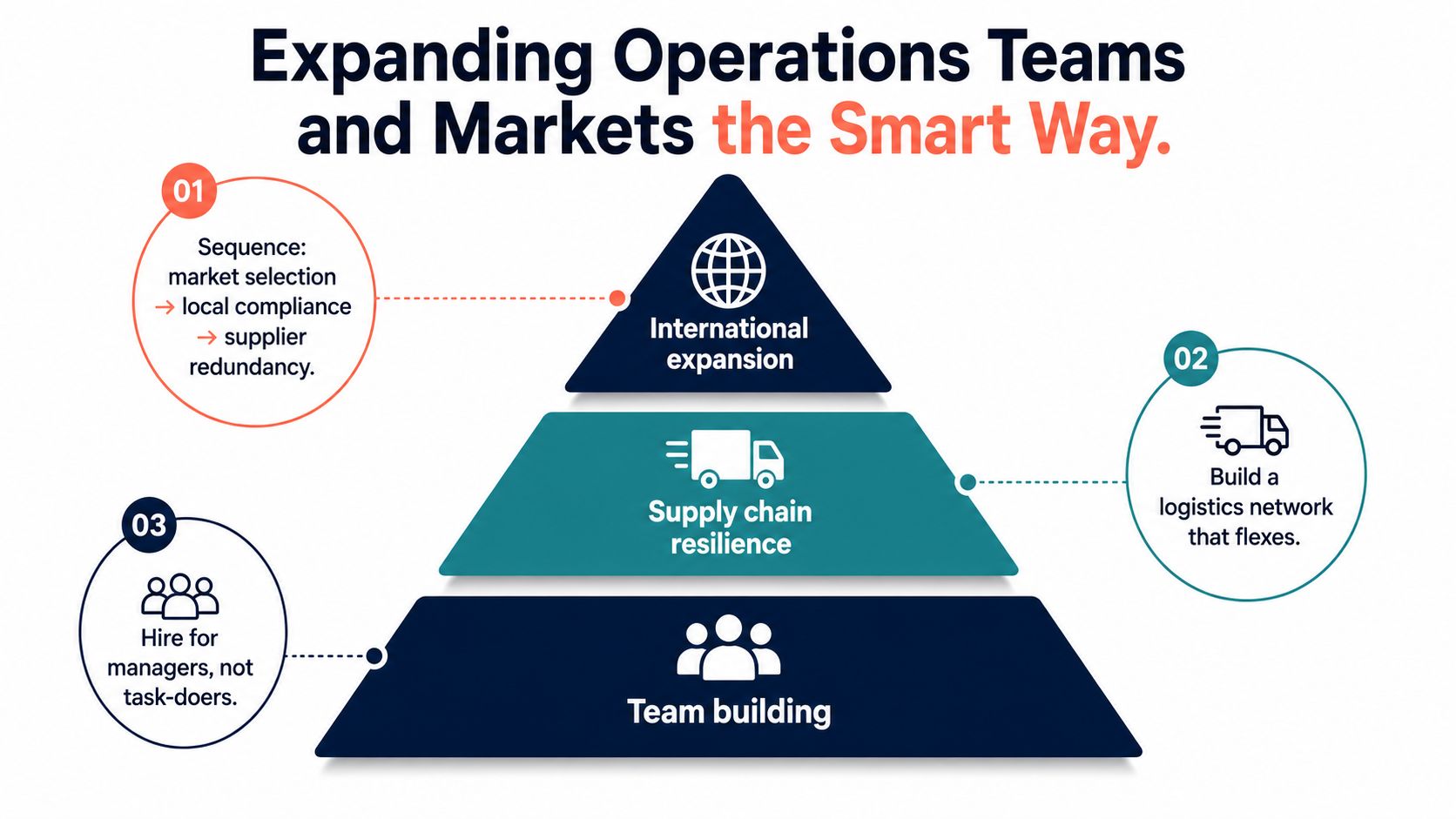
Start with the domestic operating model. Document purchasing, forecasting, listing changes, PPC approvals, customer service escalation, quality control, and financial reporting. If a process depends on a founder remembering a special exception, it isn't ready for replication.
Then assess a new market against practical requirements:
Supply chain resilience comes next. Qualify alternate suppliers where the economics justify it, maintain quality documentation, and establish escalation paths for late production or defective shipments. Use a fulfillment network that can flex between channels instead of forcing every order through one fragile path.
The first meaningful hires should remove recurring decision load. An operations manager can own purchase-order cadence, inbound tracking, and inventory exceptions. A creative or brand manager can own listing testing and asset production. A finance operator can reconcile contribution margin, cash requirements, and forecast changes.
Don't hire a group of coordinators who still need the founder to prioritize every task. Give each manager a scorecard, decision rights, and documented escalation limits. Automation should handle reporting and alerts, while people handle trade-offs.
External financing can support inventory or expansion, but debt should match the cash-conversion cycle. Founders comparing funding structures may find a GoSBA Loans broker guide useful for understanding how broker-assisted SBA financing works. Financing doesn't fix weak unit economics. It gives a sound model more room to operate.
The right expansion path is usually narrow before it becomes broad. Stabilize hero ASINs, create repeatable SOPs, assign accountable managers, then add markets or products where the same operating capabilities can create a force multiplier.
Scaling decisions become clearer when the dashboard separates demand, profitability, inventory, and transferability. Revenue alone can't tell you whether the business is becoming stronger. A seller can grow sales while increasing dependence on paid traffic, consuming cash, and making the company harder for another operator to run.
Review operating indicators weekly. That includes TACOS, CTR, Unit Session Percentage, advertising spend, contribution margin by ASIN, days of inventory remaining, and stockout or excess-inventory exceptions. Monthly reviews should focus on cash flow, organic sales mix, product-level profitability, supplier performance, and the accuracy of the demand forecast.
Quarterly, step back from the account. Ask whether the brand has defensible demand, diversified revenue channels, documented processes, reliable reporting, and managers who can operate without constant founder intervention. Those qualities matter whether you plan to hold the business or prepare it for a transaction.
A buyer doesn't acquire your personal memory. They acquire contracts, inventory, brand assets, supplier relationships, customer demand, financial records, and operating systems. A business becomes more transferable when another competent operator can understand how it makes money and continue running it without reconstructing the company from scattered messages and spreadsheets.
Watch for warning signs:
The practical path is straightforward. Prove conversion, scale profitable demand, protect inventory velocity, hire owners for recurring systems, and expand only when the operating model can absorb complexity. That's how to scale an Amazon business without confusing activity for enterprise value.
Million Dollar Sellers offers established e-commerce founders a private peer network, strategy-sharing forums, curated events, mastermind calls, and vetted service recommendations from operators building at serious scale. Visit Million Dollar Sellers to explore whether its operating insights and founder network fit the next stage of your Amazon business.
Join the Ecom Entrepreneur Community for Vetted 7-9 Figure Ecommerce Founders
Learn MoreYou may also like:
Learn more about our special events!
Check Events