Chilat Doina
April 18, 2026
You’re probably in a familiar spot.
Revenue isn’t collapsing, but it’s not breaking open either. Your Meta account has gone through three “winning” creative cycles that stopped winning. Amazon still matters, but it can’t carry the whole company. Your team keeps asking the right questions about margin, inventory, new channels, and forecasting, and the honest answer is that generic growth advice stopped being useful a while ago.
That’s usually the point where founders start looking for signal instead of content.
The operators podcast has earned attention because it sounds less like marketing theatre and more like a leak from the rooms where real allocation decisions get made. Not “how to build a brand” in broad strokes. More like: what are serious operators seeing in paid media, what are they cutting, where are they leaning in, and how do they think when growth stalls.
That’s why smart listeners get hooked, then get frustrated.
The show is built around high-level operator thinking, much of it drawn from a rumored circle of nine-figure founders. The insight quality is high. The translation layer often isn’t there. If you run a 7- or 8-figure brand, you can easily walk away with useful ideas and no clear implementation path.
That gap matters. Advice built for massive teams, broader SKU depth, and larger testing budgets can hurt a smaller brand when copied too directly.
This guide treats the operators podcast the way a seasoned founder should. Not as entertainment, and not as doctrine. As raw strategic material. The job is to extract the principle, strip out the ego and scale bias, and rebuild it into something your business can execute this quarter.
A founder at the growth ceiling usually sounds calm in meetings and restless everywhere else.
The dashboard looks fine on the surface. Orders are still moving. Returning customers still buy. But the business has started absorbing more effort for less gain. New channel tests feel noisy. Forecasts keep getting revised. Every hire and every dollar starts carrying more weight.
That’s where a lot of operators start hunting for sharper input. Not inspiration. Not motivation. Better decision frameworks.
The operators podcast fits that need because it speaks to the problems that show up after you’ve already proved you can sell. It sits closer to operator-to-operator shop talk than to mainstream business content. The appeal isn’t polish. It’s access to how experienced founders and executives frame trade-offs under pressure.
What makes the show worth your time isn’t just that it covers growth. Plenty of podcasts do that. It’s that it tends to focus on the uncomfortable parts of scaling: channel concentration, margin compression, bad attribution, inventory stress, and the gap between what works at one scale and what works at another.
Practical rule: Don’t listen to elite operator content for answers. Listen for decision logic.
That’s the difference between getting smarter and just getting overloaded.
For a 7- or 8-figure founder, the value isn’t in copying the exact move a larger brand made. The value is learning why they made it, what assumptions sat underneath it, and what version of that move makes sense when your team, budget, and tolerance for mistakes are smaller.
The operators podcast sits in a useful lane for brands that have already found product-market fit and are now dealing with the messier part of growth. It is not really a founder-origin story show. It is closer to a recurring conversation among people who manage P&Ls, channel mix, margin pressure, and team performance in real time.

The show launched in 2023 and traces back to a private WhatsApp group associated with operators from large eCommerce brands. That backstory matters because it shapes the format. The conversations feel closer to internal operator debate than public-facing content built for broad appeal.
The anonymous-host format helps too. It removes some of the performance you usually get when founders speak under their own brand. As a result, the discussion often gets more specific about mistakes, channel fatigue, and what changed inside the business after a decision was made.
That is the primary appeal. Access to how experienced operators frame a problem before they commit budget and headcount to it.
A lot of eCommerce podcasts drift toward hindsight. The operators podcast is more useful when it stays focused on current decisions. Media mix. Inventory risk. Channel dependence. Team structure. Those topics matter more to a 7- or 8-figure brand than another polished story about how someone built a brand from scratch five years ago.
A cited example is a 2025 episode discussion of DTC performance data covered in a LinkedIn post by Sean Frank, including the gap between sub-$5 million brands and $100 million-plus companies, along with major shifts in ad spend toward AppLovin and away from Snapchat. Used the right way, that kind of episode gives founders a sharper way to pressure-test assumptions about scale, channel viability, and whether their current playbook still fits the market.
For smaller teams, that is the practical gap to solve. A nine-figure operator can survive a bad quarter in a way a $15 million brand cannot. So the value is not copying the move. The value is converting the logic behind the move into a version your team can execute with less cash, less specialization, and less room for error.
Treat the show as a source of decision frameworks, then resize those frameworks to your stage.
If you like podcasts that stay close to execution and operations more broadly, Opsstars Podcast is also worth a look. It comes from a different angle, but it is useful for operators who prefer practical discussion over startup theater.
Three groups tend to get the highest return from listening:
That is why the podcast keeps its value. It gives listeners access to high-level operating logic. The primary job for a 7- or 8-figure brand is turning that logic into systems, tests, and decisions that fit their actual constraints.
The biggest mistake founders make with a show like this is treating it like industry entertainment. It’s more valuable than that, and more dangerous if you use it lazily.
When the operators podcast is good, it sharpens judgment. It helps founders think more clearly about where to push, where to pull back, and where the team is confusing activity with progress. That’s useful because brand building at scale is mostly a sequence of allocation decisions under imperfect information.
Most brands don’t have an idea shortage. They have a filtering problem.
A founder doesn’t need another list of channels to test. They need to know which test deserves resources now, which one can wait, and which one only looks smart because everyone else is talking about it. The show matters because it often surfaces the kind of information that changes that ranking.
That is where listening creates real return. Not in copying tactics line for line, but in making fewer bad decisions.
For teams thinking about how content itself can support a brand and generate impact, this guide to podcasting for small business is useful because it frames podcasting as an operating asset rather than a vanity project. That same mindset helps when evaluating any media channel. Ask what strategic function it serves, not whether it sounds modern.
This kind of podcast matters most in periods when founders have to protect margin and still hunt for growth. That means:
There’s another reason the podcast lands with experienced operators. It normalizes hard conversations. Growth stalls. Channels fatigue. Attribution gets messy. Not every quarter is a breakthrough quarter.
Good operator content doesn’t make scaling look easy. It makes the hard parts easier to diagnose.
That matters for morale as much as strategy. A team performs better when leadership can explain what’s happening without panic and without fantasy.
It doesn’t remove the need for context. It doesn’t know your cash position, your category, your inventory constraints, or the political realities inside your team. It also doesn’t tell you whether a tactic that works for a nine-figure brand can survive contact with your actual resourcing.
That’s where disciplined listeners separate themselves. They use the show to improve decision quality, then force every takeaway through the constraints of their own business.
A founder hears a sharp idea on the operators podcast during a Monday commute, brings it into the exec meeting by noon, and by Friday the team is debating a new channel, a new creative process, or a new reporting view. That sequence is common. The failure usually happens in the middle. The episode was useful, but nobody translated it into a decision model that fits a 7 or 8 figure brand.
That is the right way to approach the foundational episodes. Use them to study operator judgment first. Tactics come second.
Start with the benchmark-heavy episode built around broad ecommerce performance data and channel shifts. It is one of the better entry points because it shows how experienced operators interpret change before they commit budget. The value is not the headline prediction. The value is the filtering process. What gets treated as signal, what gets treated as noise, and what gets put on a watchlist instead of into next quarter's plan.
One example discussed in that conversation is the rise of AI-driven discovery. The useful takeaway is not a single traffic number. It is the operating posture behind it. Serious teams do not ignore an early channel because it is small, and they do not force spend into it because the growth curve looks exciting. They set review criteria, define a test budget, and decide what proof would justify a larger move.
That discipline matters more for scaling brands than for nine-figure companies. A larger team can absorb messy testing. A 7 or 8 figure brand needs each experiment to teach something specific.
The show is usually strongest in two formats.
Market-read episodes
These help founders update assumptions about channel efficiency, media mix, and what has changed across the market.
Operator playbook episodes
These show how strong teams solve execution problems. They are useful, but only after you separate the principle from the resources behind it.
Here is the shortlist I would use.
| Episode Title (Example) | Core Topic | Actionable Takeaway for Founders |
|---|---|---|
| Here’s Who Won in 2025 Ecommerce Data Nobody Else Has | Cross-brand performance benchmarks | Build a monthly channel review that separates current winners from habits your team has not questioned in a year |
| Operator Playbook for Surviving Stalled Growth | Managing flat or slowing growth | Replace reactive budget changes with a tighter test pipeline, clearer kill criteria, and weekly decision ownership |
| Episodes focused on media mix and AI creative | Emerging acquisition opportunity | Test new traffic sources and creative workflows in small, measurable batches before you change team structure or spend targets |
For operators who want another lens on how experienced teams make decisions under pressure, the archive of advice for ecommerce founders is a useful companion read.
A good episode should produce three outputs: one challenged assumption, one capability gap, and one test worth running.
Use these questions:
That third question protects teams from copying nine-figure behavior without nine-figure infrastructure.
If an episode gives you a strong idea but no clear implementation path, shrink the test until ownership, cost, and success criteria are obvious.
That is where the practical application gap closes. The operators podcast gives access to high-level thinking. The edge for a scaling brand comes from turning that thinking into smaller, cleaner decisions your team can execute.
You finish an episode fired up. By Monday, your team is discussing a new channel, a reworked org chart, and a bigger tech budget. By Friday, nothing useful has shipped because the advice was built for a company with more cash, more specialists, and more margin for error.
That is the application gap with the operators podcast. The show is strong at exposing how nine-figure brands think. The work for a seven or eight-figure operator is translating that thinking into decisions your current team can execute without adding chaos.
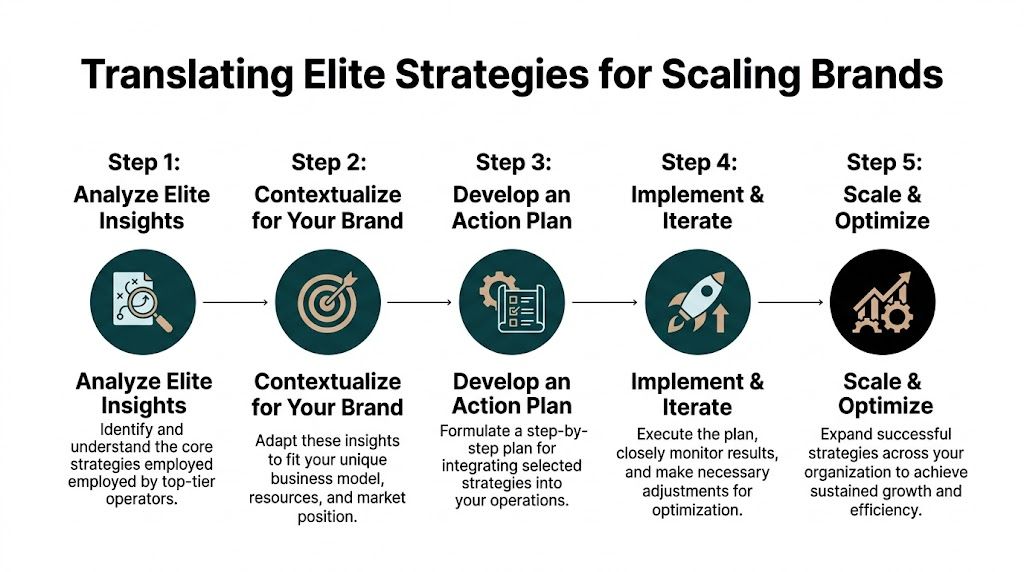
The risk is easy to spot. A larger brand can absorb a slow test, a bad hire, or six months of noisy channel data. A scaling brand usually cannot. That difference matters more than the tactic itself.
When an operator talks about expanding distribution, rebuilding retention, or changing creative workflow, reduce it to three things before you act: the principle, the constraint, and the smallest viable test.
Start with the problem being solved, not the tactic being described.
A team may say they added a new acquisition channel. The useful takeaway might be reducing dependence on one paid source. They may describe a larger retention function. The useful takeaway might be faster segmentation, better offer timing, or tighter lifecycle ownership.
If you cannot explain the principle in one sentence, keep listening and do not implement.
Seven and eight-figure brands live with tighter constraints. Team depth is thinner. Cash tolerance is lower. Reporting is often less mature. Customer data can be fragmented across platforms, which is why many brands hit retention ceilings before they fix their stack. If that is your bottleneck, choosing a CRM for ecommerce retention and lifecycle execution matters more than copying a larger brand's campaign calendar.
Translate the move to fit the business you have now:
Operators get in trouble when they import complexity before they have the volume, systems, or management layer to support it.
Good adaptation is specific enough to fail.
Examples:
That level of clarity keeps teams from hiding behind vague goals like "improve growth" or "build the brand."
Use this four-part note structure after each listen:
| What to capture | What it should answer |
|---|---|
| Problem | What issue was the operator trying to solve? |
| Principle | What logic made the move work? |
| Constraint | What would block this in our business today? |
| Test | What small version can we run with clear ownership and a stop point? |
This is how nine-figure advice becomes usable for a scaling brand.
Big-brand tactics become practical when you remove the scale advantages and keep the operating logic.
Founders do not need to think smaller. They need a cleaner method for turning high-level insight into controlled execution.
Monday morning, the team leaves a podcast episode fired up about forecasting, retention, or wholesale expansion. By Friday, nothing useful has changed because the stack cannot support the new workflow, nobody owns implementation, and reporting breaks the moment one system falls out of sync.
That gap shows up constantly in e-commerce.
Execution usually fails lower in the stack than founders expect. The strategy sounds sharp. The business case makes sense. Then the media team cannot trust attribution, ops is still reconciling inventory in spreadsheets, and finance is closing the month with different numbers than the dashboard everyone used to make decisions.

The operators podcast is useful here, but only if you listen like an operator. The hosts are often discussing what worked inside much larger machines. A 7- or 8-figure brand needs to translate that advice into system requirements, owner assignments, and rollout sequencing before treating it like a plan.
Stack changes fail less from bad software choices and more from weak implementation discipline. A new ERP, CRM, or reporting layer changes how data moves, who approves exceptions, how often teams reconcile errors, and what gets trusted in meetings. If those decisions stay fuzzy, the tool becomes expensive theater.
Founders usually blame the platform, but the failure happened in rollout.
That matters when you hear operators discuss better inventory control, cleaner customer segmentation, or tighter channel coordination. Nine-figure brands can absorb more tooling mistakes because they have more people, more specialized operators, and more room for temporary inefficiency. Smaller scaling brands do not get that luxury. One broken integration can create margin leakage, stock errors, support issues, and bad decision-making at the same time.
If your team is evaluating customer data flow, lifecycle execution, or sales process design, this guide to the best CRM for ecommerce is useful because it frames the decision around operating requirements, not feature shopping.
Use a harder filter after any episode that touches systems, analytics, or operational tooling:
What process changes with this tool?
If the answer is unclear, the team is buying software before defining the workflow.
Who is the direct owner for rollout?
One person needs authority over setup, testing, training, and post-launch cleanup.
What is the minimum working version?
Start with the smallest implementation that produces a reliable operational gain.
Where will data break first?
Usually in attribution, inventory sync, customer records, or finance reconciliation.
What manual work are we accepting temporarily?
Some workarounds are fine. Hidden recurring work is not.
A healthy stack helps the business execute decisions with consistency. It should make planning easier, handoffs cleaner, and reporting credible enough that teams stop arguing about whose numbers are right.
That is the practical application gap listeners need to close. The value is not hearing how a nine-figure brand uses tech. The value is knowing which parts of that setup your brand can adopt now, which parts need process maturity first, and which parts should wait until the business has enough volume to justify the added complexity.
The operators podcast is easy to access. The harder part is listening with intent.
Use the platform that fits how you work. If you like queueing episodes during travel or workouts, Operators on Apple Podcasts works well. If Spotify is your default player, Operators on Spotify is the obvious choice. If you prefer clips, comments, and the ability to scan titles visually, the Operators YouTube channel is useful.
A practical approach is simple:
If you want a broader shortlist beyond this show, this guide to the best ecommerce podcast can help you build a stronger listening stack without defaulting to generic business content.
The bigger opportunity isn’t just listening. It’s participating in the kind of conversations the show points toward. Communities, private groups, and founder circles often matter more than the episode itself because that’s where ideas get pressure-tested by people who’ve tried them.
The operators podcast is strongest when it triggers that second layer. Not “that was interesting,” but “how would this work in our business, and what would we need to change first?”
If you want that second layer with peers who already operate at serious scale, Million Dollar Sellers is where high-level eCommerce founders compare notes, stress-test strategy, and turn insights like these into better execution.
Join the Ecom Entrepreneur Community for Vetted 7-9 Figure Ecommerce Founders
Learn MoreYou may also like:
Learn more about our special events!
Check Events